Table of Contents
The Lombard Effect, In One Sentence
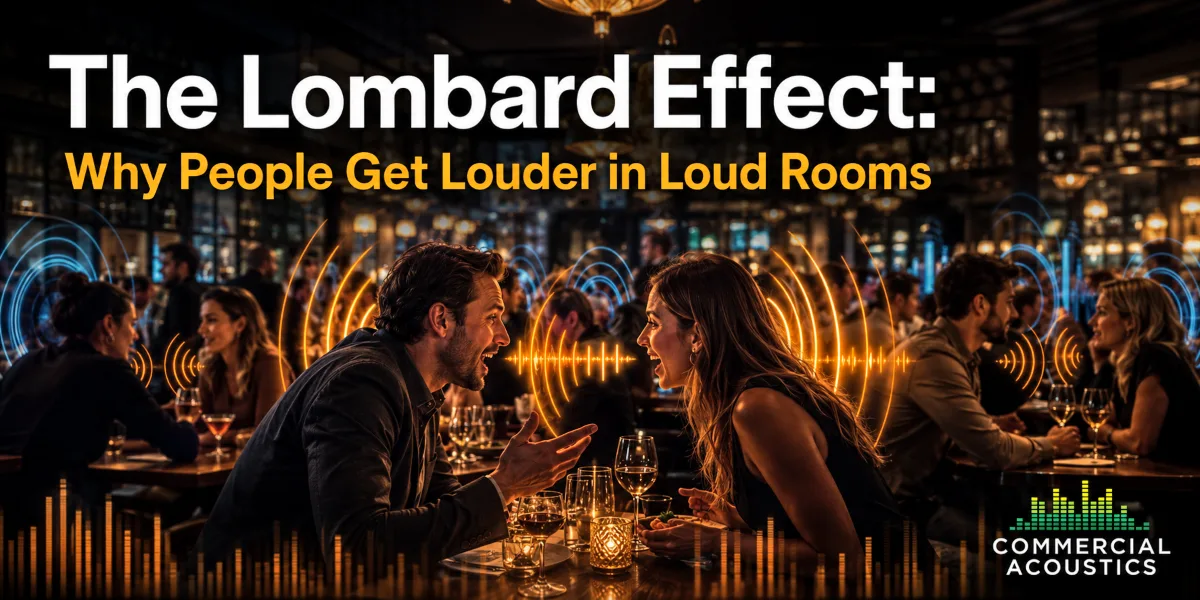
When the room around you gets louder, you raise your voice without thinking about it. That is the Lombard Effect — a documented, involuntary reflex first described over a century ago. Every restaurant that gets louder as the night goes on, every open office that spirals past a useful working level, every daycare that wears out staff voices by 3 p.m. is running the same physiological loop.
The reflex is small at any given instant — a fraction of a decibel for each decibel of added background noise. But it compounds. The voices that respond to noise become the noise the next round of voices respond to, and the level climbs until something in the system absorbs the extra energy. In a hard-surfaced room, that something is usually the patrons’ vocal cords.
This post sits on the same shelf as our Decibels Explained primer. If you already understand the dB scale and the difference between airborne and structure-borne noise, this is the post that explains why noise in a room is a feedback system, not a static number.
Where the Name Came From: Étienne Lombard, 1911
The effect is named for Étienne Lombard, a French otolaryngologist working at Hôpital Lariboisière in Paris in the early twentieth century. In 1911 he reported that when he piped noise into a patient’s ear — using a contraption invented by the Hungarian otologist Robert Bárány — the patient unconsciously spoke more loudly to compensate. Take the noise away, and the patient quieted down again, also without realizing it. Lombard was looking for a way to test malingering; he found a universal reflex.
More than a hundred years of research later, the effect has been confirmed in essentially every population studied: adults, children, infants, hearing-impaired listeners, professional singers, even non-human animals. It is mediated through auditory feedback — the speaker monitors their own voice, and when the voice gets masked by background noise, the brain pushes the volume up to keep the signal-to-noise ratio usable. The reflex is fast, involuntary, and impossible to turn off.
- Voices stay at conversational 55–60 dBA
- Speech clearly above background
- No instinct to raise voice or lean in
- Reverberation does not amplify the room
- Energy expenditure on speech is normal
- Voices climb to 75–85 dBA
- Fundamental frequency and pitch rise
- Speech effort is involuntary and unconscious
- Hard surfaces amplify the feedback
- Vocal fatigue, complaints, and lost revenue
The Mechanism: 0.3 to 0.6 dB Rise per dB of Noise
The numbers are remarkably consistent across studies. For every 1 dB increase in background noise above the threshold, a talker raises their voice by roughly 0.3 to 0.6 dB. Put another way: a 10 dB rise in ambient noise produces about a 3 to 6 dB rise in voice level. The exact slope depends on the listener, the speech task, and the type of noise, but the band is narrow enough to design around.
Voice level is not the only thing that changes. Under Lombard speech, talkers also:
- Raise their fundamental frequency — the pitch goes up, and the voice sounds strained
- Lengthen vowels and slow down articulation, trying to preserve clarity
- Shift formants higher, which is one of the cues that makes a Lombard voice sound effortful
- Use more breath per syllable, which is why vocal fatigue is a real occupational complaint in noisy environments
Everything about the speech pattern is more effortful. None of it is conscious.
Why It Compounds: The Feedback Loop
The reflex on its own is a small, useful adaptation — it keeps speech intelligible against momentary noise. The problem is what happens when many people are doing it at once in the same room.
Picture a restaurant at the start of service. Ten conversations, each at a comfortable 55 dBA. Background noise from the open kitchen pushes the ambient up by 5 dBA. Every talker reflexively raises their voice by 2–3 dB to stay over the new background. Those louder voices become the new background. Reverberation off the hard surfaces — concrete floor, exposed brick, metal ceiling, no curtains — smears the speech together and feeds it back into the room.
The system does not have a built-in stopping point. Each lap of the loop raises both the background and the speech effort. By two hours into service, ambient levels can sit above 80 dBA — close to OSHA exposure territory — and patrons are shouting across the table without realizing they have been shouting for the last hour. The room did not get louder because anything changed; it got louder because the loop never broke.
The Lombard feedback loop
Once the loop starts, each lap raises both background noise and speech effort. The room does not settle on its own — it has to be broken by absorption, geometry, or speech privacy treatment.
The Threshold Where It Starts
The Lombard reflex is weak or absent in quiet rooms. The published threshold for most listeners is around 50 dBA, with strong, measurable effects beginning above 55 dBA. A 2018 study in the Journal of the Acoustical Society of America on restaurant patrons found that diners began to be disturbed by noise at 52 dBA and began raising their voices at 57 dBA — remarkably close to the design-target range that acoustic consultants have been recommending for decades.
That number sets the practical design line. A space designed to stay under 50 dBA in normal operation never starts the loop. A space that drifts above 55 dBA will start it on its own, and once started it will not stop without intervention. The Acoustic Bulletin’s practitioner-facing write-up, “The Lombard Effect in Hospitality,” walks through the design implications and the table-spacing and absorption levers that consistently work in restaurants.
Where You See It in the Real World
Once you know what to look for, the Lombard Effect is everywhere there are people in rooms with hard surfaces.
- Restaurants — the textbook case. Hard floors, exposed ceilings, no soft seating, and a feedback loop that owners notice on the second seating and complain about by month three.
- Open offices — where the reflex collides with concentration. Above 55 dBA, knowledge workers either shout over the room or give up on focused work. Sound masking is one of the few tools that breaks the loop without absorbing every reflective surface.
- Gyms and fitness studios — coach mics get cranked, music gets cranked, and the room climbs past the threshold for serious noise exposure.
- Daycares and classrooms — staff voice fatigue and elevated stress hormones in children are both documented outcomes of Lombard-driven rooms.
- Hospital wards — where the loop interferes with care, sleep, and patient-reported satisfaction (HCAHPS quietness scores).
- Worship spaces — congregational responses, music, and speech amplification all interact with the same reflex.
The common thread is hard surfaces, dense occupancy, and a design that did not budget for absorption. The Lombard Effect is what turns those three ingredients into a complaint.
Breaking the Loop: Absorption, RT60, and Speech Privacy
Because the reflex itself is involuntary, the way to fix a Lombard room is to design the room so the reflex never triggers. Three levers do most of the work:
Absorption. Adding broadband absorption — ceiling clouds, baffles, wall panels, soft seating, fabric finishes — reduces both reverberation and the steady-state ambient level. Less reverb means voices do not re-enter the room; lower ambient means the reflex never starts. Our noise reduction guide covers the math.
Reverberation time. The RT60 target for a restaurant is around 0.6–0.8 seconds, for an office around 0.5 seconds, for a classroom under 0.6 seconds. Rooms above those targets stretch each speech sound and feed it back into the ambient; rooms below them let the loop unwind between sentences.
Speech privacy and masking. In open offices, the goal is not silence but a controlled background that masks distant conversations without raising the perceived noise level. Sound masking systems deliver a constant low-level pink noise tuned to the speech band, which lowers the intelligibility of background voices and short-circuits the Lombard reflex.
Layout helps too — table spacing in restaurants, partial partitions in offices, soft furnishings in lobbies — but it is rarely sufficient on its own. The room needs to absorb enough energy that even a busy night stays under the threshold.
Conclusion: Noise Is a System, Not a Number
A dBA reading on a sound level meter is a snapshot. The Lombard Effect is what makes the snapshot misleading: rooms full of people are dynamic systems, and the dB reading you take now is partly a consequence of the dB reading you took five minutes ago. Design only to the snapshot and the room will surprise you by lunch.
The fix is not louder amplification, not better seating, not asking patrons or staff to keep it down — it is design that absorbs enough energy and controls enough reverberation to keep the ambient level below the threshold where the reflex starts. Once you get there, the room takes care of itself.
For expert consulting, RT60 testing, or help diagnosing a Lombard-driven space, contact Commercial Acoustics to connect with our engineering team.
FAQs: The Lombard Effect
What is the Lombard Effect?
The Lombard Effect is an involuntary reflex in which talkers raise their voice when background noise rises. It was first described by French otolaryngologist Étienne Lombard in 1911. The reflex is mediated by auditory feedback — the brain monitors the speaker’s own voice and pushes the volume up when the voice is being masked by noise.
Who discovered the Lombard Effect?
Étienne Lombard, a French otolaryngologist working at Hôpital Lariboisière in Paris, first published the effect in 1911. He was originally trying to develop a test for malingering — patients claiming hearing loss they did not actually have — and noticed that everyone he tested raised their voice when noise was piped into one ear, whether they were aware of it or not.
At what noise level does the Lombard Effect start?
For most listeners the reflex begins around 50 dBA of background noise, with strong, measurable effects above 55 dBA. Below the threshold the reflex is weak or absent, which is why design targets for restaurants, offices, and classrooms all cluster in the 45 to 55 dBA range.
How much do people raise their voice in noisy rooms?
Roughly 0.3 to 0.6 dB of voice rise for every 1 dB of added background noise — about 3 to 6 dB of voice rise for every 10 dB rise in ambient. The slope depends on the listener, the speech task, and the type of noise, but the band is narrow enough that designers can use it to predict room behavior.
How do you break the Lombard Effect feedback loop?
Three levers work in combination: broadband absorption (ceiling clouds, wall panels, soft furnishings) to lower steady-state ambient; reverberation control (RT60 targets around 0.6 seconds for hospitality, 0.5 seconds for offices) to keep speech from re-entering the room; and sound masking in open offices to lower the intelligibility of background voices. Layout choices like table spacing and partial partitions help but rarely solve the problem on their own.

Walker Peek|Founder & CEO, Commercial Acoustics
Walker founded Commercial Acoustics in 2013 to bring aerospace-grade engineering discipline to soundproofing, and runs the firm as CEO from its 12,000 sq ft Tampa production facility. The company designs custom acoustic panels, sound membranes, and masking systems for multi-family, hospitality, healthcare, and commercial projects across the US — built around Walker’s invention, Wall Blokker, an EVA-based sound barrier that hits STC 50-plus at roughly $1 per square foot installed.
A Jacksonville native, Walker spent five years at Kennedy Space Center with Craig Technologies before founding Commercial Acoustics — certifying aerospace manufacturing to the AS9100 standard and leading Six Sigma Black Belt process-improvement teams on NASA programs. He is a certified Industrial Noise Control Engineer and the author of Architectural Acoustics: A Practical Handbook.
