Table of Contents
Decibels are everywhere in acoustics—on product specs, OSHA charts, phone apps, and hearing aids—but the number itself is one of the most misunderstood units in science. A jump from 60 dB to 70 dB doesn’t mean “a little louder.” It means ten times more sound energy. Understanding what the decibel really measures is the first step to understanding everything else about how sound behaves in a space.
What a Decibel Actually Is
A decibel isn’t a unit of loudness—it’s a ratio. Specifically, it’s one-tenth of a bel, a unit named after Alexander Graham Bell that compares two power levels on a logarithmic scale.
In acoustics, that ratio is between a measured sound pressure and a reference pressure—0.00002 pascals, roughly the quietest sound a healthy young ear can detect. So when you see “60 dB,” what’s really being said is: this sound is 60 decibels above the threshold of human hearing.
The formula:
dB = 20 × log10 (P / P0)
Where P is the measured sound pressure and P0 is the reference (20 µPa in air). Because the human ear can perceive pressures spanning a trillion-to-one range, a linear scale would be unworkable. The decibel compresses that range into something manageable—from 0 to about 140.
Why the Decibel Scale Is Logarithmic
Our ears don’t perceive sound linearly. Double the sound energy and we don’t perceive double the loudness—we perceive a small increase. The logarithmic scale matches the way we actually hear.
This is why a whisper (30 dB) and a jet engine (130 dB) can coexist on the same chart. In linear terms, the jet is ten million times more powerful. In decibels, it’s just 100 units higher. The tradeoff: the numbers feel small, but the differences behind them are enormous.
This compression also matches how the ear responds biologically. The cochlea is built to handle a vast dynamic range without saturating, and its response curve looks roughly logarithmic across most of the audible band. Decibels aren’t just convenient math—they’re the unit that fits the instrument doing the listening.
The +10 Rule: Why Small Numbers Mean Big Changes
Here’s the rule that trips up almost everyone:
- +3 dB = twice the sound energy (barely perceptible to the ear)
- +10 dB = ten times the sound energy (perceived as roughly twice as loud)
- +20 dB = 100 times the energy (perceived as four times as loud)
So a 70 dB office isn’t “slightly louder” than a 60 dB office—it has ten times more acoustic energy hitting the room. That gap is the difference between conversational comfort and chronic distraction.
This is also why a 3 dB reduction from a wall assembly is meaningful even though it sounds trivial. You’ve cut the transmitted energy in half. When manufacturers advertise a few decibels of improvement, the math behind the claim is bigger than the number suggests.
dBA, dBC, and dBZ: Weighting Explained
Raw decibel readings treat all frequencies equally. Human ears don’t. We’re more sensitive to mid-range frequencies (around 1–4 kHz) and less sensitive to very low and very high ones. To account for this, sound meters apply weighting filters.
dBA (A-weighted)
Adjusts the measurement to match human hearing sensitivity. Most building codes, OSHA limits, and product specs use dBA. If you see a decibel number without a letter, it’s almost always A-weighted.
dBC (C-weighted)
Flatter weighting that captures more low-frequency content. Used for measuring peak sounds, concerts, and bass-heavy noise sources where dBA would understate the impact.
dBZ (Z-weighted)
No weighting at all—the raw measurement across the full frequency spectrum. Used in scientific and engineering work where the unfiltered signal matters.
The same sound source can read 85 dBA and 95 dBC. Neither number is wrong; they’re answering different questions.
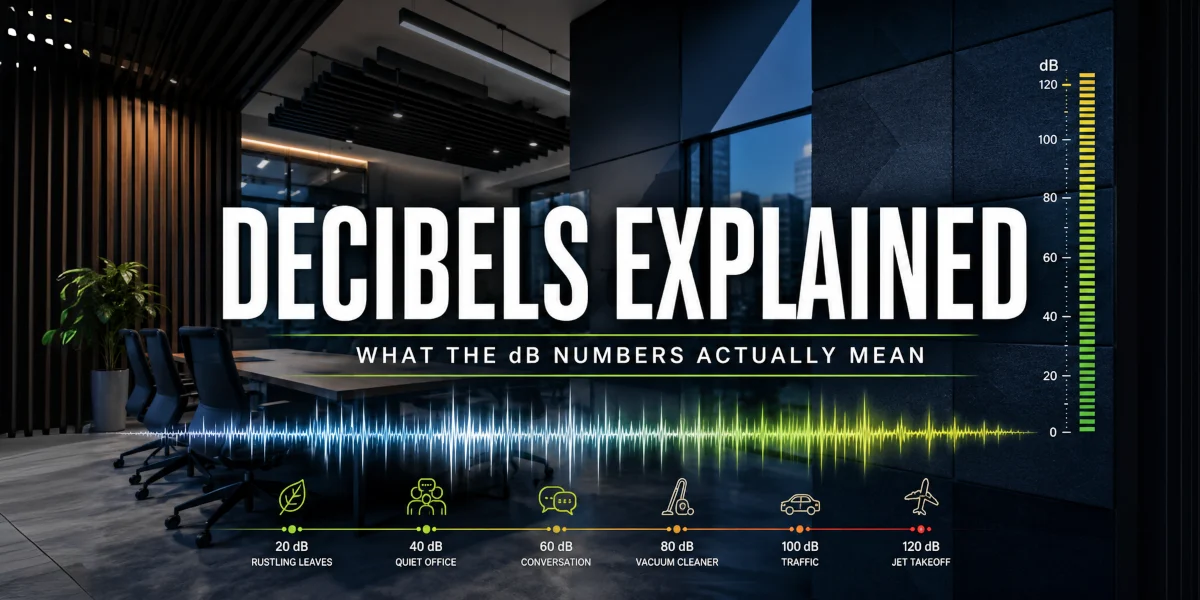
Decibel Levels of Common Sounds
- 0 dB – Threshold of human hearing
- 25–30 dB – Quiet bedroom at night
- 35–40 dB – Library
- 60 dB – Normal conversation
- 75–85 dB – Busy restaurant
- 85 dB – City traffic at curbside
- 95 dB – Subway platform
- 100–110 dB – Power tools
- 110–120 dB – Rock concert, front rows
- 130–140 dB – Jet engine at 100 ft
- ~140 dB – Threshold of pain
OSHA caps allowable workplace exposure at 90 dBA over 8 hours. Every 5 dB above that cuts the allowable time roughly in half. At 115 dBA, the limit is 15 minutes. For context on the other extreme, the 1883 eruption of Krakatoa is widely cited as the loudest sound in recorded history—an estimated 310 dB at the source, heard 3,000 miles away. For a deeper reference, see our Decibel Level Chart.
How Decibels Add (and Why 60 + 60 ≠ 120)
Because decibels are logarithmic, you can’t add them like normal numbers. Two 60 dB sources playing together don’t make 120 dB—they make 63 dB.
The rule of thumb:
- Two equal sources: add 3 dB
- One source 10 dB louder than the other: the quieter one is essentially inaudible
This is why adding a second noisy HVAC unit to a rooftop barely increases the perceived noise, and why silencing the loudest source in a room often delivers most of the benefit. Decibel math punishes diminishing returns—and rewards going after the biggest offender first.
Decibels in Architectural Acoustics
Most acoustic ratings architects and contractors deal with are decibel-based, even when the unit isn’t labeled “dB.”
- STC (Sound Transmission Class): a single-number rating derived from decibel transmission loss measurements across frequencies. A wall rated STC 50 reduces airborne sound by roughly 50 dB in the speech range. See our STC Rating Chart.
- OITC: similar to STC, but weighted for outdoor low-frequency sources like traffic and aircraft. See STC vs OITC.
- NRC (Noise Reduction Coefficient): measures how much sound energy a surface absorbs rather than reflects. Decibels show up in the underlying absorption math.
- NC and RC Curves: background noise criteria for HVAC and mechanical systems, expressed as decibel limits across octave bands.
Understanding the decibel scale is what lets you read these ratings critically. A wall going from STC 45 to STC 50 isn’t a 10% improvement—it’s a 5 dB reduction, meaning roughly three times less sound energy passes through. The same logic applies when comparing airborne and structure-borne mitigation strategies: small decibel gains can represent large energy reductions in the real world.
Conclusion: What the Numbers Mean
The decibel is a compressed, logarithmic way of describing a vast range of sound energy. Once you internalize that +3 dB doubles the energy, +10 dB sounds twice as loud, and that weighting filters change what the number means, every acoustic spec on a drawing or datasheet becomes easier to read. Decibels aren’t just a measurement—they’re a language for talking about how much sound is in a space and how much of it you’ve managed to control.
FAQs: Decibels Explained
What does dB actually stand for?
dB stands for decibel, which is one-tenth of a bel—a unit named after Alexander Graham Bell that expresses a ratio between two power levels on a logarithmic scale.
Is 0 dB silent?
Not exactly. 0 dB is the threshold of human hearing—the quietest sound a healthy young ear can detect. Sounds below 0 dB exist; we just can’t hear them. Negative decibel values are possible and used in anechoic chambers.
Why does +10 dB sound twice as loud?
Because human loudness perception is logarithmic. A tenfold increase in sound energy corresponds to roughly a doubling in perceived loudness. The ear compresses the enormous range of audible pressures into a manageable sensory scale.
What is the difference between dB and dBA?
dB is the raw measurement. dBA applies a frequency weighting that matches the sensitivity of human hearing, de-emphasizing very low and very high frequencies. Most regulations and product specs use dBA.
How loud is too loud?
Prolonged exposure above 85 dBA can cause permanent hearing damage. OSHA limits 8-hour workplace exposure to 90 dBA, and every 5 dB above that halves the safe exposure time.

Walker Peek|Founder & CEO, Commercial Acoustics
Walker founded Commercial Acoustics in 2013 to bring aerospace-grade engineering discipline to soundproofing, and runs the firm as CEO from its 12,000 sq ft Tampa production facility. The company designs custom acoustic panels, sound membranes, and masking systems for multi-family, hospitality, healthcare, and commercial projects across the US — built around Walker’s invention, Wall Blokker, an EVA-based sound barrier that hits STC 50-plus at roughly $1 per square foot installed.
A Jacksonville native, Walker spent five years at Kennedy Space Center with Craig Technologies before founding Commercial Acoustics — certifying aerospace manufacturing to the AS9100 standard and leading Six Sigma Black Belt process-improvement teams on NASA programs. He is a certified Industrial Noise Control Engineer and the author of Architectural Acoustics: A Practical Handbook.
