Table of Contents
Why Wavelength Matters in Soundproofing
Every soundproofing decision — how thick to build a wall, which door to spec, whether to add mass or absorption, why bass traps are a separate product from acoustic panels — comes back to one physical fact: sound has a size. A 50 Hz bass note is more than twenty feet long. A 4 kHz speech consonant is barely three inches. The same wave equation describes both, but the engineering problem at each end of the spectrum is completely different.
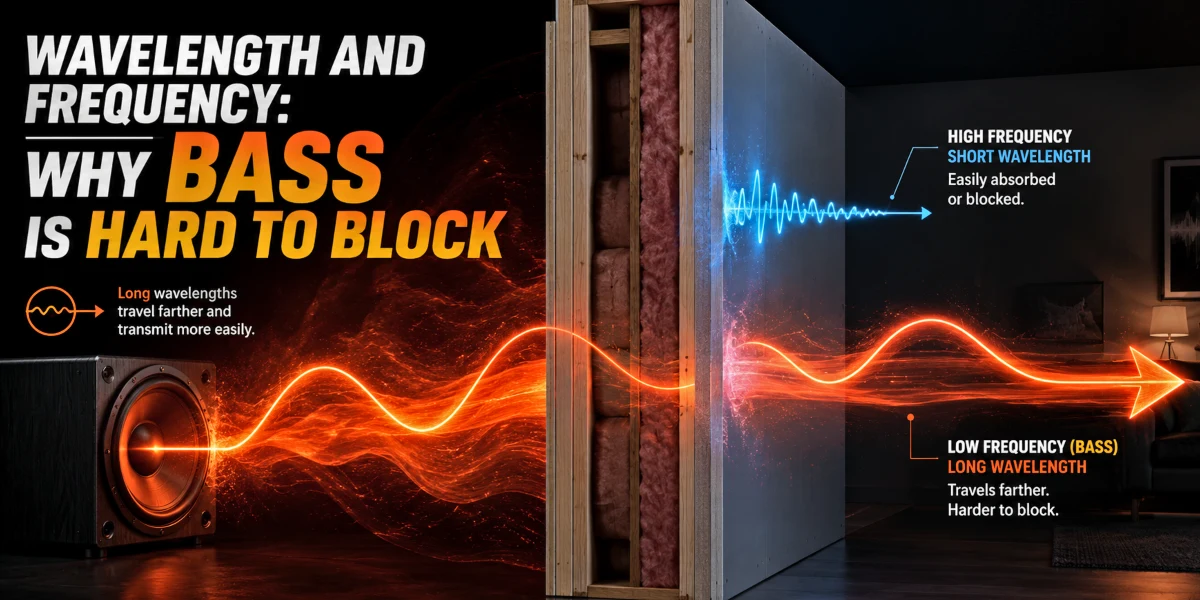
Most clients learn this intuitively when they hear their neighbor’s music from down the street: just the bass. Voices, drums, vocals — all gone. Just that thumping low end. The wavelengths are doing the talking. This post puts numbers on that intuition, then explains the three independent physics reasons bass keeps winning.
This sits on top of our Decibels Explained primer and our Octave Bands reference. If you have not read those, start there; this post assumes both.
The Formula: λ = c / f
Wavelength is the physical length of one full pressure cycle of a sound wave as it travels through the air. It is calculated by dividing the speed of sound by the frequency:
λ = c / f
Where c is the speed of sound in air (about 343 m/s, or 1,125 ft/s at room temperature) and f is the frequency in hertz. Because the speed of sound is essentially constant for building-acoustics purposes, doubling the frequency halves the wavelength. The audible range spans three decades of frequency, which means it also spans three decades of physical size — from tens of feet at the bottom to a fraction of an inch at the top.
Wavelengths Across the Audible Range
Putting the formula to work across the audible spectrum lines up wavelengths with familiar objects. This table is the foundation of every argument that follows.
- Wavelengths under 13 inches
- Reflects off ordinary walls and finishes
- Sealed by standard caulk, gaskets, door sweeps
- Mass law gives full 40+ dB TL at typical wall builds
- Absorbs into common fibrous panels (NRC tested at 250–2000 Hz)
- Wavelengths of 5–56 feet — larger than walls
- Diffracts around obstacles smaller than one wavelength
- Mass law gives only ~22 dB TL at 100 Hz
- Mass-air-mass resonance creates a low-frequency dip
- Couples into structure-borne paths and re-radiates elsewhere
| Frequency | Wavelength | Physical Comparison |
|---|---|---|
| 20 Hz | 56 ft / 17 m | Length of a tractor-trailer |
| 50 Hz | 22.5 ft / 6.9 m | Two-story building |
| 100 Hz | 11.3 ft / 3.4 m | Standard ceiling height — kick drum fundamental |
| 200 Hz | 5.6 ft / 1.7 m | Human height — low male voice |
| 500 Hz | 27 in / 0.69 m | Drywall sheet width |
| 1,000 Hz | 13.5 in / 34 cm | Laptop screen — speech reference |
| 2,000 Hz | 6.7 in / 17 cm | Smartphone |
| 4,000 Hz | 3.4 in / 8.6 cm | Coffee mug — peak ear sensitivity |
| 10,000 Hz | 1.4 in / 3.4 cm | Penny diameter |
Three decades of frequency, three decades of physical size. That single observation drives the rest of this post. For a practitioner-facing deep dive into how low frequencies behave in real rooms, Metropolitan Acoustics has a thorough “Low End Theory” newsletter on the same set of phenomena.
Sound wavelength vs everyday objects
A 50 Hz bass note (22.5 ft) is larger than most walls. A 4 kHz speech consonant (3.4 in) fits in your hand. That single fact is most of the soundproofing problem.
Reason 1: Diffraction — Long Waves Bend Around Walls
A sound wave only behaves like a beam when the obstacle in its path is larger than its wavelength. When the wavelength is comparable to or larger than the obstacle, the wave diffracts — it bends around. The rule of thumb in barrier acoustics is direct: a barrier’s minimum dimension needs to be at least one wavelength to block the sound effectively.
That makes interior walls great at blocking treble and structurally invisible to bass. A standard 8-foot-tall, 20-foot-long demising wall easily dwarfs the 3.4-inch wavelength at 4 kHz. The same wall is smaller than the 22.5-foot wavelength at 50 Hz — the wave bends around the wall, through the floor, through the ceiling, around the door frame, and arrives on the other side largely intact.
This is also why outdoor sound barriers along highways block tire noise but do little for the 60–100 Hz engine and exhaust rumble. The wavelengths at the bottom of the truck-noise spectrum are longer than the barrier is tall.
Reason 2: Mass Law — 6 dB Less TL per Octave
For a single-leaf partition, the mass law predicts that transmission loss increases by about 6 dB for each doubling of frequency — and by another 6 dB for each doubling of surface mass. That slope is built into the physics of how heavy a wall has to be to slow down a vibrating pressure wave.
Run the math on a typical wall. If a single layer of 5/8-inch drywall on studs gives you 40 dB of transmission loss at 1 kHz, the same wall gives you about 34 dB at 500 Hz, 28 dB at 250 Hz, and only 22 dB at 100 Hz. The bass gets through with less than half the attenuation of the speech band, before any other effect is considered.
This is why low-frequency isolation specs require either much heavier walls, decoupled assemblies, or both. Adding mass is the most reliable lever, but doubling mass only buys you 6 dB — the same as moving up one octave. Spec writers learn quickly that there is no cheap way to drop bass.
Reason 3: Mass-Air-Mass Resonance
Adding a second leaf to a wall (the standard double-stud or staggered approach) buys huge transmission loss above a certain frequency — but it introduces a low-frequency resonance where the two leaves “breathe” against the air cavity between them. At that resonance, TL collapses. For typical drywall walls, the dip lands between 50 Hz and 100 Hz, exactly where kick drums, bass guitars, and HVAC fan tones live.
The resonance frequency drops as cavity depth or leaf mass increases. That is one reason serious low-frequency builds use deep cavities (4 to 6 inches or more), heavy gypsum, and dense fiberglass or mineral wool inside — not for thermal reasons, but to push the mass-air-mass resonance down below the music spectrum and damp it when it does occur.
This is also why a wall that looks great on its STC rating can still “fail” a music venue or movie theater. STC is averaged from 125 Hz to 4,000 Hz; the resonance dip can sit below the STC measurement band entirely and never show up in the headline number. See our movie theater STC 65 case study for a real-world build that explicitly chases bass attenuation below the standard STC band.
Real-World Applications
The Kick Drum Problem
A 60 Hz kick drum has a wavelength of 18.75 feet. No interior wall on a typical floorplan is one wavelength thick or one wavelength tall. The wave bends around walls, couples into the slab, walks through stud cavities, and reappears two units away as the thumping that complaints are made of. Treble is gone, midrange is gone, but the kick is still on the beat. This is why brewery, gym, and music-venue soundproofing always specifies decoupled assemblies and structural isolation, not just heavy walls.
Why Your Door Doesn’t Matter for Bass
A solid-core door with a perimeter seal will block speech beautifully. The 3-inch wavelength at 4 kHz cannot navigate a tight gasket. But a 1/2-inch undercut at the threshold is meaningless to a 11-foot wavelength at 100 Hz — the wave does not even notice the gap. Door seals matter for speech privacy, not for bass containment. The bass problem is the wall behind the door, the floor under it, and the structure around it.
HVAC Hum That Will Not Go Away
A persistent low-frequency hum traces to a 60 Hz transformer or a fan blade tone in the 80–120 Hz range. The wavelengths run 9 to 14 feet. Diffraction routes the wave around any partial enclosure. Mass law gives any reasonable enclosure only 20–25 dB of TL at those frequencies. Structural coupling carries the rest into floors and ceilings. Mechanical noise control at low frequencies almost always requires source-side isolation — spring or pad isolators under the unit, inertia bases, flex connectors — not just an absorptive enclosure.
Conclusion: Block What You Can See, Plan for What You Cannot
Treble is an obstacle-and-leak problem. Bass is a dimension-and-coupling problem. The first responds to mass, sealing, and absorption you can stand next to and point at. The second responds to decoupling, structural isolation, and depth — design moves that do not look like soundproofing until you understand why the wavelength demands them.
The single most useful question on any soundproofing project is: what frequency range is the complaint at? If it is speech, the toolkit is familiar. If it is bass, the budget, depth, and structural strategy all need to scale up before the first wall goes in.
For expert consulting, low-frequency noise diagnosis, or help building an assembly that survives bass, contact Commercial Acoustics to connect with our engineering team.
FAQs: Wavelength, Frequency, and Bass Soundproofing
Why is bass harder to block than treble?
Bass has long wavelengths — 5 to 56 feet across the low end of the audible spectrum. Long waves diffract around obstacles smaller than one wavelength, get only ~22 dB transmission loss at 100 Hz versus 40+ dB at 1 kHz under mass law, and excite a low-frequency mass-air-mass resonance that drops TL further. Three independent physics effects all favor the bass.
How long is a 100 Hz sound wave?
About 11.3 feet (3.4 m) in air at room temperature. A 50 Hz bass note is 22.5 feet. A 1 kHz speech tone is 13.5 inches. The full audible range spans wavelengths from roughly 56 feet at 20 Hz down to about two-thirds of an inch at 20 kHz.
What is the mass law in acoustics?
The mass law predicts that transmission loss through a single-leaf partition increases by roughly 6 dB for each doubling of frequency and by another 6 dB for each doubling of surface mass. That slope means bass frequencies always have less attenuation than higher frequencies through the same wall, regardless of construction.
What is mass-air-mass resonance?
In a double-leaf wall, the two leaves and the air cavity between them form a spring-mass system that has a natural resonance. At that frequency, transmission loss drops sharply. For typical drywall walls the resonance lands at 50 to 100 Hz — directly in the bass band. Deeper cavities and heavier leaves push the resonance lower, which is why serious low-frequency builds use deep, mineral-wool-filled cavities.
How can you block low-frequency noise?
Combine large amounts of mass, structural decoupling (double-stud or staggered walls with deep cavities), source-side vibration isolation for mechanical equipment, and treatment of flanking paths through floors and ceilings. Bass cannot be solved with sealing and panels alone; it requires depth, mass, and decoupling at the assembly level.

Walker Peek|Founder & CEO, Commercial Acoustics
Walker founded Commercial Acoustics in 2013 to bring aerospace-grade engineering discipline to soundproofing, and runs the firm as CEO from its 12,000 sq ft Tampa production facility. The company designs custom acoustic panels, sound membranes, and masking systems for multi-family, hospitality, healthcare, and commercial projects across the US — built around Walker’s invention, Wall Blokker, an EVA-based sound barrier that hits STC 50-plus at roughly $1 per square foot installed.
A Jacksonville native, Walker spent five years at Kennedy Space Center with Craig Technologies before founding Commercial Acoustics — certifying aerospace manufacturing to the AS9100 standard and leading Six Sigma Black Belt process-improvement teams on NASA programs. He is a certified Industrial Noise Control Engineer and the author of Architectural Acoustics: A Practical Handbook.
