Build your wall assembly layer by layer and watch the estimated STC rating update instantly — then get the lab-tested number for your exact design.
The Basics
What is Sound Transmission Class (STC)?
Sound Transmission Class (STC) is a standardized rating that quantifies how effectively a material or assembly reduces airborne sound. Commonly used in architectural acoustics, STC is essential for designing walls, ceilings, and glazing systems that provide privacy and comfort. It is calculated using ASTM E90 test data and ASTM E413 rating methods, offering a single-number benchmark for comparing assemblies.
What It MeasuresHow well a partition blocks airborne sound — voices, TV, music.
The StandardsASTM E90 for testing, ASTM E413 for the rating method.
Why It MattersUsed to assess speech privacy and meet code-required performance.
Benchmarks
Typical Sound Ratings by Assembly Type
Choosing the right wall assembly upfront avoids costly retrofits when noise complaints surface after occupancy. Higher-rated assemblies like staggered studs or CMU also align with code requirements in schools, multifamily, and healthcare.
Standard Drywall WallNo insulation, basic construction
STC 33
Insulated Drywall Wall5/8″ drywall with batt insulation
45–50
Concrete Block Wall8″ CMU construction
50–55
Staggered Stud WallDouble drywall with decoupling
55–60
3040506070
Design Targets
Target Sound Ratings by Building Type
Hitting the right target creates spaces that perform as intended — quieter classrooms, offices that keep conversations confidential, and multifamily projects that avoid tenant turnover from noise complaints.
Education
STC 40–45
Classrooms & Schools
Keeps lessons from bleeding next door.
Commercial
STC 45–50
Offices & Conference Rooms
Confidential conversations stay put.
Residential
STC 50–60
Multifamily & Hotels
IBC minimum is STC 50 between units.
Healthcare
STC 50–55
Healthcare & Exam Rooms
Speech privacy for patient visits.
Secure
STC 55+
Government & Secure Rooms
Interview and sensitive spaces.
Methodology
How STC Ratings are Calculated
STC ratings are calculated by measuring how sound moves through a partition at 16 standardized frequencies, then comparing that curve to a reference contour. Real-world conditions typically reduce performance by 3–7 points, reported as Apparent STC (ASTC) under ASTM E336.
1
Frequency Testing16 bands from 125–4000 Hz measure airborne sound loss across the spectrum.
2
Contour FittingE90 test data is fitted to the E413 reference contour to produce the STC number.
3
Field VariabilityFlanking paths and construction flaws lower real-world performance below lab ratings.
Improve Performance
Design Tips to Improve Performance
Boosting STC isn’t just about thicker walls — it’s about smarter construction. Addressing these three areas can easily improve performance by 5 to 10 STC points.
1
Add Mass & InsulationHeavier drywall combined with cavity insulation raises STC significantly.
2
Isolate the StructureStaggered studs or resilient channels reduce vibration transfer through framing.
3
Seal Weak PointsOutlets, doors, and glazing are the flanking paths that undo good wall design.
Proof
Case Studies: STC Rating in Action
Patient Privacy
Healthcare Soundproofing in Alaska
When YKHC expanded its healthcare facilities, sound isolation was critical to patient privacy. High-STC wall assemblies and acoustic membranes kept confidential conversations protected in exam and consultation rooms.
Medical offices face strict HIPAA regulations, making STC performance non-negotiable. We paired sound masking with high-STC wall assemblies to eliminate sound bleed between rooms.
Noise bleed between auditoriums threatened the guest experience. Mass loaded vinyl achieved STC 65+, delivering low-frequency control while cutting three weeks from the schedule.
Law enforcement facilities demand maximum confidentiality. Interrogation rooms were upgraded with enhanced STC-rated assemblies to stop speech from leaking between rooms.
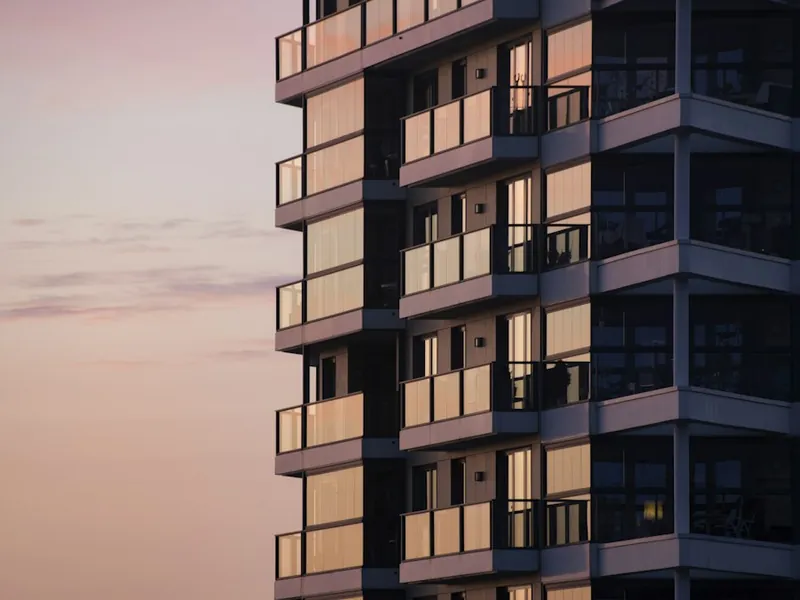
A post-construction retrofit in an 18-story, 173-unit luxury tower. Wall Blokker Pro over the existing 20-gauge stud walls reached STC 58 during an HOA-funded acoustic scope.
An STC of 50 is the minimum required by the International Building Code for walls between dwelling units. However, STC 55 or higher is typically preferred in healthcare, education, hospitality, and corporate environments where privacy is critical.
Our calculator provides realistic estimates based on common wall types and configurations. It’s ideal for early-stage design and value engineering. For final specs or sensitive projects, lab-tested assemblies or consultation with an acoustic expert is recommended.
Lab tests (ASTM E90) are conducted in ideal conditions. Field ratings (ASTM E336) account for real-world factors like construction quality, air gaps, and flanking paths. Expect field results — also called Apparent STC (ASTC) — to be 3 to 7 points lower.
Yes. Adding fiberglass or mineral wool insulation into stud cavities can raise STC by 5–10 points, depending on wall configuration. Insulation works best when combined with added mass and structural decoupling.
Use IIC (Impact Insulation Class) when designing floor-ceiling systems to reduce impact noise like footsteps or dropped items. STC is for airborne noise, such as voices or TV. In multi-story buildings, both ratings are typically required.




 Patient Privacy