Yoga studios need silence as the product. 7 prioritized strategies—STC 50+ demising walls, sealed doors, ceiling clouds, NC 30 HVAC, and more—for blocking neighbor noise and creating a tranquil practice environment.
How to Soundproof
A staggered stud wall alternates studs on a single shared plate, so the two faces decouple without a double-stud’s depth. Here is how it reaches STC 55, where the plate caps it, and when it is the smart middle ground.
Pickleball noise is the fastest-growing acoustic complaint in America. 10 prioritized strategies—5 for indoor facilities, 5 for outdoor courts—with real STC, NRC, NC, and dBA targets for keeping the courts open and the neighbors quiet.
Wine cellars have a single acoustic problem: the cooling unit. Here are 6 prioritized strategies—from cooling-system selection to STC 50+ walls and vibration isolation—for keeping a luxury cellar silent and protecting long-aging wines.
Axe-throwing venues combine 100+ dBA impact noise with structure-borne vibration and a noisy bar/lounge. Here are 10 prioritized strategies—with real STC, NRC, IIC, NC, and dBA targets—for soundproofing every zone.
A double-stud wall puts two separate framing rows on their own plates, and that clean break is what carries it to STC 60 and beyond. Here is how the gap, insulation, and mass stack up, and when it earns the footprint.
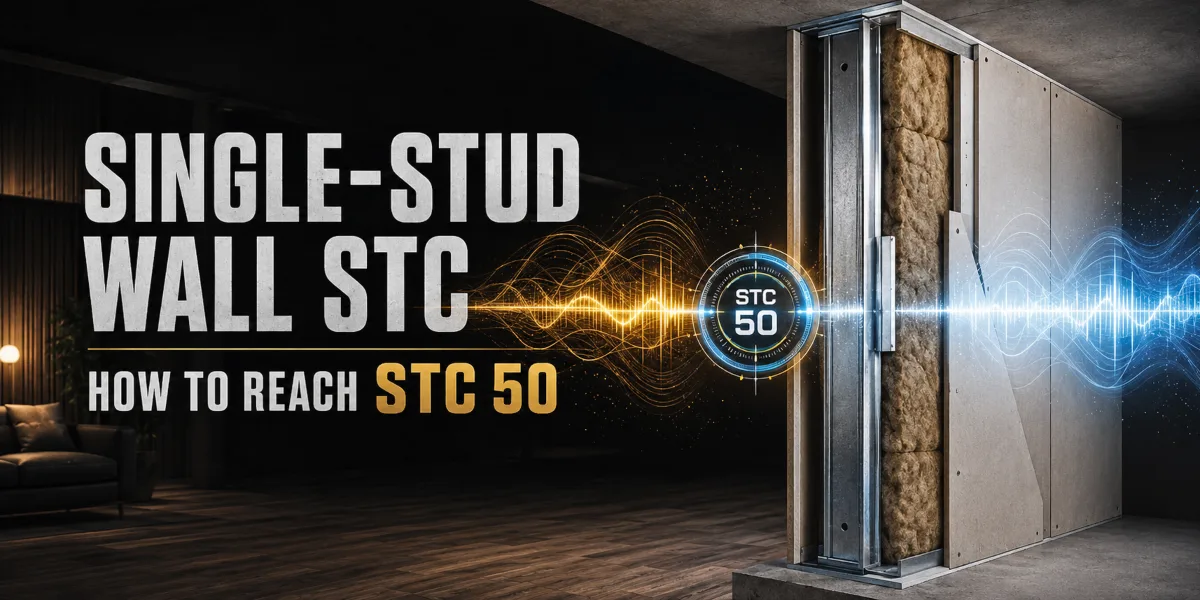
A single-stud wall can hit STC 50 with the right moves. Here is what lighter-gauge studs, wider spacing, damping, and a decoupling membrane actually add, and where the ceiling sits without a second wall.
Breweries combine industrial production noise with hospitality taprooms and often outdoor beer gardens. Here are 12 prioritized strategies-with real STC, NRC, NC, dBA targets-for soundproofing every zone of a brewery.
Country clubs blend vaulted dining rooms, multi-use ballrooms, tile-clad pools, and confidential meeting spaces under one roof. Here are 8 prioritized strategies—with real STC, NRC, RT60, and dBA targets—for soundproofing each zone.
Coworking spaces juggle focus work, calls, and collaboration in one open room. Here are 15 specific strategies—from zoning and phone booths to ceiling clouds, sound masking, and behavioral norms—that actually work.
Why music rooms leak — air gaps, shared structure, lightweight materials — and the three physics principles that fix it: mass, decoupling, and sealing. Includes typical STC and RT60 targets for studio-grade spaces.
Quick fixes, mid-level retrofits, and full-build solutions for ceiling noise from upstairs units, HVAC, and mechanical equipment. How mass, isolation, and sealing interact, plus common mistakes that waste budget without solving the problem.
Soundproofing isn’t acoustic treatment — it stops sound from passing through walls, ceilings, and gaps, not echoes inside the room. The three principles that actually work (mass, decoupling, sealing) and the quick fixes that waste money.
Doors are the weakest acoustic link in most walls — why hollow cores leak as much as open vents, what a real door upgrade looks like (seals, sweep, mass, threshold), and the targets that make it worth the spend.
Why windows are the weak link in nearly every building envelope — what laminated glass and proper IGU spec actually buy you, how STC and OITC differ here, and the realistic upgrades by site type.
- 1
- 2