Sound Absorption Coefficients: A Practical Guide for Materials, Panels, & Foam
Table of Contents
What Is a Sound Absorption Coefficient?
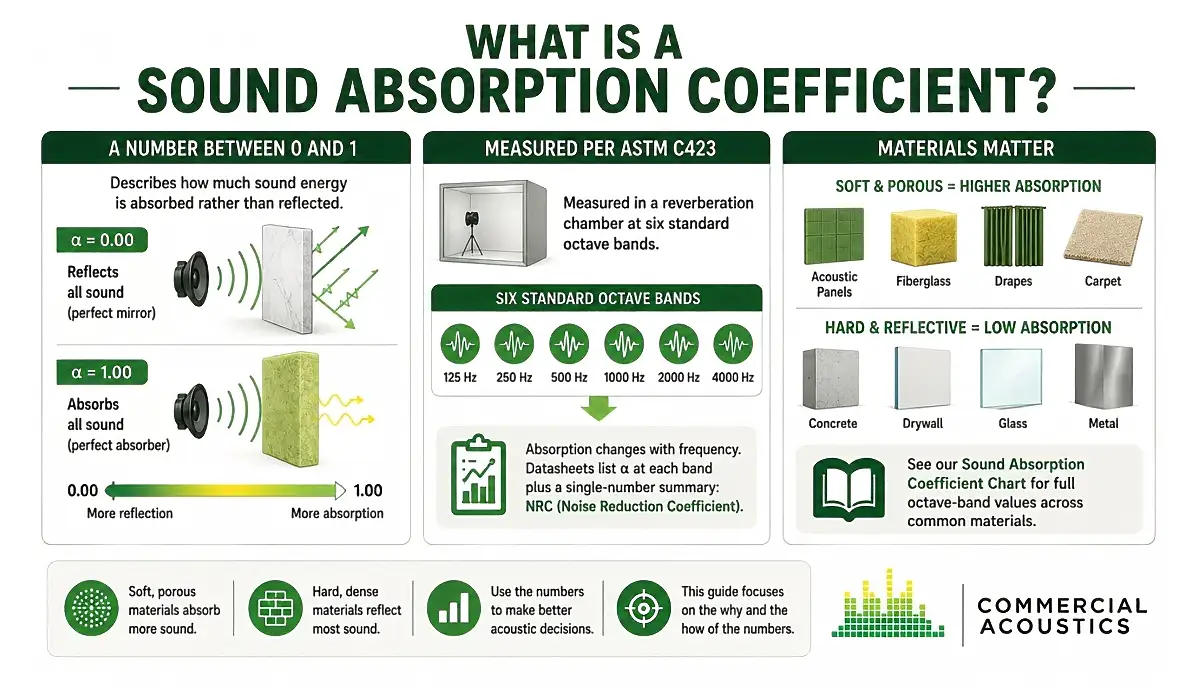
The sound absorption coefficient (often written as α, or “alpha”) is a number between 0 and 1 that describes how much of the sound energy striking a material is absorbed rather than reflected. A coefficient of 0.00 means the surface reflects all incoming sound (a perfect mirror, like polished marble). A coefficient of 1.00 means the surface absorbs all incoming sound (an open window, or a thick fiberglass acoustic panel).
Absorption coefficients are measured per ASTM C423 in a reverberation chamber, at six standard octave bands: 125 Hz, 250 Hz, 500 Hz, 1000 Hz, 2000 Hz, and 4000 Hz. Because absorption changes with frequency, most material datasheets publish the value at each band, plus a single-number summary called NRC (Noise Reduction Coefficient).
Generally speaking, soft and porous materials are more absorptive than hard and reflective ones. Concrete, drywall, glass, and metal reflect almost everything. Carpet, drapes, fabric, fiberglass, and acoustic panels absorb a much higher fraction. For the full octave-band lookup across common materials, see our sound absorption coefficient chart. This guide focuses on the why and the how — how to read those numbers, what they mean by material category, and how to use them in real design.
Absorption Coefficient vs NRC: What’s the Difference?
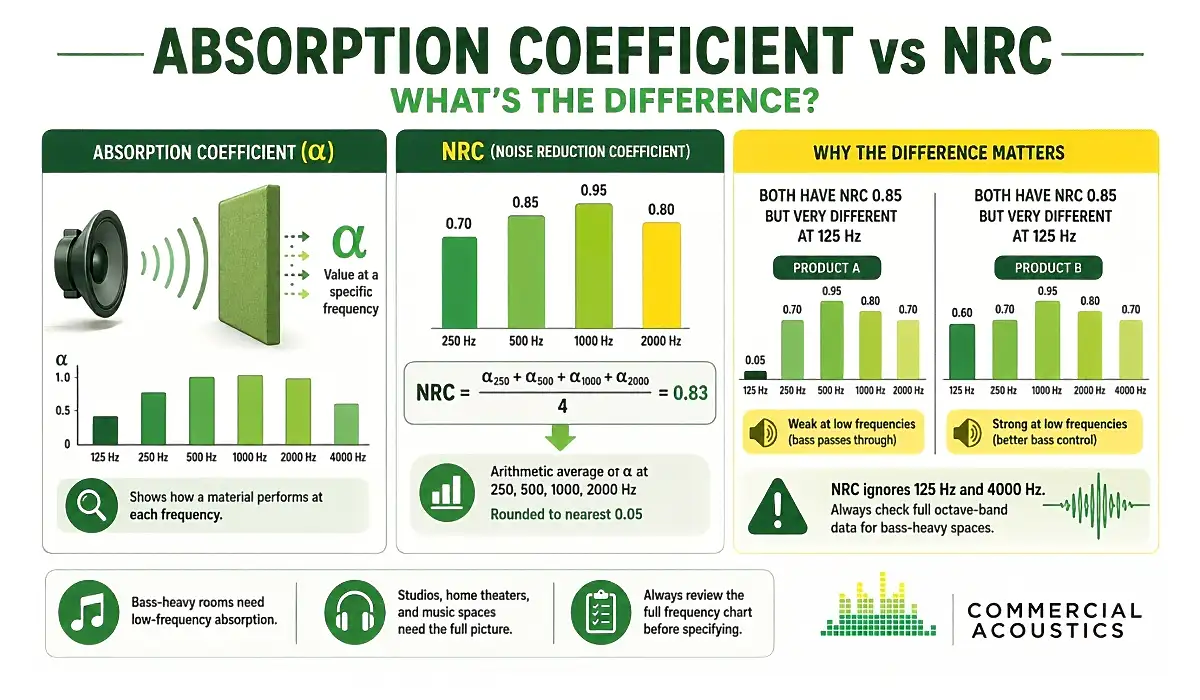
The absorption coefficient (α) is the value at a specific frequency. NRC is the arithmetic average of α values at 250, 500, 1000, and 2000 Hz, rounded to the nearest 0.05. NRC is a quick single-number rating for product comparison — useful for shortlisting acoustic treatments — but it intentionally ignores the 125 Hz and 4000 Hz bands.
That gap matters. NRC tells you nothing about low-frequency performance, which is where most bass-heavy rooms, recording studios, and home theaters need help. Two products can both have NRC 0.85 and behave completely differently at 125 Hz — one might absorb almost nothing, the other 60%. Always check the full octave-band data before specifying treatment for a space with bass content. For a deeper look at how NRC is calculated and where it falls short, see our acoustic absorption 101 guide.
How Absorption Varies by Frequency
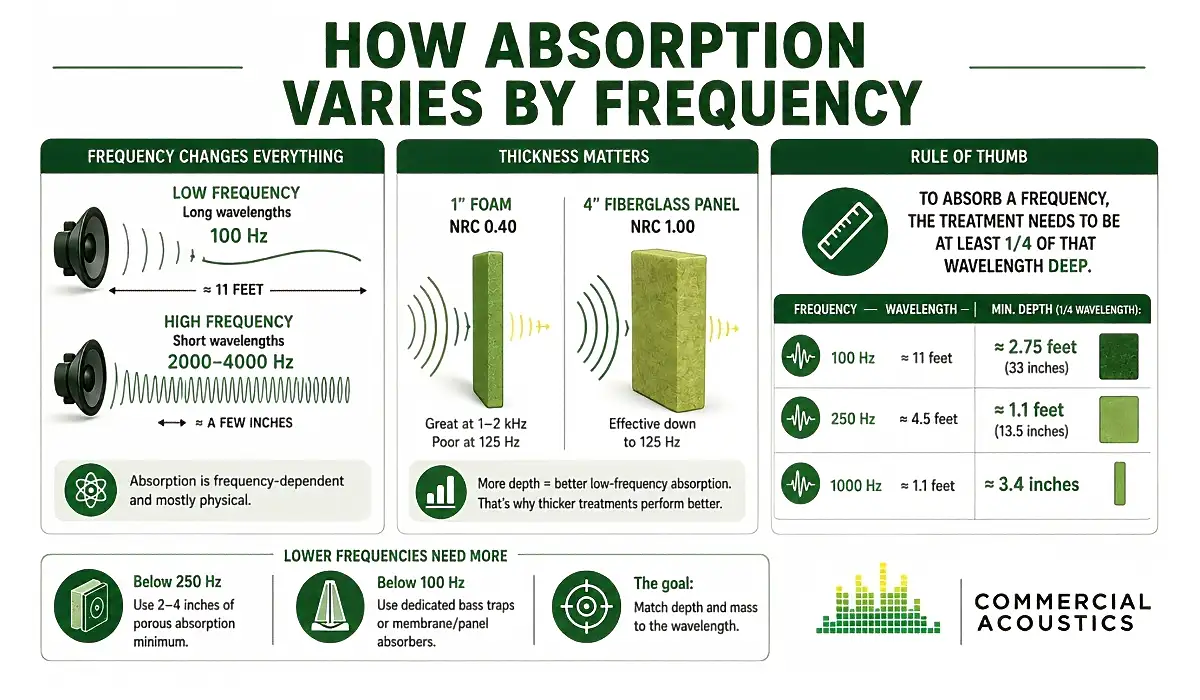
Absorption is frequency-dependent, and the relationship is mostly physical. Sound at low frequencies has long wavelengths — a 100 Hz tone is roughly 11 feet long. To absorb that wave, a material needs depth and mass; a thin material can’t interact with it efficiently. High-frequency sound (2000–4000 Hz) has wavelengths of just a few inches, which thin porous materials catch easily.
That’s why a 1-inch piece of foam reads NRC 0.40 (good at 1–2 kHz, poor at 125 Hz), while a 4-inch fiberglass panel reads NRC 1.00 and stays effective down to 125 Hz. The rule of thumb: to absorb a frequency, the treatment needs to be at least 1/4 of that wavelength deep. Below 250 Hz, that means 2–4 inches of porous absorption minimum; below 100 Hz it means dedicated bass traps or membrane/panel absorbers tuned to the frequency.
Acoustic Panel Absorption Coefficients
Acoustic panels — typically a fiberglass or mineral wool core wrapped in acoustically transparent fabric — are the workhorse of commercial absorption. They deliver high broadband absorption across the speech and music range, and their performance scales predictably with thickness. Typical published NRC values for high-density fiberglass panels (industry-standard 6–7 PCF core):
| Acoustic Panel Type | Typical NRC | Absorption |
|---|---|---|
| 1″ fiberglass panel (6 PCF) | 0.75 | 0.75 |
| 2″ fiberglass panel (6 PCF) | 1.00 | 1.00 |
| 4″ fiberglass panel (6 PCF) | 1.05 | 1.05 |
| 1″ polyester (PET) panel | 0.55 | 0.55 |
| 2″ polyester (PET) panel | 0.85 | 0.85 |
| Fabric-wrapped panel, perforated metal facing | 0.85–0.95 | 0.85–0.95 |
Representative ASTM C423 NRC values. Actual numbers vary by manufacturer, mounting, and air-gap behind the panel.
Key takeaways for acoustic panels:
- For broadband absorption (down to 125 Hz), specify at least 2-inch fiberglass panels. 1-inch panels work fine for speech but lose their grip below 500 Hz.
- For maximum absorption including bass, use 4-inch panels or 2-inch panels with a 1–2″ air gap behind the wall mount. Air gap improves low-frequency performance significantly.
- Polyester (PET felt) panels are budget-friendly but absorb roughly 25–35% less than equivalent fiberglass. Reasonable for offices and classrooms; not for studios.
Commercial Acoustics’ fiberglass acoustic panels use a 6 PCF core and ship with full ASTM C423 octave-band data on request.
Acoustic Foam Absorption Coefficients
Acoustic foam — open-cell polyurethane or melamine foam, typically cut into wedge, pyramid, or convoluted patterns — is widely sold as a low-cost absorber. Foam works, but with a major caveat: it performs well only at mid and high frequencies. Below about 250 Hz it becomes nearly transparent to sound. Typical published NRC values for studio-grade open-cell foam:
| Foam Thickness & Profile | Typical NRC | Absorption |
|---|---|---|
| 1″ wedge or pyramid foam | 0.40 | 0.40 |
| 2″ wedge or pyramid foam | 0.65 | 0.65 |
| 3″ wedge or pyramid foam | 0.75 | 0.75 |
| 4″ wedge or pyramid foam | 0.85 | 0.85 |
| Melamine foam (Basotect-type), 2″ | 0.85 | 0.85 |
Representative values. Manufacturer NRC claims for cheap foam often overstate real-world performance — always request ASTM C423 test reports.
Key takeaways for acoustic foam:
- Foam below 2″ thick is rarely worth specifying. 1″ foam adds almost no useful absorption below 500 Hz — right where speech intelligibility problems live.
- Foam cannot fix low-frequency reverberation. If your room has boomy bass, 250 Hz reflections, or music content, you need fiberglass panels with depth or dedicated bass traps — not foam.
- “Studio foam” sold online with claimed NRC 0.95 ratings is almost always tested at favorable frequencies only. Reputable manufacturers publish the full octave-band test report from an accredited lab.
Carpet, Drapes & Soft Furnishings
Furnishings provide meaningful incidental absorption in most occupied rooms — they’re often the difference between a livable office and an echoey one. Typical values:
| Material | Typical NRC | Absorption |
|---|---|---|
| Carpet, thin, glued direct to concrete | 0.15 | 0.15 |
| Carpet on foam underlay or pad | 0.35 | 0.35 |
| Heavy carpet on pad (residential) | 0.55 | 0.55 |
| Drapery, lightweight cotton, hung flat | 0.10 | 0.10 |
| Drapery, medium weight, draped to 50% gathered | 0.55 | 0.55 |
| Drapery, heavy velour, draped to 75% gathered | 0.75 | 0.75 |
| Upholstered seating, fabric, occupied | 0.85 | 0.85 |
| Upholstered seating, fabric, empty | 0.55 | 0.55 |
Furnishings absorb best at mid and high frequencies and contribute little below 250 Hz.
Practical note on drapery: the published NRC is highly dependent on how the drape is hung. A flat curtain barely absorbs more than the wall behind it. The same fabric hung at 50–75% gathered (i.e., total fabric length 1.5–2× the rod length) can hit NRC 0.50–0.75 because the folds add depth and surface area.
Hard Surfaces: Drywall, Concrete, Glass & Metal
Hard architectural surfaces reflect almost all incoming sound — that’s the source of most echo and reverberation complaints. Typical values run between 0.02 and 0.10:
| Material | Typical NRC | Absorption |
|---|---|---|
| Polished marble, granite, terrazzo | 0.02 | |
| Smooth concrete, painted | 0.05 | |
| Smooth concrete, unpainted | 0.05–0.10 | 0.05–0.10 |
| Painted drywall (gypsum board) | 0.05 | |
| Brick, painted | 0.02–0.05 | |
| Brick, unpainted | 0.05–0.10 | 0.05–0.10 |
| CMU block, unpainted | 0.20–0.35 | 0.20–0.35 |
| Glass, single pane | 0.05 | |
| Steel, structural / metal panels | 0.05–0.10 | 0.05–0.10 |
| Wood flooring on joists | 0.10–0.15 | 0.10–0.15 |
| Plywood paneling (thin, with air gap behind) | 0.25 | 0.25 |
Hard surfaces. Unpainted CMU is the one outlier — its porous open cells absorb 5–7× more than painted CMU.
The lesson: a room built entirely of hard surfaces (a glass conference room, a concrete loft, a tile lobby) will be loud and reverberant no matter how large or small it is. The absorption you add — panels, carpet, drapery, ceiling tile — carries essentially all the load.
Reflect, Absorb, Transmit: Why Coefficient Alone Isn’t Enough
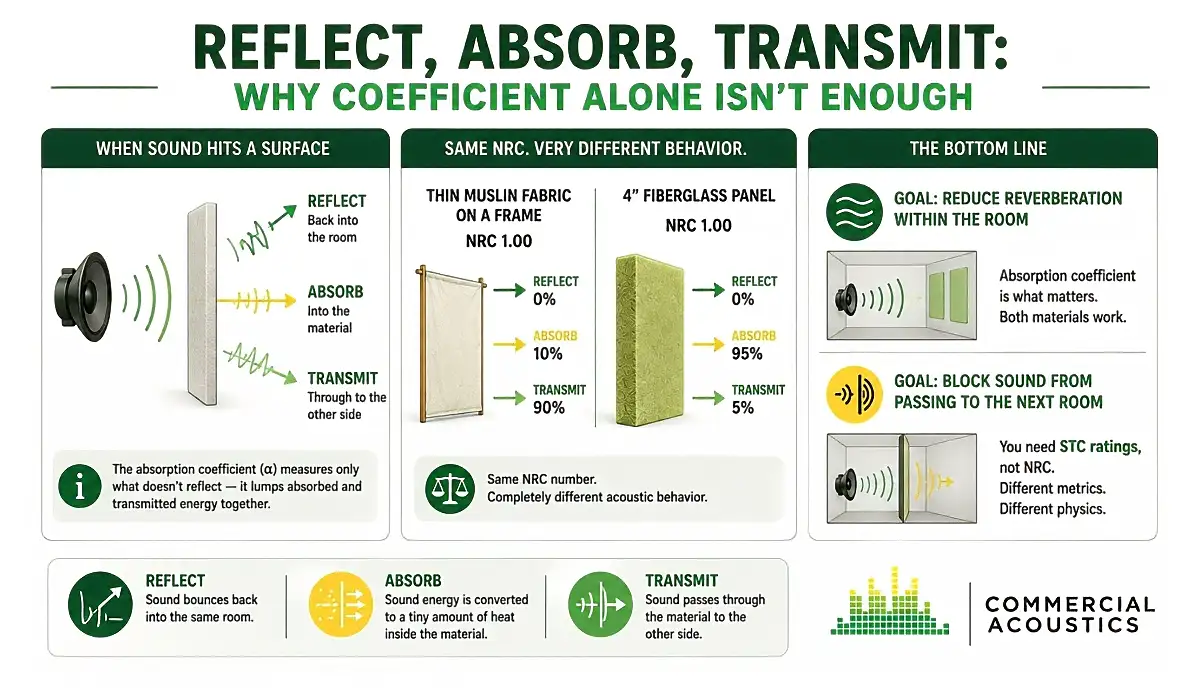
When sound strikes a surface, it can do one of three things: reflect back into the room, get absorbed within the material, or transmit through to the other side. The absorption coefficient measures only how much sound doesn’t reflect — which lumps absorbed and transmitted energy together. That can be misleading.
Consider two materials, both rated NRC 1.00. A thin sheet of muslin fabric stretched on a frame might reflect 0% of the energy — but transmit 90% of it through to the room next door and absorb only 10%. A 4-inch fiberglass panel with the same NRC 1.00 reflects 0%, transmits maybe 5%, and absorbs the remaining 95%. Same number, completely different acoustic behavior.
If your goal is reducing reverberation within a room, the absorption coefficient is what matters — both materials work. If your goal is blocking sound from passing into the next room, you need to look at STC ratings, not NRC. The two metrics measure different physics.
How to Use Absorption Coefficients in Acoustic Design
In practical room design, you don’t use the α of a single material alone — you calculate the total absorption in a room by summing each surface’s area times its absorption coefficient at each frequency. The result, expressed in sabins, drives the room’s reverberation time (RT60) through the Sabine equation:
RT60 = 0.049 × V / A