STC vs IIC vs Delta IIC: What’s the Difference?
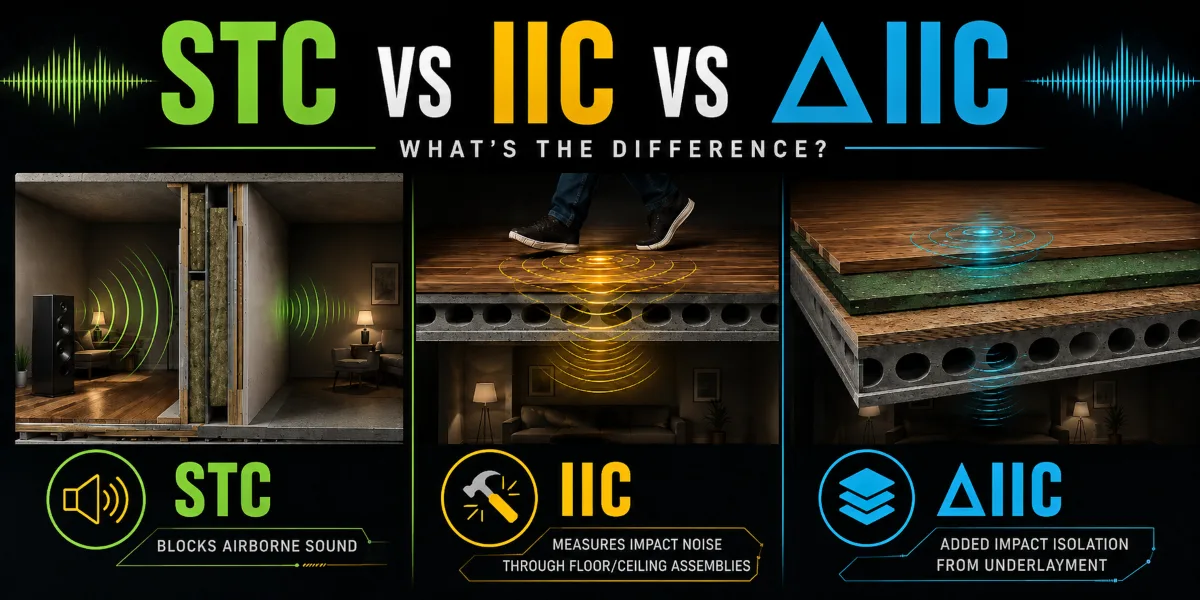
Table of Contents
STC, IIC, and Delta IIC (ΔIIC) get used interchangeably all the time — and they shouldn’t. They measure three different things, under three different ASTM standards, and confusing them is one of the most common reasons specs miss in the field. This guide lays them out side-by-side, explains when each one matters, and points you to the right chart for the numbers.
STC vs IIC vs Delta IIC at a Glance
Use this table to keep them straight. Below the table, we go deeper on each rating and link out to a full chart of typical values.
STC — Sound Transmission Class
STC (Sound Transmission Class) rates how well a wall, floor, or door blocks airborne sound — voices, music, televisions, anything traveling through air. It is a single-number average of the transmission loss measured at 18 frequencies between 125 Hz and 4,000 Hz, per ASTM E90 in the lab and ASTM E336 in the field.
Two important limits of the STC rating:
- STC is an average across 18 frequencies. If you need high attenuation at a specific frequency — say, a 60 Hz subwoofer note — the STC alone won’t tell you whether you’re achieving it.
- STC only covers 125 Hz to 4,000 Hz. For very low-frequency sources — movie theater LFE, HVAC rumble, traffic — the 63 Hz and 80 Hz bands matter more than anything STC captures. That’s why critical projects also look at OITC.
A quick field check: with an SPL meter and white noise, measure the dBA in the source room and again in the receive room; the difference is a rough STC. The exact number requires the full frequency-band measurement and the ASTM contour calculation.
IIC — Impact Insulation Class
IIC (Impact Insulation Class) rates how well a floor-ceiling assembly blocks impact noise — footsteps, dropped objects, dragged chairs — from passing into the space below. It is tested with a standardized tapping machine on the finished floor and a mic in the room below, per ASTM E492 (lab) and ASTM E1007 (field).
Unlike STC, which is mostly about the partition itself, IIC bakes in every layer of the floor-ceiling assembly:
- Floor supports — joists or slab beneath everything else.
- Substrate — the subfloor (plywood, OSB, concrete, gypcrete).
- Acoustic underlayment — the dedicated impact-isolation layer (rubber, cork, fiber, foam).
- Finish flooring — the visible surface (carpet, LVT, tile, hardwood). Hard finishes can drop IIC by 10–25 points without an underlayment.
Change any layer and the IIC changes — which is exactly why an underlayment’s ΔIIC doesn’t transfer cleanly from one assembly to another.
Delta IIC (ΔIIC) — Underlayment Improvement
Delta IIC (ΔIIC) is the number that lets you compare two acoustic underlayments directly. It’s measured per ASTM E2179: test a bare 6″ concrete reference slab, then re-test the same slab with the underlayment installed; the difference between the two IIC results is the ΔIIC.
Because every product is tested on the same standardized slab, ΔIIC is the cleanest apples-to-apples ranking metric for underlayments — cork vs rubber vs foam vs engineered mat. Thin builder-grade foams land around ΔIIC 15–18; quality rubber mats hit ΔIIC 22–25; premium engineered mats post ΔIIC 26+.
The catch every consultant warns about: ΔIIC is measured only on bare concrete. It does not transfer to wood-framed floors or predict the final assembly IIC. Two mats both rated ΔIIC 23 on concrete can perform very differently under LVT on wood joists. Use ΔIIC to pick the mat, then verify the finished floor with a full IIC rating.
Which Rating Do You Need?
Most spec confusion comes from asking “what’s the right STC?” when the actual problem is an IIC problem — or pulling an underlayment’s ΔIIC off a cut sheet and forgetting to check the assembly IIC. This decision tree keeps them straight:
When in doubt: STC for walls, IIC for floors, ΔIIC for shopping underlayments. Sizing a planned assembly? Use the STC Calculator and IIC Calculator together — both account for the typical 2–5 point field penalty so the finished building passes on testing day.
Conclusion: Using STC, IIC, & Delta IIC Together
STC, IIC, and ΔIIC aren’t competing ratings — they answer different questions. STC tells you how well a wall blocks voices and music. IIC tells you how well a floor blocks footsteps. ΔIIC tells you how much credit a single underlayment deserves for an IIC result. Use them together: spec by STC and IIC for the assembly, compare underlayments by ΔIIC, and check the finished building against a Field IIC measurement before sign-off.
Commercial Acoustics has been specifying walls, floor-ceiling assemblies, and acoustic underlayments since 2008. If you need help mapping these ratings to a project, contact us and we’ll walk through targets, products, and field-test cushion.
FAQs: STC vs IIC vs Delta IIC
What’s the difference between STC and IIC?
STC measures airborne sound (voices, music, TVs) through a wall or floor; IIC measures impact noise (footsteps, dropped objects) through a floor-ceiling assembly. Both are tested per ASTM standards but on different rigs — STC uses a loudspeaker, IIC uses a tapping machine. They’re independent: a partition can pass STC and fail IIC, or vice versa.
Is Delta IIC the same as IIC?
No. IIC is an absolute rating for an entire floor-ceiling assembly (slab, ceiling, underlayment, and finish floor combined). Delta IIC (ΔIIC) is the point improvement a single underlayment adds when tested on a standard bare 6-inch concrete slab per ASTM E2179. ΔIIC compares products; IIC rates the whole floor.
Do I need both STC and IIC?
For floor-ceiling assemblies in multifamily and hospitality, yes — STC handles airborne noise (a TV upstairs), IIC handles impact noise (footsteps upstairs). The IBC requires both to meet at least 50 between dwelling units. Walls only need STC, since impact through a wall is rare and not regulated.
Which is more important — STC or IIC?
Neither, individually — they measure different problems. In a residential floor, IIC complaints (footsteps) are much more common than STC complaints (voices), so IIC often gets more attention. But a floor with great IIC and weak STC still leaks voices and TVs between units.
Can you add a slab’s IIC and an underlayment’s Delta IIC to get the final rating?
Not reliably. ΔIIC is measured only on the standard concrete reference slab in ASTM E2179, so the math only holds on that exact assembly. On a wood-framed floor or with a different finish floor, the real gain is usually smaller. Use ΔIIC to choose the underlayment; use a full IIC test or assembly estimate to verify the floor.