Table of Contents
Quick Answer
- Echo: distinct repeat, 50 ms+ delay.
- Reverberation: continuous tail, measured in RT60.
- Echo needs distance: reverb happens in any untreated room, no matter the size.
- Most “echoey” rooms are reverberant: the fix is broadband absorption, not heavier walls.
What Is an Echo?
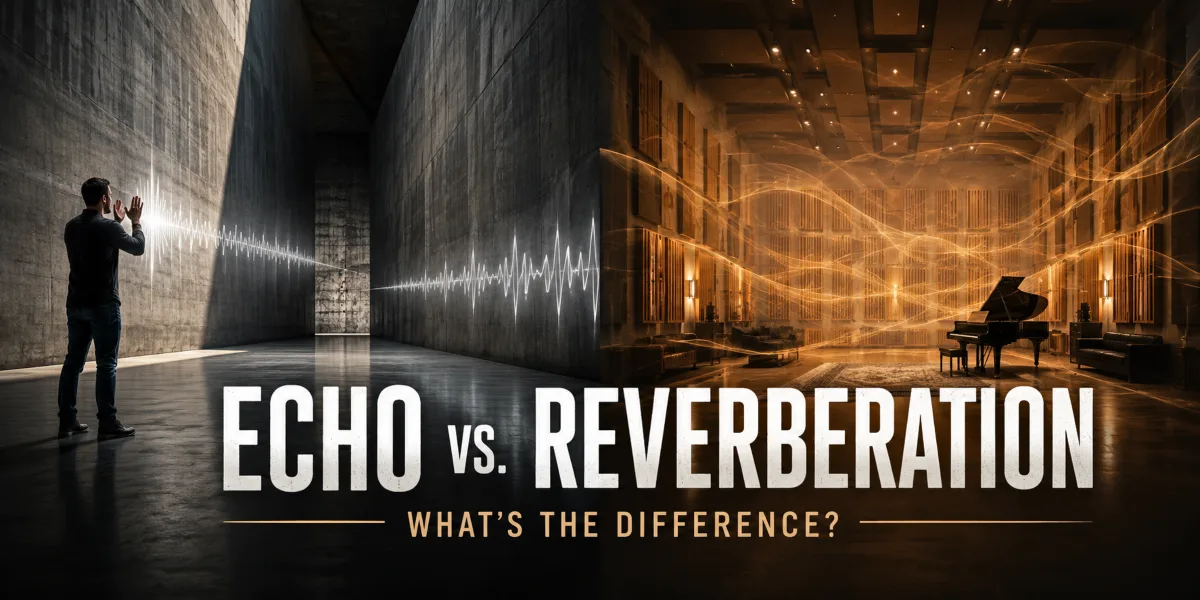
An echo is a single reflection that returns late enough to be heard as a separate sound. The rule of thumb is the 50 ms threshold. Below that delay the brain fuses the reflection with the original. Above it, the repeat is perceived on its own.
The 50 ms threshold
Fifty milliseconds is roughly the time sound takes to travel 56 feet round trip in air. A reflector has to sit at least 28 feet from the source to produce an audible echo. Smaller rooms cannot. They produce reverberation that gets called “echo” in conversation.
- Canyons: classic outdoor echo from one distant surface.
- Parking garages: long sightlines, bare concrete, clean repeats.
- Empty gyms: distant walls and high decks produce true echo.
- Flutter echo: metallic “zing” between two parallel walls.
Flutter echo is the one type of echo you can hear in a normal-sized room. It occurs when two parallel hard walls bounce energy back and forth without enough absorption to break the train. A single hand clap reveals it instantly, and it is one of the most common findings during a room walk-through.
What Is Reverberation?
Reverberation is the dense smear of reflections arriving faster than 50 ms apart. The brain cannot separate them, so they blend into a tail that decays over time. That tail is what makes a tile bathroom sound “live” and a carpeted bedroom sound “dead.”
Acousticians quantify reverberation with RT60: the time, in seconds, for sound pressure to fall 60 decibels after the source stops. A church might run 1.5 to 2.5 seconds. A well-tuned office runs 0.4 to 0.6. A recording booth can sit below 0.2.
RT60: time to decay 60 dB
Reverberation is not bad on its own. The right RT60 for the program is what matters. Too short and the space feels lifeless. Too long and speech smears, music muddies, and noise climbs. The room acoustics calculator estimates RT60 from your dimensions and finishes before any product is specified.
Echo vs. Reverberation: Side-by-Side
| Attribute | Echo | Reverberation |
|---|---|---|
| What you hear | Distinct, repeated sound | Continuous decaying tail |
| Reflection delay | 50 ms or more | Less than 50 ms between reflections |
| Minimum room size | ~28 ft to the reflector | Any room, any size |
| How it is measured | Delay time in milliseconds | RT60 in seconds |
| Typical spaces | Canyons, garages, gyms, atriums | Offices, restaurants, classrooms, lobbies |
| Effect on speech | Word doubling, confusion | Smeared consonants, raised voices |
| Primary fix | Break parallel surfaces, target first reflections | Broadband absorption across 25–40% of surface |
The single most useful row is the delay threshold. Anything under 50 ms collapses into the original sound and becomes part of the reverberation tail. Anything over 50 ms reads as a discrete event. That one number explains why a small conference room can sound terrible without ever producing a true echo.
Why It Matters in Commercial Spaces
In commercial work the practical concern is almost always reverberation, not echo. Long RT60 reduces the Speech Transmission Index, raises voices, and forces staff to work harder to be heard. In open offices and call centers that translates to fatigue, errors, and turnover.
RT60 targets by room type
In classrooms the standard is explicit. ANSI S12.60 caps RT60 at 0.6 seconds in unoccupied core learning spaces under 10,000 cubic feet. Above that, the loss of consonants directly degrades comprehension, particularly for younger students and anyone learning in a second language.
Restaurants and lobbies live or die by sound. A dining room with RT60 over 1.2 seconds forces guests to shout, which raises the ambient level further, which makes everyone shout louder. The Lombard effect is real, measurable, and a reason guests leave a one-star review without quite knowing why.
How to Diagnose Which One You Have
- Clap test: distinct repeat = echo, buzzy ring = flutter, fading tail = reverb.
- Phone app: AudioTools or Room EQ Wizard estimates RT60 within 0.1 s.
- Parallel-wall check: two facing hard surfaces almost guarantee flutter.
- Speech check: if 20-foot conversation feels strained, RT60 is too long.
For a sub-5,000-square-foot room a clap test plus a phone app gets you 90 percent of the way to a diagnosis. Anything larger, occupied, or compliance-driven warrants a measurement pass with calibrated gear. That is where an acoustic consultant earns the fee.
How to Fix Echo
- Break parallel surfaces: add absorption or angled diffusion to at least one of any two facing flat walls.
- Target first-reflection points: place panels on the surfaces opposite primary talkers or speakers.
- Treat distant reflectors: in atriums, gyms, and warehouses, focus on the far wall generating the late repeat.
True echo is a geometry problem. You do not need full-room treatment to fix it. You need enough absorption or scattering on the specific surface generating the late reflection to push it below audibility. A targeted strip of acoustic absorption panels on the offending wall is usually enough.
Flutter echo responds especially well to engineered diffusion on one of the two parallel surfaces. A run of EKKO barrel-pyramidal diffusers on a rear wall scatters the reflection across angles, kills the buzz, and keeps the room from sounding overly dead.
How to Fix Reverberation
- Plan for coverage: 25–40% of wall and ceiling surface at NRC 0.85 or higher.
- Treat the ceiling first: usually the largest unbroken hard surface in the room.
- Skip foam for speech: it falls off below 250 Hz, so use fiberglass or mineral wool.
- Mix in diffusion: a little scatter keeps the room from going flat and lifeless.
Reverberation is a coverage problem more than a placement problem. The math behind Sabine’s equation says total absorption area drives RT60, so the priority is surface percentage, not panel position. Get the coverage right first, then tune location on a second pass.
In rooms with high or exposed ceilings the fastest win is overhead. A grid of ceiling clouds at 12 to 18 inches below the deck cuts vertical reflections hard, frees wall space for finishes, and almost always drops RT60 more per dollar than wall panels alone.
For a deeper walk-through of placement and panel math, see our guide on how to reduce echo in a room. The same methods that cut audible “echo” in a typical commercial space are what bring RT60 into program range.
By Space Type
- Restaurants: reverb problem. RT60 0.5–0.8 s with ceiling clouds.
- Open offices: reverb plus privacy. Pair panels with sound masking.
- Gyms: both. Baffles on the deck, panels behind bleachers.
- Worship: long RT60 for music ruins amplified speech. Treat the rear.
- Multi-family lobbies: flutter plus reverb. Treat ceiling and one long wall.
- Atriums and garages: true echo. Treat the far reflector only.
The space type sets the program. Program sets the RT60 target. Target drives the coverage. That order matters more than any single product choice, and it is the reason a generic “add foam” answer almost never solves a commercial complaint.
Common Mistakes
- Wrong label: calling reverb “echo” leads to the wrong fix and wasted budget.
- Treatment vs. transmission: panels do not stop noisy neighbors, that needs mass and sealing.
- Foam-only solutions: foam chokes below 250 Hz and misses most of the speech band.
- Ignoring the ceiling: half the reflection energy lives overhead.
- Over-deadening: strip too much energy and the room feels lifeless and clinical.
The biggest single trap is treating a reverberation problem as if it were an echo problem, or vice versa. The clap test, the 50 ms threshold, and an honest RT60 reading sort that out in under ten minutes and stop tens of thousands of dollars of misspent treatment.
Need Help Sizing a Fix?
Echo and reverberation look similar from the listener’s seat and behave very differently in the math. A short measurement pass and a floor plan are usually enough to settle which one you have and how much treatment the room actually needs.
If you want a second opinion on a room that is not landing, the team at Commercial Acoustics can size the fix from your drawings, finishes, and ceiling height before you order a single panel. Send a floor plan and a few photos and we will come back with a treatment plan and a budget range.
FAQs: Echo vs. Reverberation
What is the main difference between echo and reverberation?
An echo is a single delayed repeat you hear as a separate sound, 50 ms or more after the original. Reverberation is the continuous decay of many overlapping reflections that arrive too fast to separate.
Why do small rooms sound “echoey” if they cannot produce a true echo?
They are reverberant, not echoey. A room under 28 feet across cannot create the 50 ms delay needed for a true echo. The bouncy tail people hear is reverberation, and the fix is broadband absorption.
How is reverberation measured?
With RT60, the time in seconds for sound pressure to fall 60 decibels after the source stops. Phone apps estimate it within 0.1 seconds, which is accurate enough for most commercial sizing decisions.
Does fixing echo also fix noise from the next room?
No. Echo and reverberation are inside-the-room problems. Noise from next door is sound transmission, which needs mass, decoupling, and sealed assemblies. Acoustic panels do not stop transmitted noise.
What RT60 should a commercial room target?
Offices and classrooms 0.4 to 0.6 seconds. Restaurants 0.5 to 0.8. Worship and lecture halls 0.8 to 1.2. Studios under 0.4. ANSI S12.60 caps classrooms at 0.6 seconds.
Is acoustic foam enough to fix echo or reverb in a commercial space?
Rarely. Foam loses absorption below about 250 Hz, which covers most of the speech band. Fiberglass or mineral wool panels at NRC 0.85 or higher are the standard for commercial work.

Walker Peek|Founder & CEO, Commercial Acoustics
Walker founded Commercial Acoustics in 2013 to bring aerospace-grade engineering discipline to soundproofing, and runs the firm as CEO from its 12,000 sq ft Tampa production facility. The company designs custom acoustic panels, sound membranes, and masking systems for multi-family, hospitality, healthcare, and commercial projects across the US — built around Walker’s invention, Wall Blokker, an EVA-based sound barrier that hits STC 50-plus at roughly $1 per square foot installed.
A Jacksonville native, Walker spent five years at Kennedy Space Center with Craig Technologies before founding Commercial Acoustics — certifying aerospace manufacturing to the AS9100 standard and leading Six Sigma Black Belt process-improvement teams on NASA programs. He is a certified Industrial Noise Control Engineer and the author of Architectural Acoustics: A Practical Handbook.
