
STC Ratings for Walls: A Guide to Common Wall Assemblies
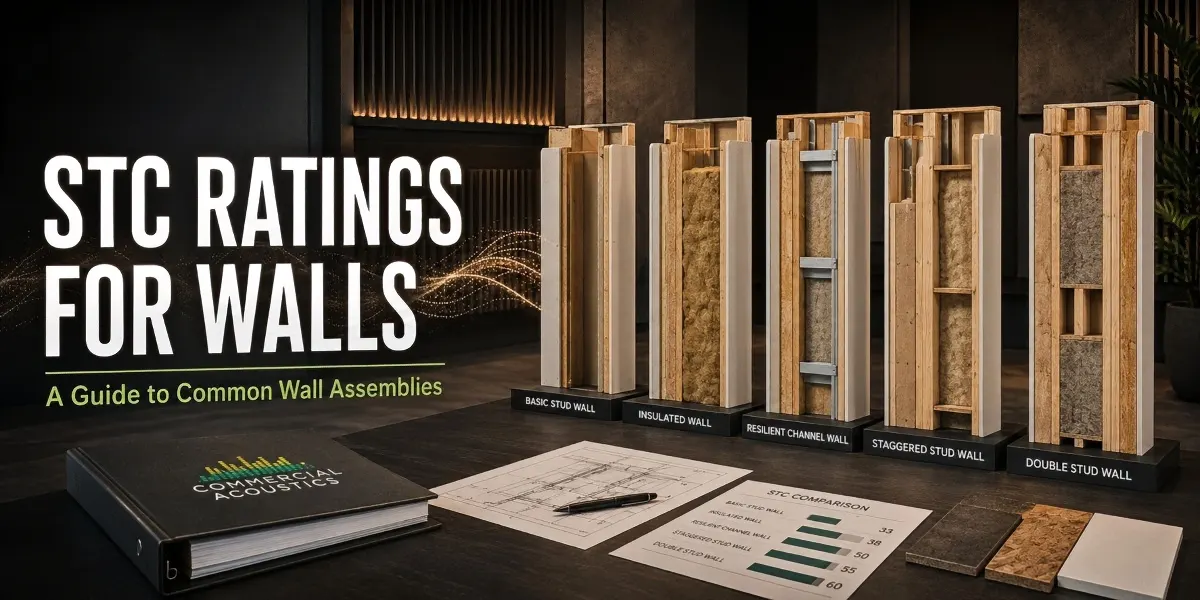
Table of Contents
What Determines a Wall’s STC Rating?
A wall’s STC rating is determined by four variables, in roughly this order of impact:
- Mass. Heavier walls block more sound. Each doubling of mass adds roughly 6 STC points. This is why two layers of drywall outperform one.
- Decoupling. Breaking the rigid path between surfaces is the single biggest lever. A resilient channel or staggered stud wall eliminates the direct structural bridge that carries vibration from one side to the other.
- Absorption. Batt insulation in the cavity absorbs sound energy before it reaches the second face. An uninsulated cavity can cost 5–8 STC points.
- Airtightness. Any gap — electrical box, pipe penetration, unsealed perimeter — can drop a lab-tested STC 50 wall to STC 35 in the field. Sound is a gas; it finds openings.
The tables below give typical lab-tested STC ranges for common assembly configurations. For the full ASTM E90 lab test reports organized by stud type, see the STC-rated wall assemblies resource page. To find the target STC you need, see the recommended STC ratings guide.
Wood Stud Wall STC Ratings
Wood stud walls are the most common construction type in multifamily residential. A basic single-stud wood wall without insulation sits around STC 33 — clearly inadequate for any occupied adjacency. The path to STC 50 requires either decoupling the stud structure or doubling it entirely.
| Type | Assembly Description | STC | Performance |
|---|---|---|---|
| Base | 2×4 wood stud, single layer 5/8″ drywall each side, no insulation | 33 | |
| + Insul | 2×4 wood stud, single layer 5/8″ drywall each side, batt insulation | 36–39 | |
| 2x DW | 2×4 wood stud, double layer 5/8″ drywall one side, batt insulation | 41–44 | |
| RC | 2×4 wood stud, resilient channel one side, double layer drywall, batt insulation | 48–52 | |
| RC x2 | 2×4 wood stud, resilient channel both sides, double layer drywall, batt insulation | 52–56 | |
| Staggered | Staggered 2×4 stud on 2×6 plate, double layer drywall, batt insulation | 52–57 | |
| Double Stud | Double 2×4 stud wall (1″ air gap), double layer drywall, batt insulation | 58–63 |
Typical lab-tested STC ranges for wood stud assemblies. Actual field performance (ASTC) runs 3–5 points lower.
Metal Stud Wall STC Ratings
Metal stud walls are the standard in commercial construction — predictable performance, fire resistance, and easier to decouple than wood. The STC 43–44 baseline you see widely cited is a single-layer 25-gauge metal stud wall with batt insulation: the standard commercial partition. A 25-gauge stud is slightly more flexible than 20-gauge, giving a small inherent acoustic advantage on direct-attach assemblies.
| Type | Assembly Description | STC | Performance |
|---|---|---|---|
| Base | 3-5/8″ 25-ga metal stud, single layer 5/8″ drywall each side, no insulation | 38–40 | |
| + Insul | 3-5/8″ 25-ga metal stud, single layer 5/8″ drywall each side, batt insulation | 43–44 | |
| 2x DW | 3-5/8″ 25-ga metal stud, double layer 5/8″ drywall each side, batt insulation | 46–49 | |
| 20-ga | 3-5/8″ 20-ga metal stud, single layer 5/8″ drywall each side, batt insulation | 42–44 | |
| 2x DW | 3-5/8″ 20-ga metal stud, double layer 5/8″ drywall each side, batt insulation | 49–52 | |
| RC | 3-5/8″ metal stud, resilient channel one side, double layer drywall, batt insulation | 51–55 | |
| Iso-Clip | Iso-clip / resilient mount on metal stud, double layer drywall each side, batt insulation | 56–60 |
Typical lab-tested STC ranges for metal stud assemblies. 25-gauge and 20-gauge refer to stud thickness; heavier gauge = stiffer = slightly lower STC without decoupling.
CMU & Concrete Wall STC Ratings
Masonry and concrete walls rely on mass for acoustic performance. Unlike stud walls, decoupling is less practical — the mass is the primary mechanism. Adding mass to a concrete wall is expensive, but a bare 8″ concrete wall already exceeds STC 50 without any added treatment.
| Type | Assembly Description | STC | Performance |
|---|---|---|---|
| 4″ CMU | 4″ CMU block, unpainted, hollow | 40–43 | |
| 8″ CMU | 8″ CMU block, unpainted, hollow | 48–52 | |
| Grouted | 8″ CMU block, painted or grouted, solid | 51–54 | |
| + Furring | 8″ CMU + 1 layer 5/8″ drywall on furring, batt insulation in cavity | 56–60 | |
| 6″ Conc | 6″ poured concrete, bare | 55–58 | |
| 8″ Conc | 8″ poured concrete, bare | 57–60 | |
| + Stud | 8″ concrete + stud wall on resilient clips + drywall, batt insulation | 65–70 |
Typical lab-tested STC ranges for CMU and poured concrete assemblies. Hollow CMU performs worse than solid or grouted because cavities can resonate.
Exterior Wall STC Ratings
Exterior walls block outdoor noise — traffic, aircraft, mechanical equipment — rather than adjacent-occupancy speech. For low-frequency outdoor sources, OITC is the more accurate rating, but STC is still widely used in exterior wall specs.
| Type | Assembly Description | STC | Performance |
|---|---|---|---|
| Wood | Wood stud, OSB sheathing, vinyl siding, batt insulation, single layer drywall inside | 42–46 | |
| Brick | Metal stud, exterior sheathing, brick veneer, batt insulation, single layer drywall inside | 50–54 | |
| EIFS | Metal stud, EIFS cladding, batt insulation, single layer drywall inside | 48–52 | |
| 2x DW | Metal stud, EIFS + double layer drywall inside, batt insulation | 52–56 | |
| CMU | 8″ CMU exterior, furring + batt insulation + double layer drywall inside | 60–65 | |
| ICF | ICF (Insulated Concrete Form), single layer drywall inside | 55–60 |
Typical STC ranges for exterior wall assemblies. For low-frequency outdoor noise (traffic, aircraft), specify OITC alongside STC.
Staggered, Double & Decoupled Wall Assemblies
Once you need to exceed STC 50, the design shifts from “add mass” to “break the structural bridge.” The three primary strategies:
- Resilient channel (RC-1): A hat-channel screwed to the stud, with drywall screwed only to the channel. If any screw contacts the stud behind it — “short-circuiting” — decoupling is lost. The most common workmanship failure on high-STC walls.
- Staggered stud: 2×4 studs alternating on a 2×6 plate so no stud touches both sides. Eliminates the short-circuit risk. Slightly wider assembly.
- Double stud / room-within-a-room: Two independent stud walls with an air gap between them. Maximum decoupling. Required for STC 60+ targets and recording studios.
| Type | Assembly Description | STC | Performance |
|---|---|---|---|
| RC | Resilient channel on wood stud, double layer drywall each side, batt insulation | 50–54 | |
| Iso-Clip | Iso-clip / resilient mount on metal stud, double layer drywall each side, batt insulation | 56–60 | |
| Staggered | Staggered 2×4 stud (2×6 plate), double layer drywall each side, batt insulation | 52–57 | |
| Double Stud | Double 2×4 stud wall, 1″ air gap, double layer drywall, batt insulation | 58–63 | |
| Min Wool | Double 2×4 stud wall, 2″ air gap, double layer drywall, mineral wool insulation | 63–67 |
Decoupled wall assemblies. Resilient channel performance depends entirely on workmanship — a short-circuited RC wall can perform worse than a direct-attach assembly.
The STC 50 Wall Assembly
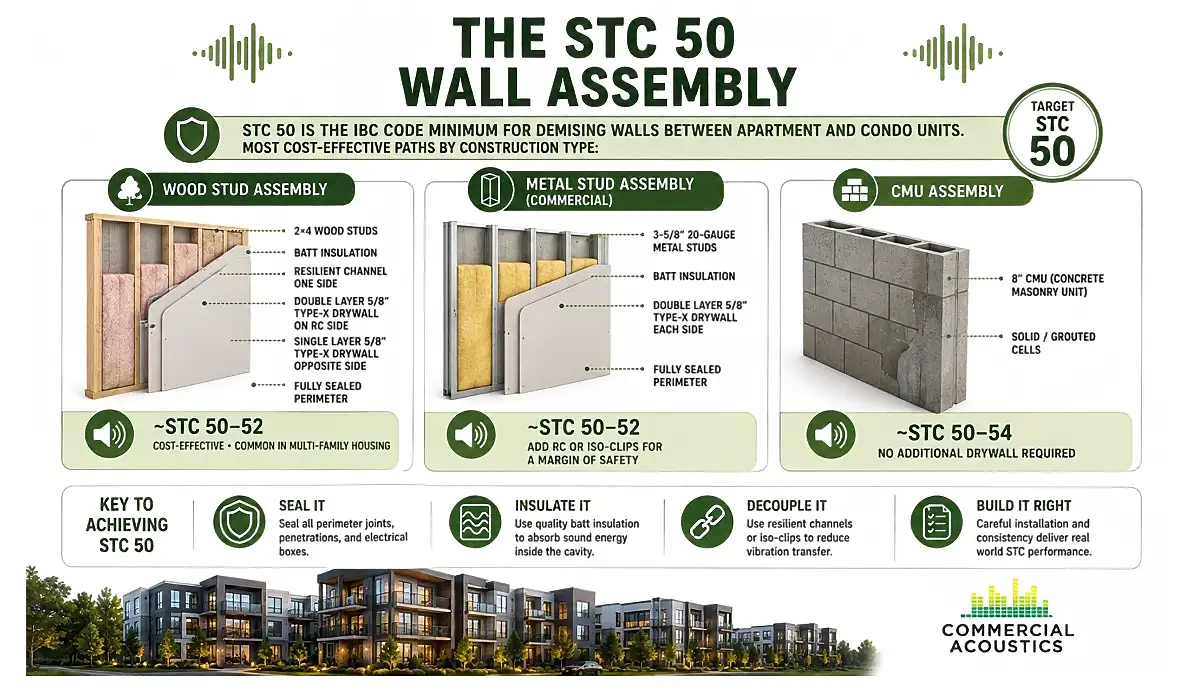
STC 50 is the IBC code minimum for demising walls between apartment and condo units. Most cost-effective paths by construction type:
- Wood stud: 2×4 stud, resilient channel one side, double layer 5/8″ type-X drywall on the RC side, single layer opposite, batt insulation, fully sealed perimeter. ~STC 50–52.
- Metal stud (commercial): 3-5/8″ 20-gauge stud, double layer 5/8″ drywall each side, batt insulation. ~STC 50–52. Add RC or iso-clips for a margin of safety.
- CMU: 8″ CMU, solid/grouted. ~STC 50–54 without any additional drywall.
For a deeper walkthrough including cost comparisons and failure modes, see the guide on how to achieve an STC 50 rating.
Field STC vs Lab STC: Why Real Walls Underperform
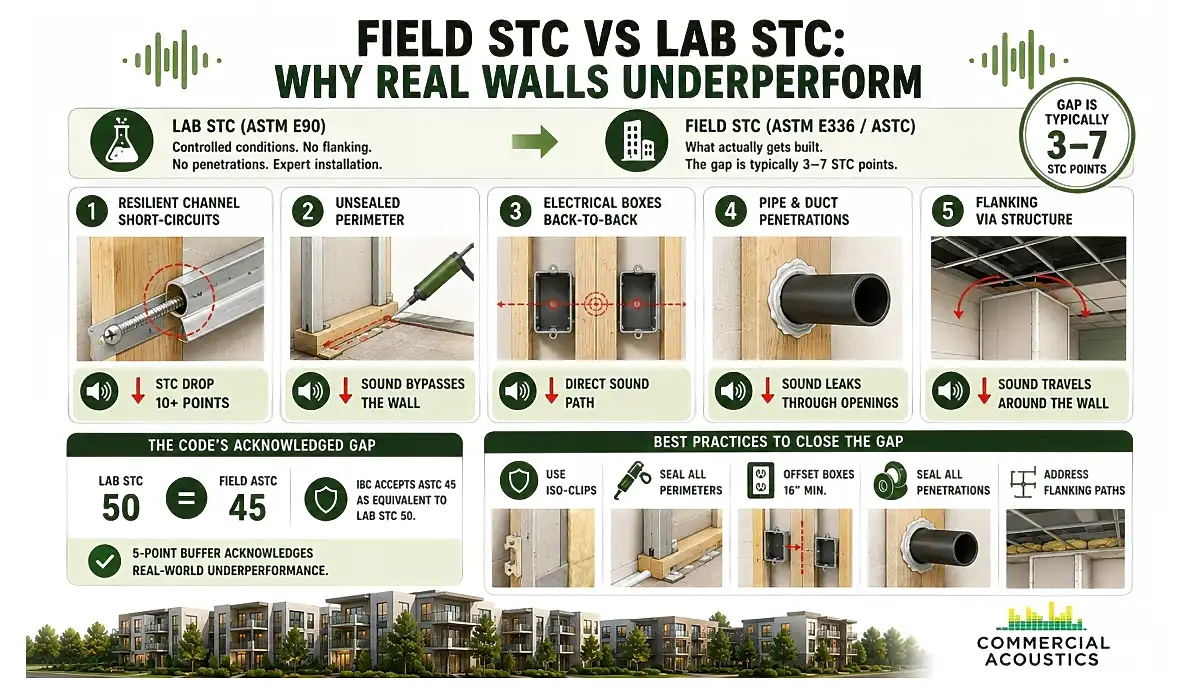
Lab STC values (ASTM E90) are measured under controlled conditions with no flanking paths, no penetrations, and expert installation. Field STC values (ASTM E336, reported as ASTC) reflect what actually gets built. The gap is typically 3–7 STC points — enough to fail code on a wall you thought would pass.
- Resilient channel short-circuits. One screw through the RC to the stud behind it can drop STC by 10+ points. Iso-clips are more forgiving and the preferred spec for STC-critical walls.
- Unsealed perimeter. Gaps at the floor and ceiling plate allow sound to bypass the wall entirely. All perimeters must be fully caulked before finish work.
- Electrical boxes back-to-back. A standard outlet box through both faces creates a direct sound path. Offset boxes 16″ minimum in adjacent stud bays.
- Pipe and duct penetrations. Any opening through the assembly must be sealed with acoustic sealant — not standard fire caulk.
- Flanking via structure. Sound travels through the slab and ceiling plenum. A wall terminating at a dropped ceiling with an open plenum above is acoustically a wall that ends mid-room.
The IBC acknowledges this gap: it accepts a field-tested ASTC of 45 as equivalent to a lab-rated STC 50. That 5-point buffer is the code’s built-in acknowledgment that real construction underperforms the lab.
How to Pick the Right Assembly
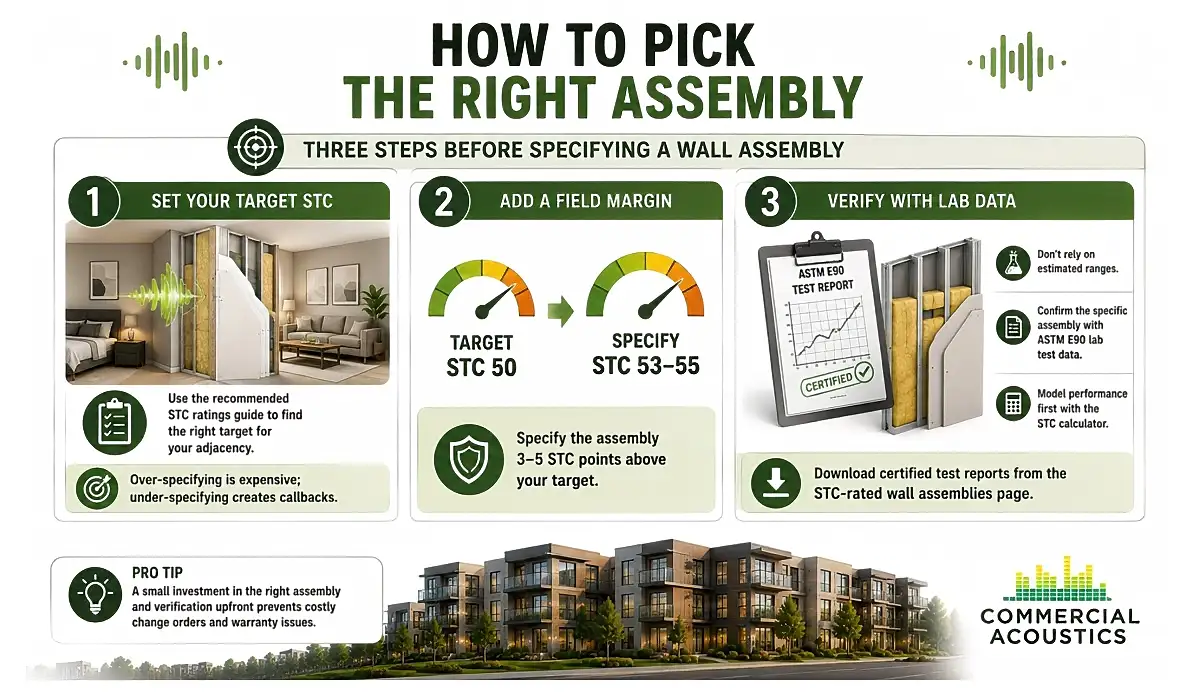
Three steps before specifying a wall assembly:
- Set your target STC. Use the recommended STC ratings guide to find the right target for your adjacency. Over-specifying is expensive; under-specifying creates callbacks.
- Add a field margin. Specify the assembly 3–5 STC points above your target. If your target is STC 50, spec an STC 53–55 assembly.
- Verify with lab data. Don’t rely on estimated ranges. Before issuing specs, confirm the specific assembly against ASTM E90 lab test data. Download certified test reports from the STC-rated wall assemblies page. To model performance first, use the STC calculator.
Next Steps
The STC ranges in this guide are a starting point, not a spec. Before finalizing a wall assembly, pull the actual ASTM E90 lab test report for the specific configuration you plan to build — stud size, drywall thickness, insulation type, and mounting method all affect the number. Certified test reports organized by assembly type are available on the STC-rated wall assemblies page.
If you haven’t set a target STC yet, do that first. The right assembly depends entirely on what’s on the other side of the wall. Use the recommended STC ratings guide to find the right target for your adjacency, then come back here to match it to an assembly.
FAQs: STC Ratings for Walls
What is a good STC rating for a wall?
STC 50 is the IBC code minimum for multifamily demising walls and the most common commercial target. STC 44 is a standard commercial partition (single-layer metal stud with insulation). STC 55–60 is good for luxury residential, hotels, and sensitive adjacencies like conference rooms next to offices.
What STC rating does a standard wall have?
A basic 2×4 wood stud wall with one layer of drywall each side and no insulation is approximately STC 33. Add batt insulation and it reaches STC 36–39. A standard commercial metal stud wall (25-gauge, single layer drywall, batt insulation) is approximately STC 43–44.
What is the STC rating of drywall?
Drywall alone has no STC rating — STC applies to an assembly, not a single material. Each additional layer of 5/8″ drywall adds approximately 3–5 STC points to a standard stud wall, depending on whether decoupling is present.
What is the STC rating of a metal stud wall?
A 3-5/8″ 25-gauge metal stud wall with single-layer 5/8″ drywall and batt insulation is approximately STC 43–44. Double drywall raises this to STC 46–49. Adding resilient channel or iso-clips with double drywall reaches STC 51–60 depending on the assembly.
How do I get STC 50 in a wood stud wall?
The most reliable path: 2×4 stud, resilient channel on one side (no short-circuits), double layer 5/8″ type-X drywall on the RC side, batt insulation, fully caulked perimeter. This assembly typically tests at STC 50–52 in a lab. Spec it at STC 53–55 to account for field variance.
What is the difference between STC and ASTC?
STC (ASTM E90) is a lab test under controlled conditions. ASTC (Apparent STC, ASTM E336) is a field test that includes flanking transmission. ASTC is typically 3–7 points lower than lab STC. The IBC accepts ASTC 45 as equivalent to lab STC 50 for multifamily compliance.