Recommended STC Ratings by Room & Building Type
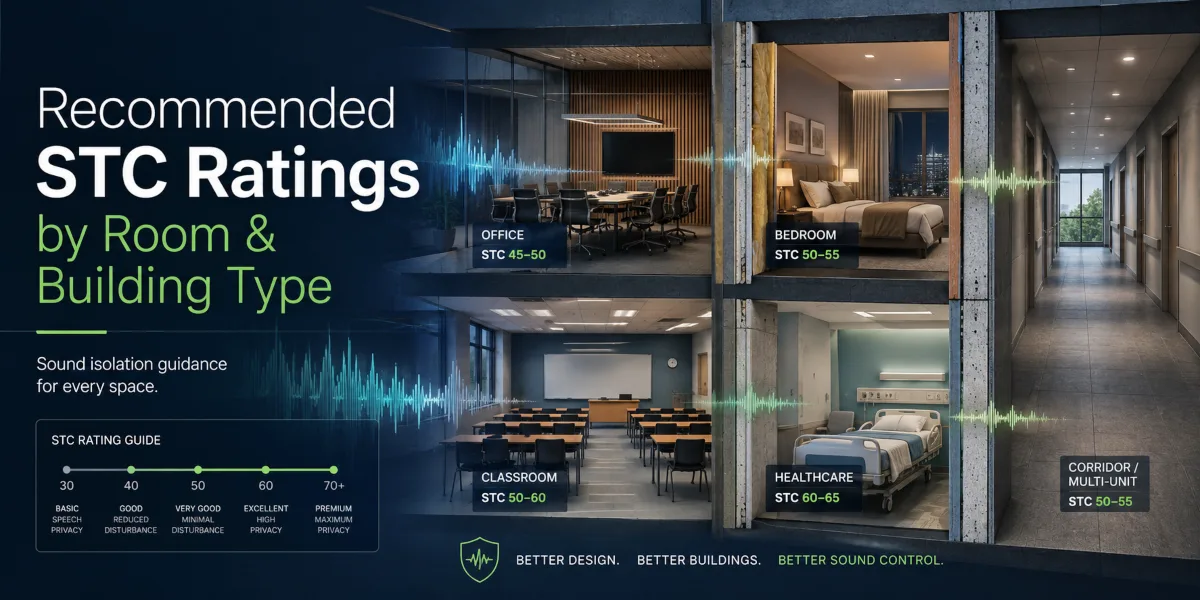
Table of Contents
What Are Recommended STC Ratings?
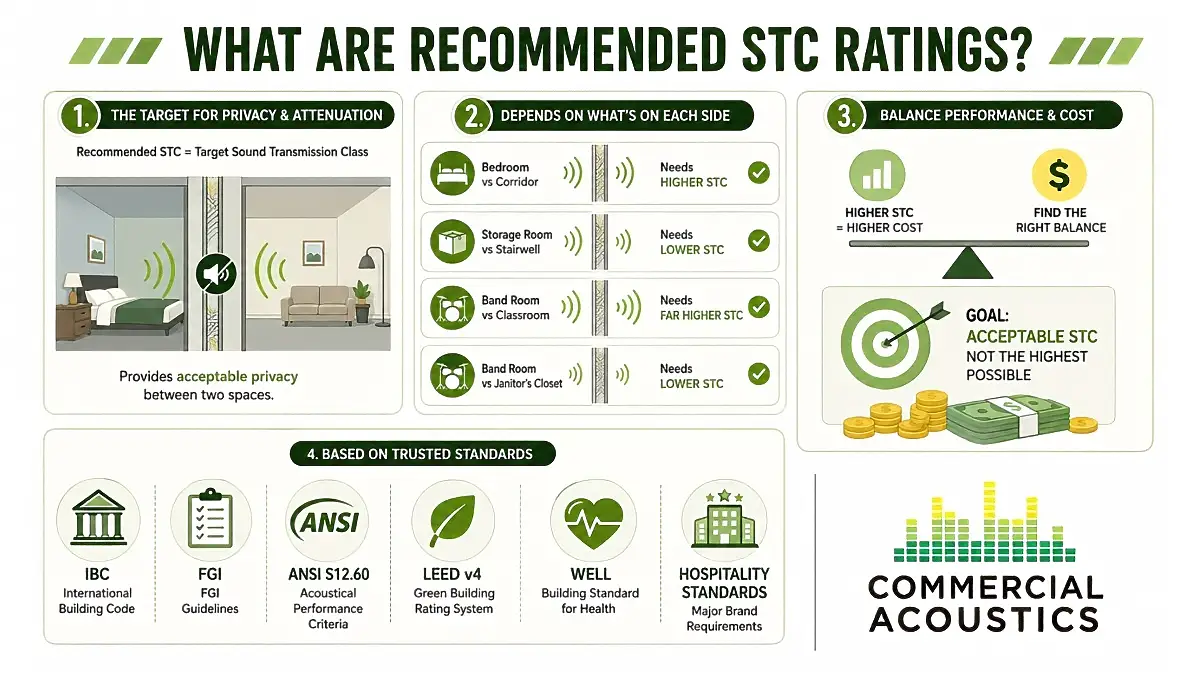
The recommended STC rating for a wall is the target Sound Transmission Class value that provides acceptable privacy and sound attenuation between two specific spaces. The right number depends entirely on what’s on each side of the partition — a bedroom next to a corridor needs more isolation than a storage room next to a stairwell, and a band room next to a classroom needs far more than a band room next to a janitor’s closet.
Determining a target STC is one of the first acoustical analyses an architect or consultant should perform when designing a new structure. Because construction cost rises with the STC level, the goal is to find an acceptable STC — not the highest possible one. This guide gives you the recommended values used by the International Building Code (IBC), FGI Guidelines, ANSI S12.60, LEED v4, WELL, and major hospitality brand standards, organized by room type and adjacency.
Recommended STC Ratings Chart by Adjacency
Find your occupancy on the left, the adjacent space in the middle, and the recommended target STC on the right.
| Occupancy | Adjacent Space | Target STC | Driver |
|---|---|---|---|
| Hotel Room | Hotel Room | 55 | Brand standard for upscale hotels |
| Corridor | 50 | Brand standard; not code-required | |
| Apartment / Condo | Apartment / Condo | 50 | IBC code minimum for demising walls |
| Corridor | 50 | IBC code minimum for corridor walls | |
| Apartment or Hotel | Retail | 60 | Mixed-use buffer; retail can be loud |
| Retail | Retail | 50 | Standard tenant-to-tenant separation |
| Standard Office | Standard Office | 45 | Speech privacy at normal voice |
| Executive Office | Executive Office | 50 | Confidential speech; HR & legal |
| Conference Room | Conference Room | 50 | Meeting & interview privacy |
| Admin, Admissions | 45 | Casual privacy; non-confidential meetings | |
| Office / Conference | Corridor | 50 | Speech privacy from corridor leakage |
| Mechanical Room | Occupied Area | 60 | Blocks HVAC & pump noise |
| Movie Theater | Movie Theater | 65 | Cinema audio at reference level |
| Hospital Room | Hospital Room | 45 | FGI baseline for patient privacy |
| Classroom | Classroom or Corridor | 50 | ANSI S12.60 classroom standard |
| Restroom | 53 | ANSI S12.60; plumbing & restroom noise | |
| Electrical or Mechanical Room | 60 | Blocks HVAC & equipment noise | |
| Music / Drama Room | Dining or Corridor | 60 | Music & instrument isolation |
| Restroom | 53 | Music isolation; plumbing noise | |
| Entry | Teachers Support or Waiting Rooms | 45 | Speech privacy at entry |
Recommended STC ratings by occupancy and adjacency. Hover any row to highlight. Sources: IBC, FGI, ANSI S12.60, LEED v4, WELL.
What Each STC Rating Means in Practice
Picking a target number is easier when you know what people on the other side of the wall will actually hear. Here's how each STC level translates to real-world sound isolation:
Effectiveness of sound isolation by STC rating. The bar shows how much sound passes through the wall — shorter is better.
Hotel STC Ratings & Brand Standards
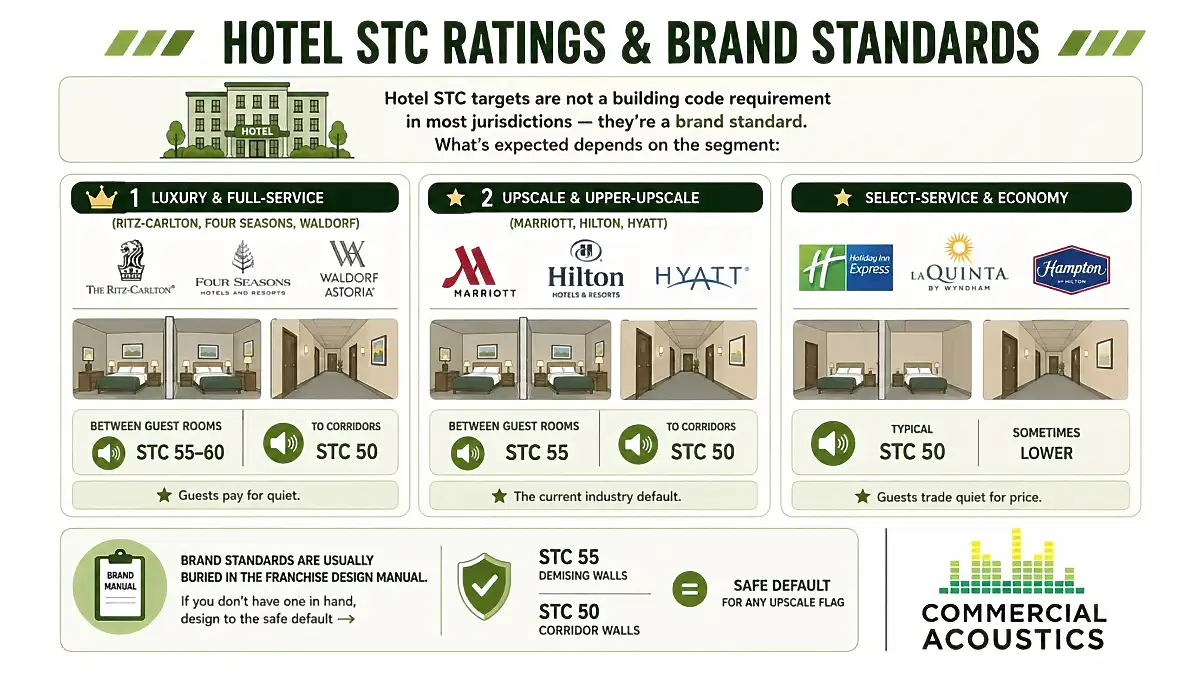
Hotel STC targets are not a building code requirement in most jurisdictions — they're a brand standard. What's expected depends on the segment:
- Luxury & full-service (Ritz-Carlton, Four Seasons, Waldorf): STC 55–60 between guest rooms, STC 50 to corridors. Guests pay for quiet.
- Upscale & upper-upscale (Marriott, Hilton, Hyatt): STC 55 between guest rooms, STC 50 to corridors. The current industry default.
- Select-service & economy: STC 50 is typical, sometimes lower. Guests trade quiet for price.
Brand standards are usually buried in the franchise design manual. If you don't have one in hand, design to STC 55 demising / STC 50 corridor as a safe default for any upscale flag.
Apartment & Condo STC Code Requirements
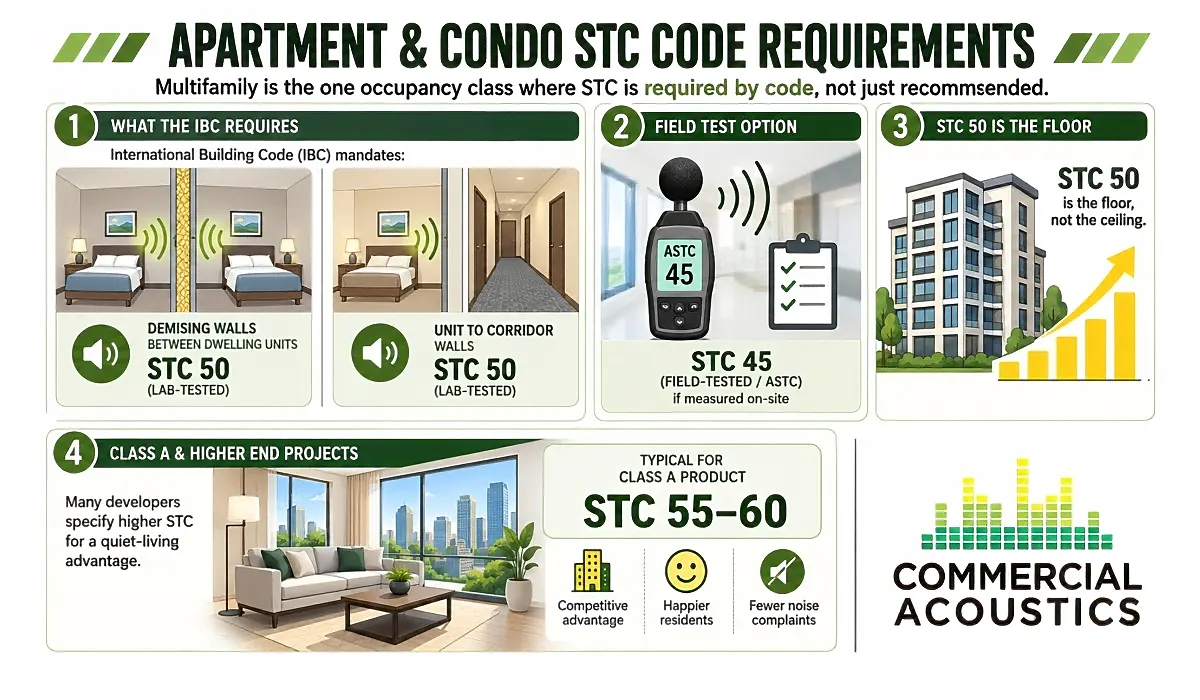
Multifamily is the one occupancy class where STC is required by code, not just recommended. The International Building Code (IBC) mandates:
- STC 50 (lab-tested) for demising walls between dwelling units
- STC 50 (lab-tested) for walls between a unit and a public corridor
- STC 45 (field-tested / ASTC) if measured on-site instead of in a lab
STC 50 is the floor, not the ceiling. Many developers building Class A product specify STC 55–60 for a competitive quiet-living advantage, especially in urban infill projects where unit-to-unit noise is the #1 resident complaint. For a deep dive on hitting the code minimum cost-effectively, see how to achieve an STC 50 rating.
Office & Conference Room STC Targets
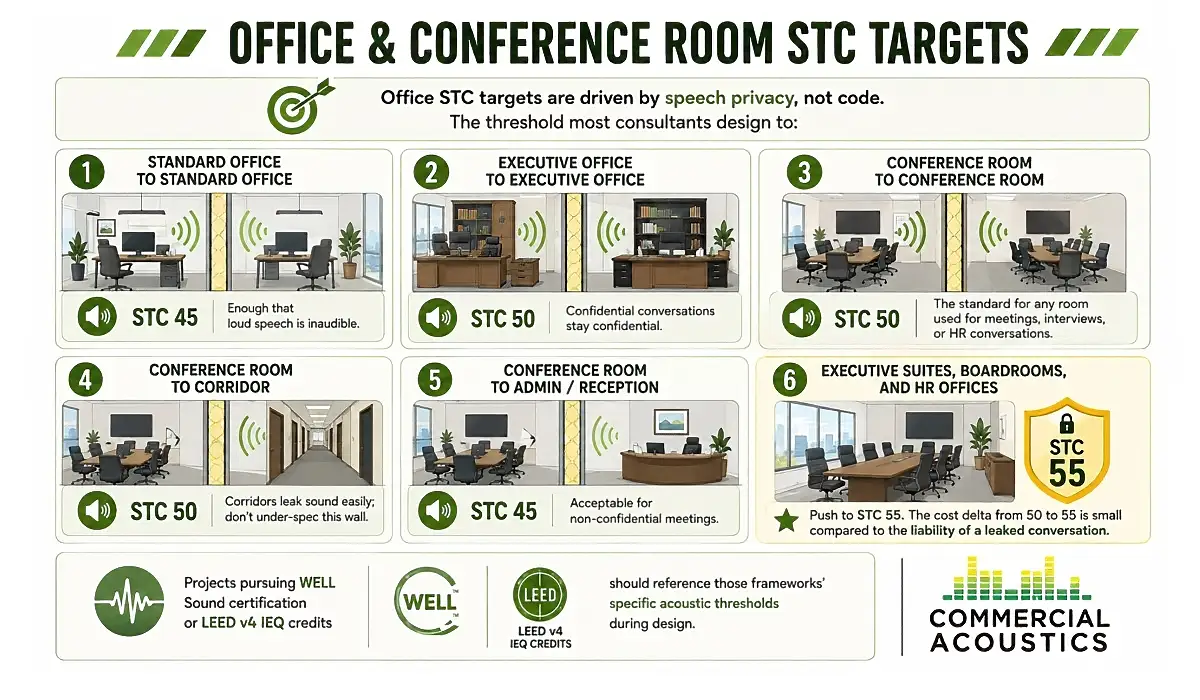
Office STC targets are driven by speech privacy, not code. The threshold most consultants design to:
- Standard office to standard office: STC 45 — enough that loud speech is inaudible.
- Executive office to executive office: STC 50 — confidential conversations stay confidential.
- Conference room to conference room: STC 50 — the standard for any room used for meetings, interviews, or HR conversations.
- Conference room to corridor: STC 50 — corridors leak sound easily; don't under-spec this wall.
- Conference room to admin / reception: STC 45 — acceptable for non-confidential meetings.
For executive suites, boardrooms, and HR offices where confidentiality matters, push to STC 55. The cost delta from 50 to 55 is small compared to the liability of a leaked conversation. Projects pursuing WELL Sound certification or LEED v4 IEQ credits should reference those frameworks' specific acoustic thresholds during design.
School & Classroom STC Ratings (ANSI S12.60)
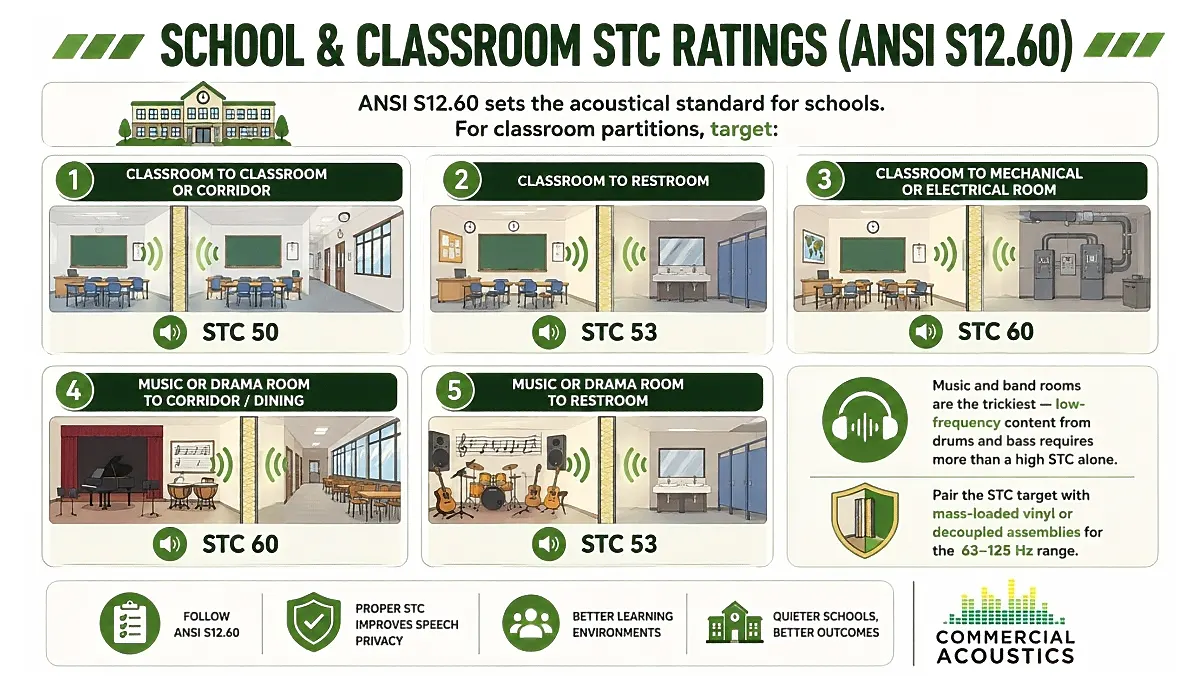
ANSI S12.60 sets the acoustical standard for schools. For classroom partitions, target:
- Classroom to classroom or corridor: STC 50
- Classroom to restroom: STC 53
- Classroom to mechanical or electrical room: STC 60
- Music or drama room to corridor / dining: STC 60
- Music or drama room to restroom: STC 53
Music and band rooms are the trickiest — low-frequency content from drums and bass requires more than a high STC alone. Pair the STC target with mass-loaded vinyl or decoupled assemblies for the 63–125 Hz range.
Healthcare STC Ratings (FGI Guidelines)
The Facility Guidelines Institute (FGI) Guidelines for the Design and Construction of Hospitals govern healthcare acoustics. Common targets:
- Patient room to patient room: STC 45 minimum (FGI baseline); STC 50 recommended for HIPAA-sensitive areas.
- Patient room to corridor: STC 35–40 (lower because of door requirements and access needs).
- Exam room to exam room: STC 45 minimum.
- Consultation room to public space: STC 50 for full speech privacy.
How to Choose the Right Target STC
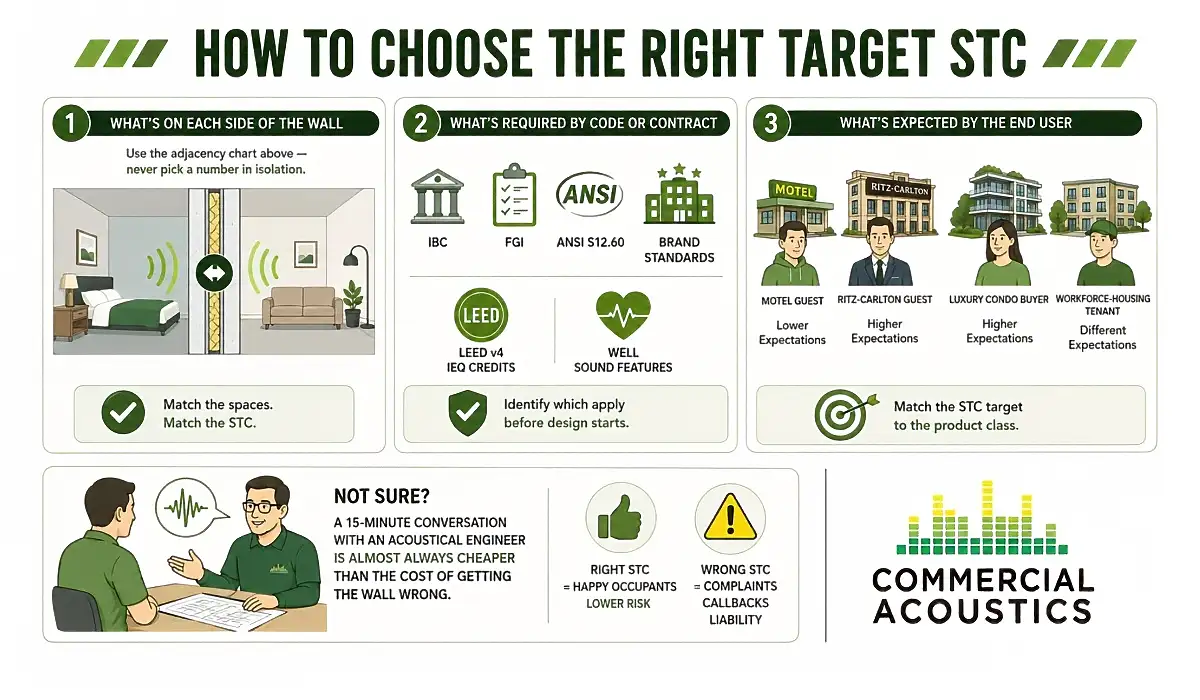
Over-specifying STC is expensive. Under-specifying creates complaints, callbacks, and liability. The right target balances three factors:
- What's on each side of the wall. Use the adjacency chart above — never pick a number in isolation.
- What's required by code or contract. IBC, FGI, ANSI S12.60, brand standards, LEED v4 IEQ credits, and WELL Sound features all carry hard or soft STC requirements. Identify which apply before design starts.
- What's expected by the end user. A motel guest and a Ritz-Carlton guest have different expectations. A luxury condo buyer and a workforce-housing tenant do too. Match the STC target to the product class.
If you're unsure where to land, a 15-minute conversation with an acoustical engineer is almost always cheaper than the cost of getting the wall wrong. Commercial Acoustics offers free project reviews on STC targets and wall assembly selection.
STC 65 and Above: The Low-Frequency Problem
At STC 65 and above, careful attention should be paid to the 63 Hz and 80 Hz frequency bands — the thuds, bangs, bass, and drums. These two bands are not included in the STC calculation. Low-frequency sound is much harder to block, and in practice, sounds below 100 Hz are usually all that leaks into adjacent auditoriums and studios with STC 65+ partitions. For these projects, STC alone isn't enough — you need a full transmission loss spectrum, often paired with decoupled or mass-loaded assemblies.
Next Steps: Hitting Your Target STC
Once you've identified your target STC, the next question is which wall assembly hits that number cost-effectively. Browse our library of STC-rated wall assemblies or request a free project review and we'll recommend an assembly matched to your target.
FAQs: Recommended STC Ratings
What is a good STC rating?
A "good" STC rating depends on the wall's purpose. STC 50 is the building-code minimum for apartment and condo demising walls and is the most common target across commercial construction. STC 55–60 is considered good for luxury hotels and Class A multifamily. STC 65+ is reserved for studios, auditoriums, and theaters.
What is the recommended STC rating for an apartment wall?
The International Building Code requires STC 50 for both demising walls between units and walls between a unit and a public corridor. STC 55–60 is recommended for luxury or competitive Class A product.
What is the recommended STC rating for a conference room?
STC 50 is the standard recommendation for conference room walls — enough to keep normal conversation private from adjacent rooms or corridors. For executive boardrooms or HR offices where confidentiality is critical, push to STC 55.
What is the recommended STC rating for a hotel?
Hotel STC targets are set by brand standard, not code. The industry default is STC 55 between guest rooms and STC 50 to corridors. Luxury brands push higher (STC 55–60); economy properties may settle at STC 50.
Is STC 50 enough?
STC 50 is enough to meet IBC code for multifamily and is sufficient to make loud TV audible but unintelligible through the wall. It's not enough to block loud music, bass, or impact noise. If your project includes bars, music venues, or home theaters, design above STC 55.
What's the difference between STC and OITC?
STC measures interior partition performance against speech frequencies (125 Hz – 4 kHz). OITC measures exterior wall performance against low-frequency outdoor noise (aircraft, traffic). Use STC for interior walls and OITC for exterior envelopes. See our guide on STC vs OITC.