Table of Contents
What Is RT60?
RT60 (reverberation time) is the number of seconds it takes for sound to decay by 60 dB after the source stops — effectively, how long a room “rings.” A recording studio measures around 0.3 seconds. A cathedral can stretch past 3.0 seconds. Hitting the right RT60 target is the single biggest lever for room intelligibility, musical quality, and occupant comfort, including senior living RT60 targets for dining, activity, and memory care spaces.
RT60 is governed by the Sabine formula: RT60 = 0.161 × V / A, where V is room volume in m³ and A is total absorption in sabins. The larger the room, the more absorption it takes to bring RT60 down — which is why gymnasiums and atriums are notoriously difficult to treat. For the science behind the formula and how it’s measured, see our RT60 Rating 101 guide.
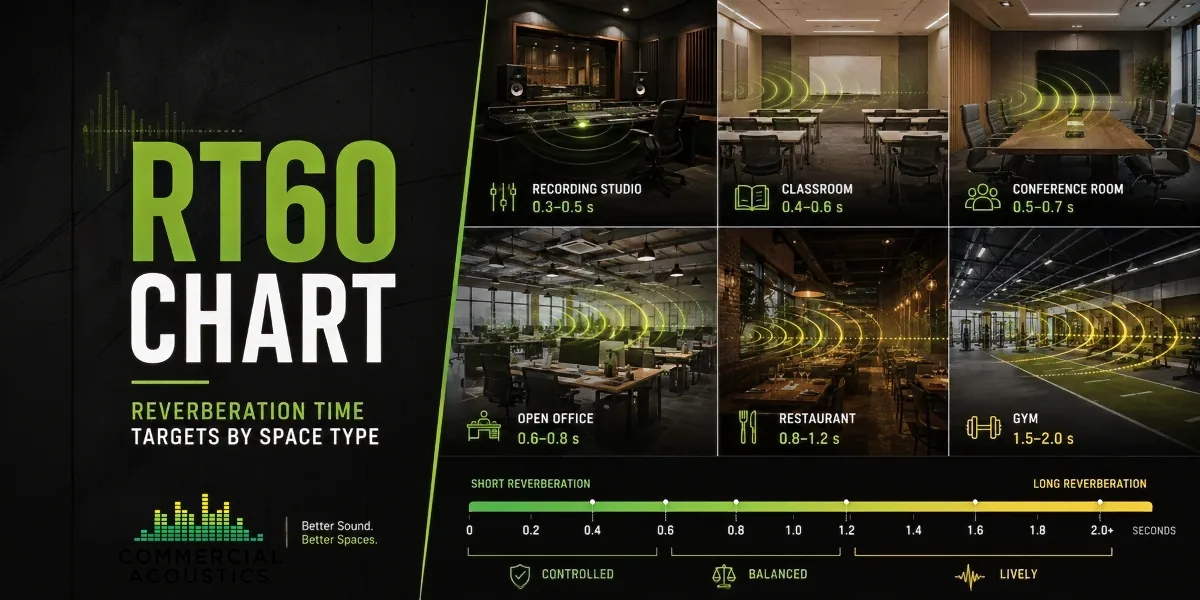
RT60 Target Times by Space Type
How to Hit Your RT60 Target
- Start with the ceiling. The largest unobstructed surface — and the most acoustically active in most rooms. Acoustic ceiling tile or sprayed cellulose at NRC 0.80+ does the heavy lifting.
- Add wall absorption to handle reflections. Fabric-wrapped panels at first-reflection points handle echo and flutter. See material values in our Sound Absorption Coefficient Chart.
- Account for room finishes already in place. Carpet, drapery, soft seating, and people all contribute absorption. Empty rooms read 1.5–2× longer RT60 than occupied rooms.
- Use the Sabine calculation: Total sabins needed = 0.161 × V / target RT60. Divide by average NRC of your panel system to get required m² of treatment.
For larger or more complex rooms (auditoriums, gyms, atriums), modeling tools like CATT-Acoustic or Odeon predict RT60 by frequency band — important because untreated rooms often have very different RT60 values at low vs. high frequencies.
Treatment Strategy by RT60 Band
The amount and type of acoustic treatment depend on the target RT60 band. Use this quick reference when planning materials.
Measurement & Standards
- ISO 3382: The international standard for measuring RT60 (and other room acoustic parameters) using interrupted noise or impulse response methods.
- ASTM E2235: Standard test method for determining decay rates in rooms — used in U.S. building acoustics.
- ANSI/ASA S12.60: Sets RT60 limits for classrooms (≤0.6 s for small rooms, ≤0.7 s for larger learning spaces).
- Field measurement: Octave-band RT60 is typically reported at 125 Hz, 250 Hz, 500 Hz, 1 kHz, 2 kHz, and 4 kHz — low-frequency RT60 almost always lags high-frequency RT60 in untreated rooms.
Modern measurement uses a balloon pop or starter pistol as the impulse source and a calibrated omnidirectional microphone. Software (e.g., REW, Smaart, EASERA) computes RT60 from the decay curve. Most acoustic consultants report both Sabine RT60 and the more rigorous Schroeder-integrated T20 / T30 values.
Conclusion: Tuning Rooms with RT60
RT60 is the room-acoustic counterpart to STC and NC: STC controls what comes through the wall, NC controls what the HVAC contributes, and RT60 controls what happens to sound once it’s inside the room. All three need to be in range for a building to actually sound good. For deeper guidance on specific spaces, see our companion guide on Target Reverb Times.
Commercial Acoustics has tuned reverberation in classrooms, performing arts venues, hotels, hospitals, and houses of worship since 2008. If you have an RT60 target you need to hit — or an existing room that sounds too live — contact us and we’ll walk through modeling, treatment options, and budget.
FAQs: RT60 Chart
What is a good RT60 for a classroom?
ANSI/ASA S12.60 limits classroom RT60 to 0.6 seconds for rooms up to 10,000 ft³ and 0.7 seconds for larger learning spaces. Most acoustic designers target 0.4–0.6 seconds for optimal speech intelligibility.
What is a good RT60 for an office?
Private offices and conference rooms target 0.4–0.6 seconds; open-plan offices typically target 0.5–0.7 seconds paired with sound masking calibrated to 45–48 dBA.
How is RT60 calculated?
Using the Sabine formula: RT60 = 0.161 × V / A, where V is the room volume in cubic meters and A is the total absorption in sabins. Multiply each surface area by its NRC (or octave-band absorption coefficient) to get total sabins.
Why is my room so echoey?
Most likely the RT60 is too long for the room’s purpose — typically because hard surfaces (concrete, glass, drywall) dominate and there’s insufficient absorption. Adding ceiling absorption is usually the highest-leverage fix.
What’s the difference between RT60 and reverberation?
Reverberation is the persistence of sound after the source stops; RT60 is the standard numerical measurement of that persistence (the time it takes for sound to decay by 60 dB). RT60 makes reverberation measurable and comparable between rooms.

Walker Peek|Founder & CEO, Commercial Acoustics
Walker founded Commercial Acoustics in 2013 to bring aerospace-grade engineering discipline to soundproofing, and runs the firm as CEO from its 12,000 sq ft Tampa production facility. The company designs custom acoustic panels, sound membranes, and masking systems for multi-family, hospitality, healthcare, and commercial projects across the US — built around Walker’s invention, Wall Blokker, an EVA-based sound barrier that hits STC 50-plus at roughly $1 per square foot installed.
A Jacksonville native, Walker spent five years at Kennedy Space Center with Craig Technologies before founding Commercial Acoustics — certifying aerospace manufacturing to the AS9100 standard and leading Six Sigma Black Belt process-improvement teams on NASA programs. He is a certified Industrial Noise Control Engineer and the author of Architectural Acoustics: A Practical Handbook.
