Table of Contents
What Is a Decibel?
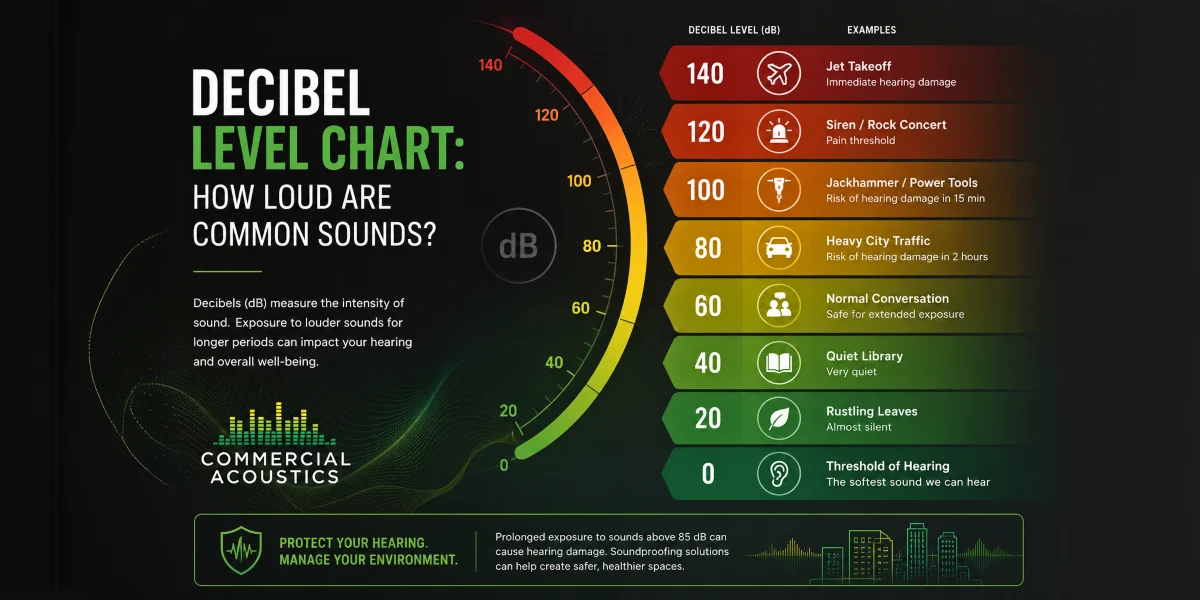
A decibel (dB) is the standard unit for measuring sound intensity. The scale runs from 0 dB (the quietest sound a healthy human ear can detect) to roughly 180 dB (rocket launches and rifle muzzle blasts). Most everyday environments fall between 30 dB (a whisper) and 90 dB (a lawnmower). Because the scale is logarithmic, every 10 dB increase represents a 10× jump in sound intensity — and a perceived doubling of loudness.
The decibel level chart below maps everyday sounds against the dB scale, shows where OSHA and NIOSH hearing-protection limits kick in, and flags the levels that cause permanent damage. Use it as a quick reference when specifying acoustic targets, troubleshooting noise complaints, or assessing workplace exposure.
Decibel Levels of Common Sounds
OSHA Safe Exposure Limits
OSHA and NIOSH set maximum exposure times based on sound level. Workplaces above 85 dBA require a hearing conservation program; above 115 dBA, exposure must be limited to 15 minutes per day. The table below shows the standard time-weighted limits with a visual scale of safe daily exposure.
Decibel Levels by Environment
Specifying acoustic targets usually starts with the existing ambient dB level of the space. Use this table as a baseline for design — then check whether the assembly STC and absorption treatment together can bring the space within target.
How the Decibel Scale Works
- Logarithmic, not linear: Every 10 dB step is 10× the sound intensity.
- Perceived loudness: +10 dB feels roughly twice as loud to the human ear.
- dB vs dBA: dBA is “A-weighted” to match human hearing sensitivity, filtering out low and very high frequencies the ear barely perceives. Most regulatory limits use dBA.
- Adding sources: Two equally loud sounds together only add 3 dB — not double the number.
This logarithmic behavior is why an STC 50 wall doesn’t sound twice as quiet as an STC 25 wall — it sounds roughly five times as quiet. The same principle applies in reverse: a noise complaint of “the music is twice as loud now” almost always corresponds to a 10 dB increase at the source.
How to Reduce Decibel Levels
- Block at the source: Higher-STC walls, sealed penetrations, and isolated mechanical equipment. See our STC Rating Chart for assembly-level targets.
- Absorb in the room: Add acoustic panels, baffles, or ceiling treatment to drop reverberation and perceived loudness. The Sound Absorption Coefficient Chart shows material performance by frequency.
- Mask intelligible noise: Sound masking adds a controlled 45–48 dBA background to cover speech without raising overall levels into the harmful range.
- Use PPE for unavoidable exposure: NRR-rated earmuffs or earplugs reduce in-ear dB by 20–33 points depending on rating and fit.
Not sure how much reduction your assembly can deliver? Use our STC Calculator to estimate transmission loss for a planned wall, or our Sound Masking Calculator to size a system for an open office.
Conclusion: Managing Decibel Levels in Real Spaces
Knowing the decibel level of common sounds is only the first step — controlling them in a real building takes the right combination of source treatment, isolation, and absorption. A whisper-quiet bedroom next to a 90 dB rooftop fan needs more than awareness; it needs a designed acoustic path from equipment to occupant.
Commercial Acoustics has been designing and supplying acoustic solutions for offices, hospitals, multifamily buildings, schools, and industrial sites since 2008. Browse the rest of our resources at Commercial Acoustics for charts, guides, calculators, and case studies — or reach out if you have a specific noise problem you’d like help solving.
FAQs: Decibel Levels
How many decibels is too loud?
Sustained exposure above 85 dB can damage hearing over time, and exposure above 120 dB risks immediate damage. OSHA requires hearing protection in workplaces averaging 85 dBA or higher over an 8-hour shift.
How loud is a normal conversation in decibels?
Normal conversation sits around 60 dB at a 3-foot distance — well within the safe range. Raised voices or speakerphone use can push that to 70-75 dB.
At what decibel level does hearing damage occur?
Damage begins at 85 dB with prolonged exposure (8+ hours daily). Above 100 dB, damage can occur within 15 minutes. Above 120 dB, damage can occur in seconds.
What’s the difference between dB and dBA?
dB is the raw sound pressure level. dBA is A-weighted — adjusted to match how the human ear perceives different frequencies — and is the standard for occupational and environmental noise regulations.
Is 70 decibels loud?
70 dB is moderately loud — comparable to a vacuum cleaner or busy street. It’s safe for everyday exposure but can become annoying over many hours, which is why offices and classrooms target lower ambient levels.

Walker Peek|Founder & CEO, Commercial Acoustics
Walker founded Commercial Acoustics in 2013 to bring aerospace-grade engineering discipline to soundproofing, and runs the firm as CEO from its 12,000 sq ft Tampa production facility. The company designs custom acoustic panels, sound membranes, and masking systems for multi-family, hospitality, healthcare, and commercial projects across the US — built around Walker’s invention, Wall Blokker, an EVA-based sound barrier that hits STC 50-plus at roughly $1 per square foot installed.
A Jacksonville native, Walker spent five years at Kennedy Space Center with Craig Technologies before founding Commercial Acoustics — certifying aerospace manufacturing to the AS9100 standard and leading Six Sigma Black Belt process-improvement teams on NASA programs. He is a certified Industrial Noise Control Engineer and the author of Architectural Acoustics: A Practical Handbook.
