OITC Rating 101: Understanding Outdoor-Indoor Transmission Class
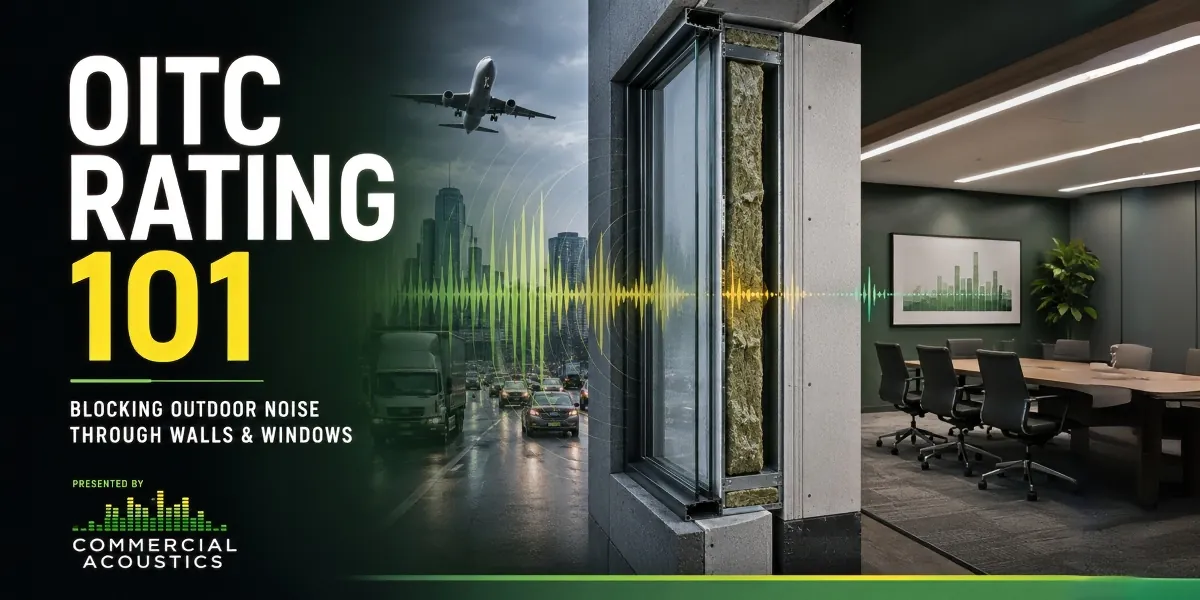
Table of Contents
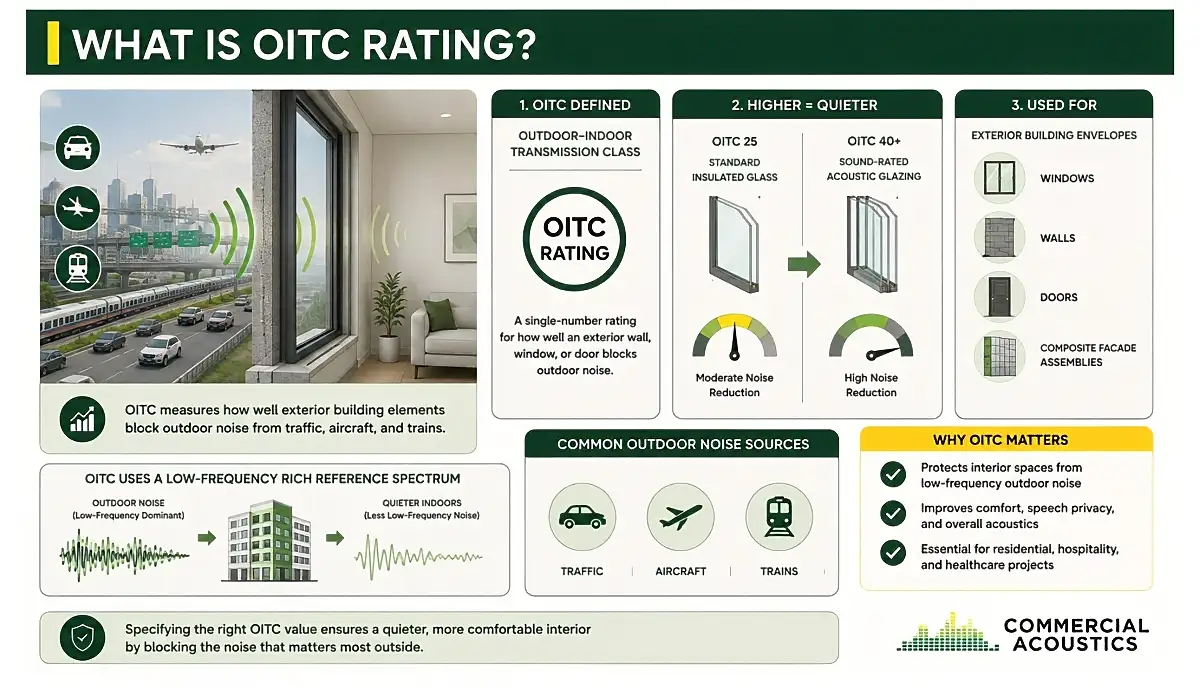
What Is OITC Rating?
- OITC Defined: Outdoor-Indoor Transmission Class — a single-number rating for how well an exterior wall, window, or door blocks outdoor noise.
- Higher = Quieter: OITC 25 = standard insulated glass; OITC 40+ = sound-rated acoustic glazing.
- Used For: Exterior building envelopes — windows, walls, doors, and composite facade assemblies.
The Outdoor-Indoor Transmission Class (OITC) rating describes how effectively a building’s exterior envelope blocks outdoor noise sources such as traffic, aircraft, and trains. Unlike STC, which uses a speech-weighted reference spectrum, OITC uses a reference noise spectrum dominated by low-frequency content — the kind of sound that dominates outside a building. Specifying the right OITC value protects interior spaces from urban, highway, and airport noise, especially in residential, hospitality, and healthcare projects.
How Is OITC Measured?
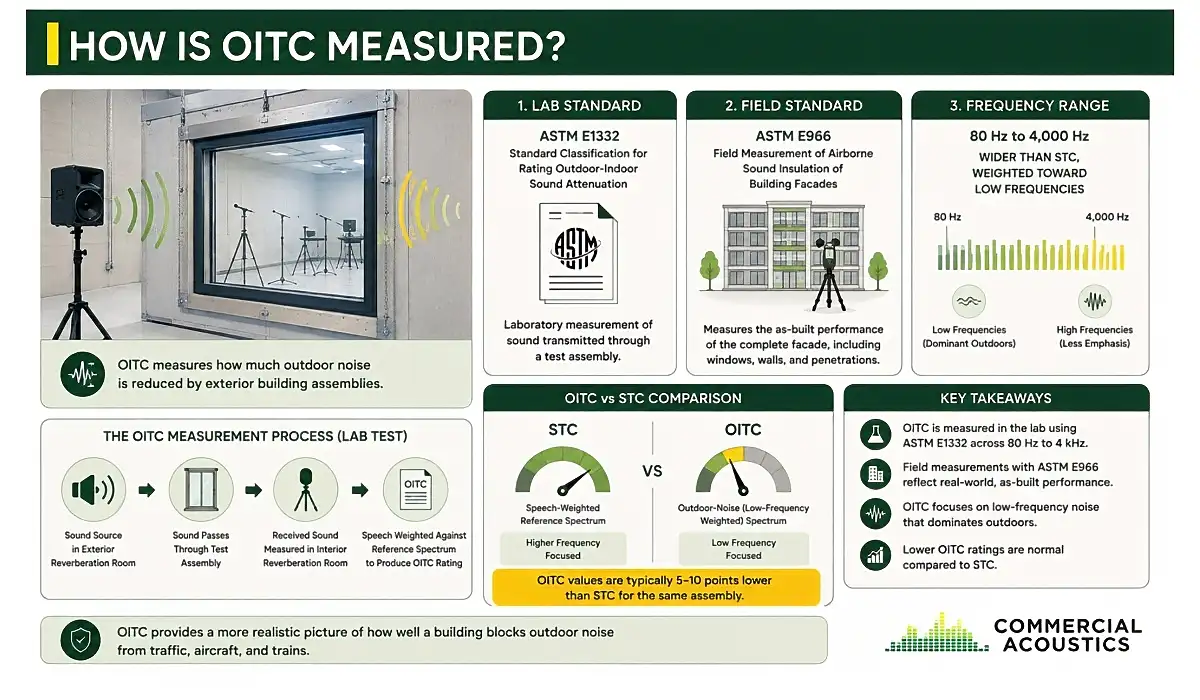
- Lab Standard: ASTM E1332 — Standard Classification for Rating Outdoor-Indoor Sound Attenuation.
- Field Standard: ASTM E966 — Field Measurement of Airborne Sound Insulation of Building Facades.
- Frequency Range: 80 Hz to 4,000 Hz — wider than STC, weighted toward low frequencies.
OITC is measured in a laboratory by transmitting sound through a test assembly across octave bands from 80 Hz to 4 kHz. The measured attenuation is then weighted against a reference outdoor-noise spectrum to produce the single-number rating. Because the test emphasizes low-frequency content, OITC values are typically 5–10 points lower than the STC of the same assembly. Field measurement using ASTM E966 captures the as-built performance of a complete facade — including all windows, walls, and penetrations.
Typical OITC Ratings by Assembly
| Assembly Type | Typical OITC | Comments |
|---|---|---|
| Single-pane 1/4″ glass | OITC 20–23 | Standard residential window; minimal outdoor noise reduction. |
| Standard insulated glass (IGU) | OITC 25–28 | Common new-construction baseline. |
| Laminated glass (PVB interlayer) | OITC 28–32 | Better than IGU for traffic and voice frequencies. |
| Acoustic IGU + asymmetric lites | OITC 35–40 | Sound-rated window for highway- and airport-adjacent sites. |
| Triple-pane laminated glazing | OITC 38–44 | Premium acoustic window; aircraft-noise mitigation. |
| Brick veneer + insulated stud wall | OITC 35–40 | Common residential exterior wall. |
| CMU + insulated cavity wall | OITC 40–46 | Higher mass for commercial / institutional exteriors. |
These values illustrate how dramatically OITC varies across assembly types. A laminated acoustic window can deliver 15+ more OITC points than a single-pane glass unit. Designers often pair high-OITC glazing with massive walls to achieve a balanced facade — the composite OITC of a wall + window assembly is governed by the weakest element multiplied by its area.
What Do Different OITC Ratings Mean?
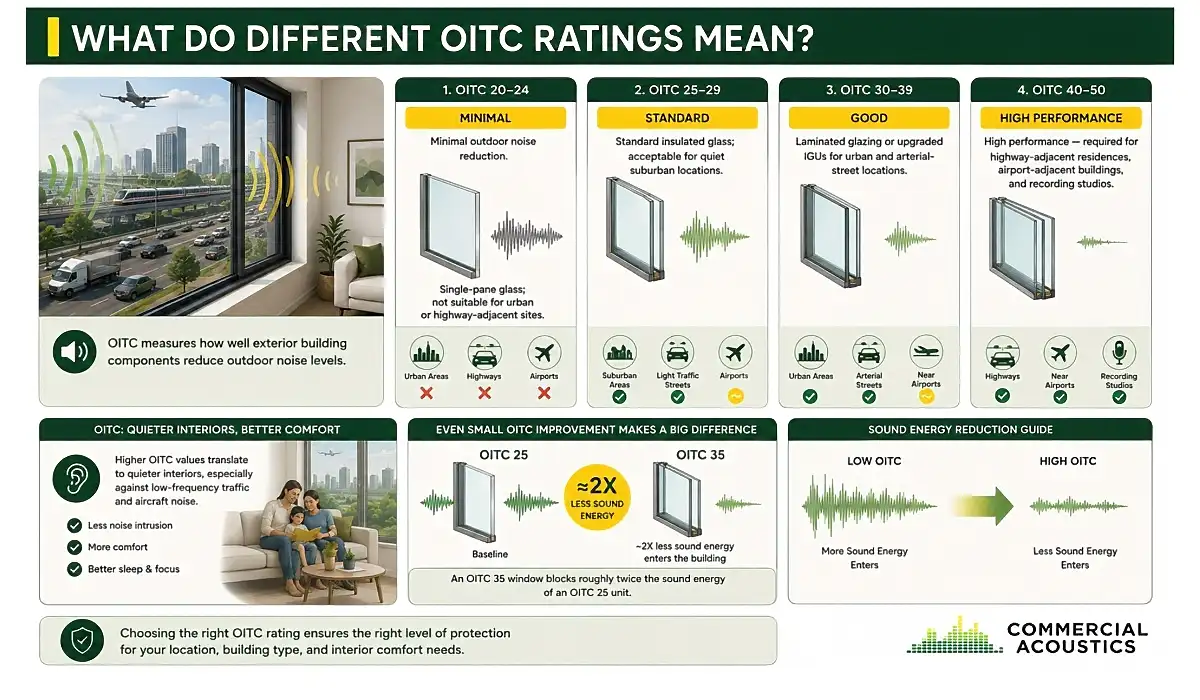
- OITC 20–24: Minimal outdoor noise reduction — single-pane glass; not suitable for urban or highway-adjacent sites.
- OITC 25–29: Standard insulated glass; acceptable for quiet suburban locations.
- OITC 30–39: Good — laminated glazing or upgraded IGUs for urban and arterial-street locations.
- OITC 40–50: High performance — required for highway-adjacent residences, airport-adjacent buildings, and recording studios.
Higher OITC values translate to quieter interiors, especially against low-frequency traffic and aircraft noise. Because the human ear is more sensitive to mid- and high-frequency speech sounds, even modest OITC improvements can dramatically reduce perceived outdoor disturbance. For comparison, an OITC 35 window blocks roughly twice the sound energy of an OITC 25 unit.
OITC Requirements by Site & Building Type
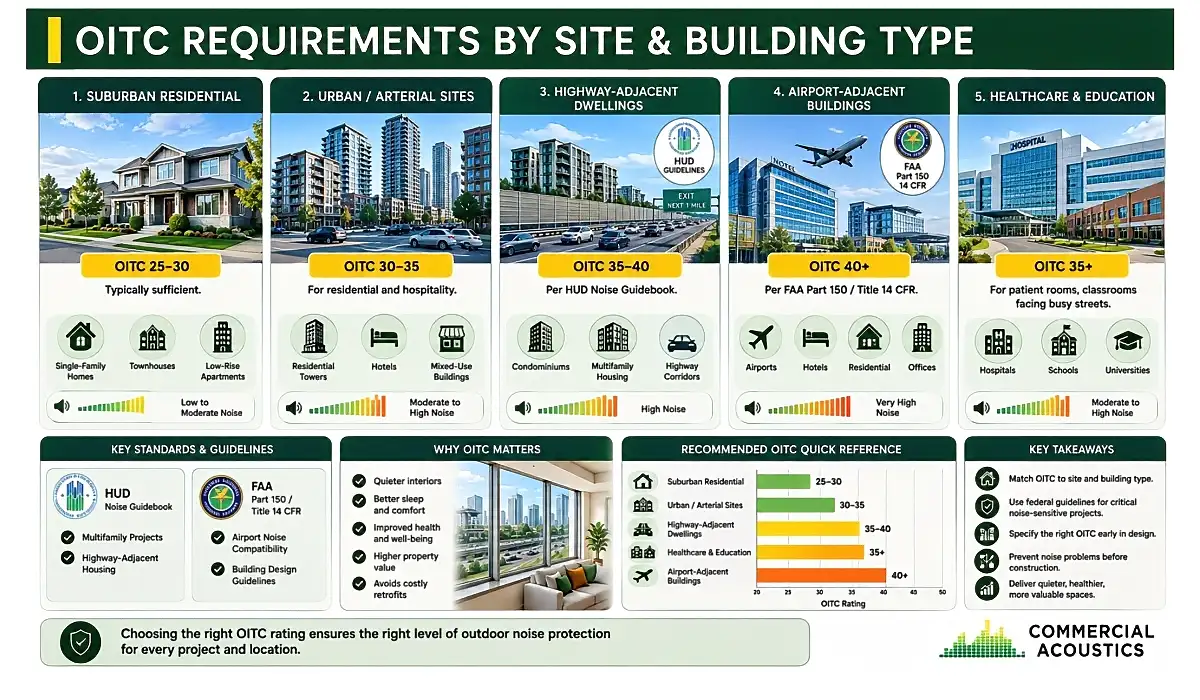
- Suburban residential: OITC 25–30 typically sufficient.
- Urban / arterial sites: OITC 30–35 for residential and hospitality.
- Highway-adjacent dwellings: OITC 35–40 per HUD Noise Guidebook recommendations.
- Airport-adjacent buildings: OITC 40+ per FAA Part 150 / Title 14 CFR.
- Healthcare & education: OITC 35+ for patient rooms, classrooms facing busy streets.
Many federal programs reference OITC when evaluating exterior noise mitigation, including HUD multifamily projects and FAA airport noise compatibility planning. Specifying OITC correctly during design avoids costly retrofits later — particularly window replacements, which are among the most expensive post-occupancy acoustic interventions.
How to Improve OITC Performance
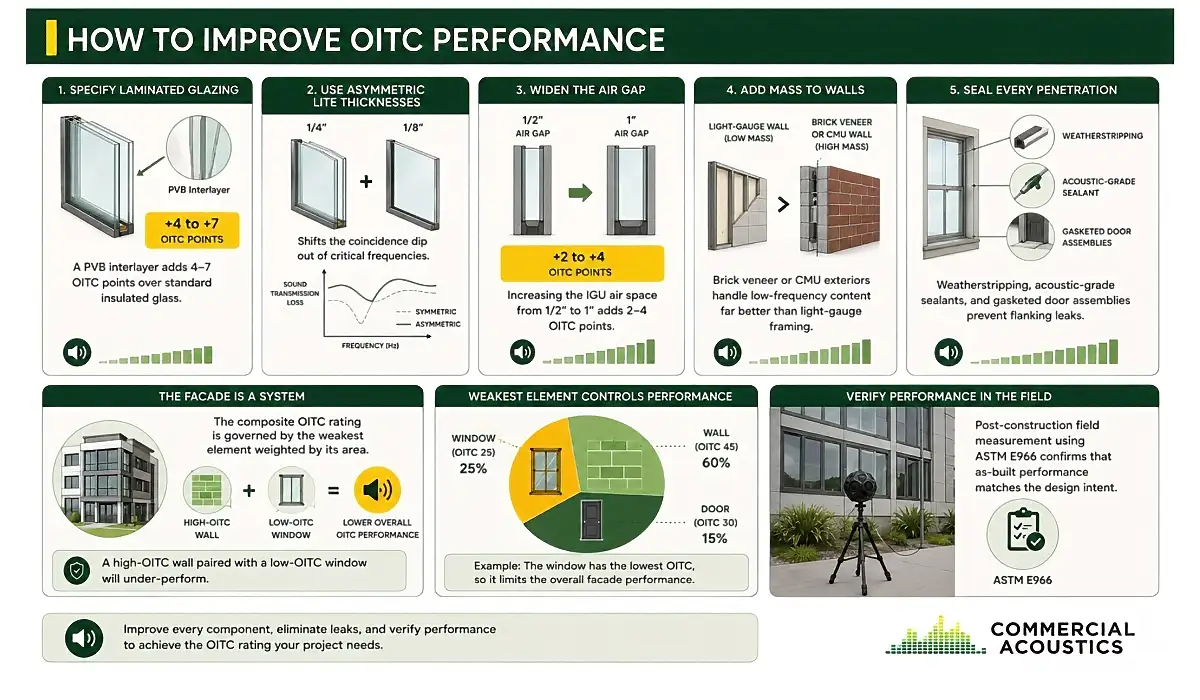
- Specify laminated glazing: A PVB interlayer adds 4–7 OITC points over standard insulated glass.
- Use asymmetric lite thicknesses: Different glass thicknesses (e.g., 1/4″ + 1/8″) shift the coincidence dip out of critical frequencies.
- Widen the air gap: Increasing the IGU air space from 1/2″ to 1″ adds 2–4 OITC points.
- Add mass to walls: Brick veneer or CMU exteriors handle low-frequency content far better than light-gauge framing.
- Seal every penetration: Weatherstripping, acoustic-grade sealants, and gasketed door assemblies prevent flanking leaks.
Achieving target OITC values requires the entire facade to perform as a system. The composite rating is governed by the weakest element weighted by its area — meaning a high-OITC wall paired with a low-OITC window will under-perform. Post-construction field measurement using ASTM E966 confirms that as-built performance matches the design intent.
Conclusion: OITC Ratings Define Outdoor Noise Control
OITC ratings are the standard metric for designing building envelopes that effectively block outdoor noise. By specifying the right OITC values for windows, walls, and doors, designers create comfortable interior environments even on urban, highway, and airport-adjacent sites. Whether you are designing residential, hospitality, healthcare, or office space, understanding OITC helps you protect occupants from outdoor noise and meet code requirements.
At Commercial Acoustics, we help architects and contractors specify the right exterior assemblies and hit their acoustic targets efficiently. From preconstruction consulting to turnkey installation, our team is here to guide you through the science of sound.
FAQs: OITC Ratings & Design
What is a good OITC rating?
A good OITC rating depends on the site: OITC 25–30 is acceptable for suburban residential, OITC 30–35 for urban locations, and OITC 35–40+ for highway- or airport-adjacent buildings.
What does OITC measure?
OITC (Outdoor-Indoor Transmission Class) measures how well an exterior wall, window, or door blocks outdoor noise from entering a building. It uses a reference spectrum weighted toward low frequencies like traffic, aircraft, and trains.
What is the difference between OITC and STC?
STC uses a speech-weighted reference spectrum and is best for interior partitions. OITC uses an outdoor-noise spectrum dominated by low frequencies and is the correct rating for exterior walls and windows. OITC is typically 5–10 points lower than STC for the same assembly.
How is OITC tested?
OITC is measured in a lab per ASTM E1332 across octave bands from 80 Hz to 4 kHz, weighted to a standard outdoor noise spectrum. Field measurement uses ASTM E966 for as-built facade performance.
Who sets OITC standards?
OITC classification is defined by ASTM E1332, with related field-measurement protocols in ASTM E966. Federal programs like HUD and FAA reference OITC for noise-impacted projects.
Can OITC be improved after construction?
Yes — typically by replacing windows with laminated acoustic glazing, adding storm windows or interior secondary windows, and sealing facade penetrations. Window replacement is the most common and impactful retrofit.