Reverberation Time for Different Rooms
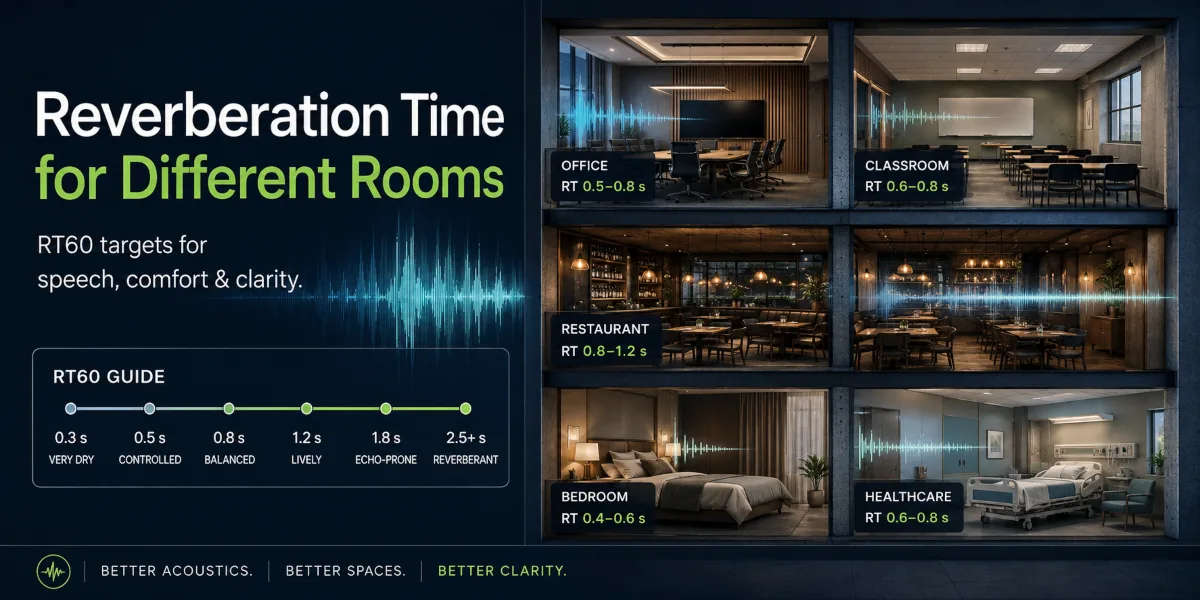
Table of Contents
What Is Reverberation Time?
Reverberation time is how long sound lingers in a space after the source stops. Acousticians measure it as RT60, the time in seconds for sound pressure to fall 60 decibels once the source is cut. A short RT60 makes a room feel “dead.” A long RT60 makes it feel “live.”
Reverberation time is driven by two things: the room’s volume and the total absorption in the surfaces. Sabine’s equation puts it plainly: RT60 = 0.161 × V / A, where V is volume in cubic meters and A is total absorption area in sabins. Bigger rooms reverberate longer. Softer rooms reverberate less.
There is no single “good” reverberation time. The right RT60 depends entirely on what happens in the room. A recording studio needs under 0.3 seconds. A cathedral can run past 6. Speech-driven rooms want short tails, music-driven rooms want longer ones.
Reverberation Time Chart by Room Type
The chart below shows typical reverberation time targets across common commercial and residential spaces. Targets are RT60 values measured at mid-frequencies (500–1000 Hz) in the unoccupied room.
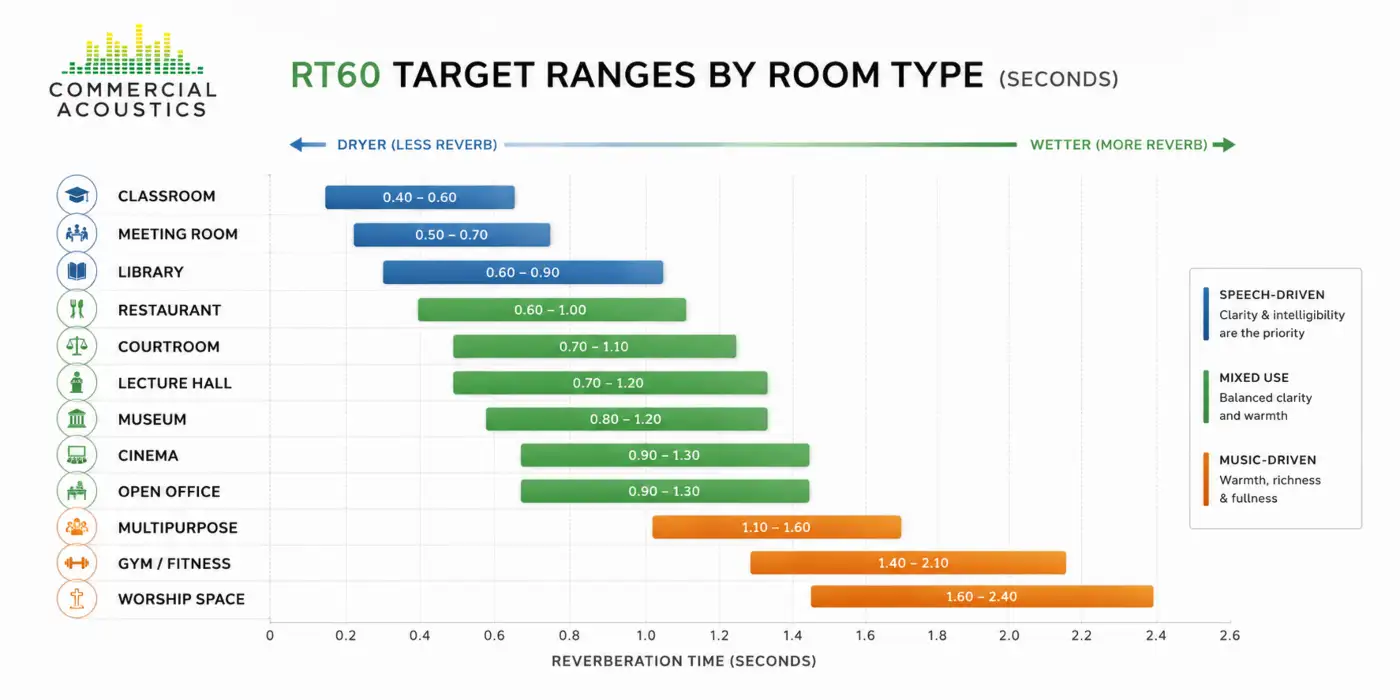
| Category | Room Type | Ideal RT60 | Acceptable Range | Primary Use |
|---|---|---|---|---|
| Speech | Classroom | 0.5 s | 0.4–0.6 s | Instruction (ANSI) |
| Speech | Open Office | 0.5 s | 0.4–0.6 s | Collaboration |
| Speech | Meeting Room | 0.6 s | 0.5–0.7 s | Conference, calls |
| Speech | Library | 0.6 s | 0.5–0.8 s | Quiet study |
| Mixed | Restaurant | 0.7 s | 0.5–0.9 s | Intimate / Lively |
| Mixed | Courtroom | 0.8 s | 0.6–1.0 s | Unamplified / Amplified |
| Mixed | Lecture Hall | 0.8 s | 0.7–1.0 s | Amplified speech |
| Mixed | Museum | 0.9 s | 0.8–1.0 s | Gallery, ambience |
| Mixed | Cinema | 1.0 s | 0.8–1.2 s | Dialogue + score |
| Music | Multipurpose | 1.3 s | 1.0–1.6 s | Flex, events |
| Music | Gym / Fitness | 1.5 s | 1.2–1.8 s | Sport, classes |
| Music | Worship Space | 1.8 s | 1.5–2.2 s | Music + speech |
Rooms with mixed use should target the more demanding program. A multipurpose room that hosts both lectures and choral performances should aim for the lower of the two ranges. Adjustable acoustics with deployable curtains or rotating panels are a good fit when the program varies week to week.
What Each Reverberation Time Means in Practice
- Under 0.3 seconds: the room sounds dead. Voices feel clipped. Right for studios and vocal booths. Wrong for offices, where it reads as oppressive.
- 0.3 to 0.5 seconds: tight and intelligible. Conversation is crisp at distance. Standard target for offices, classrooms, conference rooms, and fine dining.
- 0.5 to 0.8 seconds: the natural range for restaurants, libraries, and casual hospitality. Speech still clear, room still feels lively.
- 0.8 to 1.2 seconds: lecture halls and speech-led worship. Amplified speech holds up. Unamplified conversation starts to smear at distance.
- 1.2 to 2.0 seconds: music-friendly. Gymnasiums and large worship spaces sit here. Speech requires amplification.
- Over 2.0 seconds: concert halls, cathedrals, and large reverberant volumes. Wonderful for orchestral and choral music, terrible for unamplified speech.
The same room can sound different occupied vs. unoccupied. Bodies, clothing, and soft furnishings add absorption. A church measured at 2.4 seconds empty can drop to 1.8 with a full congregation. Most published targets are unoccupied values to keep the spec consistent.
Ideal Reverberation Time by Space Type
Classroom: Where ANSI Sets the Bar
🚨 Typical Problems: older classrooms with hard ceilings & concrete block walls routinely sit at 1.0–1.5 s RT60, well above the ANSI S12.60 cap of 0.6 seconds. Long RT60 demonstrably reduces comprehension for younger students & second-language learners.
✅ Top Fix: a full acoustic ceiling tile grid plus a small rear-wall panel array. Hits the ANSI target in most modern rooms. Older rooms with exposed structure need retrofit panels on a higher percentage of the surface area.
Office: Where Speech Privacy Collapses First
🚨 Typical Problems: open offices with exposed deck & hard finishes routinely measure 0.9–1.2 s RT60 untreated, well above the 0.4–0.6 s target. Speech privacy collapses, video calls suffer, & cognitive fatigue climbs.
✅ Top Fix: ceiling clouds over the primary collaboration zones. They cut vertical reflections hard, free wall space for design finishes, & drop RT60 more per dollar than wall panels alone.
Meeting Room: Where Remote Attendees Tune Out
🚨 Typical Problems: glass-walled meeting rooms & video-conference suites often measure 0.8–1.2 s, well above the 0.5–0.7 s target. Mic pickup degrades for remote attendees & speech across the table feels muddy.
✅ Top Fix: acoustic absorption panels on the wall behind the camera plus a ceiling cloud over the conference table. Aim for ~25% wall coverage at NRC 0.85+.
Library: Where Every Whisper Travels
🚨 Typical Problems: modern libraries with open reading rooms, study commons, & atrium spaces routinely measure 0.9–1.3 s, well above the 0.5–0.8 s target. Whisper conversations carry across the room.
✅ Top Fix: large-area ceiling clouds at NRC 0.90+ over reading zones, plus felt panels on the perimeter walls.
Restaurant: Where the Lombard Effect Lives
🚨 Typical Problems: hard-finish concept restaurants frequently land at 1.2–1.6 s RT60 at open, far above the 0.5–0.8 s target. Above 1.0 s the Lombard effect kicks in — guests shout, ambient climbs, guests shout louder.
✅ Top Fix: ceiling clouds paired with banquette upholstery. Together they often drop RT60 from 1.4 to 0.7 s without touching the design intent. Our restaurant case study walks through one such project.
Courtroom: Where Tradition Fights the Mic
🚨 Typical Problems: courtrooms with hard wood paneling & high ceilings often measure 1.2–1.8 s, well above the 0.6–1.0 s target. Unamplified counsel from the well loses clarity by the back row, & amplified PA stacks reflections.
✅ Top Fix: rear-wall acoustic absorption panels plus a perforated wood ceiling treatment. Maintains the formal aesthetic while pulling RT60 inside the target. See our interview-room case study for a related fact-pattern.
Lecture Hall: Where the Back Row Loses Consonants
🚨 Typical Problems: amphitheater-style lecture halls with raked seating & hard walls routinely measure 1.2–1.8 s, well above the 0.7–1.0 s target. Amplified speech smears & students at the back lose 30–40% of consonants.
✅ Top Fix: a large rear-wall panel array & treatment on the upper side walls. Preserves the front-of-room acoustics for unamplified Q&A while bringing RT60 inside target for amplified lecture.
Museum: Where the Docent Loses the Group
🚨 Typical Problems: gallery spaces with hard floors, plaster walls, & open ceilings often measure 1.0–1.5 s, above the 0.8–1.0 s target. Docent talks lose clarity & ambient noise from adjacent galleries bleeds in.
✅ Top Fix: discreet stretched fabric wall systems behind exhibit walls plus ceiling absorption hidden above structural elements. Keeps the architectural language intact while pulling RT60 inside target.
Cinema: Where Dialogue Drowns in Score
🚨 Typical Problems: small-format & boutique cinemas often measure 1.3–1.8 s, above the 0.8–1.2 s target. Dialogue intelligibility drops & low-frequency definition smears across overlapping reflections.
✅ Top Fix: full rear-wall acoustic panels, side-wall treatment at first-reflection points, & bass traps in the front corners.
Multipurpose: Where One Number Cannot Win
🚨 Typical Problems: multipurpose rooms hosting both lectures & music events face conflicting targets — speech wants 0.6–0.8 s, music wants 1.4–1.8. A single fixed treatment compromise serves neither program well.
✅ Top Fix: deployable absorption — drapes, banner panels, or rotating cylinders — that lets staff switch between a “dry” speech configuration & a “live” music configuration. See our multipurpose case study.
Gym & Fitness: Where Four-Second Tails Are Normal
🚨 Typical Problems: gymnasiums & fitness studios with hard floors, exposed deck, & block walls routinely measure 2.5–4.0 s RT60, well above the 1.2–1.8 s target. Music tracks blur, instructor calls disappear at the back, & sound bleeds into adjacent spaces.
✅ Top Fix: fabric-wrapped ceiling baffles plus wall panels at NRC 0.90+. For multifamily gyms, also treat impact noise on the floor. See our fitness-studio case study.
Worship Space: Where Sermon & Music Compete
🚨 Typical Problems: worship is the hardest acoustic program because it usually does double duty. Speech-led services want 0.8–1.4 s; music-led services want 1.5–2.2 s. A design that prioritizes one almost always fails the other.
✅ Top Fix: rear-wall absorption panels with deployable side-wall coverage. The rear panels kill the long echo path; the deployables let the congregation tune the room shorter for sermons & longer for music sets. See our modern sanctuary case study.
Closet vs. Concert Hall: Why Room Size Drives RT60
The single biggest driver of reverberation time is room volume. A small closet and a large cathedral have wildly different RT60 values even when both are finished in similar hard surfaces, because sound has to travel longer paths in the larger space before it loses 60 decibels of energy.
| Space | Typical Volume | Typical RT60 | Why |
|---|---|---|---|
| Small Closet | ~50 ft³ | 0.2–0.4 s | Tiny volume, soft contents, no resonance |
| Bathroom | ~400 ft³ | 0.4–0.7 s | Small but hard tile, glass, mirror |
| Bedroom | ~1,500 ft³ | 0.3–0.5 s | Soft furnishings absorb most reflections |
| Conference Room | ~3,000 ft³ | 0.4–0.6 s | Treated ceiling and one or two wall panels |
| Restaurant Dining Room | ~15,000 ft³ | 0.5–1.2 s | Hard finishes plus high ceilings |
| Gymnasium | ~80,000 ft³ | 1.2–1.8 s | Large volume, mostly hard surfaces |
| Worship Space | ~150,000 ft³ | 1.5–2.5 s | Very large volume, stone or plaster finishes |
| Concert Hall | ~700,000 ft³ | 1.8–2.2 s | Designed reverberation, tuned absorption |
| Cathedral | 1,000,000 ft³+ | 3.0–6.0 s | Vast volume, almost no absorption |
A bathroom can sound more “echoey” than a bedroom even though the bathroom is much smaller, because the bathroom is finished entirely in reflective tile and glass while the bedroom is full of fabric and soft goods. Volume sets the ceiling on RT60. Absorption sets the floor.
The takeaway for design: if you cannot change the volume of a space, the only lever is absorption. Doubling the absorption roughly halves the reverberation time. That is why a high-NRC ceiling treatment in a worship space or restaurant has such a dramatic effect.
Reverberation Time Standards
- ANSI S12.60-2010 (Classrooms): RT60 ≤ 0.6 s for spaces under 10,000 ft³, ≤ 0.7 s for 10,000–20,000 ft³. Unoccupied, measured at 500–2,000 Hz.
- FGI Guidelines (Healthcare): recommended RT60 0.4–0.6 s in patient rooms and clinical exam spaces. Aligned with HIPAA speech-privacy goals.
- WELL Building Standard (v2): RT60 ≤ 0.5 s in open offices, ≤ 0.6 s in classrooms, ≤ 0.7 s in conference rooms. One of the credits under the Sound concept.
- LEED v4.1 (Acoustic Performance): references ANSI S12.60 for classrooms and provides points for offices and healthcare meeting RT60 targets.
- ISO 3382-1 and ASTM E2235: the measurement standards for RT60 in performance spaces and ordinary rooms. Govern how the number itself is captured.
Standards matter when the project is bidding for certification, code compliance, or healthcare licensure. For most commercial work, the chart above is enough to set a defensible target. For schools and healthcare specifically, the ANSI and FGI numbers are the contract.
NRC Ratings of Common Finishes
Once you have a target RT60, the next question is which finishes get you there. NRC (Noise Reduction Coefficient) is a single-number rating, 0.00 to 1.00, that summarizes how much sound a material absorbs at mid-frequencies. NRC 0.00 reflects all incident energy. NRC 1.00 absorbs all of it.
In rooms with carpeting and acoustic ceiling tiles already in place, dedicated treatment is often a lower priority because those finishes alone deliver NRC 0.4 to 0.6 across the floor and ceiling. In rooms finished in hard materials (drywall, concrete, glass, tile) the existing NRC sits well under 0.1 and treatment becomes the only path to a target RT60.
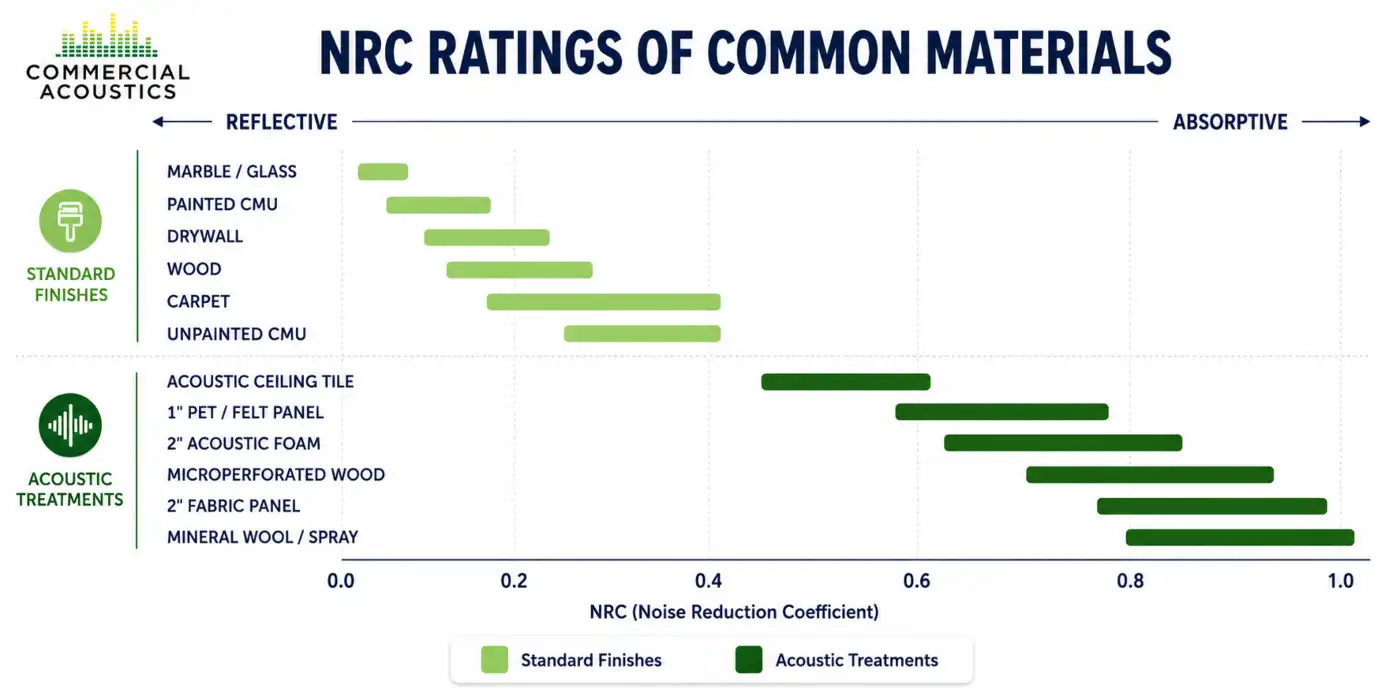
| Material | NRC | α @ 500 Hz | α @ 1000 Hz |
|---|---|---|---|
| Ceilings | |||
| Smooth Concrete (Unpainted) | 0.20 | 0.10 | 0.22 |
| Smooth Concrete (Painted) | 0.05 | 0.025 | 0.055 |
| Wood | 0.15 | 0.075 | 0.165 |
| Rubber | 0.05 | 0.025 | 0.055 |
| Plywood | 0.25 | 0.125 | 0.275 |
| Walls | |||
| CMU (Unpainted) | 0.35 | 0.175 | 0.385 |
| CMU (Painted) | 0.05 | 0.025 | 0.055 |
| Brick (Unpainted) | 0.05 | 0.025 | 0.055 |
| Brick (Painted) | 0.025 | 0.0125 | 0.0275 |
| Steel (Structural) | 0.10 | 0.05 | 0.11 |
| Plaster | 0.05 | 0.025 | 0.055 |
| Painted Drywall | 0.15 | 0.075 | 0.165 |
| Gypsum | 0.10 | 0.05 | 0.11 |
| Glass | 0.05 | 0.025 | 0.055 |
| Flooring | |||
| Linoleum | 0.05 | 0.025 | 0.055 |
| Terrazzo | 0.00 | 0.00 | 0.00 |
| Marble | 0.00 | 0.00 | 0.00 |
| Carpet on Foam Rubber | 0.55 | 0.275 | 0.605 |
| Carpet on Padding | 0.30 | 0.15 | 0.33 |
| Low-Pile Carpet | 0.20 | 0.10 | 0.22 |
| Hardwood | 0.30 | 0.15 | 0.33 |
| Acoustic Treatments | |||
| Cellulose Fibers (1″) | 0.75 | 0.375 | 0.825 |
| Polyurethane Foam | 0.30 | 0.15 | 0.33 |
| Semi-Rigid Fiberglass (1″) | 0.75 | 0.375 | 0.825 |
| Cork Tiles | 0.70 | 0.35 | 0.77 |
| Acoustic Ceiling Tiles | 0.50 | 0.25 | 0.55 |
The pattern is hard to miss. Standard architectural finishes (concrete, drywall, glass, brick) all sit at NRC 0.05 to 0.15. Dedicated acoustic treatments and soft floor coverings carry the load. Hitting an RT60 target in any room with hard finishes always comes down to how much of the surface area gets covered in NRC 0.70+ material.
For a deeper dive on how these numbers behave across the full frequency band, the sound absorption coefficient chart shows alpha values from 125 Hz to 4 kHz, not just the headline NRC.
How to Measure Reverberation Time
- Calibrated meter (ASTM E2235): the gold standard for compliance work. A trained operator with a Class 1 sound level meter and a balloon or pistol source.
- Room EQ Wizard (REW): free PC software with a calibrated microphone. Accurate to within 0.1 s for most rooms. Standard for studio and home theater tuning.
- Phone-based apps: AudioTools, NIOSH Sound Level Meter Pro. Useful for ballpark readings, not for compliance documentation.
- Modeled estimate: Sabine’s equation from a floor plan and finish schedule. Good enough to size treatment before construction. See our room acoustics calculator.
For a sub-5,000-square-foot room a phone app gets you 90 percent of the way to a diagnosis. Anything larger, occupied, or compliance-driven warrants a measurement pass with calibrated gear. The cost of a proper measurement is a small fraction of the cost of a treatment plan sized to the wrong target.
How to Choose the Right Target RT60
- Start with program: what happens in the room? Speech, music, both, neither?
- Check the standard: ANSI S12.60 for classrooms, FGI for healthcare, WELL/LEED for certified projects.
- Measure the existing room: establish a baseline RT60 before specifying anything.
- Compare to the chart: if the existing number is above target, calculate how much absorption needs to be added.
- Plan for occupied use: if the design target is unoccupied, add about 0.1–0.3 s of headroom for occupancy effects.
The biggest single mistake is treating reverberation time as a generic problem rather than a program-specific one. A treatment plan that drops RT60 by half is wrong in a concert hall and right in a classroom. The number on the spec is the number that matches the use, not the lowest number available.
Conclusion
Reverberation time is the single most important acoustic metric in any room with people in it. The right RT60 depends entirely on what happens in the room — speech, music, or both — and the right treatment depends on which finishes are already in place. Recording studios need under 0.3 seconds. Offices want 0.4 to 0.6. Restaurants 0.5 to 0.8. Concert halls 1.8 to 2.2. Cathedrals can run past 3.0 and consider it desirable.
The pattern across every space type is the same: measure the existing room first, set the target from the program, and treat the largest unbroken hard surface (usually the ceiling) before touching anything else. The chart at the top of this page sets your target; the typical-problem / top-fix sections show what hitting that target looks like in practice. The case studies linked in each section show those fixes deployed in real commercial projects.
FAQs: Reverberation Time for Rooms
What is the ideal reverberation time for a room?
It depends on the room program. Offices and classrooms target 0.4 to 0.6 seconds. Restaurants 0.5 to 0.8. Worship 1.0 to 2.0. Concert halls 1.8 to 2.2. Recording studios under 0.3.
How is reverberation time measured?
RT60 is the time in seconds for sound pressure to fall 60 decibels after the source stops. Measured with a calibrated meter (ASTM E2235), free software like Room EQ Wizard, or phone apps for ballpark readings.
What is the reverberation time of a concert hall?
Symphonic concert halls target RT60 1.8 to 2.2 seconds at mid-frequencies. Boston Symphony Hall measures about 1.85 s occupied. Opera houses run 1.3 to 1.8 s to keep voice intelligible alongside the orchestra.
What reverberation time does ANSI require for classrooms?
ANSI S12.60 caps RT60 at 0.6 seconds for unoccupied classrooms under 10,000 cubic feet, and at 0.7 seconds for spaces between 10,000 and 20,000 cubic feet, measured at 500 to 2,000 Hz.
How do you reduce reverberation time in a room?
Add broadband absorption to 25 to 40 percent of total wall and ceiling surface area, using NRC 0.85 or higher material. Treat the ceiling first since it’s usually the largest unbroken hard surface in the room.
Next Steps: Hitting Your Target RT60
Once you have identified the target reverberation time for the program, the next question is which combination of ceiling treatment, wall panels, and soft furnishings gets the room there cost-effectively. Treatment plans are sized from room volume, finish schedule, and target RT60 using Sabine’s equation.
Run the numbers yourself with the room acoustics calculator, or send a floor plan and a few photos to Commercial Acoustics and we will come back with a treatment plan and a budget range matched to your target.