Table of Contents
Why Sound Still Amazes Us
Sound surrounds us every second of the day — from the 32 Hz hum of city traffic to the 20,000 Hz buzz of a cicada. It shapes mood, focus, and even how buildings feel. Despite being invisible, sound is energy you can measure, control, and design with precision. Whether you’re creating music, improving speech privacy, or tuning a workspace, these facts reveal how sound truly works — and how understanding it leads to better acoustics everywhere.
1. The Science Behind Sound
- Sound is energy in motion: Vibrations move air molecules, creating pressure waves we interpret as sound.
- Frequency defines pitch: Faster vibration = higher frequency, measured in Hertz (Hz).
- Amplitude defines loudness: Stronger vibration = greater sound pressure, measured in decibels (dB).
Every sound is a mechanical wave that transfers energy through air, liquid, or solid material. The average person can detect frequencies from 20 Hz to 20,000 Hz, but certain low-frequency sounds can be felt rather than heard — an important concept in architectural acoustics and industrial noise control.
2. Sound Travels Faster Through Solids and Liquids
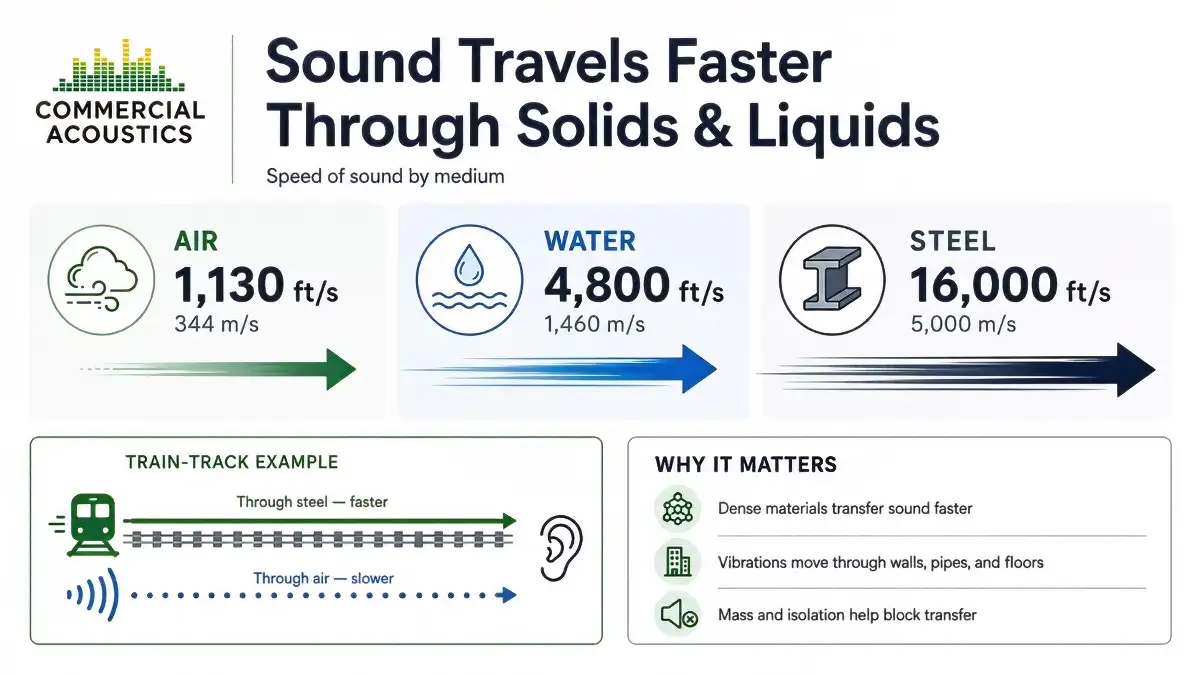
- In air: ~1,130 ft/s (344 m/s).
- In water: ~4,800 ft/s (1,460 m/s).
- In steel: ~16,000 ft/s (5,000 m/s).
The denser the medium, the quicker sound moves because molecules transmit energy more efficiently. That’s why you hear a train coming sooner through the track than through the air. In acoustic engineering, this principle explains why vibrations travel so easily through walls, pipes, and floors — and why mass and isolation are critical in soundproofing.
3. Egg Cartons Don’t Absorb Sound (Myth Busted)
- Low mass = low absorption: Thin paper surfaces simply reflect sound.
- Irregular shape diffuses, not absorbs: It scatters waves instead of dissipating energy.
- True absorption needs density: Use open-cell foam or fiberglass instead.
Real acoustic materials convert vibration into heat through friction inside porous fibers. Egg cartons lack the mass and micro-structure to do this. Professional products like fiberglass panels or acoustic foam achieve NRC ratings up to 1.00, while cardboard remains near 0.05 — practically reflective.
4. The Loudest Sound on Earth
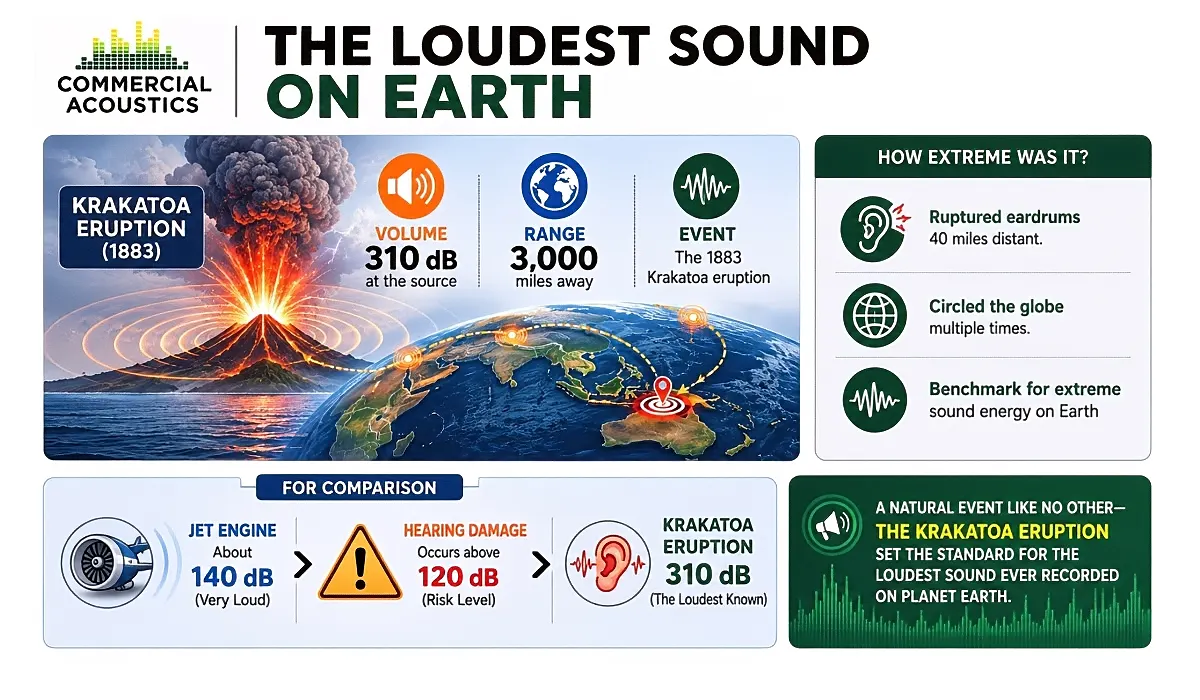
- Event: The 1883 Krakatoa eruption.
- Volume: Reached approximately 310 dB at the source.
- Range: Heard 3,000 miles away.
That single explosion ruptured eardrums 40 miles distant and circled the globe multiple times. For comparison, a jet engine measures about 140 dB, and permanent hearing damage occurs above 120 dB. The Krakatoa blast remains the benchmark for extreme sound energy in Earth’s atmosphere.
5. Sound Can Be Used to Move Objects
- Acoustic levitation uses ultrasonic pressure waves to suspend particles.
- Ultrasound frequencies: Typically between 20 kHz–100 kHz.
- Used in: Medical research, 3D printing, and materials testing.
By generating standing sound waves, scientists can lift small items without contact. The principle—balancing acoustic pressure against gravity—shows how precisely sound can manipulate matter. These experiments prove that acoustic energy is more than audible—it’s a tangible force.
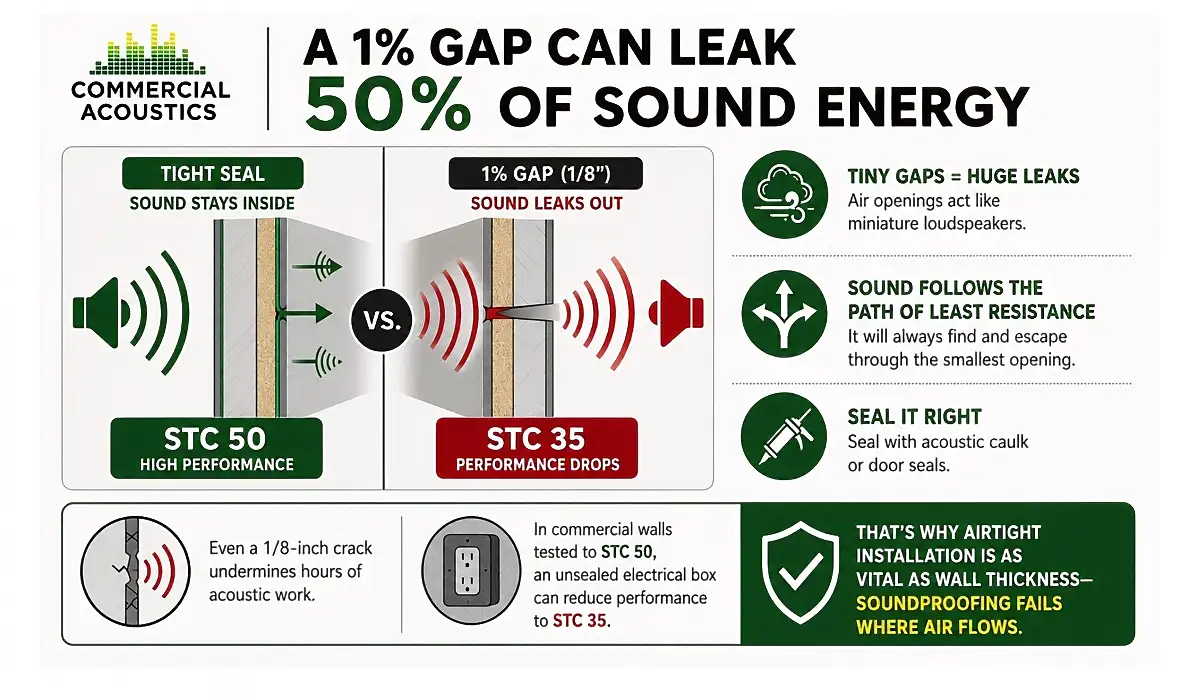
6. A 1% Gap Can Leak 50% of Sound Energy
- Tiny gaps = huge leaks: Air openings act like miniature loudspeakers.
- Sound follows the path of least resistance.
- Seal with acoustic caulk or door seals.
Even a 1/8-inch crack undermines hours of acoustic work. In commercial walls tested to STC 50, an unsealed electrical box can reduce performance to STC 35. That’s why airtight installation is as vital as wall thickness—soundproofing fails where air flows.
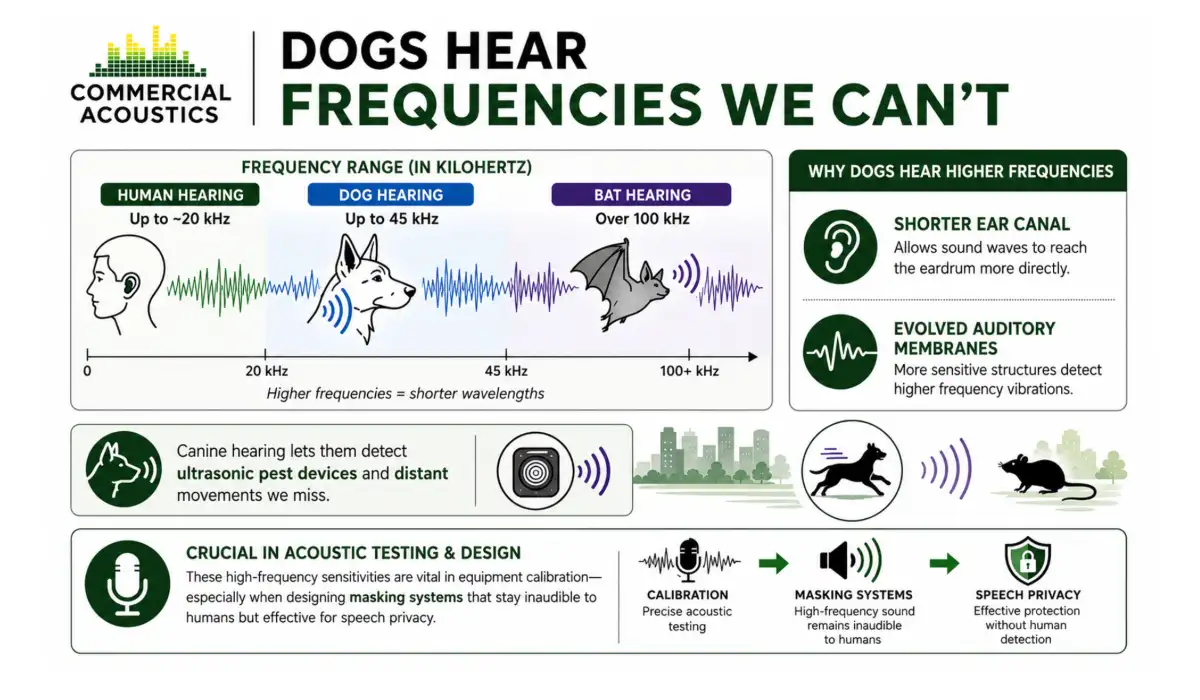
7. Dogs Hear Frequencies We Can’t
- Human hearing limit: ~20 kHz.
- Dogs: Up to 45 kHz; bats: Over 100 kHz.
- Reason: Shorter ear canal and evolved auditory membranes.
Canine hearing lets them detect ultrasonic pest devices and distant movements we miss. These high-frequency sensitivities are crucial in acoustic testing equipment calibration—especially when designing masking systems that stay inaudible to humans but effective for speech privacy.
8. Whips Create Mini Sonic Booms
- Speed: Tip exceeds 760 mph—the speed of sound.
- Result: The “crack” is a micro-sonic boom.
- Fact: First man-made object to break the sound barrier.
Each whip’s taper accelerates its tip faster than its base, causing a small shockwave. This demonstrates how simple tools can achieve supersonic velocity through energy transfer—an example used often in fluid-dynamics and acoustic-motion studies.
9. Sound Can Be Used to Extinguish Fires
- Frequency range: Around 30–60 Hz for maximum flame disruption.
- Mechanism: Pressure waves separate fuel from oxygen.
- Demonstrated by: George Mason University researchers (2015).
Low-frequency waves can snuff out small flames by disturbing combustion. Though not practical for large fires yet, acoustic fire control could one day replace chemical agents in confined spaces, proving again that sound is a versatile form of mechanical energy.
10. Some Animals Don’t Hear at All
- Example: Houseflies are deaf—they rely on vibrations sensed through hairs and antennae.
- Contrast: Elephants detect infrasound as low as 16 Hz, traveling miles.
- Takeaway: Nature spans the entire sound spectrum.
While humans hear roughly 20–20,000 Hz, elephants communicate through rumbles below 20 Hz and dolphins through whistles near 100 kHz. Studying this range helps engineers understand vibration transmission in structures and ecosystems alike.
11. Music Affects Behavior and Productivity
- Calm music lowers stress: Slow tempos reduce cortisol by up to 65% in studies.
- Fast beats boost alertness: Ideal for gyms and retail environments.
- Proven link to milk yield: Cows exposed to gentle music produce 3–5% more milk.
Sound impacts both physiology and performance. Music therapy, ambient design, and sound masking all rely on this principle—controlling acoustic rhythm and frequency to influence emotion, focus, and comfort in homes, schools, and workplaces.
12. Sound Moves in Patterns — Not Straight Lines
- Waves bend (diffract) around objects.
- Hard surfaces reflect; soft ones absorb.
- Reflections cause echo and reverb.
Sound radiates outward but interacts with everything in its path. This is why flutter echo happens between parallel walls and why open-plan offices feel loud even at low volumes. Acoustic panels and ceiling clouds strategically break those patterns for balanced reverberation.
13. Soundproof Paint Doesn’t Stop Noise
- Myth: It blocks sound.
- Reality: Only reduces high-frequency reflection.
- Better solution: Mass-Loaded Vinyl (MLV) or dense barrier layers.
Paint coatings can slightly dampen echo, but they lack mass—the foundation of real soundproofing. For measurable transmission loss, use composite systems like Wall Blokker™, which adds up to 10 STC points to a wall assembly.
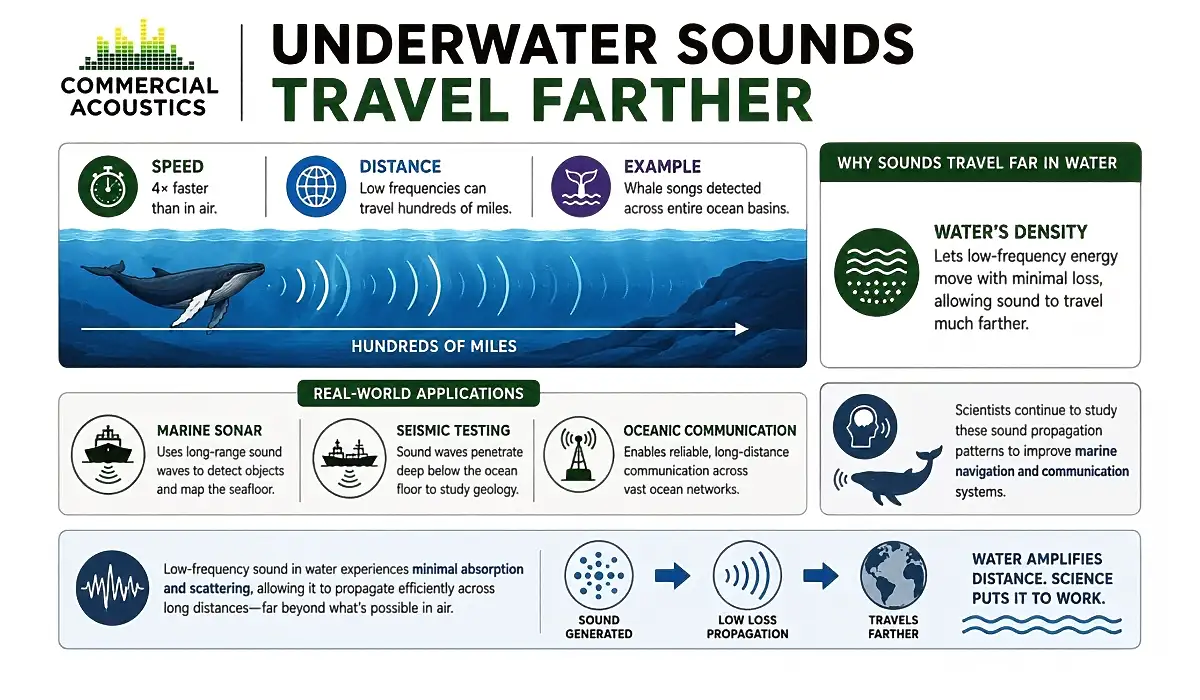
14. Underwater Sounds Travel Farther
- Speed: 4× faster than in air.
- Distance: Low frequencies can travel hundreds of miles.
- Example: Whale songs detected across entire ocean basins.
Water’s density lets low-frequency energy move with minimal loss. This property enables marine sonar, seismic testing, and oceanic communication networks—all based on controlled underwater acoustics. Scientists continue to study these sound propagation patterns to improve marine navigation and communication systems.
15. Humans Can Feel Sound Below 20 Hz
- Infrasound threshold: 0.001–20 Hz.
- Effects: Chest resonance, unease, vibration fatigue.
- Sources: Wind turbines, subwoofers, earthquakes.
Though inaudible, infrasound affects the human body physically. Engineers study it when designing mechanical rooms or large subwoofer systems to avoid harmful resonance. Prolonged exposure can influence heart rate and stress levels, making proper low-frequency control vital in architecture.
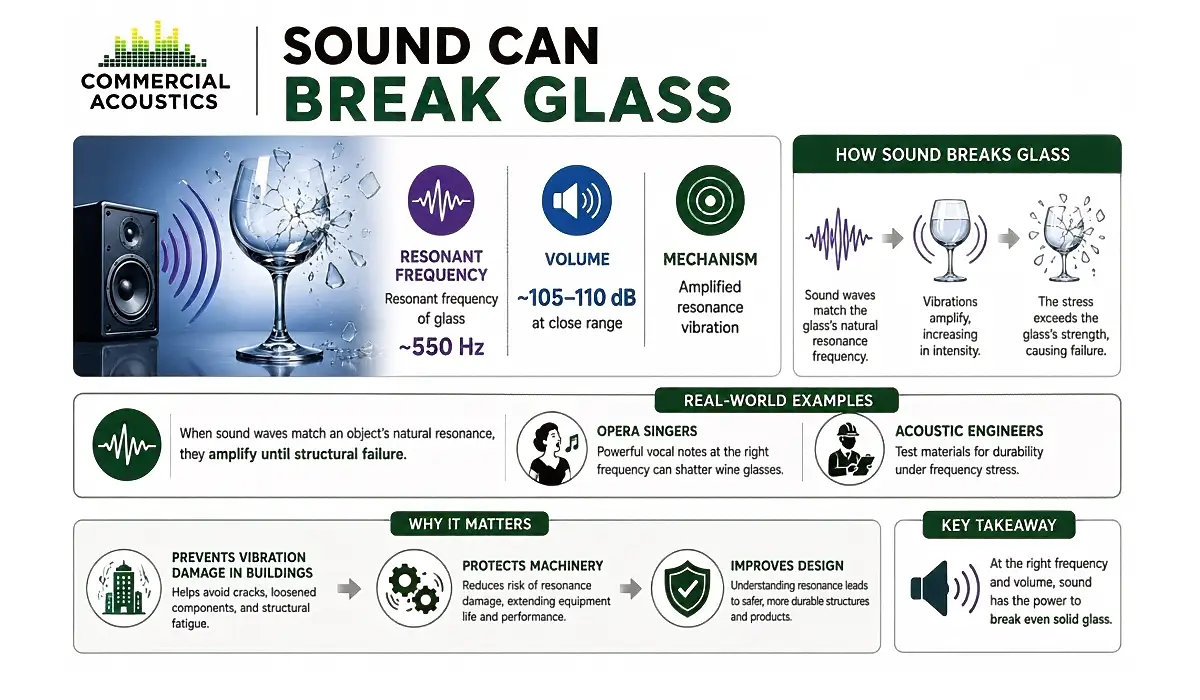
16. Sound Can Break Glass
- Required frequency: Resonant frequency of glass (~550 Hz).
- Volume: ~105–110 dB at close range.
- Mechanism: Amplified resonance vibration.
When sound waves match an object’s natural resonance, they amplify until structural failure. This resonance effect is why opera singers can shatter wine glasses and why acoustic engineers test materials for durability under frequency stress. Understanding this helps prevent vibration damage in buildings and machinery.
17. Silence Has a Decibel Level Too
- Threshold of hearing: 0 dB.
- Quietest lab on Earth: −20.3 dB (Microsoft’s anechoic chamber).
- Human limit: Few can stay longer than 45 minutes.
Absolute silence doesn’t exist in nature—there’s always molecular motion. Anechoic chambers reveal that total silence amplifies our internal sounds like heartbeat and breathing, proving the brain craves ambient noise for comfort. This insight drives how sound masking systems are tuned for realistic quiet in offices.
18. Space Is Completely Silent
- Reason: No air molecules to carry vibration.
- Only electromagnetic waves travel there.
- Result: Explosions in movies = pure fiction.
Astronauts rely on radio waves, not sound waves, to communicate. It’s a reminder that sound is fundamentally tied to its medium—no molecules, no motion. This fact often inspires comparisons between soundproof environments and space-level isolation in lab acoustics.
19. Humans Localize Sound with Two Ears
- Delay difference: About 0.0007 seconds helps pinpoint direction.
- Brain triangulates: Phase and intensity cues.
- Application: 3D audio, VR, and surround mixing.
Binaural hearing lets us locate sound sources with incredible precision. Audio engineers replicate this process using binaural recording to create immersive listening experiences in film, gaming, and acoustic simulation. This understanding also informs architectural acoustics, improving spatial awareness indoors.
20. Sound Can Heal
- Therapeutic ultrasound: Frequencies of 1–3 MHz used in medicine.
- Applications: Physical therapy, wound healing, tissue stimulation.
- Effect: Increases blood flow and reduces inflammation.
Medical ultrasound shows how controlled acoustic energy can promote recovery rather than damage. New research explores how low-frequency sound therapy can alleviate stress, improve sleep, and accelerate muscle regeneration — proving that sound’s impact extends from hospitals to holistic wellness.
Conclusion: Sound Is Energy You Can Shape
Sound is more than what we hear — it’s a measurable, controllable force that shapes our environment. From the roar of Krakatoa to the whisper of a cello string, vibration connects physics and feeling. Understanding how it travels, reflects, and resonates lets us build quieter, healthier, and more inspiring spaces.
At Commercial Acoustics, we use these same principles daily—designing, testing, and installing high-performance soundproofing and acoustic treatments across North America. Whether you’re fascinated by the science or ready to improve your own space, our experts can help you turn sound into performance.
FAQs: Facts About Sound
What are 5 facts about sound?
Sound travels through air, water, and solids; moves faster in denser materials; reflects off hard surfaces; loses energy when absorbed; and can’t travel through space.
Who discovered sound?
No single person did, but Pythagoras studied musical vibration around 500 BC, and later Galileo and Newton described the physics that govern it.
What are the 10 types of sound?
Mechanical, longitudinal, transverse, audible, ultrasonic, infrasonic, impulsive, continuous, ambient, and harmonic.
How can I make a room sound better?
Install acoustic panels, ceiling clouds, and bass traps to absorb reflections and reduce echo. Proper placement can improve speech clarity by over 40%.
Can sound travel through space?
No — space is a vacuum, so there are no molecules to carry vibration. Only electromagnetic waves, like radio signals, can cross that distance.

Walker Peek|Founder & CEO, Commercial Acoustics
Walker founded Commercial Acoustics in 2013 to bring aerospace-grade engineering discipline to soundproofing, and runs the firm as CEO from its 12,000 sq ft Tampa production facility. The company designs custom acoustic panels, sound membranes, and masking systems for multi-family, hospitality, healthcare, and commercial projects across the US — built around Walker’s invention, Wall Blokker, an EVA-based sound barrier that hits STC 50-plus at roughly $1 per square foot installed.
A Jacksonville native, Walker spent five years at Kennedy Space Center with Craig Technologies before founding Commercial Acoustics — certifying aerospace manufacturing to the AS9100 standard and leading Six Sigma Black Belt process-improvement teams on NASA programs. He is a certified Industrial Noise Control Engineer and the author of Architectural Acoustics: A Practical Handbook.
