Table of Contents
Quick Overview
- STC rates how well an assembly blocks indoor airborne noise like speech and TV. Frequency range 125–4000 Hz.
- OITC rates how well an assembly blocks outdoor environmental noise like traffic, trains, and aircraft. Frequency range 80–4000 Hz.
- OITC is always lower than STC on the same assembly because OITC includes the low frequencies that are hardest to block.
- Spec STC for interior partitions, OITC for windows and exterior facades. Using STC alone on a building envelope is the most common cause of low-frequency complaints.
Why STC and OITC Matter in Building Acoustics
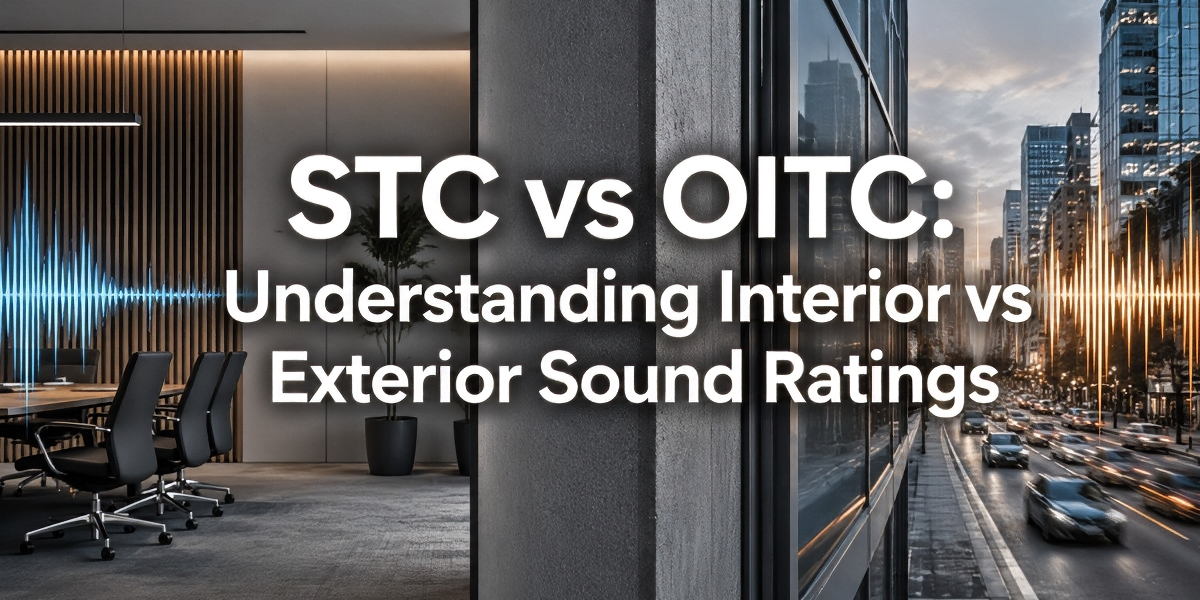
STC and OITC are two of the most commonly misunderstood sound ratings in architectural specs. STC (Sound Transmission Class) measures indoor airborne noise like speech and TV. OITC (Outdoor-Indoor Transmission Class) measures exterior environmental noise like traffic, rail, and aircraft.
When the wrong rating is specified, the assembly looks adequate on paper but fails once the building is occupied. The result is chronic noise complaints and expensive retrofits. The two ratings cannot be interchanged, and there is no clean conversion between them.
This article covers how each is measured, where each one applies, and why their numbers diverge so much on the same assembly. For wall and partition modeling, the STC calculator walks through assembly-level performance for indoor partitions.
What STC Actually Measures
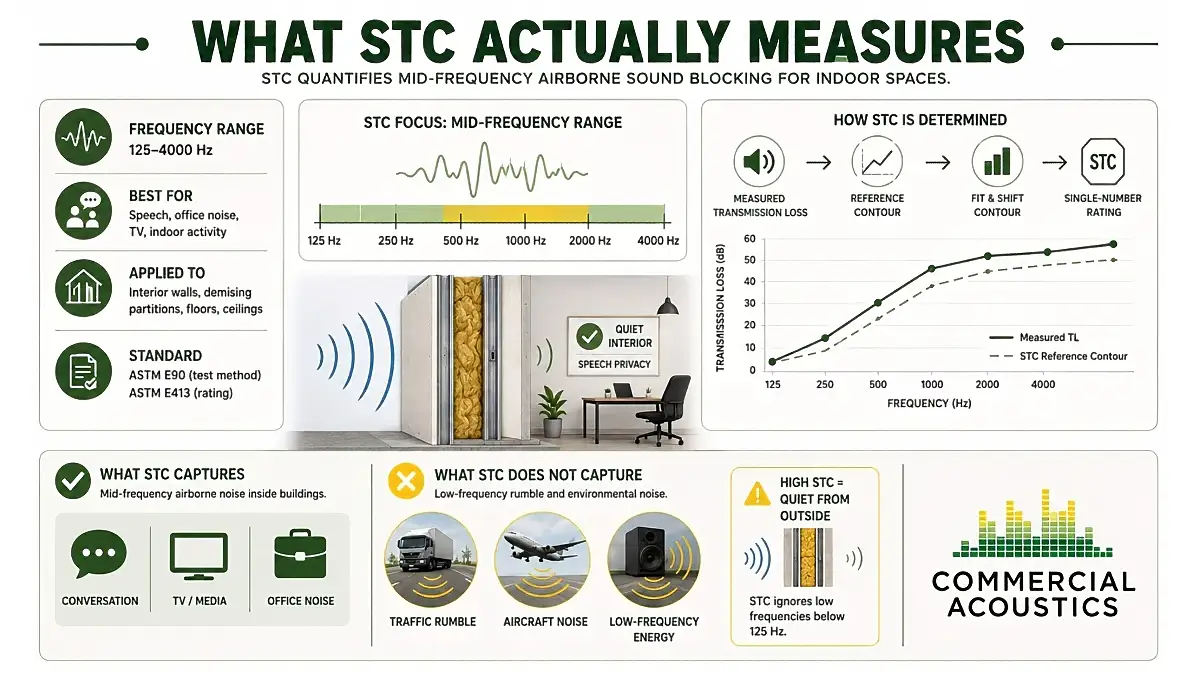
- Frequency range: 125–4000 Hz
- Best for: Speech, office noise, TV, indoor activity
- Applied to: Interior walls, demising partitions, floors, ceilings
- Standard: ASTM E90 (test method) and ASTM E413 (rating)
STC quantifies how well a partition blocks mid-frequency airborne noise. It is excellent for predicting privacy between indoor rooms. The single-number rating is generated by fitting a reference contour to the measured transmission-loss data across the 125–4000 Hz range.
STC captures essentially no energy below 125 Hz, so it does not reflect low-frequency rumble, traffic noise, or aircraft energy. Assemblies with high STC ratings can still perform poorly against outdoor noise because STC ignores the frequencies that dominate environmental sound. For a deeper walkthrough of how the number is built, the STC rating primer covers the test contour and weighting.
What OITC Actually Measures
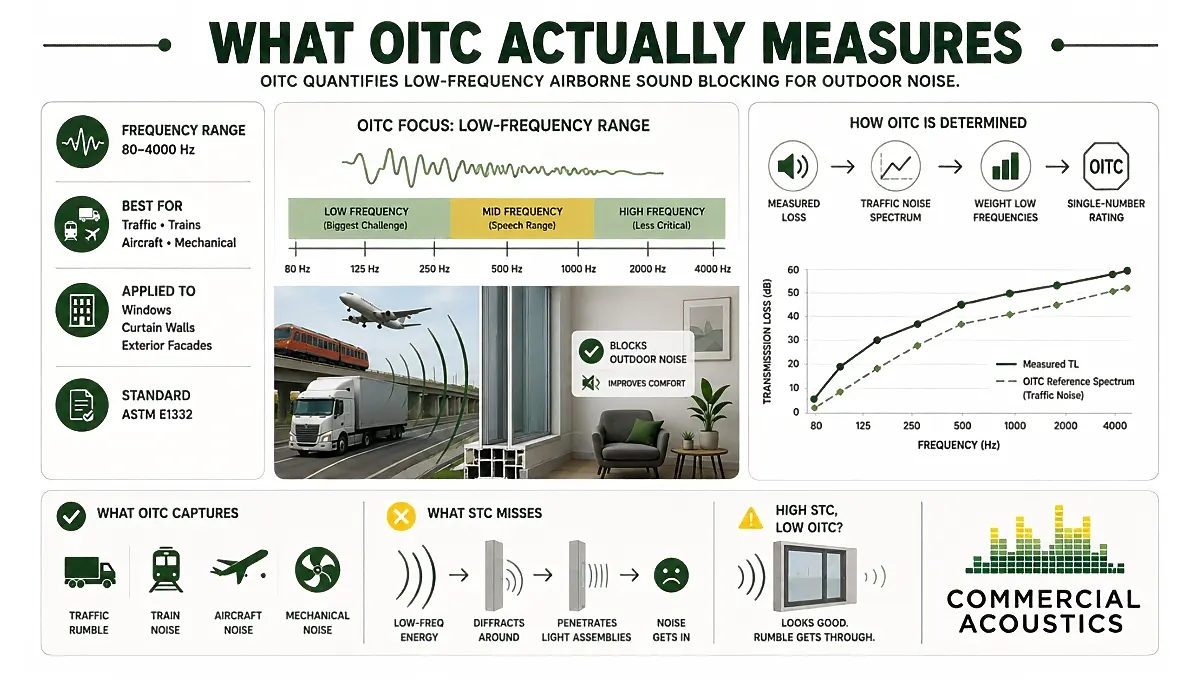
- Frequency range: 80–4000 Hz (extends a full octave lower than STC)
- Best for: Traffic, trains, aircraft, mechanical equipment noise
- Applied to: Windows, curtain walls, exterior facade assemblies
- Standard: ASTM E1332
OITC exists because STC does not measure low frequencies. Transportation noise contains large amounts of energy below 200 Hz. That energy travels farther through air, diffracts around obstructions, and penetrates lightweight assemblies more easily than mid-frequency speech.
OITC weights the low-frequency region heavily using a reference spectrum derived from real outdoor traffic noise, including highway noise through windows. That makes it the correct rating for any building envelope facing outdoor environmental noise. A high-STC, low-OITC window will read as “good” on a spec sheet and still let truck rumble through unimpeded.
Why STC and OITC Often Disagree
- STC overestimates real-world envelope performance because it ignores low-frequency content.
- OITC reveals the weakness by penalizing the low-frequency leakage that STC misses.
- No conversion factor exists. The two ratings measure different spectra against different reference contours.
A window assembly might rate STC 35 and OITC 26 on the same lab test. Those are not comparable numbers. STC will almost always be the higher of the two because it avoids the hardest frequencies to block.
OITC exposes the flaws in glazing and lightweight facade systems that STC papers over. For exterior noise control, OITC predicts real indoor comfort. Specifying a window by STC alone in an urban or transportation-adjacent site is the textbook way to generate move-in noise complaints.
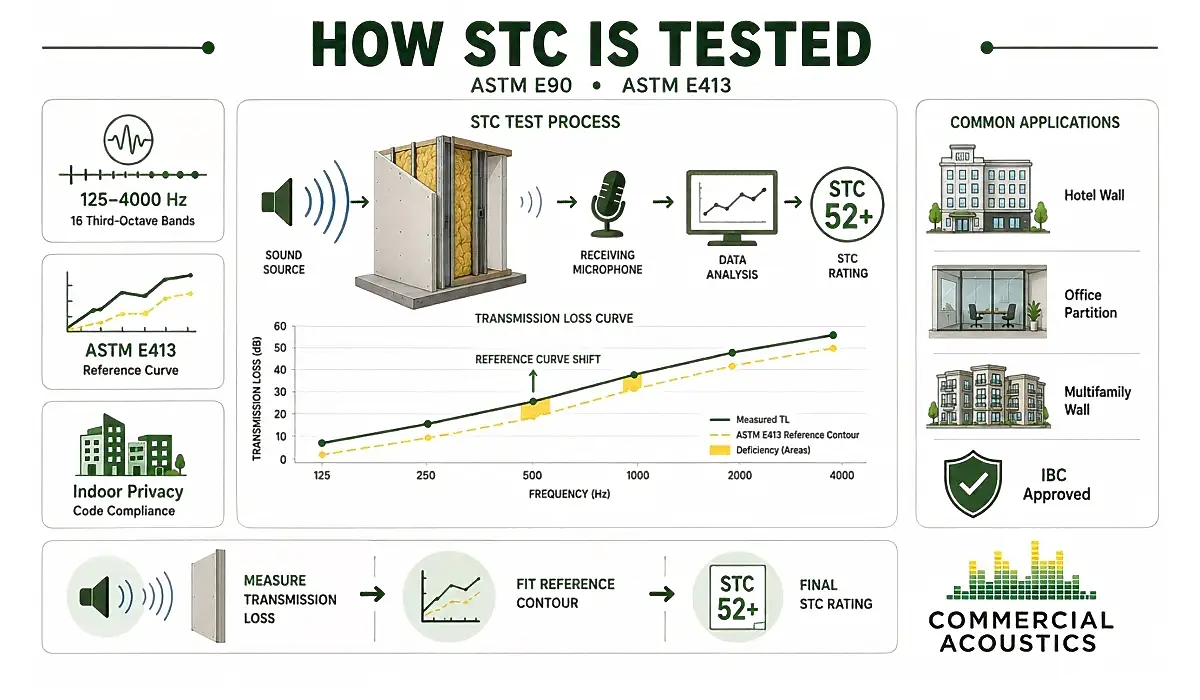
How STC Is Tested (ASTM E90 and E413)
- Measures: Transmission loss across 16 third-octave bands from 125 to 4000 Hz
- Contour: Speech-weighted reference curve from ASTM E413
- Use case: Indoor airborne privacy and code compliance
STC testing compares an assembly against a reference contour optimized for mid-frequency speech isolation. The contour is shifted upward until the sum of all “deficiencies” (bands where the assembly underperforms the contour) reaches a defined ceiling. The contour position at that point becomes the STC value.
That method works well for hospitality demising walls, office partitions, and multifamily party walls. It is the rating IBC and most local codes reference for interior airborne isolation. The Wall Blokker mass-loaded vinyl membrane is a common path to STC 52+ on a single-stud demising wall when paired with two layers of 5/8″ Type X drywall.
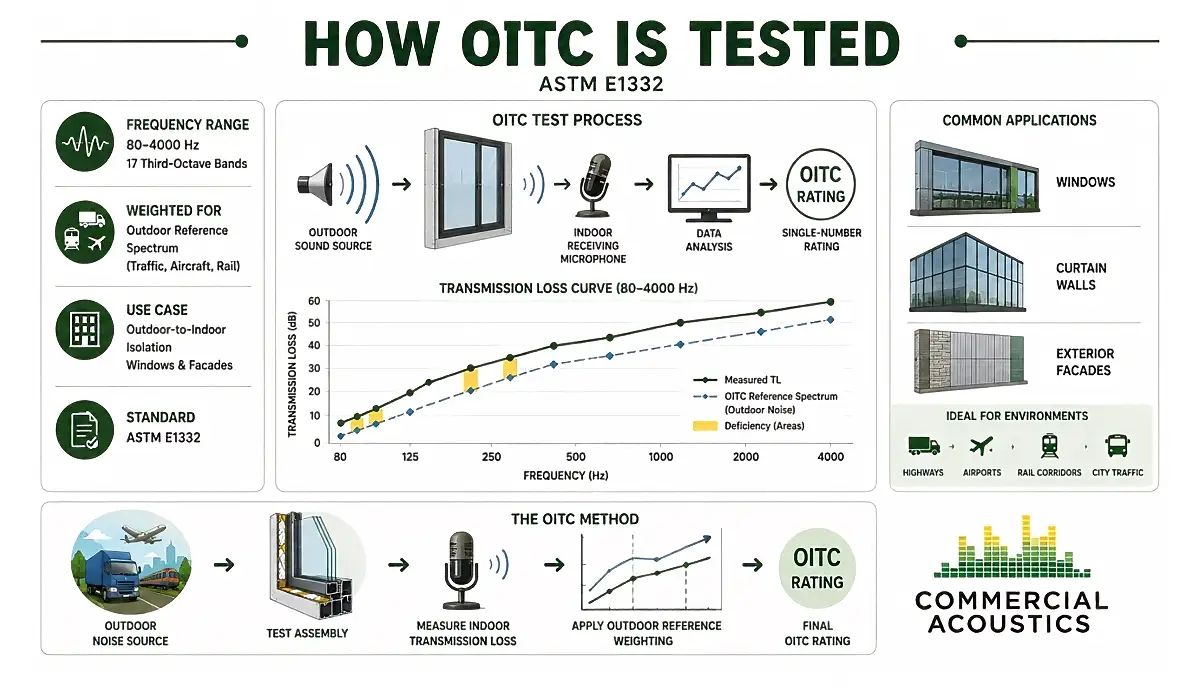
How OITC Is Tested (ASTM E1332)
- Measures: Transmission loss across 17 third-octave bands from 80 to 4000 Hz
- Weighted for: Composite outdoor reference spectrum (aircraft, road, rail traffic)
- Use case: Outdoor-to-indoor isolation for windows and exterior facades
OITC testing incorporates the low-frequency energy found in heavy trucks, buses, rail corridors, and aircraft overflights. These frequencies travel long distances and penetrate easily through glass and thin-clad walls. The OITC method weights the spectrum to match real outdoor noise instead of a speech-tuned contour.
OITC ratings expose the vulnerabilities that STC hides. The result is a single number that actually predicts how a window or facade will perform once the building is sited next to a highway, runway, or rail line.
Typical STC and OITC Ratings for Common Assemblies
| Assembly | STC | OITC |
|---|---|---|
| Interior insulated stud wall (single 5/8″ GWB each side) | 34–38 | N/A (interior) |
| Standard double-pane IGU window | 28–32 | 22–27 |
| Laminated double-pane window | 34–38 | 28–33 |
| Triple-pane + laminated outboard lite | 38–42 | 32–36 |
| Brick veneer over 2×6 wood-frame exterior wall | 48–52 | 40–44 |
| 8″ CMU exterior wall | 50–54 | 44–48 |
These values highlight a hard truth of facade design: glazing is almost always the weak link in exterior noise control. Even high-performance window systems rarely match OITC values of the dense walls around them. That gap is where occupant complaints originate.
Practitioner shorthand: every doubling of glass mass adds roughly 4–5 dB of low-frequency transmission loss. Laminated interlayers shift the coincidence dip up and out of the speech range. Both moves help OITC more than they help STC.
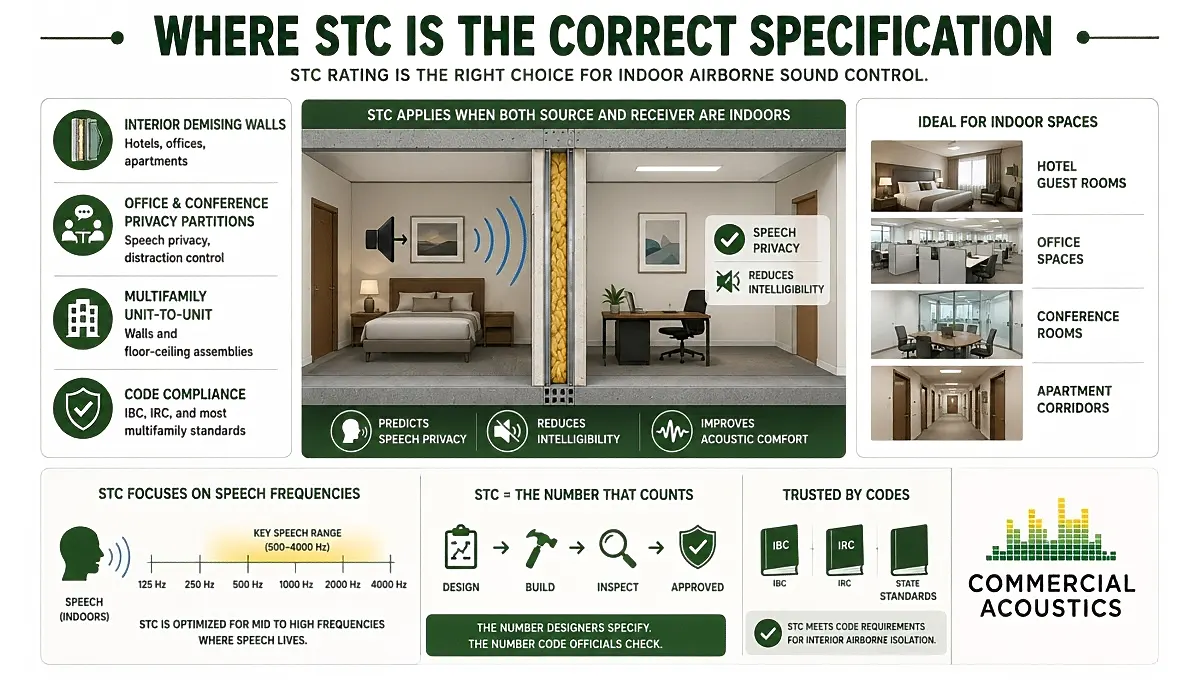
Where STC Is the Correct Specification
- Interior demising walls in hotels, offices, and apartments
- Office and conference room privacy partitions
- Multifamily unit-to-unit walls and floor-ceiling assemblies
- Code compliance for IBC, IRC, and most state-level multifamily standards
STC is the right rating when both the source and the receiver are indoors. It predicts speech privacy, reduces intelligibility between rooms, and maintains acoustic comfort inside the building. For interior airborne isolation, STC is the number that governs design and the number that code officials check.
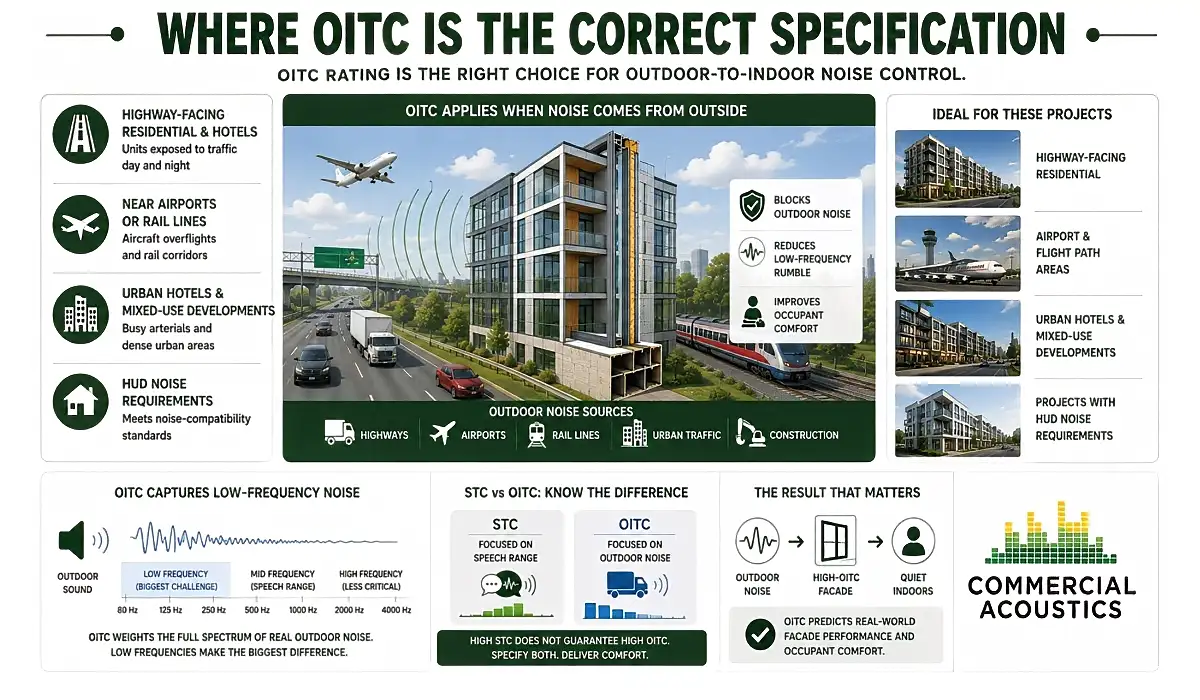
Where OITC Is the Correct Specification
- Highway-facing residential and hospitality units
- Buildings near airports, flight paths, or rail lines
- Urban hotels and mixed-use developments on busy arterials
- Any project with HUD noise-compatibility requirements
Any outdoor noise source pushes you to OITC. Specifying high-STC but low-OITC windows is the number-one cause of low-frequency rumble complaints in newly constructed apartments and hotels. For facade performance, OITC is the rating that governs occupant comfort.
Using STC and OITC Together
- STC governs interior partitions: party walls, corridor walls, demising assemblies
- OITC governs the building envelope: glazing, curtain walls, exterior facades
- Mixed-use or transportation-adjacent sites need both, specified separately by element
A well-coordinated acoustic spec uses STC and OITC together. STC controls indoor privacy. OITC controls outdoor noise intrusion. Projects that specify both, with different minimum values per assembly type, end up with predictable performance and very few post-occupancy complaints.
Specifying Acoustic Performance the Right Way
STC and OITC address completely different acoustic challenges. Treating them interchangeably leads to predictable failures. STC protects indoor privacy and is the standard for demising walls, offices, and interior partitions. OITC protects against outdoor environmental noise and is essential for glazing, curtain walls, and facades near transportation corridors.
The best-performing buildings address both ratings early in design, pay specific attention to low-frequency isolation, and evaluate glazing assemblies separately from opaque walls. When the right rating is applied to the right element, the result is predictable acoustic performance and quieter, more comfortable interiors.
Need Help Specifying STC or OITC?
If you are sizing facade performance for a highway-adjacent multifamily project, an airport-flight-path hotel, or a downtown mixed-use site, the OITC numbers usually drive the glazing budget. Getting the rating right at design development saves a remediation bid two years later.
Send us your floor plans and exterior noise context and we will come back with assembly recommendations and rating targets. Start a project conversation with the acoustic engineering team.
FAQs: STC, OITC, and Exterior Noise Ratings
Is OITC more important than STC?
For exterior noise, yes. OITC measures low-frequency energy from traffic, rail, and aircraft that STC does not capture. For interior partitions, STC is still the right rating.
Why is OITC always lower than STC?
OITC includes long-wavelength energy below 125 Hz that is much harder to block. STC avoids those frequencies entirely, so the same assembly always rates higher on STC.
Can you convert STC to OITC?
No. The two ratings use different frequency ranges and different reference contours. There is no reliable conversion factor between them.
What OITC rating is good for urban buildings?
Most dense urban sites need OITC 30–34 or higher in the window assembly. Highway-adjacent or flight-path sites push that to OITC 35–40 to keep interior dBA in range.
Does code require OITC?
IBC and most state codes still reference STC. HUD noise-compatibility rules and many municipal codes near airports do require OITC. Always confirm against the project AHJ.

Walker Peek|Founder & CEO, Commercial Acoustics
Walker founded Commercial Acoustics in 2013 to bring aerospace-grade engineering discipline to soundproofing, and runs the firm as CEO from its 12,000 sq ft Tampa production facility. The company designs custom acoustic panels, sound membranes, and masking systems for multi-family, hospitality, healthcare, and commercial projects across the US — built around Walker’s invention, Wall Blokker, an EVA-based sound barrier that hits STC 50-plus at roughly $1 per square foot installed.
A Jacksonville native, Walker spent five years at Kennedy Space Center with Craig Technologies before founding Commercial Acoustics — certifying aerospace manufacturing to the AS9100 standard and leading Six Sigma Black Belt process-improvement teams on NASA programs. He is a certified Industrial Noise Control Engineer and the author of Architectural Acoustics: A Practical Handbook.
