Table of Contents
What Is an STC Rating?
- Definition: STC (Sound Transmission Class) measures how well a partition blocks airborne sound between adjacent spaces.
- Scale: The higher the STC, the better the sound isolation performance.
- Purpose: Used to compare wall, door, and window assemblies in architectural and acoustic design.
STC ratings help architects and engineers evaluate how effectively walls and partitions reduce noise transfer. Use the chart below to identify assemblies that meet specific performance goals for privacy, comfort, or code compliance in multi-family, hospitality, and office projects.
STC Rating Chart – Typical Assemblies
| Type | Assembly | Construction | STC | Visual Range | Privacy Level |
|---|---|---|---|---|---|
| WALL | Single ½″ drywall, wood studs 16″ o.c. | Basic residential wall | 33–35 | Speech clearly audible | |
| WALL | Double ½″ drywall, insulation, wood studs | Standard multifamily wall | 40–42 | Loud voices muffled | |
| WALL | Double ⅝″ drywall, insulation, resilient channel | Enhanced privacy wall | 50–52 | IBC code minimum | |
| WALL | ⅝″ drywall + Wall Blokker membrane each side | Tested membrane system | 54–56 | Normal speech inaudible | |
| WALL | Staggered stud wall, ⅝″ drywall each side | Decoupled framing | 55–60 | Hotel-grade privacy | |
| WALL | Double stud wall, insulation, ⅝″ drywall | Fully separated framing | 60–65 | Studio / media room | |
| WALL | 20-gauge load-bearing stud wall + sound membrane | Structural assembly | 52 | Code-level with heavy framing | |
| DOOR | Solid core wood door (1¾″) | Interior door | 30–35 | Limited speech privacy | |
| DOOR | Acoustic door (laminated or sealed frame) | STC 45–50 door | 45–50 | Offices, hospitals, theaters | |
| WINDOW | Double-glazed window (¼″ + ¼″) | Standard insulated glazing | 32–35 | Moderate street noise | |
| WINDOW | Laminated acoustic glazing (¼″ + ⅜″) | Sound-rated window | 40–44 | Highway / urban noise |
Required STC Ratings by Building Type
Code requirements set the floor — most professional specifications aim higher than the minimum, especially when setting senior living wall STC targets for resident privacy and sleep quality. Use this table to translate building type into a target STC.
| Building Type | Code Minimum | Recommended | Visual Range | Source / Notes |
|---|---|---|---|---|
| Multifamily / Apartments | STC 50 | STC 55–60 | IBC §1206 between dwelling units | |
| Hotels & Hospitality | STC 50 | STC 55–60 | Marriott/Hilton brand specs often higher | |
| Hospitals / Healthcare | STC 45–50 | STC 55–65 | FGI Guidelines; HIPAA speech privacy | |
| Office Demising Walls | none | STC 45–55 | Per ANSI/ASA S12.60 for executive privacy | |
| Classrooms | STC 45–50 | STC 50 | ANSI S12.60 between learning spaces | |
| Recording Studios | none | STC 65–75 | Double-stud or decoupled construction required | |
| Theaters / Performance | none | STC 60–70 | House/lobby separation, mechanical room walls | |
| Courtrooms / Conference | none | STC 55–60 | Confidentiality-driven; sound masking common |
Choosing the Right STC Rating
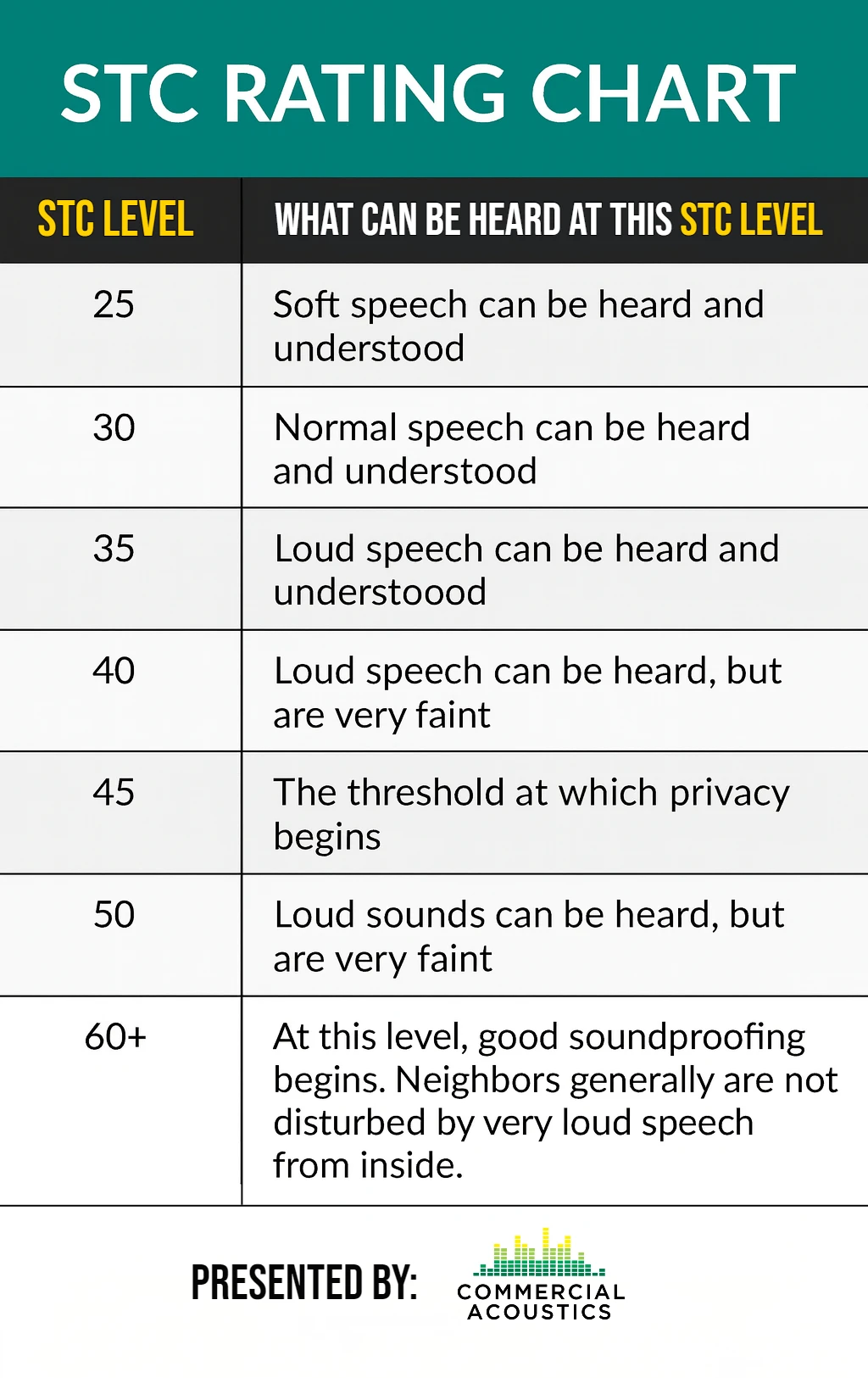
- STC 30–35: Basic separation; normal conversation clearly audible.
- STC 40–45: Moderate privacy; raised voices heard faintly.
- STC 50–55: Code minimum for multi-family; loud speech barely audible.
- STC 60+: High privacy; recommended for theaters, hospitals, and studios.
Each 10-point increase in STC roughly halves the sound energy that passes through a wall — so the jump from STC 50 to STC 60 is the difference between hearing muffled music and hearing nothing at all. Selecting the right assembly during schematic design prevents costly retrofits and ensures comfort across the full life of the building.
Three factors determine which STC target is right for your project:
- Adjacent use type: A bedroom next to a mechanical room demands far higher STC than a closet next to a hallway. Pair the noisy and quiet spaces, not the room labels.
- Wall thickness allowance: STC 55+ generally requires 5½″–7″ wall depth. If your floor plate budget is tight, switch to membrane systems instead of double-stud framing.
- Field STC penalty: Plan for a 2–5 point drop from lab to field. If code calls for STC 50, specify STC 55 to land safely above the line on testing day.
Not sure where to land? Use our STC Calculator to estimate the rating of a planned assembly, or the IIC Calculator if floor-ceiling impact noise is also in scope. Both tools are free and tuned to the field STC penalty so you can size the design correctly the first time.

Field vs. Laboratory Ratings
- Lab STC (LSTC): Measured under perfect test conditions with sealed joints.
- Field STC (FSTC): Real-world measurement that reflects workmanship and flanking paths.
Field STC ratings often test 2–5 points lower than laboratory results due to installation gaps, unsealed penetrations, or shared framing paths. Lab STC follows ASTM E90, and Field STC follows ASTM E336. Learn how to avoid these issues in our Resilient Channel: Best Uses & Worst Mistakes guide.
Conclusion: Building Walls That Deliver Real-World Sound Control
The STC rating chart provides a reliable reference for understanding how different assemblies perform in blocking sound. By selecting materials and configurations that meet your project’s target STC, you can prevent noise complaints, improve tenant satisfaction, and ensure lasting value. Pairing tested assemblies with proper detailing and quality workmanship leads to dependable field results — making every project quieter, more comfortable, and code-compliant from day one.
FAQs: STC Rating Chart
What STC rating is required by code?
The International Building Code requires a minimum of STC 50 between dwelling units (or 45 in field testing). Higher ratings may be specified for hotels, hospitals, or classrooms to meet performance standards.
What STC rating blocks normal conversation?
Walls rated STC 45–50 block most normal conversation, while STC 55+ eliminates clear speech transfer and ensures acoustic privacy.
What’s the difference between STC and NRC?
STC measures how well a partition blocks airborne sound transmission, while NRC measures how much sound a surface absorbs within a room. Both affect perceived noise but in different ways.
Can a wall exceed STC 70?
Yes, but it typically requires double-stud or masonry construction, multiple layers of dense board, and complete decoupling between framing systems. Such assemblies are used in studios or performance spaces.
Can Commercial Acoustics help design STC-rated walls?
Yes. Our acoustic specialists provide lab-tested assemblies, material recommendations, and field testing services to help you achieve target STC ratings efficiently and consistently.
Walker Peek|Founder & CEO, Commercial Acoustics
Walker founded Commercial Acoustics in 2013 to bring aerospace-grade engineering discipline to soundproofing, and runs the firm as CEO from its 12,000 sq ft Tampa production facility. The company designs custom acoustic panels, sound membranes, and masking systems for multi-family, hospitality, healthcare, and commercial projects across the US — built around Walker’s invention, Wall Blokker, an EVA-based sound barrier that hits STC 50-plus at roughly $1 per square foot installed.
A Jacksonville native, Walker spent five years at Kennedy Space Center with Craig Technologies before founding Commercial Acoustics — certifying aerospace manufacturing to the AS9100 standard and leading Six Sigma Black Belt process-improvement teams on NASA programs. He is a certified Industrial Noise Control Engineer and the author of Architectural Acoustics: A Practical Handbook.