Recommended IIC Ratings by Floor & Building Type
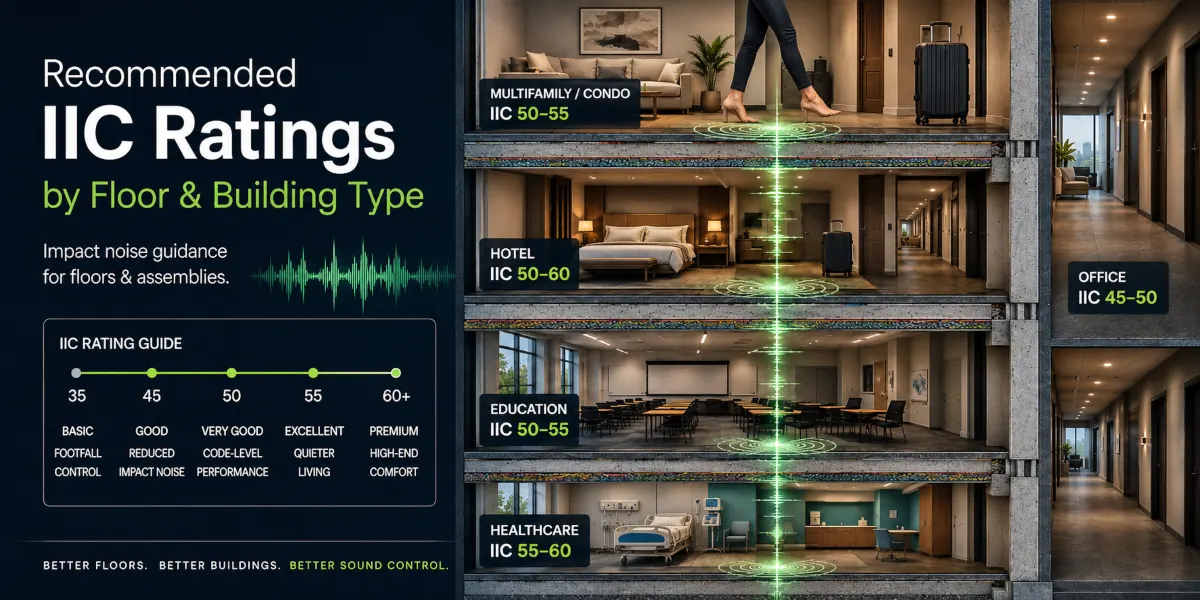
Table of Contents
What Are Recommended IIC Ratings?
The recommended IIC rating for a floor-ceiling assembly is the target Impact Insulation Class value that keeps footsteps, dropped objects, and other impact noise from disturbing the space below. Unlike STC (which measures airborne sound through walls), IIC measures structure-borne noise traveling through floors — the kind a neighbor’s heels, a rolling chair, or a dropped phone create.
IIC is tested in a lab per ASTM E492 using a standardized tapping machine on the floor above, while a microphone in the room below measures how much sound transmits through. Field-tested values are reported as AIIC per ASTM E1007. The higher the number, the better the assembly blocks impact noise.
This guide gives you the recommended target IIC values used by the International Building Code (IBC), FGI Guidelines, ANSI S12.60, LEED v4, and major hospitality brand standards — organized by application and the space below.
Recommended IIC Ratings Chart by Application
Find your floor application on the left, the space directly below in the middle, and the recommended target IIC on the right.
| Application | Space Below | Target IIC | Driver |
|---|---|---|---|
| Hotels | Guest room above guest room | 55+ | Brand standard for upscale hotels |
| Apartments | Unit above unit | 50+ | IBC code minimum (meets requirement) |
| Mid-Market Condos | Unit above unit | 50+ | Market standard for condo product |
| Luxury Condos | Unit above unit | 60+ | Quality expectation for luxury buyers |
| Offices / Commercial | Occupied space below | 40+ | Light foot traffic; minimal impact |
| Schools (Ancillary) | Occupied space below | 40+ | ANSI S12.60 support spaces |
| Schools (Core Learning) | Occupied space below | 45+ | ANSI S12.60 classroom standard |
Recommended IIC ratings by application. Sources: LEED v4 and David M. Egan, Architectural Acoustics.
Expected IIC by Floor-Ceiling Assembly
Once you know your target IIC, the next question is which floor-ceiling assembly will hit it. The table below shows expected IIC values across the three most common variables: ceiling type, acoustic underlayment thickness, and floor finish — for both wood-joist and concrete structures. Find your assembly, read across to your floor finish, and the cell shows the expected IIC. Cells in green meet or exceed IBC code (IIC 50); cells in yellow or red fall short of code minimums.
← Scroll table horizontally →
| Ceiling Type | Underlayment | 🪵Wood Joist | 🪩Concrete | ||||||||
|---|---|---|---|---|---|---|---|---|---|---|---|
| LVT | Carpet | Tile | Laminate | Hardwood | LVT | Carpet | Tile | Laminate | Hardwood | ||
| Exposed Ceiling | None | 33 | 47 | 30 | 32 | 32 | 36 | 50 | 33 | 35 | 35 |
| 2mm | 37 | 51 | 34 | 36 | 36 | 40 | 54 | 37 | 39 | 39 | |
| 3mm | 38 | 52 | 35 | 37 | 37 | 41 | 55 | 38 | 40 | 40 | |
| 5mm | 45 | 59 | 42 | 44 | 44 | 48 | 62 | 45 | 47 | 47 | |
| 10mm | 48 | 62 | 45 | 47 | 47 | 51 | 65 | 48 | 50 | 50 | |
| Direct-Mounted Drywall | None | 35 | 49 | 32 | 34 | 34 | 38 | 52 | 35 | 37 | 37 |
| 2mm | 39 | 53 | 36 | 38 | 38 | 42 | 56 | 39 | 41 | 41 | |
| 3mm | 40 | 54 | 37 | 39 | 39 | 43 | 57 | 40 | 42 | 42 | |
| 5mm | 47 | 61 | 44 | 46 | 46 | 50 | 64 | 47 | 49 | 49 | |
| 10mm | 50 | 64 | 47 | 49 | 49 | 53 | 67 | 50 | 52 | 52 | |
| Resiliently-Mounted Drywall | None | 43 | 57 | 40 | 42 | 42 | 46 | 60 | 43 | 45 | 45 |
| 2mm | 47 | 61 | 44 | 46 | 46 | 50 | 64 | 47 | 49 | 49 | |
| 3mm | 48 | 62 | 45 | 47 | 47 | 51 | 65 | 48 | 50 | 50 | |
| 5mm | 55 | 69 | 52 | 54 | 54 | 58 | 72 | 55 | 57 | 57 | |
| 10mm | 58 | 72 | 55 | 57 | 57 | 61 | 75 | 58 | 60 | 60 | |
Expected IIC values by floor-ceiling assembly combination. Reference values from acoustic underlayment lab test data. Field-tested AIIC values typically run 3–5 points lower.
How to read this chart: the biggest IIC swings come from two factors — ceiling type (resilient-mounted drywall adds 10–15 points over an exposed ceiling) and floor finish (carpet adds 14–17 points over tile or LVT). A 5mm or 10mm acoustic underlayment makes the difference between failing and passing code for most hard-surface flooring assemblies.
What Each IIC Rating Means in Practice
Picking a target IIC is easier when you know what people in the unit below will actually hear. Here's how each IIC level translates to real-world impact isolation:
Effectiveness of impact isolation by IIC rating. The bar shows how much impact noise passes through the floor — shorter is better.
Hotel IIC Ratings & Brand Standards
Hotel IIC targets, like STC, are set by brand standard rather than building code. Industry norms by segment:
The industry-standard target for hotel guest room floors is IIC 55+ (per LEED v4 and Egan's Architectural Acoustics). Luxury and upscale brands often specify higher; some economy properties design closer to the IBC apartment code minimum of IIC 50. Specific targets are set in the franchise design manual — check yours before finalizing the floor assembly.
Carpeted hotel floors hit IIC 55+ easily; hard-surface flooring (tile, LVT, hardwood) requires a high-performance acoustic underlayment such as our AcoustiStep sound mat to reach the same target.
Apartment & Condo IIC Code Requirements
Like STC, IIC is required by code for multifamily. The International Building Code (IBC) mandates:
- IIC 50 (lab-tested per ASTM E492) for floor-ceiling assemblies between dwelling units
- IIC 50 (lab-tested) for floors between a dwelling unit and a public corridor
- IIC 45 (field-tested / AIIC per ASTM E1007) if measured on-site instead of in a lab
IIC 50 is the code minimum. Per LEED v4 and Egan's Architectural Acoustics, common targets by product class are IIC 50+ for apartments and mid-market condos and IIC 60+ for luxury condos where footfall noise drives buyer satisfaction.
Hard-surface flooring is the #1 cause of IIC failures in the field. Tile and LVT can drop a wood-joist assembly's IIC by 10–15 points without the right underlayment. For more detail on the relationship between STC and IIC in field testing, see our guide on STC, IIC, and Delta IIC explained.
Office & Commercial IIC Targets
Office IIC targets are driven by occupant comfort, not code. The threshold most consultants design to:
Per LEED v4 and Egan's Architectural Acoustics, the standard target for office and commercial floor-ceiling assemblies is IIC 40+. Higher targets are sometimes specified for spaces with elevated occupant expectations or heavier foot traffic above (executive suites, restaurants, retail-over-residential), but values vary by project — review your specific scenario with an acoustical consultant or reference manufacturer assembly test data.
School & Classroom IIC Ratings (ANSI S12.60)
ANSI S12.60 sets the acoustical standard for schools. For floor-ceiling assemblies, target:
- Core learning spaces (classrooms) over occupied space: IIC 45+
- Ancillary spaces (offices, support) over occupied area: IIC 40+
Music, dance, and gym spaces produce far heavier impact noise (instruments, jumping, dropped weights) and require higher IIC targets case-by-case — consult the manufacturer's underlayment test data or an acoustical engineer for these scenarios.
Healthcare IIC Ratings (FGI Guidelines)
The Facility Guidelines Institute (FGI) Guidelines for the Design and Construction of Hospitals govern healthcare acoustics, including impact noise between patient rooms and over support spaces. Targets vary by space type and FGI edition — refer to the current FGI document for the specific IIC values applicable to your project.
Concrete vs Wood Joist Assemblies
A common misconception: concrete floors always outperform wood joist for IIC. They don't.
Concrete is heavier and excels at airborne sound (STC), but for impact sound (IIC) it can actually perform worse than a well-designed wood-joist assembly. The reason: concrete is rigid and transmits structure-borne vibration efficiently. Without an acoustic underlayment, a bare concrete slab might only hit IIC 25–30 — well below code.
What drives IIC in real assemblies:
- Floor finish: Carpet on padding can add 20+ IIC points; tile and hardwood can subtract 10–15.
- Acoustic underlayment: A 5–10mm rubber or foam mat under hard flooring is the single most effective IIC upgrade. Edge isolation is critical — mats that touch the wall transmit sound through the flanking path.
- Ceiling assembly below: Resilient channels, decoupled ceilings, and insulated cavities all add IIC.
- Workmanship: Penetrations, gaps, and short-cuts at the floor edge regularly drop field IIC by 5–10 points vs lab numbers.
Because IIC is notoriously hard to model, design decisions should reference lab test data. The Canadian National Research Council (CNRC) publishes extensive assembly test data, and reputable underlayment suppliers will provide both lab- and field-test results on request.
How to Choose the Right Target IIC
The right IIC target balances three factors:
- What's on each side of the floor. A bedroom under a kitchen has a very different requirement than an office under an office. Use the chart above — never pick a number in isolation.
- What's required by code or contract. IBC code (IIC 50 for multifamily), FGI for healthcare, ANSI S12.60 for schools, brand standards for hospitality, and LEED v4 IEQ credits all carry hard or soft IIC requirements.
- What flooring is going on top. Hard surfaces drop field IIC by 10–15 points without underlayment. Specify the assembly (slab + underlayment + finish + ceiling) as a system, not piece by piece.
Next Steps: Hitting Your Target IIC
Once you've identified your target IIC, the next question is which underlayment and ceiling assembly will get you there cost-effectively. Browse our line of AcoustiStep sound mats or use our IIC Calculator to estimate assembly performance. For a deeper look at IIC fundamentals, see IIC Rating 101.
FAQs: Recommended IIC Ratings
What is a good IIC rating?
A "good" IIC depends on the application. IIC 50 is the IBC code minimum for apartment and condo floors and is the most common target. IIC 55–60 is considered good for luxury condos and upscale hotels. IIC 65+ is reserved for music studios, dance studios, and gyms.
What is the recommended IIC for an apartment floor?
The IBC requires IIC 50 for floor-ceiling assemblies between dwelling units. Luxury condos commonly target IIC 60+ (per LEED v4 and Egan, Architectural Acoustics) where unit-to-unit footfall is a known complaint driver.
What is the recommended IIC for a hotel?
Hotel IIC targets are set by brand standard. The industry-standard target is IIC 55+ between guest rooms (per LEED v4 and Egan, Architectural Acoustics). Specific brand-segment targets are documented in the franchise design manual.
Is IIC 50 enough?
IIC 50 meets IBC code for multifamily but it only blocks normal footsteps — heavy footsteps and dropped objects will still be audible below. For Class A product or any project where resident satisfaction matters, design to IIC 55 or higher.
What's the difference between IIC and STC?
STC (Sound Transmission Class) measures airborne sound — voices, TV, music — passing through walls and floors. IIC (Impact Insulation Class) measures structure-borne sound — footsteps, dropped objects — passing through floor-ceiling assemblies. A wall has an STC rating only. A floor-ceiling assembly has both an STC and an IIC rating.
What's the difference between IIC and AIIC?
IIC is lab-tested per ASTM E492 under controlled conditions. AIIC (Apparent IIC) is field-tested in the completed building per ASTM E1007 and includes flanking transmission — typically 3–5 points lower than the lab IIC. IBC accepts AIIC 45 as equivalent to lab IIC 50.