Table of Contents
How We Ranked the Loudest MLS Stadiums
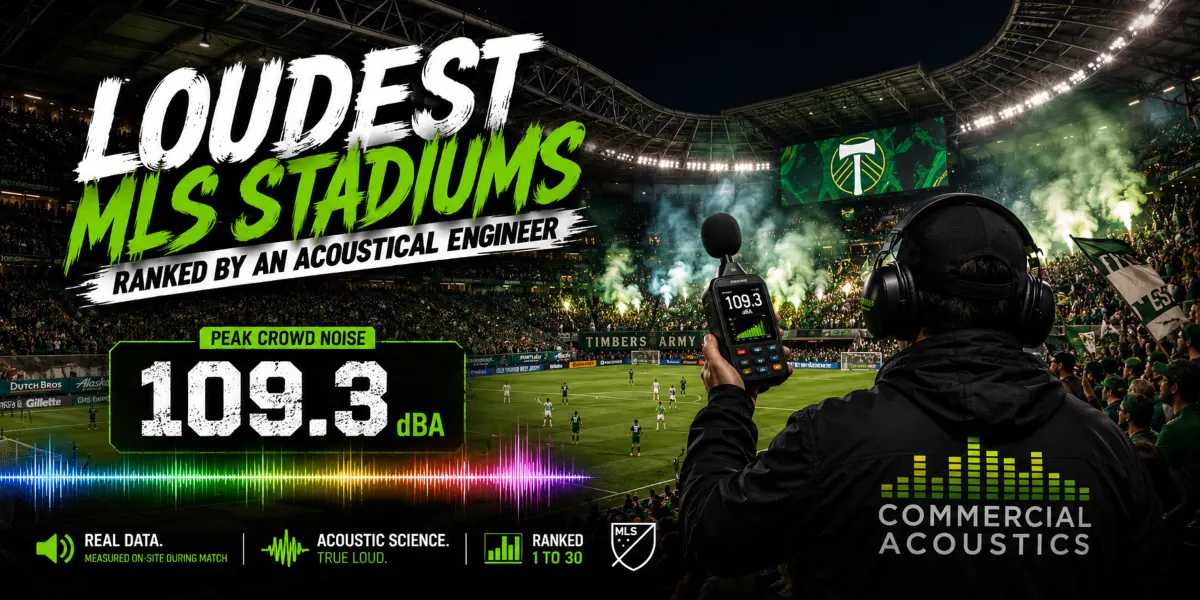
Crowd noise in an MLS stadium is a different physics problem than the NFL, NBA, or NHL. Soccer atmospheres are sustained, not peak. The drum, the capo, the tifo unfurl, the 90-minute chant — the loudness is a steady-state event, not a burst on a single play. After two decades specifying sound systems and acoustic treatment for venues, we have opinions about which MLS bowls earn the “loudest” label and which just have a loud supporter section in an otherwise dead room.
No MLS stadium has a Guinness-verified record. The only American sports venue with one is Arrowhead Stadium (Kansas City Chiefs, 142.2 dBA, 2014) — a number no soccer match anywhere has approached. So we built an editorial index instead of pretending one exists for MLS.
- 35 PTSArchitectural Acoustics: bowl tightness, roof overhang on supporter sections, soccer-specific versus NFL/baseball shared, surface materials.
- 35 PTSSustained Crowd Baseline: supporter group size and tradition (Nordecke, 3252, Timbers Army, ECS, Blue Hell, Sons of Ben, The Bailey), capo and drum culture, 90-minute chant intensity.
- 20 PTSAttendance Density: 2025 average attendance versus MLS-configured capacity. A packed 18k bowl outweighs a half-empty 60k one.
- 10 PTSOperational Design: capo platforms, drum lines, tifo display areas, PA shaping for supporter chants.
The result is the CA (Commercial Acoustics) Loudness Index, a 0-to-100 score you should read as informed opinion, not a calibrated SPL (Sound Pressure Level) measurement. A side metric, Per 1k Seat, rewards smaller-bowl clubs whose supporters punch above their seat count — so Sporting KC at 18,467 capacity is not unfairly dinged for having fewer chairs than the NFL-bowl tenants. For context on what individual decibel levels actually mean at the ear, our dB chart for occupied spaces covers the full range from quiet office to threshold of pain.
All 30 MLS Clubs, Ranked by Stadium Loudness



This index is informed editorial, not metrology. No MLS-wide calibrated dataset exists. Newsweek’s 2025 Fans’ Choice Award named Atlanta United the Loudest MLS Home Pitch, and the supporter group reputations of Nordecke (Columbus), Timbers Army (Portland), ECS (Seattle), 3252 (LAFC), and Blue Hell (Sporting KC) drive the rest of the top tier.
Top Ten Loudest MLS Stadiums, Broken Down
 #1 Atlanta United | Mercedes-Benz Stadium
Atlanta United won Newsweek’s 2025 Fans’ Choice Award for Loudest MLS Home Pitch, and the math backs it up. Mercedes-Benz Stadium is a true dome — the only one in our top tier — and the lower-bowl MLS configuration packs 42,500 fans into a building engineered to reflect every chant from the supporter sections back onto the pitch. The 2025 average attendance of 45,600 is the highest in the league by ten thousand fans.
 #2 Seattle Sounders | Lumen Field
Lumen Field was designed for noise. Architects intentionally covered 70% of the seats and angled the roof to amplify crowd sound — the same building that holds the former Guinness record for crowd roar at any sporting event (137.6 dBA, set by the NFL Seahawks in 2013). Sounders matches don’t peak that high, but the Emerald City Supporters (ECS) sustain a baseline most MLS clubs cannot touch, with 30,831 fans averaging across the 2025 season.
 #3 Portland Timbers | Providence Park
Providence Park opened in 1926 and is the oldest soccer-specific bowl in MLS. The Timbers Army packs into a 25,218-capacity stadium with sightlines so tight visitors complain they can hear individual chants from the field. “No Pity in the Rose City” is sustained from kickoff to whistle, and the wood-and-steel building from a century ago still has the reflective shell that compresses every drumbeat back onto the pitch.
 #4 Columbus Crew | ScottsMiracle-Gro Field
ScottsMiracle-Gro Field opened in 2021 (originally Lower.com Field) and the Nordecke supporter section is the second-largest in MLS at 3,364 standing-only spots. Steep sightlines and a soccer-specific bowl mean the Crew won the 2023 MLS Cup playing in front of a stadium that sounds bigger than its 20,011 capacity suggests. 2025 set a new club average attendance record of 22,795.
 #5 FC Cincinnati | TQL Stadium
TQL Stadium opened in 2021 with The Bailey supporter section dialed in from day one. The intimate 26,000-seat bowl with translucent ETFE skin (similar architecturally to U.S. Bank Stadium in the NFL) lets FC Cincinnati’s relatively new fanbase punch above its age. The bowl’s tight pitch-to-seat distance is the key acoustic asset.
 #6 Sporting Kansas City | Children’s Mercy Park
Children’s Mercy Park is the smallest top-tier bowl in MLS at 18,467 capacity, and Sporting KC’s “Blue Hell” supporter culture is the densest in the league. The Cauldron supporters concentrate noise into a building where every seat feels like the front row — and the per-occupied-seat math reflects it. SKC’s Per 1k Seat score leads the league.
 #7 Los Angeles FC | BMO Stadium
BMO Stadium hasn’t had an empty seat since LAFC’s 2018 debut. The 3252 supporters group (named for the latitude of the stadium) packs the north end and sustains a baseline through 90 minutes that visiting teams routinely call the most uncomfortable road environment in the western conference. Intimate 22,000-seat bowl in the middle of downtown LA does the architectural work.
 #8 St. Louis CITY SC | CITYPARK
CITYPARK is the newest soccer-specific stadium in MLS (opened 2023) and St. Louis CITY SC sold every match through their first two seasons. The 22,500-capacity bowl has a steep rake and a reflective roof line that the St. Louis Ligue 1 supporter group exploits with sustained Bundesliga-style chanting that no other expansion club has matched.
 #9 Philadelphia Union | Subaru Park
Subaru Park sits on the Delaware River with a 18,500-capacity bowl that the Sons of Ben supporters group has occupied loudly since 2010. The Union have built one of the most consistent atmospheres in MLS — small bowl, steep rake, deep supporter culture, and the kind of working-class identity that produces sustained noise across 90 minutes.
 #10 Nashville SC | GEODIS Park
GEODIS Park is the largest soccer-specific stadium in MLS at 30,000 capacity. Nashville SC averaged 25,204 fans in 2025 and The Backline supporter group has built a country-music-meets-football atmosphere unique in the league. The 30,000 capacity hurts the per-seat math but the absolute crowd size compensates.
The 2026 MLS Loudness Awards
Engineered for Sound
(Newsweek 2025)
Deepest Supporter Culture
Atlanta United took home Newsweek’s 2025 Fans’ Choice Award for Loudest MLS Home Pitch, with a 2025 average attendance of 45,600 in the only true dome in our top tier. Seattle takes silver as our editorial #2 in the CA (Commercial Acoustics) Loudness Index. Sporting Kansas City earns the bronze for the most noise per occupied seat in the league — the smallest top-tier bowl (18,467) with the deepest supporter culture, “Blue Hell.”
The 2026 MLS Sadness Awards

NFL Bowl — Vast and Empty
in MLS (2025)

NFL Stadium
Three clubs share the bottom of the index. FC Dallas posted the worst average attendance in MLS in 2025 at 11,004 fans per match — barely half of a 20,500-capacity stadium. The Revs and the Fire share the same architectural problem from a different angle: both play MLS matches in NFL bowls (Gillette and Soldier Field), where 18-20k supporters disappear into a 60-plus-thousand-seat venue. Per-occupied-seat math punishes them in our index because the buildings were never designed for soccer.
Why Some MLS Stadiums Get Loud and Others Do Not
Put the same 22,000 supporters in two different stadiums and you can get wildly different atmospheres. The crowd is only the source. The building decides what happens to the sound after it leaves their mouths. Four design factors do most of the work in MLS, and they are weighted differently than in the NFL because soccer is a sustained-noise sport instead of a peak one.
1. Soccer-Specific Versus Shared NFL Bowl
The bottom of our index is dominated by MLS clubs playing in NFL stadiums. The Revs at Gillette and the Fire at Soldier Field both put 17-20,000 supporters in 60-plus-thousand-seat bowls, and the math punishes them. Atlanta United is the exception that proves the rule — Mercedes-Benz Stadium is also an NFL bowl, but the dome trap and the 45,600-fan average attendance overwhelm the dilution.
2. Bowl Geometry: Why Children’s Mercy Park Hits Per Seat
Tight bowls with steep rakes pack supporters close to the pitch. Children’s Mercy Park at 18,467 seats packs more fans per cubic foot than Bank of America Stadium at 38,000, and the per-seat math reflects it. Sporting KC’s Blue Hell produces the highest sustained crowd pressure per occupied chair in MLS because the building lets them.
3. Roof Overhang on Supporter Sections
Open-air pitches let crowd noise escape upward — bad for absolute loudness but it keeps the bowl from drowning in reverberation. Modern soccer-specific stadiums (Lower.com Field, TQL, Q2, CITYPARK, Allianz Field) use partial roof overhangs specifically over the supporter sections to bounce sustained chant energy back toward the pitch without trapping the whole bowl. You can estimate how a room’s volume and surfaces drive its decay using a room acoustics calculator.
4. Supporter Culture: Why Atlanta and Portland Both Win
Architecture sets the ceiling. Supporter culture decides whether you hit it. Atlanta wins by absolute crowd size (45,600 in a dome). Portland wins by supporter density (25,218 packed into a 99-year-old bowl). Columbus wins by section design (Nordecke is 3,364 standing only). Three different recipes, three top-five finishes. The common thread is supporters who never sit down for 90 minutes.
The Designer’s Real Problem: Roar Versus Clarity
Why Loud Atmospheres Kill the PA
Here is the tension no fan thinks about. Everything that makes a soccer stadium sound enormous also makes the public address system unintelligible. A long reverberation time smears speech into mush, so the announcer, the goal call, and the emergency PA all suffer in the exact conditions that produce the best atmosphere. MLS stadiums amplify the problem because VAR reviews, substitution announcements, and added-time displays all depend on a PA system that has to fight 90 minutes of sustained supporter noise.
How Modern Soccer-Specific Stadiums Split the Difference
Newer MLS soccer-specific builds solve it with targeted absorption. Absorptive material lines the upper concourses and back walls to kill runaway reverberation, while the supporter-section overhangs stay reflective to bounce chant energy back down. Acoustic ceiling clouds appear in concourse and concession areas to keep the building functional outside the supporter end. Open-air pitches get reverb control for free, but lose some of the SPL that domed buildings like Mercedes-Benz Stadium produce.
The Same Tradeoff in Smaller Rooms
The same physics scales down to any space where a crowd and a sound system share a hard-surfaced room. We work through that tradeoff with acoustic absorption panels for gyms, restaurants, and event halls — taming the reverberation without killing the energy that makes the room worth being in.
How Loud Is Too Loud at an MLS Match?
- 130 dBA: threshold of pain for many listeners — no MLS stadium reliably hits this; reserved for NFL/concert territory.
- 120 dBA: safe exposure under 9 seconds, chainsaw or close-range siren territory.
- 110 dBA: safe exposure under 90 seconds — peak goal celebrations at top MLS venues plausibly touch this briefly.
- 105-110 dBA: sustained baseline for top-tier MLS supporter sections during 90-minute matches.
- 100 dBA: NIOSH safe exposure drops to about 15 minutes — typical Atlanta or Seattle baseline.
- 85 dBA: OSHA permissible exposure limit averaged over 8 hours.
NIOSH uses a 3 dB exchange rate, meaning every 3 dB doubles the sound energy and halves the safe exposure time. A sustained 105 dBA supporter section delivers one hundred times the acoustic energy of an 85 dBA office. The roar lasts 90 minutes, not seconds, and that cumulative exposure is the real hearing-health question for MLS supporters who attend 17 home matches a season in the front rows.
Goalkeepers and field-level officials face the same cumulative risk that NFL sideline staff do. Capo platforms and drum lines deliver SPL right at the ear of the supporters near them. We see anecdotal evidence of supporter-section regulars wearing custom earplugs at LAFC, Seattle, Portland, and Columbus — the same hearing-protection move NFL officials make at Arrowhead and Lumen Field.
What Stadium Design Teaches Office and Venue Acoustics
The same physics that makes Mercedes-Benz Stadium ring during a packed MLS match makes a hard-finished restaurant unbearable at conversation volume. Reflective walls, hard floors, no absorption. The bowl-of-soup effect scales down to any room you have ever shouted in.
For commercial spaces where the goal is the opposite — speech clarity, lower noise floor, sustainable acoustic comfort — the design moves are the inverse of an MLS supporter end. Add absorption at the reflective surfaces, break up parallel walls, control reverberation. Our acoustic absorption panels address the surface-finish side of that equation directly.
HVAC noise floor matters too. A target NC rating that is too low leaves the room exposed to every footfall and HVAC ramp. A target that is too high masks speech privacy. The NC rating chart for occupied spaces covers the right targets by room type.
Conclusion: The Real Engine Behind a Loud Soccer Stadium
Supporter volume is a fan-energy story everyone wants to tell, but the building writes half the script in MLS too. A tight bowl, a partial roof overhang on the supporter section, the right balance of reflective and absorptive surfaces. Those choices decide whether 22,000 chanting fans sound like a 90-minute wall of noise or a polite hum in an oversized NFL stadium.
Atlanta won Newsweek’s 2025 Fans’ Choice, but the design moves that made Mercedes-Benz Stadium loud are the same moves we ask architects to avoid in every restaurant, classroom, and open office we treat. If you want to know how an acoustical engineering team thinks about rooms like these, the people behind this work have spent the last 17 years doing exactly that.
FAQs: Loudest MLS Stadiums
What is the loudest MLS stadium?
Atlanta United’s Mercedes-Benz Stadium won Newsweek’s 2025 Fans’ Choice Award for Loudest MLS Home Pitch. The dome amplification, the 45,600 average attendance (highest in MLS), and the supporter sections (Terminus Legion and Footie Mob) combine into the most consistent atmosphere in the league.
Is there a Guinness record for MLS crowd noise?
No. The only verified Guinness record for crowd roar at a sporting event belongs to Arrowhead Stadium in Kansas City at 142.2 dBA (NFL Chiefs, 2014). No MLS match has been measured at that level. Top MLS supporter sections sustain 105-110 dBA across 90 minutes rather than peaking on individual plays — soccer is a sustained-noise sport, not a burst one.
What is the loudest MLS stadium per seat?
Children’s Mercy Park (Sporting Kansas City). At 18,467 capacity it is the smallest top-tier MLS bowl, and Sporting KC’s Blue Hell supporter culture produces the highest noise per occupied seat in the league at 4.66 on our Per 1k Seat metric.
Why are MLS matches in NFL stadiums quieter?
The Revs at Gillette and the Fire at Soldier Field both put 17-20,000 MLS supporters in 60-plus-thousand-seat NFL bowls. The empty upper deck dilutes the per-seat sound pressure and the acoustics are tuned for football, not 90-minute supporter chants. Atlanta United is the exception — Mercedes-Benz Stadium’s dome and 45,600 average attendance overwhelm the dilution.
How loud is too loud for a soccer supporter?
NIOSH considers 100 dBA safe for about 15 minutes and 110 dBA for under 90 seconds. Sustained MLS supporter sections routinely run 100-108 dBA across 90-minute matches, which adds up to far more cumulative acoustic energy than a single NFL peak. Front-row regulars at LAFC, Seattle, Portland, and Columbus should consider custom earplugs for season-long exposure.
Sources & Data Notes
Capacity figures use the standard MLS-game configuration (Atlanta lower bowl, Seattle reduced upper, Charlotte lower bowl, Vancouver curtained). Soldier Field and Gillette Stadium are listed at full NFL capacity since the Fire and Revs do not curtain off the upper decks — that decision is part of the acoustic problem these clubs face.
- Newsweek 2025 Fans’ Choice — Loudest MLS Home Pitch: Atlanta United winner, announced 2025.
- 2025 MLS average attendance leaders: Atlanta 45,600; Charlotte 33,019; Seattle 30,831; San Diego 27,715; Nashville 25,204. Worst: FC Dallas 11,004. League-wide average 21,988 per Major League Soccer attendance reporting.
- Supporter section sizes: Columbus Nordecke is the 2nd-largest at 3,364 standing-only spots; LAFC 3252 fills the north end every match; Sporting KC’s Cauldron is the densest per capita.
- Arrowhead Stadium 142.2 dBA Guinness record (cross-league context): Guinness World Records, Kansas City Chiefs vs Patriots, Sept 29, 2014.
- OSHA / NIOSH exposure limits: 29 CFR 1910.95 and NIOSH Publication 98-126 (3 dB exchange rate).
The CA Loudness Index is editorial. It synthesizes architectural acoustics, supporter group reputation, 2025 attendance density, and Newsweek’s Fans’ Choice ranking into a single 0-to-100 score. The top 10 are scored on documented reputation and verified attendance; the back half leans more on capacity dilution, NFL-bowl tax, and supporter-section size since published loudness data thins out fast across 30 MLS stadiums.

Walker Peek|Founder & CEO, Commercial Acoustics
Walker founded Commercial Acoustics in 2013 to bring aerospace-grade engineering discipline to soundproofing, and runs the firm as CEO from its 12,000 sq ft Tampa production facility. The company designs custom acoustic panels, sound membranes, and masking systems for multi-family, hospitality, healthcare, and commercial projects across the US — built around Walker’s invention, Wall Blokker, an EVA-based sound barrier that hits STC 50-plus at roughly $1 per square foot installed.
A Jacksonville native, Walker spent five years at Kennedy Space Center with Craig Technologies before founding Commercial Acoustics — certifying aerospace manufacturing to the AS9100 standard and leading Six Sigma Black Belt process-improvement teams on NASA programs. He is a certified Industrial Noise Control Engineer and the author of Architectural Acoustics: A Practical Handbook.
