Table of Contents
Project Overview: Modern Sanctuary Acoustic Design
- Project: Modern Sanctuary Acoustic Design for a New Worship Build
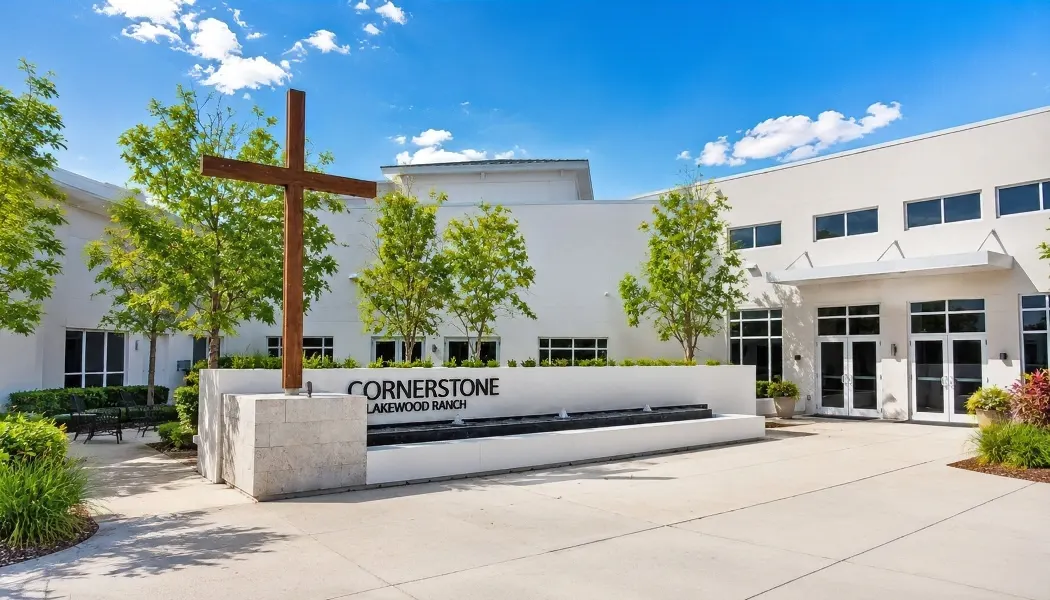
- Location: 14306 Covenant Way, Lakewood Ranch, FL 34202
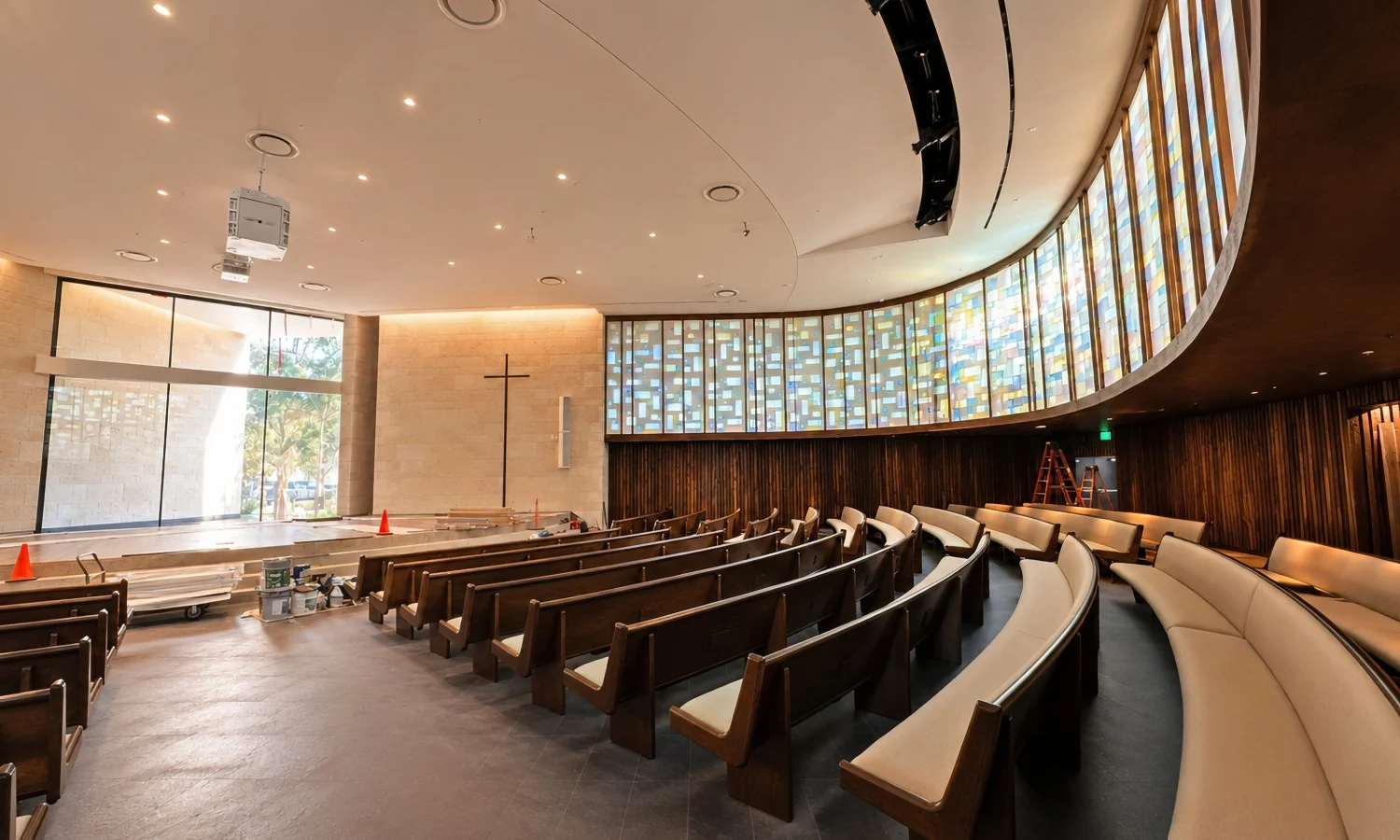
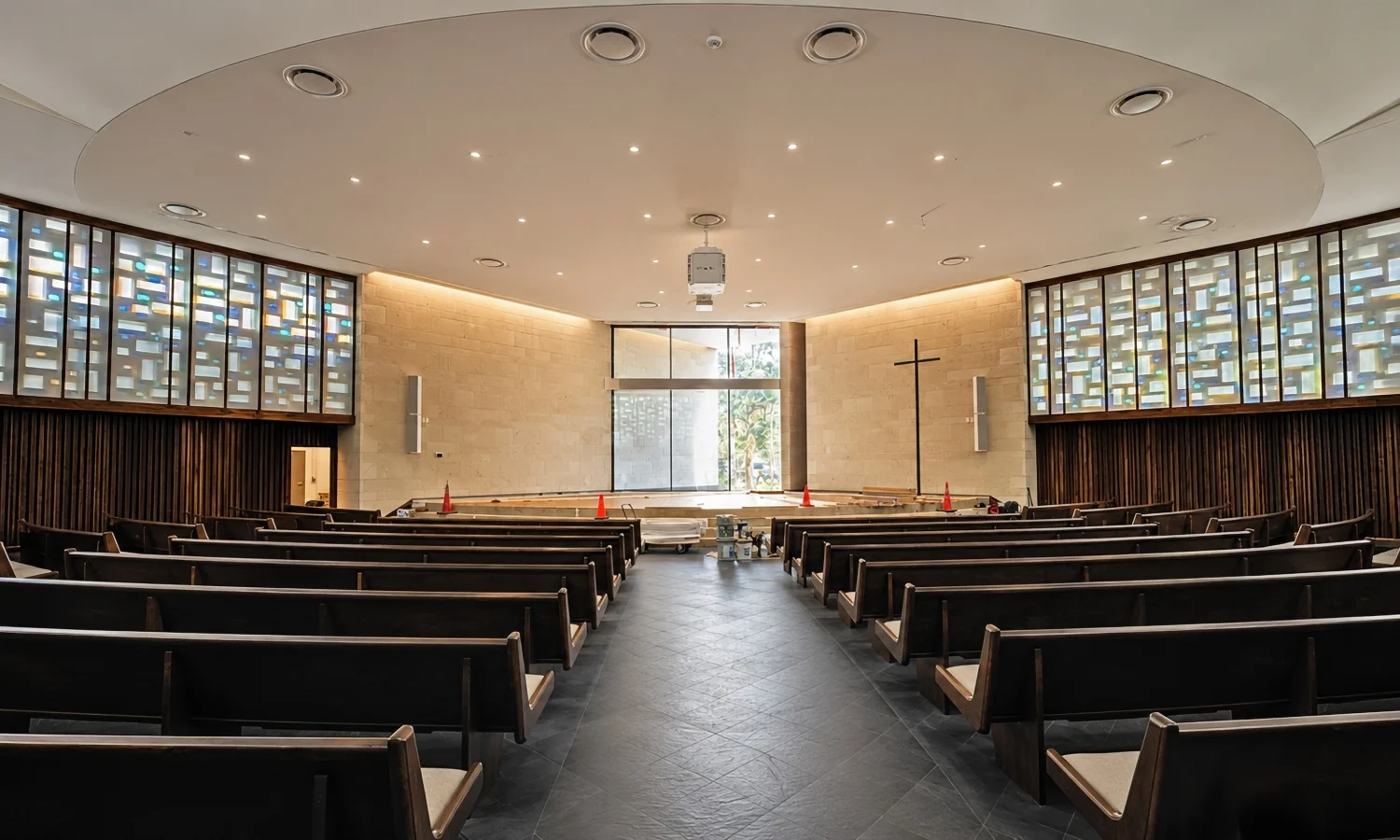
- Facility Type: Modern Sanctuary, Sweeping Curves, Expansive Glazing
- Client: Cornerstone Church of Lakewood Ranch
- Sanctuary Size: 8,000 SF Floor Plate, 25-Foot Ceiling Height
- Acoustic Scope: AcoustiBuilt Plus ACT and 60-Foot Diffuser
- Objective: Speech and Music Intelligibility at RT60 Target
- Delivery: Pre-Design Integration, New Construction
Modern sanctuary acoustic design starts before the construction drawings finish, not after the congregation moves in. The 8,000 SF Cornerstone build paired a seamless acoustic plaster ceiling with conventional ACT tile across the rear field and a 60-foot integrated diffuser to handle the long-axis reflections. The full scope landed during new construction, sequenced with the architect’s design intent rather than retrofitted into a finished room.
The Modern Sanctuary Design Brief
Cornerstone Church of Lakewood Ranch came in with the design intent that defines most contemporary worship architecture: sweeping ceiling curves, tall vertical volume, expansive glazing along the side walls, and a clean modern aesthetic that avoids the heavy textiles that older sanctuaries used to absorb sound naturally. Every one of those design choices works against acoustic comfort if the room is built without integrated treatment.
The architect approached the project with acoustics as a design parameter from the first drawing set, not as a punch-list addition. That sequencing decision is what separates a modern sanctuary that supports preaching and music from one that washes every spoken word into a long, unintelligible decay.
Why Modern Worship Spaces Demand Pre-Design Acoustics
- Hard Surface Materials: Glass, metal, polished concrete reflect sound rather than absorb
- Open Volume: 25-foot ceilings stack reverberation tail far beyond speech comfort
- Worship Program: Both spoken preaching and amplified music must remain intelligible
- Retrofit Cost: Adding acoustic treatment after the build typically runs three times pre-design pricing
Modern sanctuary architecture removes most of the soft materials that traditional church buildings carried for free. Heavy pew cushions, drapery, plaster walls with carved relief, and carpet over wood subfloor all worked as acoustic absorbers in older sanctuaries. A contemporary sanctuary with hard finishes and tall ceilings has none of that natural absorption, and the RT60 in an untreated modern worship room often runs three to five times the comfortable target.
The way out is to design acoustic systems into the architecture from day one. Specifying a seamless acoustic ceiling system during design development means the architect can include it as part of the ceiling vocabulary rather than bolt-on treatment. The church acoustical design reference walks the framework for any sanctuary build.
AcoustiBuilt Seamless Acoustic Ceiling Spec
- Product: AcoustiBuilt seamless acoustic ceiling system
- Coverage: 2,040 SF over the primary worship volume
- Application: Curved ceiling plane above the platform and front congregation rows
- Visual Read: Reads as continuous plaster ceiling, no panel edges or grid lines
AcoustiBuilt is the seamless acoustic plaster ceiling that lets a modern sanctuary keep its design intent intact. The finished surface reads as continuous plaster, which means the architect gets the smooth ceiling plane the design called for, and the absorption math gets done inside the same product. No suspended grid, no visible panel joints, no compromise on the architectural vocabulary.
The 2,040 SF coverage zone targeted the curved ceiling above the platform and front congregation rows, which is where speech and music originate and where the first-reflection geometry matters most. Behind the seamless finish, the substrate delivers the broadband absorption the open volume needed.
ACT Field and 60-Foot Linear Diffuser
- ACT Coverage: 6,000 SF of acoustic ceiling tile across the rear sanctuary field
- Linear Diffuser: 60-foot integrated diffuser along the long axis of the room
- Function: Combine absorption (ACT) with controlled scattering (diffuser) across the rear volume
- Coordination: Diffuser integrated with HVAC supply on the same ceiling plane
The rear sanctuary field used 6,000 SF of acoustic ceiling tile to handle broadband absorption in the back two-thirds of the room. ACT alone would have left the long-axis reflections unaddressed, so the design integrated a 60-foot linear diffuser running the length of the sanctuary. That combination of absorption plus controlled scattering is what keeps both spoken word and amplified music intelligible without making the room sound acoustically dead.
The diffuser also doubled as the HVAC supply path along the same ceiling plane. Coordinating mechanical and acoustic systems into a single architectural element is the design move that makes the modern sanctuary read as intentional rather than cluttered. The Hyde Park UMC diffuser project documents a different diffuser application in another worship context.
RT60 Targets for Modern Worship Spaces
- Spoken Preaching Target: RT60 1.0 to 1.4 seconds for clean speech intelligibility
- Worship Music Target: RT60 1.4 to 1.8 seconds to let vocals and instruments bloom
- Compromise Target: Most modern sanctuaries split the difference at RT60 1.2 to 1.5 seconds
- Untreated Modern Sanctuary: RT60 often runs 3 to 5 seconds, three times the comfortable target
Modern worship spaces face a design tension that older sanctuaries did not. Spoken preaching wants a relatively dry room (RT60 around 1.0 to 1.4 seconds) for clean intelligibility. Worship music wants a livelier room (RT60 around 1.4 to 1.8 seconds) so vocals and instruments bloom rather than dying immediately. The compromise target most modern sanctuaries land on sits at RT60 1.2 to 1.5 seconds. The room acoustics calculator walks the math for any sanctuary volume.
Hitting that target across an 8,000 SF room with 25-foot ceilings and hard finishes requires layered absorption distributed deliberately across the ceiling plane. AcoustiBuilt over the platform, ACT across the rear field, and the linear diffuser running the length of the room together delivered the working number.
Installation: Coordinating Acoustic Plaster With Trades
- Step 1: Structural and mechanical roughs complete, ceiling substrate prepared
- Step 2: AcoustiBuilt substrate panels installed over the platform ceiling curve
- Step 3: Acoustic plaster troweled across the AcoustiBuilt substrate for seamless finish
- Step 4: ACT grid hung, tile installed, diffuser integrated last
Acoustic plaster systems demand more trade coordination than conventional acoustic ceilings. The substrate has to land cleanly against the curved structure, the plaster finish has to be troweled under conditions that match conventional plaster work, and any mechanical or electrical penetrations have to be coordinated before the finish goes down. Rework after the finish coat is the most expensive call-back in the trade sequence.
The Cornerstone install sequenced AcoustiBuilt first, then ACT and grid second, then the linear diffuser as the final ceiling element. That order kept the seamless finish protected through the rest of the build and let the more forgiving ACT and diffuser work flex around late-stage trade conflicts.
Performance Results in the Sanctuary
- Spoken Word: Clean intelligibility from platform to rear pews
- Worship Music: Vocals and instruments project without smearing into reverb tail
- Visual Read: Seamless ceiling preserved the architect’s design intent
- Congregation Feedback: Sanctuary read as a finished, intentional acoustic environment
The finished sanctuary delivered both halves of the worship-acoustics compromise. Spoken preaching reads cleanly from the platform to the rear of the room without echoing across the curved ceiling. Music holds enough liveness to support vocals and amplified instruments without smearing the rhythm of the worship band. The architecture stayed intact because the acoustic systems were integrated rather than overlaid.
Architects designing modern sanctuaries can use the same playbook: AcoustiBuilt or equivalent seamless plaster over first-reflection zones, ACT across the broader field, diffuser elements on the long axis. The same approach scaled up in our Lakes Church Lakeland sanctuary project, where reverberation control hit the worship target on a similar new build.
Conclusion: Modern Sanctuary Acoustic Design
Modern sanctuary acoustic design works when it lands in the design phase, not as a punch-list addition after the congregation moves in. The Cornerstone build documents the layered ceiling approach: seamless acoustic plaster over the platform, ACT across the rear field, integrated diffuser on the long axis. The same multi-system pattern runs through our church acoustic treatment work across worship buildings.
FAQs: Modern Sanctuary Acoustic Design
What RT60 should a modern sanctuary target?
Most modern sanctuaries target RT60 between 1.2 and 1.5 seconds. Spoken preaching alone wants 1.0 to 1.4 seconds. Worship music alone wants 1.4 to 1.8 seconds. The compromise target lets both halves of the program read cleanly without going acoustically dead.
Why do modern worship buildings need more acoustic treatment than traditional churches?
Modern sanctuaries use hard finishes, glass, and tall open volume that all reflect sound. Traditional churches had heavy pew cushions, drapery, and textured plaster that absorbed sound naturally. Contemporary worship architecture has to engineer absorption that older buildings got for free.
What is a seamless acoustic ceiling and when should architects specify it?
A seamless acoustic ceiling is an acoustic plaster system that reads as continuous finished ceiling rather than as suspended panels or grid. Architects specify it when the design intent calls for a smooth ceiling plane and conventional acoustic ceiling tile would compromise the visual vocabulary.
How early in design development should acoustic systems be specified?
Acoustic systems should land in the schematic design phase, not later. Retrofit acoustic work on a finished sanctuary typically runs three times the cost of pre-design integration and often forces design compromises that pre-design acoustic specification avoids entirely.

Walker Peek|Founder & CEO, Commercial Acoustics
Walker founded Commercial Acoustics in 2013 to bring aerospace-grade engineering discipline to soundproofing, and runs the firm as CEO from its 12,000 sq ft Tampa production facility. The company designs custom acoustic panels, sound membranes, and masking systems for multi-family, hospitality, healthcare, and commercial projects across the US — built around Walker’s invention, Wall Blokker, an EVA-based sound barrier that hits STC 50-plus at roughly $1 per square foot installed.
A Jacksonville native, Walker spent five years at Kennedy Space Center with Craig Technologies before founding Commercial Acoustics — certifying aerospace manufacturing to the AS9100 standard and leading Six Sigma Black Belt process-improvement teams on NASA programs. He is a certified Industrial Noise Control Engineer and the author of Architectural Acoustics: A Practical Handbook.
