
Table of Contents
Project Overview: FSU Academic Building Acoustical Scope
- Project: Academic Building Acoustical Scope Across Atrium, Lecture Halls, and Classrooms
- Location: 402 W. Gaines Street, Tallahassee, FL
- Facility Type: Multi-Story Academic Building, New Construction
- Client: Florida State University (via Culpepper, General Contractor)
- Architect: Goody Clancy, Boston, MA
- Acoustic Scope: Metal Ceilings, ACT, and Fabric Wall Panels
- Objective: Performance and Aesthetic Across the Full Build
Academic building acoustic scopes split across a half-dozen space types in a single bid package, from lecture halls and atria to acoustic panels for university buildings. The FSU College of Business build spanned a multi-story atrium, large-format lecture halls, flexible classrooms, and collaborative student areas, each demanding a different ceiling and wall acoustic system. The full scope landed during new construction, sequenced with the Culpepper GC schedule.
Inside the Herbert Wertheim Center for Business Excellence
- Building: Herbert Wertheim Center for Business Excellence (formerly Legacy Hall)
- Scale: 220,000 SF Across Multiple Stories
- Investment: $160 Million, Opened Spring 2026
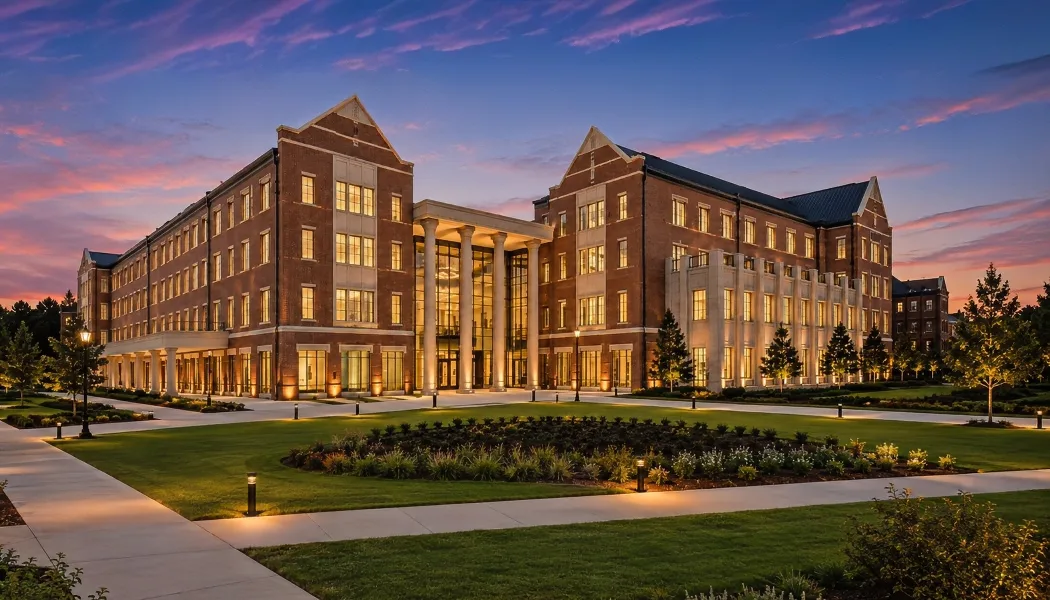
Florida State University’s College of Business commissioned the building originally as Legacy Hall, since officially renamed the Herbert Wertheim Center for Business Excellence. The 220,000-square-foot facility at 402 W. Gaines Street is one of the most ambitious academic construction projects in the school’s history and opened for classes at the start of the spring 2026 semester. The building program includes a multi-story atrium as the entry experience, large-format lecture halls along the lower floors, flexible classrooms on the academic levels, and collaborative student areas distributed across the building.
Each space type carries a different acoustic problem. The atrium needs to dampen the open-volume reflections that would otherwise wash out conversation at the entry. The lecture halls need to keep instructor speech intelligible at the back row. The classrooms need ANSI S12-compliant reverberation. The collaborative areas need to feel acoustically alive without echoing.
LEED and ANSI S12 Acoustic Targets for Academic Buildings
- ANSI S12.60 (Classrooms): RT60 0.6 to 0.7 seconds, background noise NC 35 or lower
- Lecture Halls: RT60 0.8 to 1.0 seconds for speech intelligibility at scale
- Atria: RT60 target varies, but speech intelligibility drives the absorption math
- LEED v4 Acoustic Performance: Credits available for meeting the ANSI S12.60 thresholds across academic spaces
Architects designing academic buildings to LEED or to current ANSI S12.60 standards face per-space acoustic targets that no single product can hit on its own. Classrooms target RT60 in the 0.6 to 0.7 second range with background noise capped at NC 35. Lecture halls run slightly longer to support speech projection. Atria and collaborative areas operate outside the strictest ANSI standards but still need treatment to function as event-capable spaces.
Hitting those targets across a full building program is the work that an academic acoustical scope actually delivers. The full taxonomy of ceiling system options lives in our specialty ceiling types explained reference, which architects can use as a precedent set when specifying.
Gordon Origami Perforated Metal Ceilings
- Product: Gordon Origami perforated metal ceiling system
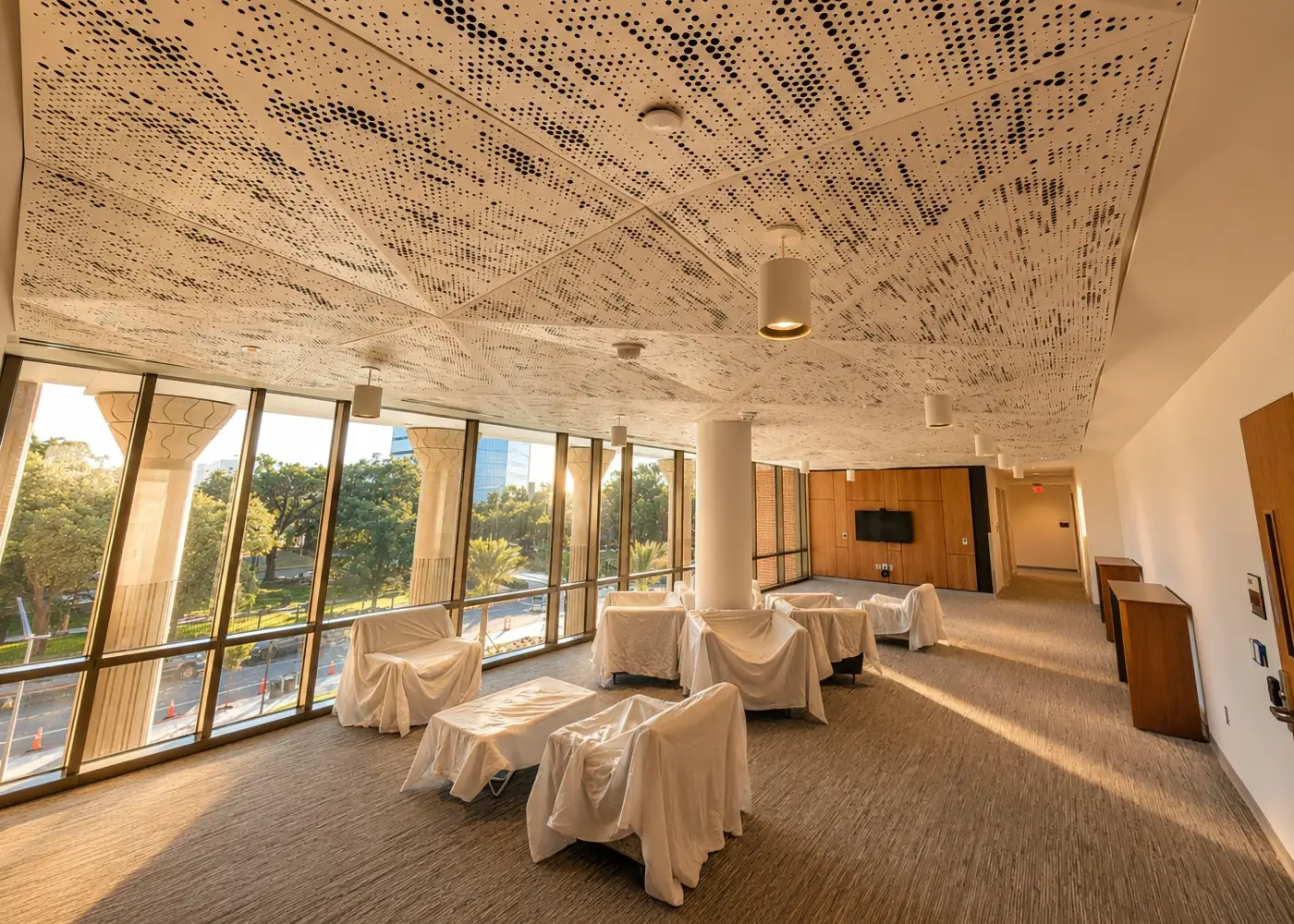
- Application: Multi-story atrium and feature ceiling zones
- Function: Aesthetic ceiling plane with perforated face for acoustic absorption
- Why Metal Here: Atria need a finish that reads as architectural envelope, not as treatment
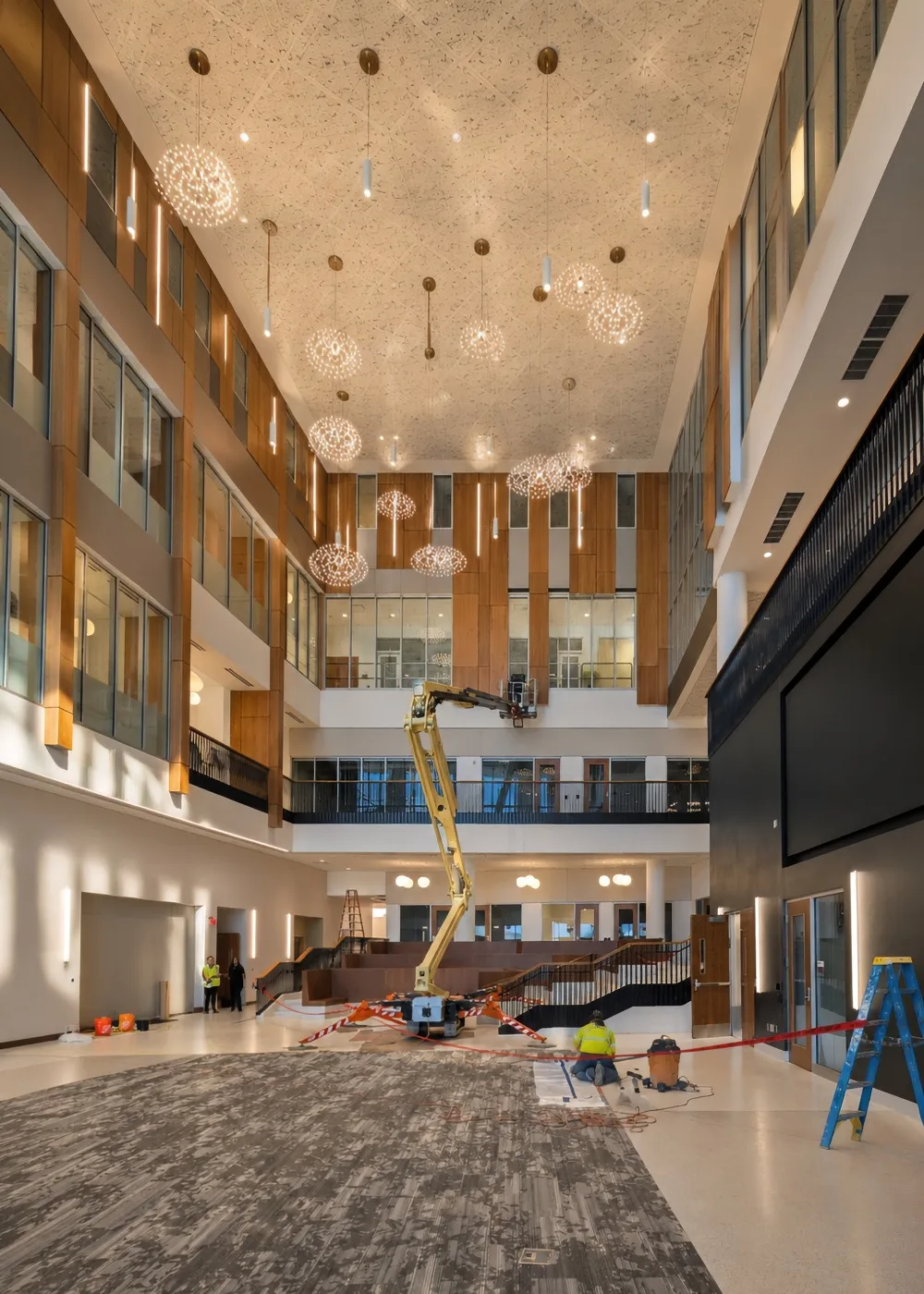
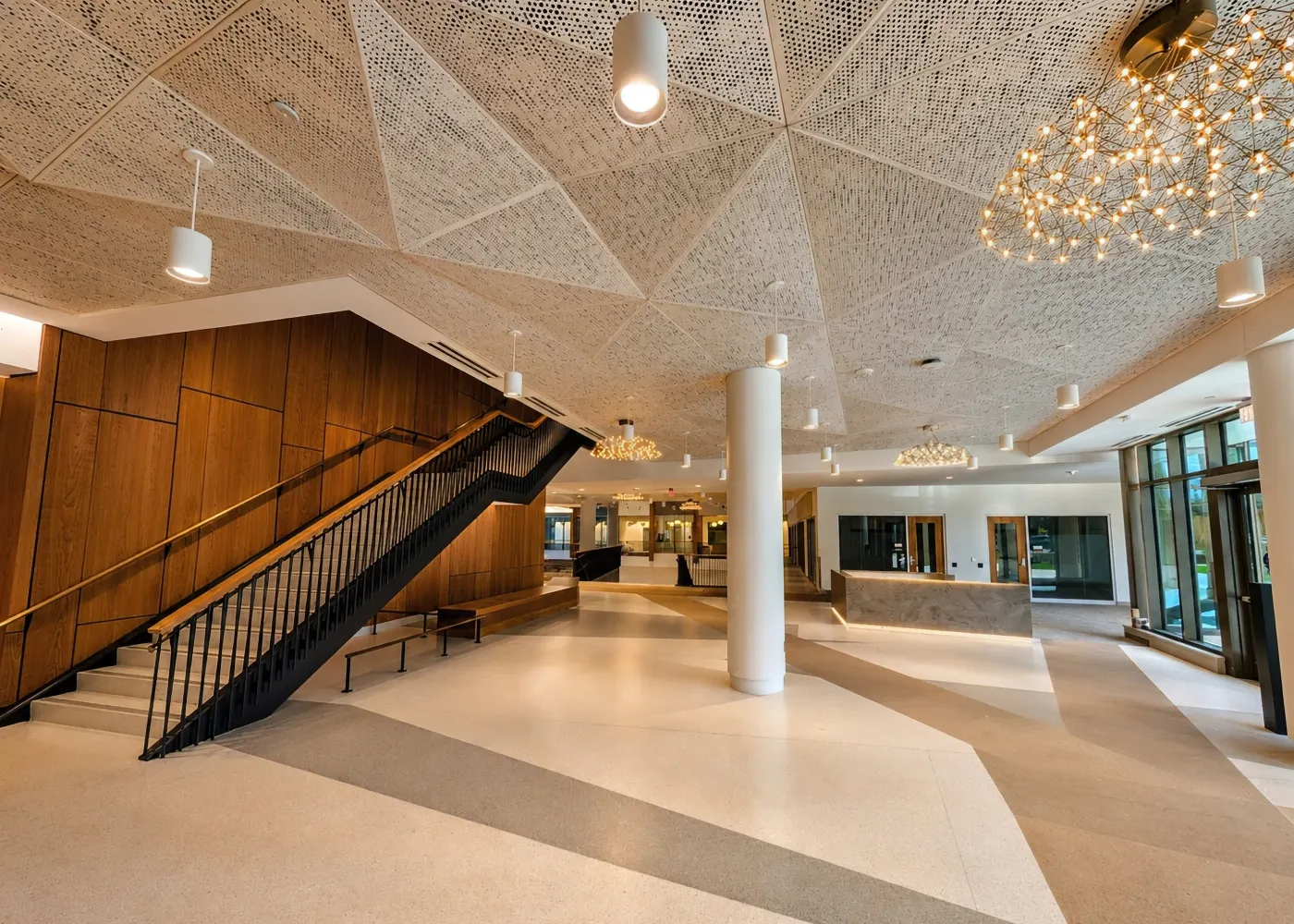
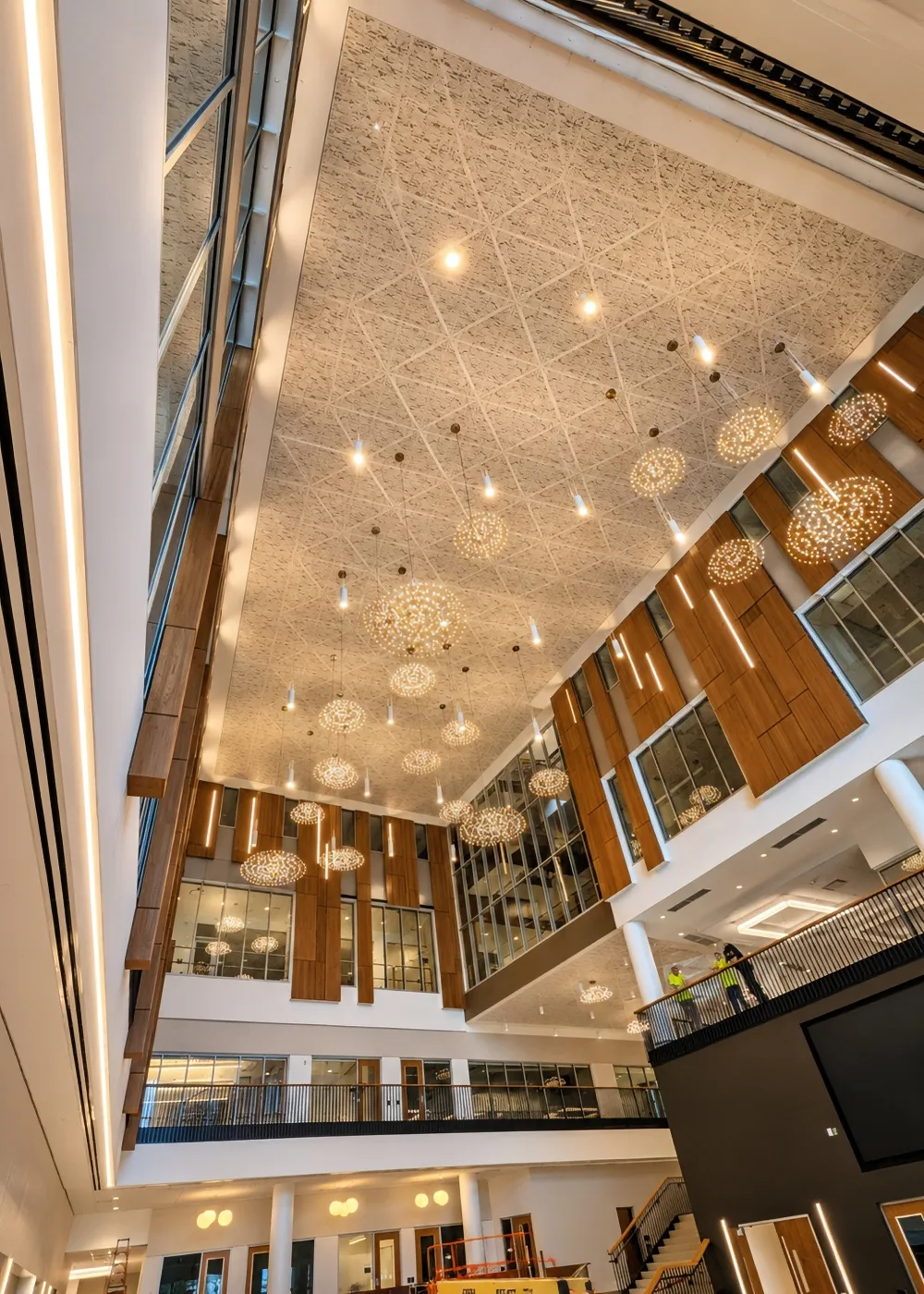
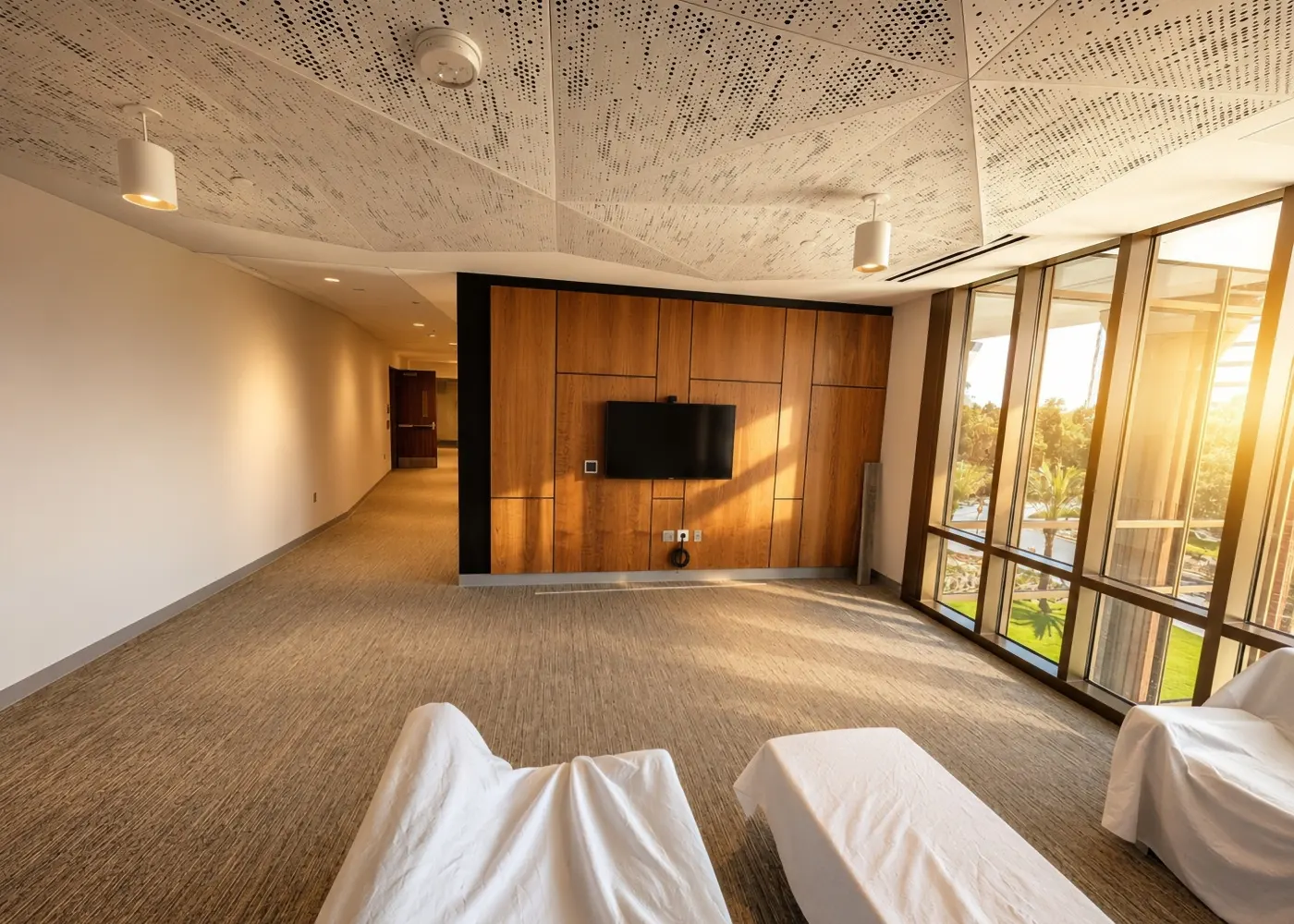
Gordon Origami perforated metal ceilings handle the spaces where the ceiling plane has to read as designed architecture. The perforated face passes sound through to acoustic backing for absorption, while the metal panel face reads as a continuous architectural surface from the floor below. That visual-acoustic combination is hard to deliver with felt, fabric, or tile alone.
In the FSU atrium, the metal ceiling carried both the entry aesthetic and the absorption math the open volume required. Architects specifying perforated metal ceilings on academic projects use this product family when the design intent calls for a metal-finish ceiling that still hits acoustic targets.
Backlit Metal Panels: Aesthetic + Absorption
- System: Backlit metal panel ceiling assembly
- Application: Feature zones across the atrium and primary circulation areas
- Function: Lighting plane and acoustic absorber in one assembly
- Design Intent: Activates the ceiling as a designed element after dark
Backlit metal panels did double duty in the atrium and primary circulation zones. The metal face reads as architectural finish during the day. The backlit assembly turns the same surface into a lighting plane after dark. Behind the panel face, the absorption substrate handles the acoustic role in both lighting states.
Combining lighting and acoustics into a single ceiling assembly is the kind of design-driven decision that separates a high-design academic project from a value-engineered build. Goody Clancy specified the backlit panel system as part of the entry experience, with the acoustic role as an integrated rather than added function.
Acoustic Ceiling Tile Across Classrooms and Lecture Halls
- Tile Families: Five different ACT product lines specified across the building
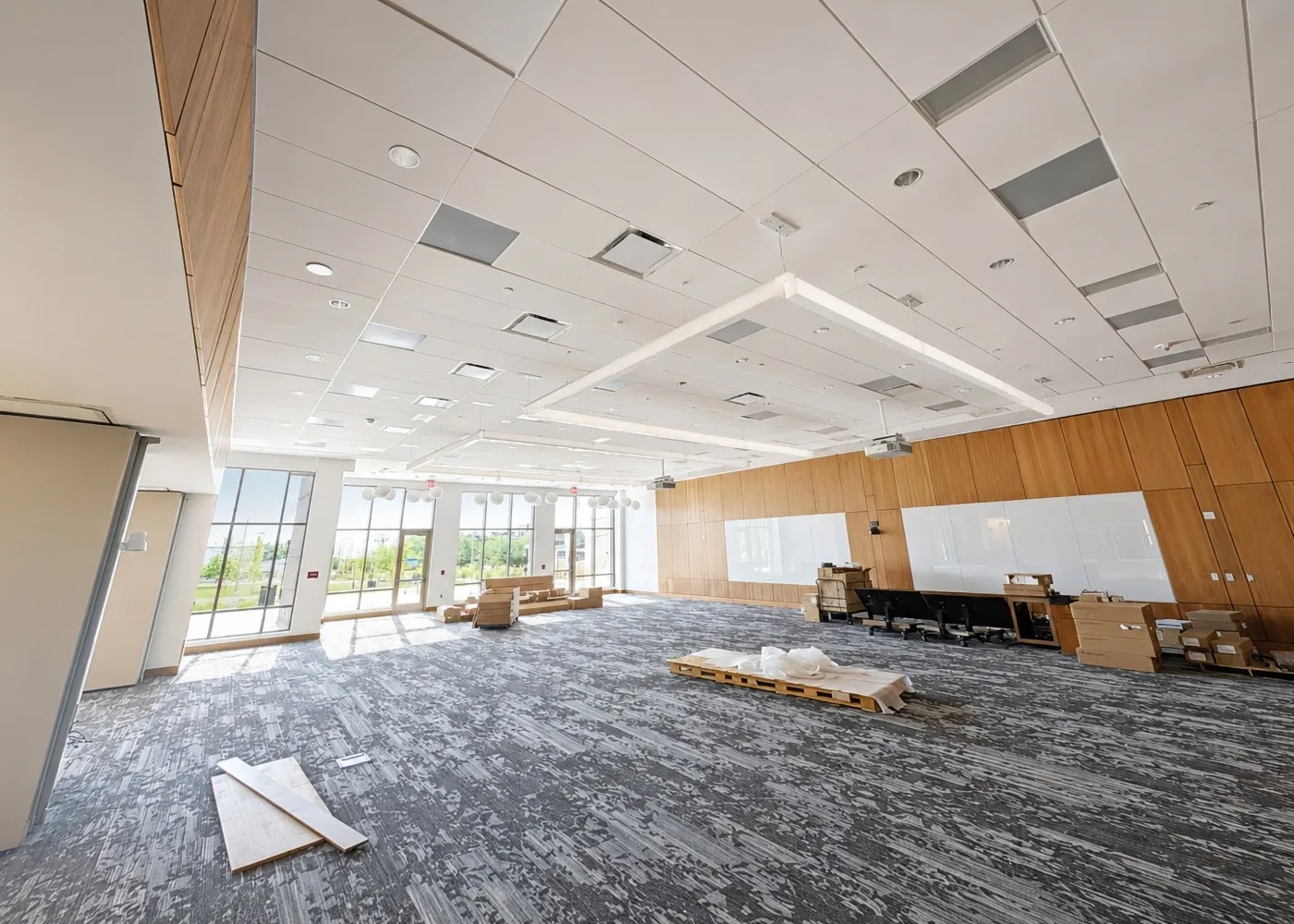
- Classrooms: Standard high-NRC ACT tile for ANSI S12-compliant RT60
- Lecture Halls: Higher-NRC tile and complementary wall absorption
- Coverage: Suspended grid across the academic floors
Five different ACT product lines across one building is not unusual on a multi-space academic project. Each tile family fits a specific room condition. Classrooms get standard high-NRC tile for ANSI S12 compliance. Lecture halls get higher-NRC tile that handles back-row speech intelligibility at scale. Corridors and back-of-house spaces use a different tile altogether. The ACT estimator walks the math for each space type.
Five tile families also mean five different grid orders, five different lead times, and five different installation schedules. That coordination work is half the scope of an academic acoustical package. The other half is the ceiling family choices that sit above it.
Conwed Fabric-Wrapped Wall Panels in Collaborative Areas
- Product: Conwed fabric-wrapped acoustic wall panels
- Application: Collaborative student areas and lecture hall walls
- Function: Wall-plane speech absorption to complement ceiling treatment
- Finish: Fabric face integrates with the interior color palette
The collaborative student areas and lecture hall walls used acoustic fabric wall panels from Conwed to handle the wall-plane absorption that ceiling tile alone cannot deliver. In a lecture hall, the back-wall reflections are the path that lose speech intelligibility for the rear rows. Treating the rear wall with absorptive panels resolves that.
In the collaborative areas, fabric panels controlled the standing-wave conditions that develop in any rectangular room with parallel walls. The panel layout integrated with the interior color palette so the absorption read as part of the wall finish rather than as an acoustic overlay.
Coordinating Scope With Goody Clancy Design Intent
- Architect: Goody Clancy of Boston
- GC: Culpepper Construction
- Coordination Scope: Five ceiling families, two wall systems, multi-story sequencing
- Delivery: Pre-occupancy install across all academic floors
Goody Clancy specified the acoustic scope alongside the architectural finish package, which is what gets the metal ceilings, backlit panels, ACT, and fabric wall systems working together rather than competing visually. Culpepper coordinated the trade sequence with the rest of the academic building program, slotting acoustic install where the trade flow allowed.
Architects looking for academic-acoustic precedent will find that the work scales the same way on most multi-story university buildings. A similar lecture-hall focus lives in our Georgia State lecture hall project, which documents a narrower scope on a different academic building.
Conclusion: Academic Building Acoustical Scope
The FSU College of Business build is the case for a full multi-system academic acoustical scope, coordinated across atrium, lecture halls, classrooms, and collaborative areas in one bid package. Five ACT families, two metal ceiling systems, and fabric-wrapped wall panels delivered the ANSI S12 targets while reading as designed architecture across the building. The same multi-system approach runs through our school acoustic treatment work.
FAQs: Academic Building Acoustical Scope
What is an academic building acoustical scope?
An academic building acoustical scope is the multi-product acoustic package specified for a university or college building. It typically covers ceiling tile in classrooms, specialty ceilings in atria, wall panels in lecture halls and collaborative spaces, and any sound-blocking work between sensitive rooms.
What RT60 targets do ANSI S12 and LEED set for academic spaces?
ANSI S12.60 sets RT60 of 0.6 to 0.7 seconds for core learning spaces and background noise levels at NC 35 or lower. Lecture halls run slightly longer for speech projection. LEED v4 credits are available for projects that meet the ANSI thresholds across academic rooms.
Why use multiple ceiling systems on one academic building?
Different academic space types need different acoustic and visual ceiling treatments. Atria need designed ceiling finishes that still absorb. Classrooms need high-NRC ACT tile. Lecture halls need higher-NRC tile plus wall absorption. A single ceiling product cannot solve all of those at once.
How do you coordinate acoustic scope with the GC and architect on a new academic build?
The acoustic scope follows the design-development specification and slots into the trade sequence the GC schedules. Ceiling grid first, acoustic tile next, specialty ceiling families through the rough-in window, then wall panels last so the finish faces are protected through other overhead trade work.

Walker Peek|Founder & CEO, Commercial Acoustics
Walker founded Commercial Acoustics in 2013 to bring aerospace-grade engineering discipline to soundproofing, and runs the firm as CEO from its 12,000 sq ft Tampa production facility. The company designs custom acoustic panels, sound membranes, and masking systems for multi-family, hospitality, healthcare, and commercial projects across the US — built around Walker’s invention, Wall Blokker, an EVA-based sound barrier that hits STC 50-plus at roughly $1 per square foot installed.
A Jacksonville native, Walker spent five years at Kennedy Space Center with Craig Technologies before founding Commercial Acoustics — certifying aerospace manufacturing to the AS9100 standard and leading Six Sigma Black Belt process-improvement teams on NASA programs. He is a certified Industrial Noise Control Engineer and the author of Architectural Acoustics: A Practical Handbook.
