Table of Contents
What Is Sound Masking?
Sound masking is an engineered, low-level background sound — frequency-shaped to match human speech — emitted through ceiling-mounted speakers to neutralize the intelligibility of nearby conversations. It doesn’t cancel sound; it raises the room’s noise floor by a few dB so that speech 15+ feet away becomes unintelligible. The result is better speech privacy, less distraction, and improved focus in open-plan and partial-height workspaces.
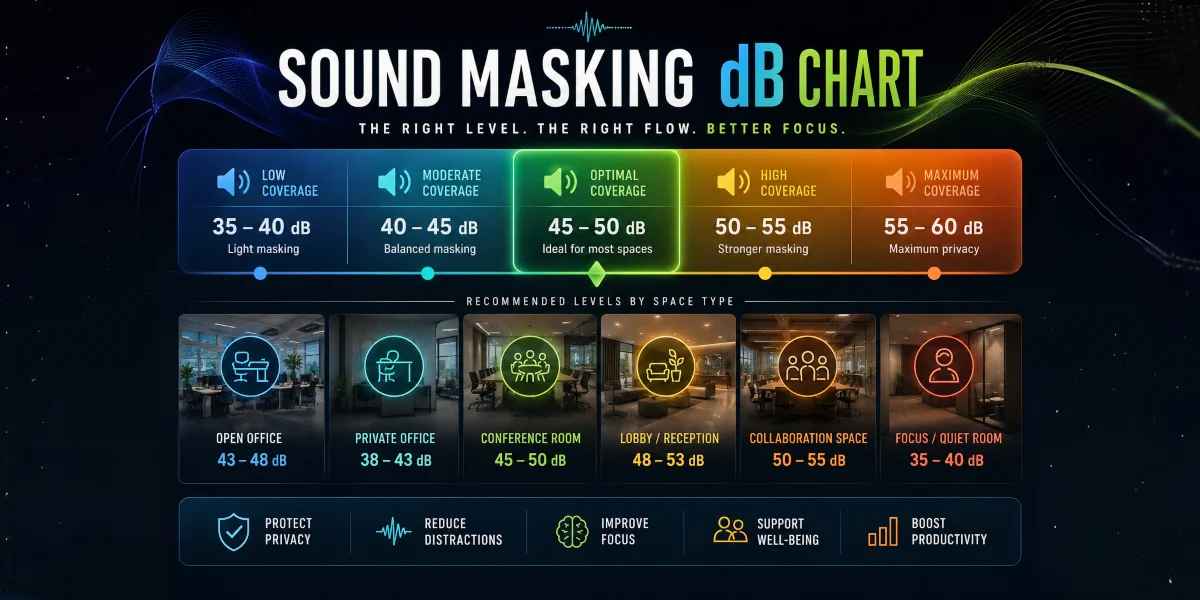
The right masking level varies by space type, but the industry consensus for open offices is 45–48 dBA. Below 42 dBA, masking stops being effective; above 50 dBA, occupants perceive it as a noisy HVAC system. For the science behind why masking works, see our Sound Masking 101 guide and the pink vs white noise primer.
Sound Masking dB Chart – Recommended Levels by Space
Pairing Masking with STC, CAC, & Absorption
Masking on its own doesn’t deliver speech privacy — it works alongside the building’s partition and ceiling system. The table below shows the most common combinations and when to use each.
The takeaway: masking is the lowest-cost privacy upgrade you can specify, but it amplifies the value of STC walls, CAC ceilings, and absorptive finishes — it doesn’t replace them.
How to Set the Right Masking Level
- Measure the existing noise floor: If the unoccupied space already sits at 38 dBA, you only need 7–10 dB of masking added to reach the 45–48 dBA target.
- Match the masking spectrum to ASHRAE / NRC curves: Most quality systems ship with a default spectrum tuned for speech-frequency content (250 Hz – 4 kHz emphasis).
- Calibrate room-by-room, not whole-floor: Hard surfaces, ceiling heights, and occupancy density all affect how the masking distributes.
- Use a uniformity tolerance of ±2 dB: Variations larger than this become perceptible as “loud zones” and create complaints.
- Ramp up gradually after install: Add 1–2 dB per week over the first month so occupants acclimate. Sudden full-level activation almost always generates complaints, even at correctly-tuned levels.
For quick sizing on a planned project, use our Sound Masking Calculator — it estimates the number of speakers needed for a given square footage and ceiling type.
Standards & Field Tuning
- ASTM E1573: Standard practice for evaluating masking sound in open offices using A-weighted sound level measurements.
- ASTM E1130: Measuring articulation class (AC) — the metric for how well speech privacy is achieved in open plans.
- LEED v4 IEQ Credit: Acoustic Performance credit awards points for proper masking specification in open-office and healthcare projects.
- WELL Building Standard: Sound Masking concept under the Sound feature; specifies background sound level targets by space type.
Field tuning should be performed by the masking-system manufacturer or an acoustic consultant with a calibrated octave-band meter. The end goal is uniform A-weighted level within ±2 dB across the open area, with a spectrum that matches the design curve at each octave band.
Conclusion: Specifying Masking that Works
Sound masking is one of the highest-value upgrades available for any open-plan or partial-height office build. At a typical install cost of $1–$2 per square foot, it adds 5–10 points of effective speech privacy — the equivalent of upgrading every demising wall from STC 35 to STC 45 at a fraction of the price. Spec masking alongside NC HVAC targets and absorptive ceiling finishes for a balanced acoustic environment.
Commercial Acoustics has specified and supplied sound masking systems for offices, healthcare facilities, financial services, and legal practices since 2008. Browse our other charts and calculators at commercial-acoustics.com, or reach out if you’d like help sizing a system for your project.
FAQs: Sound Masking dB Chart
What dB level should sound masking be set to?
Open-plan offices target 45–48 dBA — the industry-standard range for speech privacy. Private offices and healthcare patient rooms target 42–45 dBA; premium hotel guestrooms and executive offices target 38–42 dBA.
Is sound masking the same as white noise?
No. White noise has equal energy at every frequency, which the ear hears as a harsh hiss. Sound masking is frequency-shaped (typically a pink-noise-derived curve) to match the speech spectrum, making it less perceptible and more effective at masking conversation.
How loud is sound masking compared to HVAC?
Typical sound masking sits 3–5 dB above a quiet HVAC system. The two combined should not exceed 50 dBA in occupied office space, or the combined background reads as annoying.
Does sound masking work in private offices?
Yes, particularly for confidential conversations with partial-height walls or weak ceiling tile CAC. Target 42–45 dBA for private offices to maintain privacy without making the space feel noisy.
How much does sound masking cost?
Typical installed cost runs $1–$2 per square foot, including ceiling-mounted speakers, controller, and tuning. ROI is rapid — equivalent to upgrading every demising wall by ~10 STC points at a fraction of the construction cost.

Walker Peek|Founder & CEO, Commercial Acoustics
Walker founded Commercial Acoustics in 2013 to bring aerospace-grade engineering discipline to soundproofing, and runs the firm as CEO from its 12,000 sq ft Tampa production facility. The company designs custom acoustic panels, sound membranes, and masking systems for multi-family, hospitality, healthcare, and commercial projects across the US — built around Walker’s invention, Wall Blokker, an EVA-based sound barrier that hits STC 50-plus at roughly $1 per square foot installed.
A Jacksonville native, Walker spent five years at Kennedy Space Center with Craig Technologies before founding Commercial Acoustics — certifying aerospace manufacturing to the AS9100 standard and leading Six Sigma Black Belt process-improvement teams on NASA programs. He is a certified Industrial Noise Control Engineer and the author of Architectural Acoustics: A Practical Handbook.
