Table of Contents
What Is an OITC Rating?
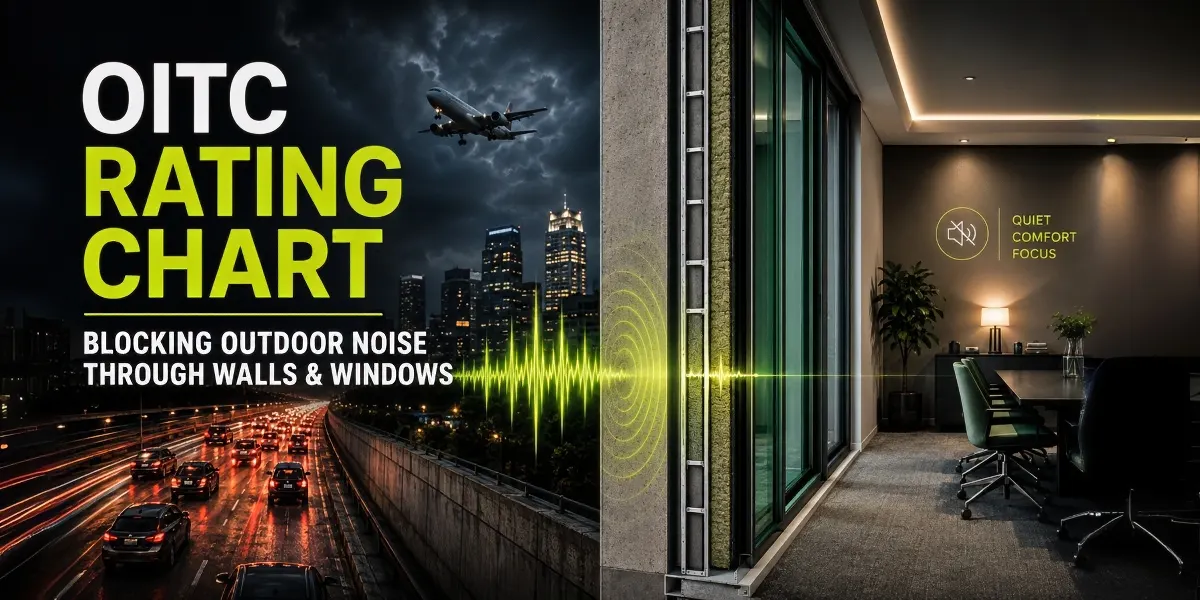
OITC (Outdoor-Indoor Transmission Class) measures how well an exterior wall, window, or door blocks outdoor noise from entering a building. Unlike STC, which uses a speech-weighted spectrum to evaluate interior partitions, OITC uses a reference noise spectrum dominated by low-frequency content — traffic rumble, aircraft, trains — exactly what you fight against outside a building.
The scale runs from about OITC 20 (single-pane glass) to OITC 50+ (decoupled mass walls with triple-pane laminated glazing). Because the test weights low frequencies more heavily, OITC values are typically 5–10 points lower than the STC of the same assembly. For exterior facade design — windows, exterior walls, doors, and combined facade systems — OITC is the right number to specify.
OITC Rating Chart – Typical Exterior Assemblies
Recommended OITC by Site & Use
The right OITC target depends as much on the site as the use. A suburban classroom needs far less than the same classroom facing an arterial road — and a hotel near a highway needs more than the brand minimum even if the brand spec is silent on OITC.
OITC vs STC: What’s the Difference?
- Reference spectrum: STC uses a speech-weighted (mid-frequency) signal; OITC uses a low-frequency-weighted outdoor noise signal.
- Where to use which: STC for interior walls/floors between rooms; OITC for exterior walls, windows, and doors facing outdoors.
- Numerical relationship: OITC is typically 5–10 points lower than STC for the same assembly — the low-frequency penalty.
- Test standards: STC follows ASTM E90/E413; OITC follows ASTM E1332.
For a longer-form comparison, see our STC vs OITC guide. The short version: never use STC to design an exterior facade — you’ll over-promise on low-frequency performance and under-deliver in the field.
How to Achieve OITC Targets
- Specify laminated glazing: The PVB interlayer in laminated glass adds 4–7 OITC points over standard IGUs — the single highest-leverage upgrade.
- Asymmetric lite thicknesses: 1/4″ + 1/8″ outperforms 1/4″ + 1/4″ at the same total mass — coincidence dip moves out of the critical band.
- Wider air gap: Increase the IGU air space from 1/2″ to 1″ for an additional 2–4 OITC points.
- Mass at the wall: 8″ CMU or brick veneer with insulated cavity vs. 2×4 + foam sheathing — exterior wall mass is decisive for low-frequency performance.
- Seal every penetration: Exterior gaskets, weatherstripping, and acoustic-grade sealants. A 1% gap can drop facade OITC by 5+ points.
The composite facade only performs as well as the weakest element multiplied by its area. Sizing this correctly requires summing transmission loss across windows, walls, and doors weighted by area — a calculation our acoustic consulting team runs routinely for highway- and airport-adjacent projects.
Standards & Field Testing
- ASTM E1332: Lab classification for OITC — uses the outdoor reference spectrum and 80–4000 Hz octave bands.
- ASTM E966: Field measurement of facade sound transmission loss using either a road, loudspeaker, or rail source.
- HUD Noise Guidebook: Required exterior noise study for HUD-financed multifamily projects; sets thresholds for acceptable, normally unacceptable, and unacceptable site conditions.
- FAA Part 150 / Title 14 CFR: Airport noise compatibility planning; defines DNL contours and recommended building treatments.
Field-measured OITC almost always tests 3–6 points lower than lab values because composite facade behavior, sealing quality, and edge details all contribute. Spec to land 5 points above your target — the same cushion logic that applies to STC and IIC.
Conclusion: Designing for Outdoor Noise
OITC is the right number for any project where outdoor noise reaches an occupied interior — urban offices, highway-adjacent residences, airport hotels, and downtown classrooms. Pair OITC specifications with STC for interior partitions and vibration isolation for mechanical noise to design a building that’s actually quiet — not just code-compliant on paper.
FAQs: OITC Rating Chart
What is a good OITC rating for windows?
Standard insulated glass units rate around OITC 25–28. For urban or arterial-street sites, target OITC 30+; for highway- or airport-adjacent residences, target OITC 35–40 with laminated acoustic glazing.
What is the difference between OITC and STC?
STC uses a speech-weighted reference spectrum and is best for interior walls. OITC uses an outdoor-noise spectrum dominated by low frequencies (traffic, aircraft, trains) and is the correct rating for exterior walls, windows, and doors. OITC is typically 5–10 points lower than STC for the same assembly.
What OITC rating does HUD require?
HUD-financed multifamily projects in noise-impacted areas require a noise study per the HUD Noise Guidebook. Exterior facade OITC requirements depend on the site DNL — typically OITC 30 for normally unacceptable sites and OITC 35–40 for unacceptable sites.
How is OITC measured?
OITC is measured in a lab using ASTM E1332, with sound transmitted through the test specimen across 80–4000 Hz octave bands and weighted to the standard outdoor reference spectrum. Field measurement uses ASTM E966.
Does brick veneer improve OITC?
Yes — brick veneer adds substantial mass and creates an air gap with the structural wall. A brick-veneer wall typically scores OITC 32–37 versus OITC 28–32 for a comparable stud wall without veneer.

Walker Peek|Founder & CEO, Commercial Acoustics
Walker founded Commercial Acoustics in 2013 to bring aerospace-grade engineering discipline to soundproofing, and runs the firm as CEO from its 12,000 sq ft Tampa production facility. The company designs custom acoustic panels, sound membranes, and masking systems for multi-family, hospitality, healthcare, and commercial projects across the US — built around Walker’s invention, Wall Blokker, an EVA-based sound barrier that hits STC 50-plus at roughly $1 per square foot installed.
A Jacksonville native, Walker spent five years at Kennedy Space Center with Craig Technologies before founding Commercial Acoustics — certifying aerospace manufacturing to the AS9100 standard and leading Six Sigma Black Belt process-improvement teams on NASA programs. He is a certified Industrial Noise Control Engineer and the author of Architectural Acoustics: A Practical Handbook.
