
Table of Contents
Wall STC at a Glance
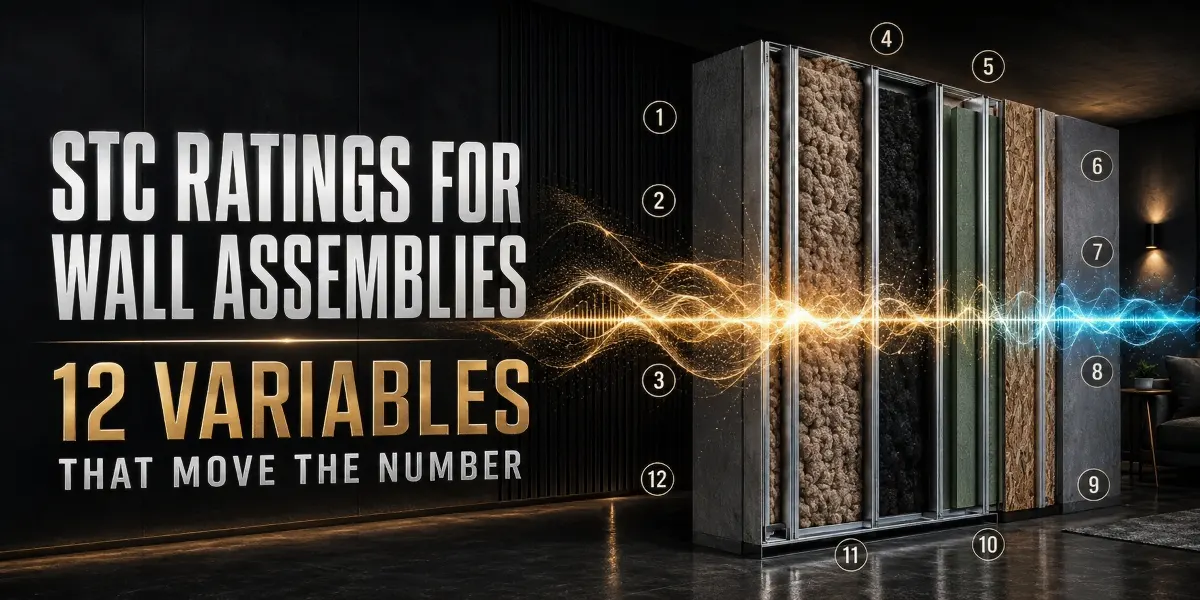
STC for walls is a single number — and a lot of variables conspire to move it. A wall might lab-test at STC 55 and field-test at STC 49 because of a single skipped bead of caulk. This chart breaks down the 12 variables that actually drive a wall’s Sound Transmission Class rating, how much each one typically buys, what they cost, and where the field gives back what the lab measured.
For specific STC values by wall assembly type, see the STC Rating Chart — this post is about the variables that move those numbers, not the lookup. To browse fully detailed, lab-tested builds, see our STC-Rated Wall Assemblies library.
The 12 Variables That Move the STC Number
Each card below shows the variable, what changing it does to the STC rating, a cross-section of the before/after wall, and the typical point gain you can expect. Cost is rough relative ($ – $$$). Cards are color-coded by category:
Wall STC Variables Ranked by Typical Gain
All 12 variables in one place, sorted to read from easy/cheap wins to higher-cost or protective measures. Numbers reflect the typical lab-tested gain for a single change against a baseline single-stud, single-layer drywall wall.
Building to STC 50, 55, or 60
Three worked-example walls that stack the variables above. Each hits a real, common spec target in the field — not just a lab number. For dozens more builds sorted by rating, see our STC-Rated Wall Assemblies library.
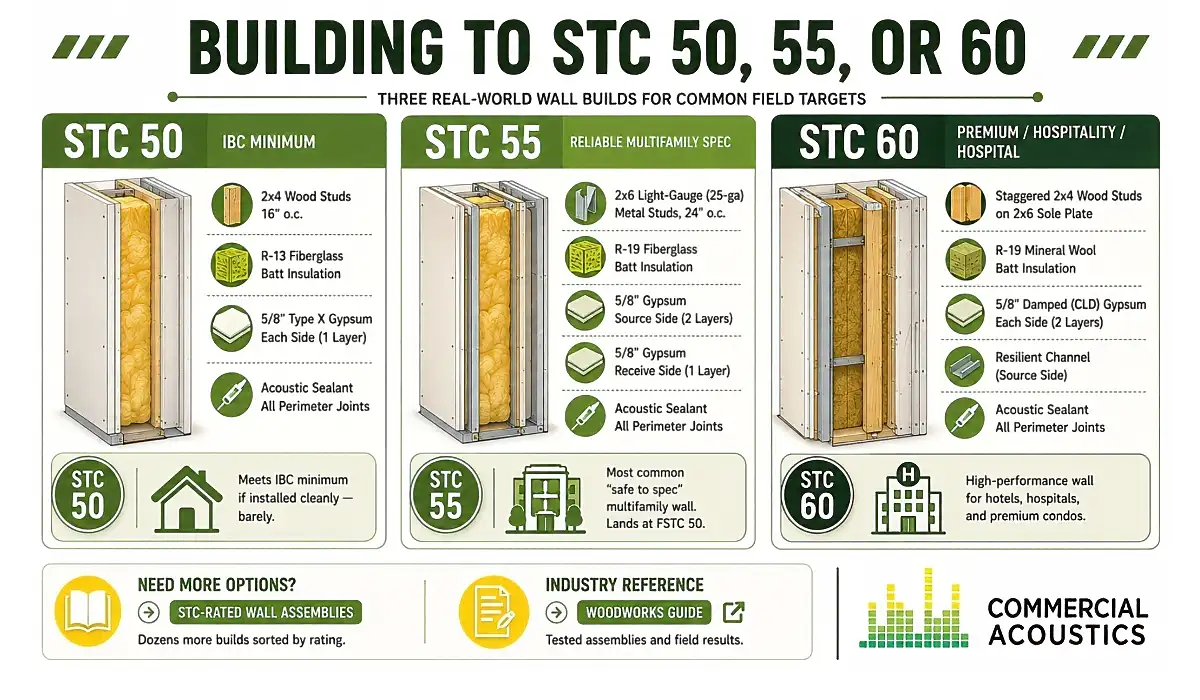
STC 50 build-up (IBC minimum). Single 2×4 wood studs at 16″ o.c., R-13 fiberglass batt, single layer of 5/8″ Type X gypsum on each side, acoustic sealant at every perimeter joint. Hits the IBC dwelling-unit minimum if installed cleanly — barely. Bumps below code on a sloppy field install.
STC 55 build-up (reliable multifamily spec). Single 2×6 light-gauge (25-ga) metal studs at 24″ o.c., R-19 batt insulation, double layer of 5/8″ gypsum on the source side, single layer on the receive side, full perimeter sealant. The most common “safe to spec” multifamily wall — absorbs the field penalty and lands at FSTC 50. For a deeper industry reference on building this kind of assembly in wood-frame multifamily projects, WoodWorks publishes a thorough Acoustical Considerations for Mixed-Use Wood-Frame Buildings guide with tested assemblies and field results.
STC 60 build-up (premium / hospitality / hospital). Staggered 2×4 wood studs on a 2×6 sole plate, R-19 mineral wool batt, double layer of 5/8″ damped (constrained-layer) gypsum on both sides, resilient channel on the source side, full sealant. Used for hotel demising, hospital patient rooms, and premium condos where the brand standard sits above code.
Field Mistakes That Quietly Kill STC
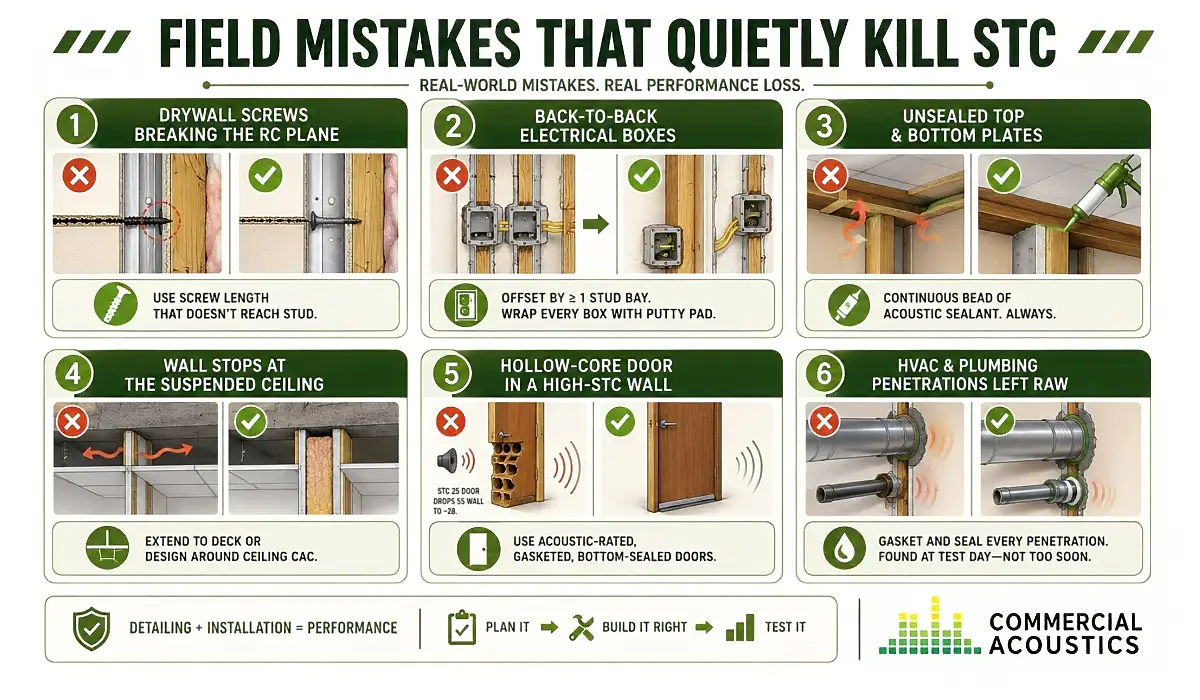
The walls that fail at testing day almost always fail for one of these reasons — not because the assembly was wrong on paper.
- Drywall screws breaking the RC plane. Long fasteners that touch the stud short-circuit the decoupling entirely. Specify a screw length that doesn’t reach the framing.
- Back-to-back electrical boxes. The most reliable way to ruin a high-STC wall. Offset by at least one stud bay; wrap every box with an acoustic putty pad.
- Unsealed top & bottom plates. A continuous bead of acoustic-grade sealant at every drywall edge is the cheapest field-vs-lab insurance you can buy. Hardening latex caulk doesn’t count.
- Wall stops at the suspended ceiling. Sound flanks straight through the plenum; the wall’s STC is irrelevant. Either extend the wall to the deck or design around the ceiling tile’s CAC rating.
- Hollow-core door in a high-STC wall. An STC 25 door composites a 55-rated wall down to roughly 28. Either match the door (acoustic-rated, gasketed, bottom-sealed) or accept the composite.
- HVAC and plumbing penetrations left raw. Every duct boot, sprinkler head, and pipe sleeve flanks the wall unless gasketed and sealed. Often discovered only at field test.
Standards & Testing (ASTM E90 & E336)
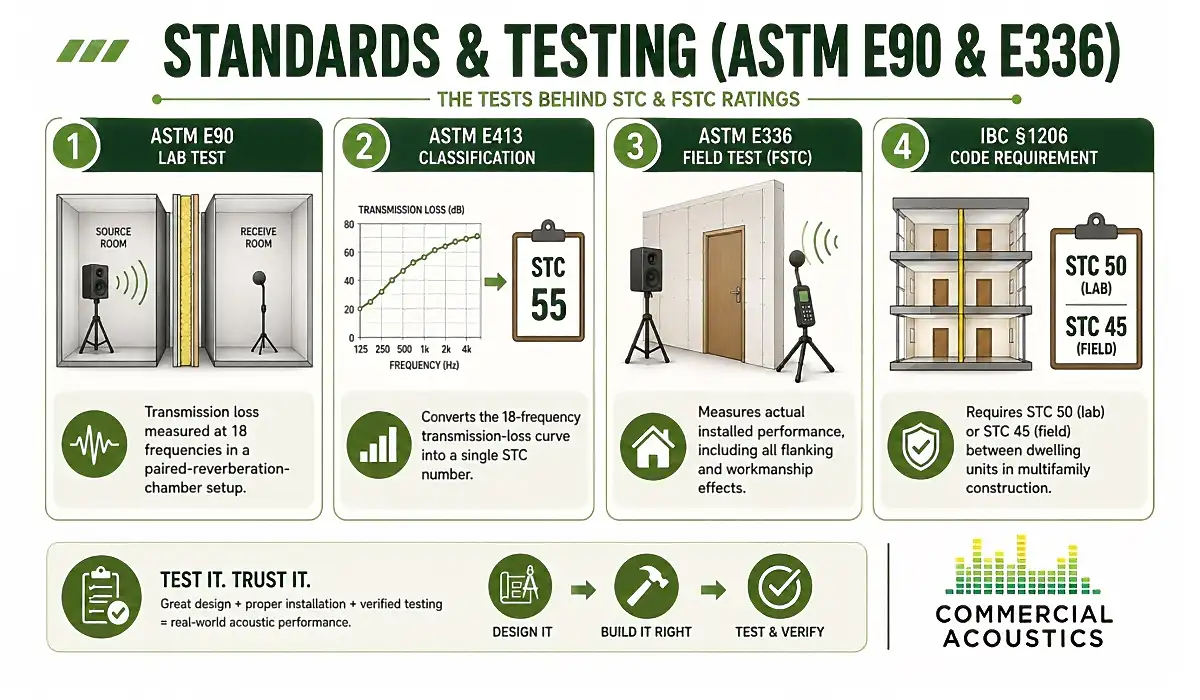
- ASTM E90: The lab test method behind every published STC rating — transmission loss measured at 18 frequencies in a paired-reverberation-chamber setup.
- ASTM E413: The classification method that converts the 18-frequency transmission-loss curve into a single STC number.
- ASTM E336: The field test (Field STC, FSTC) that measures actual installed performance, including all flanking and workmanship effects.
- IBC §1206: Requires STC 50 (lab) or STC 45 (field) between dwelling units in multifamily construction.
Need to compare STC against the other major ratings? See STC vs IIC vs Delta IIC: What’s the Difference? for the side-by-side. For impact noise through floors, see the IIC Rating Chart.
Conclusion: Specifying Walls That Hold Up in the Field
A high STC rating on paper is the easy part. The wall has to still rate after the field penalty — flanking, gaps, penetrations, sloppy sealant, hollow doors. The pros who consistently hit their numbers don’t chase a single hero variable; they stack four or five and engineer in a 5-point cushion above code.
Commercial Acoustics has specified and supplied demising-wall assemblies for multifamily, hospitality, and healthcare projects since 2008. If you need help sizing a wall to a code target or a brand standard, contact us — we’ll walk through the variables, products, and field-test cushion together.
FAQs: STC Ratings for Walls
What is a good STC rating for a wall?
STC 50 is the IBC minimum between dwelling units. Most professional specs target STC 55–60 to absorb the typical 2–5 point field penalty and produce a wall that sounds private in real-world conditions.
What’s the cheapest way to improve a wall’s STC?
Add a second layer of 5/8″ drywall to one side and fill the cavity with batt insulation. Together those two moves typically add 10–15 STC at low cost — more than any other single change.
Do metal studs have a better STC than wood studs?
Yes, slightly. Light-gauge metal studs (especially 25-gauge EQ studs at 24″ on center) flex more under sound pressure than rigid wood studs, transmitting less vibration. A 25-ga metal-stud wall typically rates 3–5 STC higher than the equivalent 2×4 wood-stud wall.
Does a resilient channel actually work?
Yes, when installed correctly — RC typically buys 5–7 STC on one side, 8–12 on both. But it’s famously easy to short-circuit with a long screw or a misaligned hat. Many field walls with RC underperform because of install quality, which is why staggered- or double-stud framing is often more reliable.
How much STC do I lose at the field test?
Typically 2–5 points below the lab STC, due to flanking through structure, gaps at perimeters, and workmanship. Specify the wall to land 5 STC points above your code target so the Field STC (FSTC) still passes.

Walker Peek|Founder & CEO, Commercial Acoustics
Walker founded Commercial Acoustics in 2013 to bring aerospace-grade engineering discipline to soundproofing, and runs the firm as CEO from its 12,000 sq ft Tampa production facility. The company designs custom acoustic panels, sound membranes, and masking systems for multi-family, hospitality, healthcare, and commercial projects across the US — built around Walker’s invention, Wall Blokker, an EVA-based sound barrier that hits STC 50-plus at roughly $1 per square foot installed.
A Jacksonville native, Walker spent five years at Kennedy Space Center with Craig Technologies before founding Commercial Acoustics — certifying aerospace manufacturing to the AS9100 standard and leading Six Sigma Black Belt process-improvement teams on NASA programs. He is a certified Industrial Noise Control Engineer and the author of Architectural Acoustics: A Practical Handbook.
