Table of Contents
What Is an NC Rating?
NC (Noise Criterion) is a single-number rating that describes the maximum acceptable background noise level inside an occupied space — almost always driven by HVAC equipment. The NC value is derived from a family of frequency-shaped curves (NC 15 through NC 65) that account for how the human ear responds differently to low, mid, and high frequencies. A room “meets NC 35” when its measured octave-band noise levels stay at or below the NC 35 curve across the full audible spectrum.
The NC rating chart below shows recommended target levels for the most common space types in commercial, hospitality, healthcare, education, and industrial work. Use these values when specifying mechanical equipment, sizing duct silencers, or setting NC targets for mechanical noise in spaces like NOC offices, data halls, and plant-adjacent work areas. For background on how the NC curves are derived, see our NC Rating 101 guide.
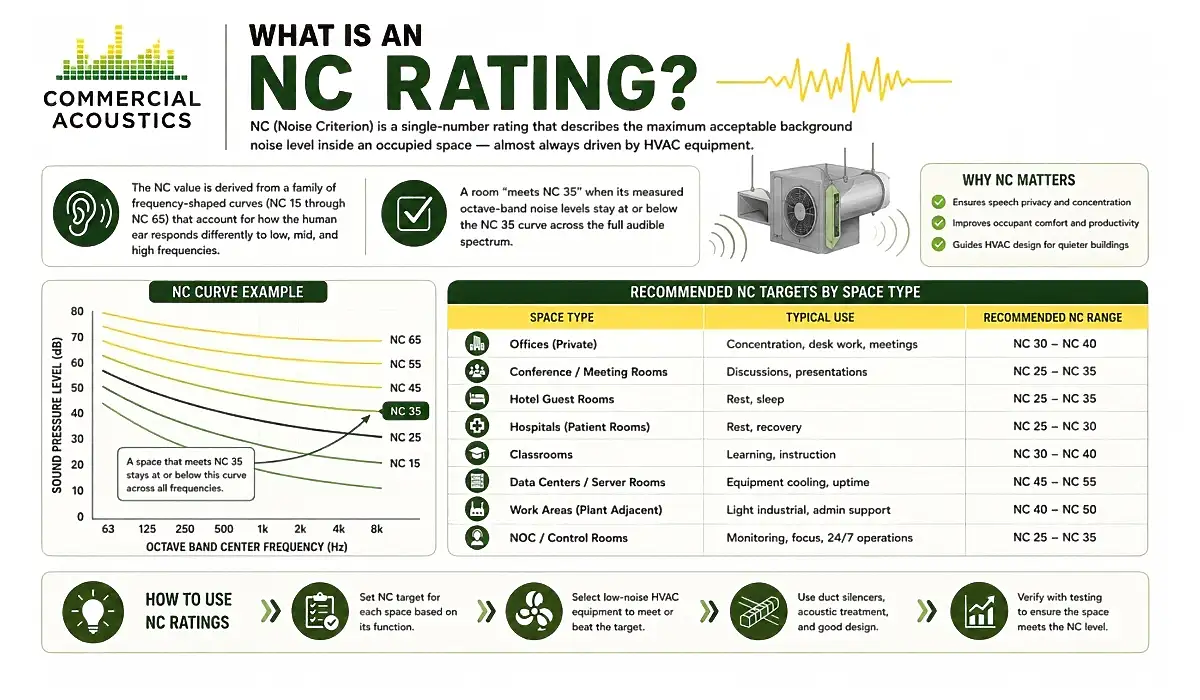
NC Rating Chart – Recommended Levels by Room Type
NC vs RC vs dBA
NC is one of several metrics used to specify mechanical noise. For a quick reference on the levels themselves, our decibel level chart covers the dB side. The table below compares the four most common metrics and when to use each.
How HVAC Equipment Drives NC
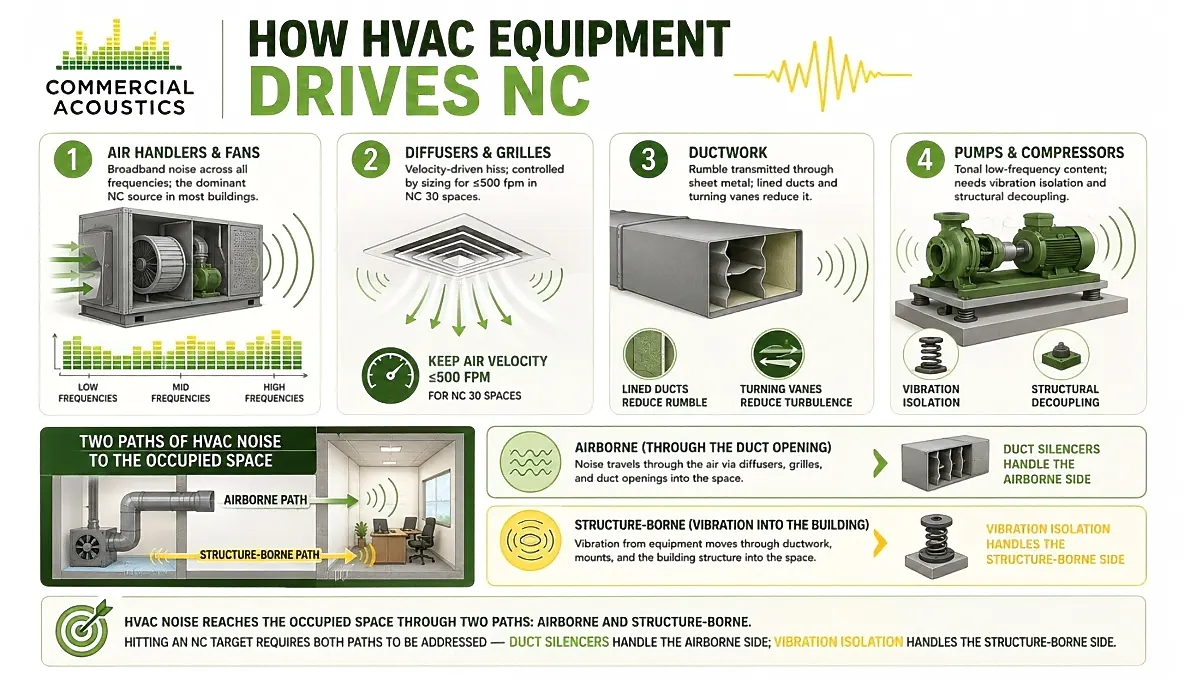
- Air handlers & fans: Broadband noise across all frequencies; the dominant NC source in most buildings.
- Diffusers & grilles: Velocity-driven hiss; controlled by sizing for ≤500 fpm in NC 30 spaces.
- Ductwork: Rumble transmitted through sheet metal; lined ducts and turning vanes reduce it.
- Pumps & compressors: Tonal low-frequency content; needs vibration isolation and structural decoupling.
HVAC noise reaches the occupied space through two paths: airborne (through the duct opening) and structure-borne (vibration into the building frame). Hitting an NC target requires both paths to be addressed — duct silencers handle the airborne side; vibration isolation handles the structure-borne side.
How to Achieve NC Targets
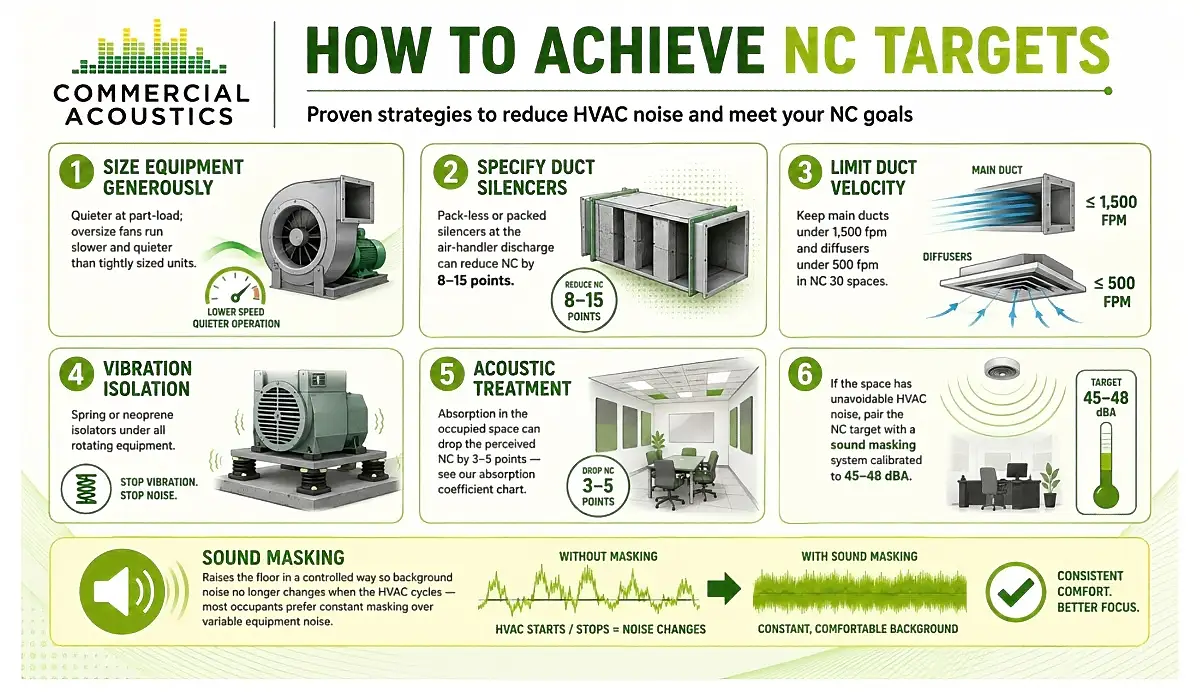
- Size equipment generously: Quieter at part-load; oversize fans run slower and quieter than tightly sized units.
- Specify duct silencers: Pack-less or packed silencers at the air-handler discharge can reduce NC by 8–15 points.
- Limit duct velocity: Keep main ducts under 1,500 fpm and diffusers under 500 fpm in NC 30 spaces.
- Vibration isolation: Spring or neoprene isolators under all rotating equipment.
- Acoustic treatment: Absorption in the occupied space can drop the perceived NC by 3–5 points — see our absorption coefficient chart.
If the space has unavoidable HVAC noise, pair the NC target with a sound masking system calibrated to 45–48 dBA. Sound masking raises the floor in a controlled way so background noise no longer changes when the HVAC cycles — most occupants prefer constant masking over variable equipment noise.
Field Measurement & Standards
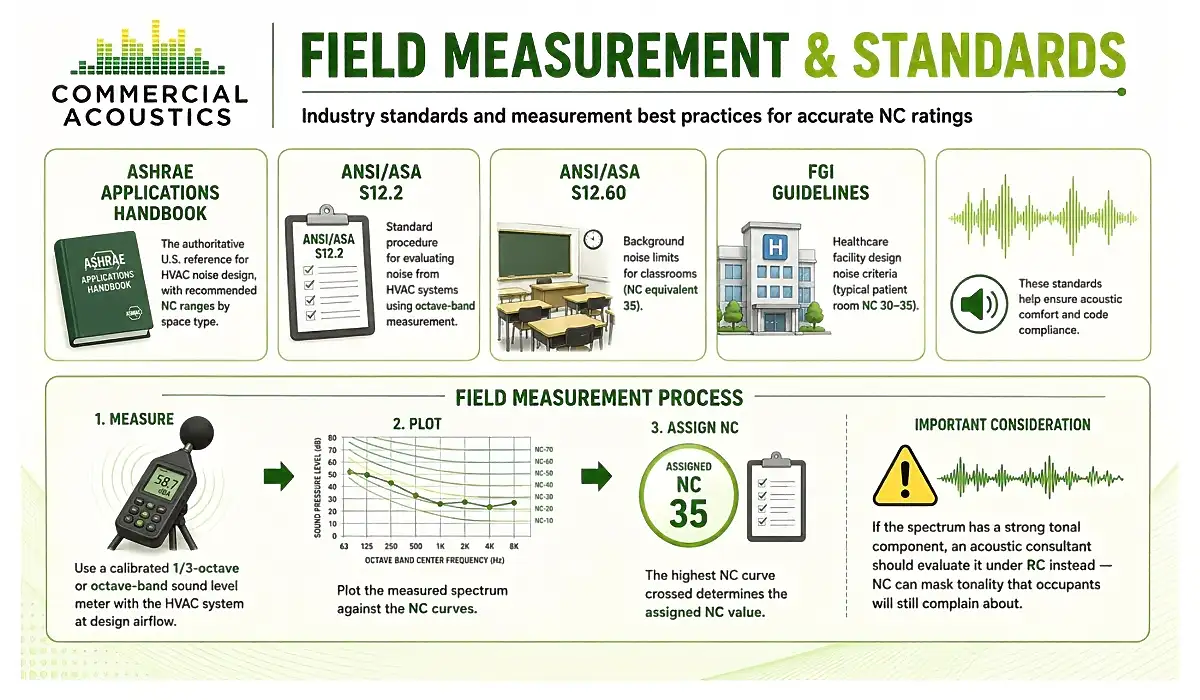
- ASHRAE Applications Handbook: The authoritative U.S. reference for HVAC noise design, with recommended NC ranges by space type.
- ANSI/ASA S12.2: Standard procedure for evaluating noise from HVAC systems using octave-band measurement.
- ANSI/ASA S12.60: Background noise limits for classrooms (NC equivalent 35).
- FGI Guidelines: Healthcare facility design noise criteria (typical patient room NC 30–35).
Field measurement uses a calibrated 1/3-octave or octave-band sound level meter with the HVAC system at design airflow. The measurement is plotted against the NC curves; the highest curve crossed determines the assigned NC value. If the spectrum has a strong tonal component, an acoustic consultant should evaluate it under RC instead — NC can mask tonality that occupants will still complain about.
Conclusion: Designing for Quiet Spaces
NC ratings translate “quiet enough for this space” from a design intent into a measurable engineering target, including NC targets for resident rooms where HVAC noise can disrupt sleep and care. Spec the NC target during schematic design alongside STC walls and IIC floors — together, those three numbers define how a building will sound. For mechanical noise that’s already in the building, our acoustic consulting team can run a field assessment, identify the dominant source, and recommend a targeted retrofit.
FAQs: NC Rating Chart
What NC rating is good for an office?
Private offices and small conference rooms target NC 30–35; open offices target NC 35–40, often paired with sound masking calibrated to 45–48 dBA.
What is the difference between NC and dBA?
dBA is a single A-weighted sound level. NC is a frequency-shaped rating derived from octave-band measurements — it accounts for how human hearing responds differently across the spectrum. NC is more diagnostic; dBA is simpler but less revealing.
What NC level do hospitals require?
Per FGI Guidelines, patient rooms target NC 25–35, corridors and exam rooms NC 30–40. ICU and operating rooms often specify lower NC to support sensitive equipment and patient recovery.
How is NC measured in the field?
With a calibrated octave-band sound level meter at the listener position with HVAC running at design airflow. The measured spectrum is plotted against the NC curves; the highest curve crossed by any band determines the rated NC.
What is the difference between NC and RC?
NC is a single-number rating from a family of curves. RC (Room Criterion) is a quality-based rating that flags hiss, rumble, or tonal content separately from the overall level — preferred by ASHRAE for critical-listening spaces.

Walker Peek|Founder & CEO, Commercial Acoustics
Walker founded Commercial Acoustics in 2013 to bring aerospace-grade engineering discipline to soundproofing, and runs the firm as CEO from its 12,000 sq ft Tampa production facility. The company designs custom acoustic panels, sound membranes, and masking systems for multi-family, hospitality, healthcare, and commercial projects across the US — built around Walker’s invention, Wall Blokker, an EVA-based sound barrier that hits STC 50-plus at roughly $1 per square foot installed.
A Jacksonville native, Walker spent five years at Kennedy Space Center with Craig Technologies before founding Commercial Acoustics — certifying aerospace manufacturing to the AS9100 standard and leading Six Sigma Black Belt process-improvement teams on NASA programs. He is a certified Industrial Noise Control Engineer and the author of Architectural Acoustics: A Practical Handbook.
