Table of Contents
What Is a CAC Rating?
CAC (Ceiling Attenuation Class) measures how well a ceiling tile blocks sound from passing between two adjacent rooms through the plenum above the suspended ceiling. In any building where demising walls stop at the suspended ceiling — most modern offices, schools, and healthcare buildouts — CAC determines whether voices in one room are audible in the next.
The scale runs from about CAC 25 (standard fiberglass acoustic tile) to CAC 50+ (engineered assemblies with plenum barriers). CAC is the inverse problem of NRC: NRC measures absorption within a room, CAC measures transmission between rooms. High-NRC tiles often have low CAC, and vice versa. For background on how CAC is derived, see our CAC Rating 101 guide.
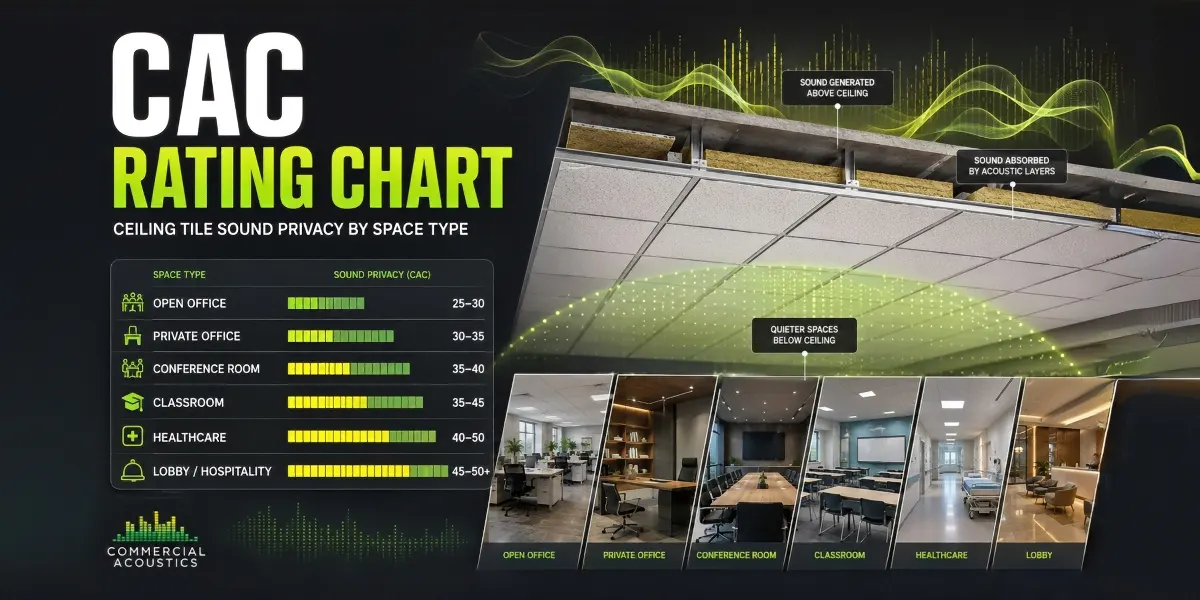
CAC Rating Chart – Ceiling Tiles & Assemblies
Recommended CAC by Space Type
CAC requirements scale with how confidential the conversations need to be. The right target depends as much on use case as on building type.
CAC vs NRC vs STC
- CAC: Sound transmission through the plenum between adjacent rooms. Use for partial-height walls.
- NRC: Sound absorption within a room. Controls reverberation, not transmission.
- STC: Sound transmission through a wall or floor partition. Use when the partition extends full-height.
- Common trade-off: Tiles with high NRC (open fiberglass) usually have low CAC. Tiles with high CAC (dense mineral fiber) usually have lower NRC. Premium tiles try to do both — verify both ratings on the spec sheet.
For a deeper comparison of these ratings, see our absorption coefficient chart for NRC and our STC rating chart for wall transmission.
How to Improve Ceiling-Path Sound Privacy
- Upgrade the tile: Swap CAC 30 mineral fiber for CAC 38–42 high-density tile. Often the easiest single-step improvement.
- Add a plenum barrier: Mineral wool batt or GWB barrier above the demising wall, extending across the plenum to the deck. Adds 5–10 CAC points.
- Extend the wall to deck: Eliminates the plenum path entirely. CAC becomes irrelevant — STC takes over.
- Add sound masking: Doesn’t increase CAC, but raises the masking floor so the transmitted signal becomes unintelligible. Most effective when paired with a CAC 35+ tile.
- Seal ceiling penetrations: Sprinkler heads, light fixtures, return-air grilles, and HVAC duct penetrations bypass the tile. Acoustic boots and gasketing maintain the assembly rating.
The biggest mistake in ceiling-path design is assuming the tile alone delivers privacy. The composite assembly — tile + plenum + light fixtures + ductwork — determines actual performance, and the weakest element wins. A CAC 42 tile with un-treated lay-in light fixtures often performs like CAC 30 in the field.
Standards & Field Testing
- ASTM E1414: The standard test method for measuring CAC in a two-room reverberation chamber configuration. Manufacturers list lab CAC per this spec.
- ASTM E336: Field measurement of airborne sound attenuation between rooms — captures the actual composite performance including plenum path.
- ANSI/ASA S12.60: Sets noise isolation requirements between learning spaces; CAC is one component of total isolation.
- FGI Guidelines: Healthcare facility design includes CAC criteria for clinical spaces with privacy requirements.
Field results almost always lag lab CAC by 3–6 points due to flanking through penetrations, light fixtures, and ductwork. Spec the tile to land 5 points above your target — the same cushion strategy used for STC and IIC.
Conclusion: Specifying Ceilings for Privacy
CAC is the deciding factor for any project with partial-height walls and shared plenums. Pair the CAC target with NRC (room absorption) and STC (wall partition) when specifying ceilings — all three together define how a space sounds and feels for the people working in it. For more on ceiling system selection, see our guide on acoustic ceiling tiles.
Commercial Acoustics has specified and installed ceiling systems for offices, healthcare facilities, schools, and multifamily projects since 2008. If you need help choosing the right CAC for your space — or if existing partitions are leaking through the plenum — contact us and we’ll walk through tile options, plenum barriers, and budget.
FAQs: CAC Rating Chart
What is a good CAC rating for an office?
Standard private offices target CAC 35–40; executive offices, conference rooms, and confidential spaces target CAC 40–45. Open-plan offices can use CAC 30–35 when paired with sound masking.
What is the difference between CAC and NRC?
CAC measures how well a ceiling tile blocks sound passing between two rooms through the plenum above. NRC measures how well a tile absorbs sound within a single room. Tiles often trade one for the other.
Do I need CAC if walls extend to the deck?
No. CAC only matters when partition walls stop at the suspended ceiling and the plenum becomes the sound path. Full-height walls eliminate the plenum path, and STC drives the demising performance instead.
What CAC rating do HIPAA spaces require?
HIPAA-protected spaces (exam rooms, consultation areas) typically require CAC 40+ ceiling tiles, often combined with plenum barriers or full-height walls and sound masking.
How is CAC measured?
CAC is measured in a lab per ASTM E1414, using two reverberation chambers separated by a common ceiling test specimen. Field measurement uses ASTM E336, which captures the full composite performance including all plenum flanking paths.

Walker Peek|Founder & CEO, Commercial Acoustics
Walker founded Commercial Acoustics in 2013 to bring aerospace-grade engineering discipline to soundproofing, and runs the firm as CEO from its 12,000 sq ft Tampa production facility. The company designs custom acoustic panels, sound membranes, and masking systems for multi-family, hospitality, healthcare, and commercial projects across the US — built around Walker’s invention, Wall Blokker, an EVA-based sound barrier that hits STC 50-plus at roughly $1 per square foot installed.
A Jacksonville native, Walker spent five years at Kennedy Space Center with Craig Technologies before founding Commercial Acoustics — certifying aerospace manufacturing to the AS9100 standard and leading Six Sigma Black Belt process-improvement teams on NASA programs. He is a certified Industrial Noise Control Engineer and the author of Architectural Acoustics: A Practical Handbook.
