
Table of Contents
What Is Delta IIC (ΔIIC)?
Delta IIC (ΔIIC) measures how many impact-isolation points a single underlayment or floor covering adds on its own. It is found by testing a bare 6″ concrete reference slab, then re-testing the same slab with the underlayment installed — the difference between the two IIC results is the ΔIIC. In short: IIC rates the whole floor, while ΔIIC isolates just the mat.
That isolation is what makes ΔIIC useful for product selection. Because every product is tested on the same standardized slab, you can line up cork, rubber, foam, and engineered mats and compare them apples-to-apples — something a raw IIC number can’t do, since IIC changes with the slab, ceiling, and finish floor around it.
Delta IIC vs IIC – What’s the Difference?
These two ratings get confused constantly, but they answer different questions. IIC tells you how the finished floor performs; ΔIIC tells you how much credit a single product deserves for that performance.
The practical rule: shop for underlayments by ΔIIC, but always confirm the assembly with a full IIC rating — especially on wood framing, where ΔIIC values measured on concrete do not carry over.
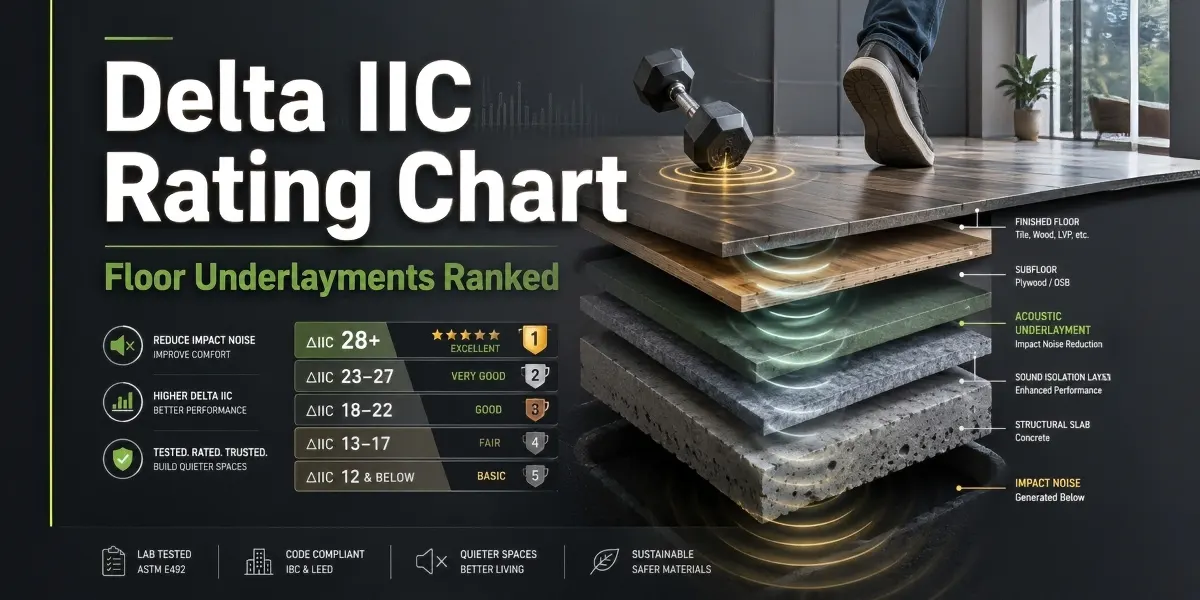
Delta IIC Rating Chart – Underlayments by Material
The chart below lists typical ΔIIC ranges for common underlayment materials, measured on a bare 6″ concrete reference slab per ASTM E2179. Thickness and density drive most of the difference — thicker, denser rubber generally posts the highest values.
How to Use Delta IIC When Specifying
- Compare products, not assemblies: Use ΔIIC to rank underlayments against each other. A higher ΔIIC means a bigger improvement on the reference slab — nothing more.
- Don’t add ΔIIC to a slab’s IIC and call it done: The math only holds on the exact concrete reference. On wood joists or with a different finish floor, the real gain can be much smaller.
- Match the mat to the finish floor: Hard finishes (LVT, tile, hardwood) need a stronger underlayment — aim for ΔIIC 22+ to offset the lost cushioning. Carpet does most of the work itself.
- Verify with an assembly rating: Once you’ve picked the mat, confirm the whole floor against an IIC assembly target and the IBC minimum of IIC 50.
- Plan for the field penalty: Like IIC, real-world results run a few points below lab numbers. Spec with a cushion and seal perimeters and penetrations.
Sizing a floor build-up? Run it through our IIC Calculator to estimate the full assembly, then cross-check airborne performance with the STC rating chart.
Standards & Testing (ASTM E2179)
- ASTM E2179: The test method behind ΔIIC — it compares a bare 6″ concrete reference slab to the same slab with the floor covering installed, and reports the improvement.
- ASTM E492: The laboratory tapping-machine test that produces a full IIC rating for a complete assembly.
- ASTM E1007: Field measurement of impact sound (FIIC) in an installed building, capturing flanking and workmanship.
Because ΔIIC is anchored to one specific concrete slab, it is a relative metric by design. It is excellent for comparing two underlayments and poor for predicting a wood-framed floor — which is exactly why manufacturers publish ΔIIC for marketing but consultants still test the full assembly.
Conclusion: Choosing an Underlayment
ΔIIC is the cleanest way to compare acoustic underlayments — one number, one reference slab, apples-to-apples. Treat ΔIIC 22–25 as a strong target for hard-surface floors and ΔIIC 26+ as premium. Just remember the metric stops at the mat: pair your ΔIIC pick with a full IIC assembly rating and an STC check to be sure the finished floor is genuinely quiet.
Commercial Acoustics has specified floor-ceiling assemblies and acoustic underlayments for multifamily, hospitality, and healthcare projects since 2008. If you need help matching an underlayment to a code target, contact us and we’ll walk through mats, finish floors, and field-test cushion.
FAQs: Delta IIC Rating Chart
What is a good Delta IIC rating?
On a bare concrete reference slab, ΔIIC 22–25 is a strong, well-specified acoustic underlayment, and ΔIIC 26+ is premium. Thin builder-grade foams land around ΔIIC 15–18 and add little real footfall reduction.
What is the difference between IIC and Delta IIC?
IIC rates the entire floor-ceiling assembly as one absolute number (ASTM E492). Delta IIC (ΔIIC) rates only the underlayment’s improvement in isolation, measured as the point gain it adds to a bare concrete reference slab (ASTM E2179).
Can I add Delta IIC to a slab’s IIC to get the final rating?
Not reliably. ΔIIC is measured only on a standard concrete slab, so it does not predict performance on wood-framed floors or under different finish floors. Use it to compare underlayments, then verify the complete assembly with a full IIC test or estimate.
Which underlayment has the highest Delta IIC?
Thick recycled-rubber mats (around 10 mm) and engineered sound mats with a reinforced rubber-and-membrane construction post the highest lab ΔIIC values, typically in the high-20s to low-30s on a concrete reference slab.
What standard is Delta IIC tested under?
Delta IIC is measured per ASTM E2179, which compares the impact sound transmission of a bare 6-inch concrete reference slab to the same slab with the floor covering or underlayment installed. The difference is the ΔIIC.

Walker Peek|Founder & CEO, Commercial Acoustics
Walker founded Commercial Acoustics in 2013 to bring aerospace-grade engineering discipline to soundproofing, and runs the firm as CEO from its 12,000 sq ft Tampa production facility. The company designs custom acoustic panels, sound membranes, and masking systems for multi-family, hospitality, healthcare, and commercial projects across the US — built around Walker’s invention, Wall Blokker, an EVA-based sound barrier that hits STC 50-plus at roughly $1 per square foot installed.
A Jacksonville native, Walker spent five years at Kennedy Space Center with Craig Technologies before founding Commercial Acoustics — certifying aerospace manufacturing to the AS9100 standard and leading Six Sigma Black Belt process-improvement teams on NASA programs. He is a certified Industrial Noise Control Engineer and the author of Architectural Acoustics: A Practical Handbook.
