Table of Contents
Quick Overview
- Echo is a reflection problem, not a soundproofing problem. The fix is absorption and diffusion inside the room, not heavier walls.
- Aim for an RT60 of 0.4–0.6 seconds in conversation-heavy rooms. Restaurants and lobbies can run a touch higher, studios lower.
- Treat the biggest hard surfaces first: the ceiling, then walls, then floor. Cover roughly 25–40% of total surface area with NRC 0.85+ material.
- Mix absorption with diffusion so the room stays clear without sounding dead.
Why Rooms Echo
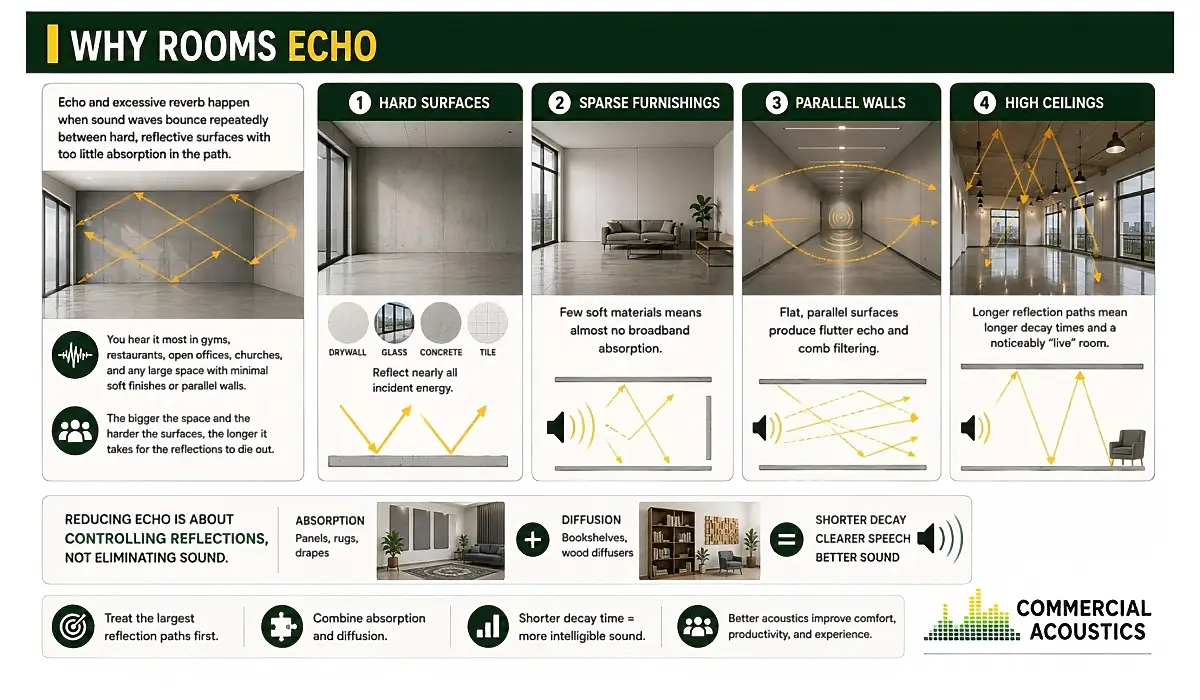
Echo and excessive reverb happen when sound waves bounce repeatedly between hard, reflective surfaces with too little absorption in the path. Glass, drywall, tile, and polished concrete reflect almost all the energy that hits them. That energy stacks up, smears consonants, and turns normal conversation into noise.
You hear it most in gyms, restaurants, open offices, churches, and any large space with minimal soft finishes or parallel walls. The bigger the space and the harder the surfaces, the longer it takes for the reflections to die out.
- Hard surfaces: Drywall, glass, concrete, and tile reflect nearly all incident energy.
- Sparse furnishings: Few soft materials means almost no broadband absorption.
- Parallel walls: Flat, parallel surfaces produce flutter echo and comb filtering.
- High ceilings: Longer reflection paths mean longer decay times and a noticeably “live” room.
Reducing echo is about controlling reflections, not eliminating sound. Strategic absorption (panels, rugs, drapes) plus light diffusion (bookshelves, wood diffusers) shortens decay so speech becomes intelligible and music sounds defined. Treat the largest reflection paths first, then balance with diffusion to keep the room lively but controlled.
Echo vs Reverberation: What RT60 Tells You
An echo is a distinct repeat, the kind you hear shouting into a canyon. Reverberation is the rapid blend of many reflections that smear together. That is what most rooms actually suffer from, and what the contractor or facility manager usually means when they say “the room echoes.”
Reverb is quantified with RT60, the time in seconds for sound to decay by 60 dB after the source stops. Lower RT60 means clearer speech. The right target depends on the room program, not just size.
Typical RT60 targets: 0.3–0.6 s for offices and classrooms, 0.5–0.8 s for restaurants and multipurpose rooms, 0.8–1.2 s for worship and performance spaces with amplified speech. Studios and critical-listening rooms run lower still. The room acoustics calculator estimates RT60 from your room dimensions and finishes before you spec a single panel.
Step 1: Cover the Floor
- Area rugs: Cover hard floors with dense, soft material at primary footprints.
- Rug pads: A cushioned underlayer roughly doubles low- and mid-frequency absorption.
- Layer coverage: Overlap rugs in larger or taller rooms where one rug cannot do the work.
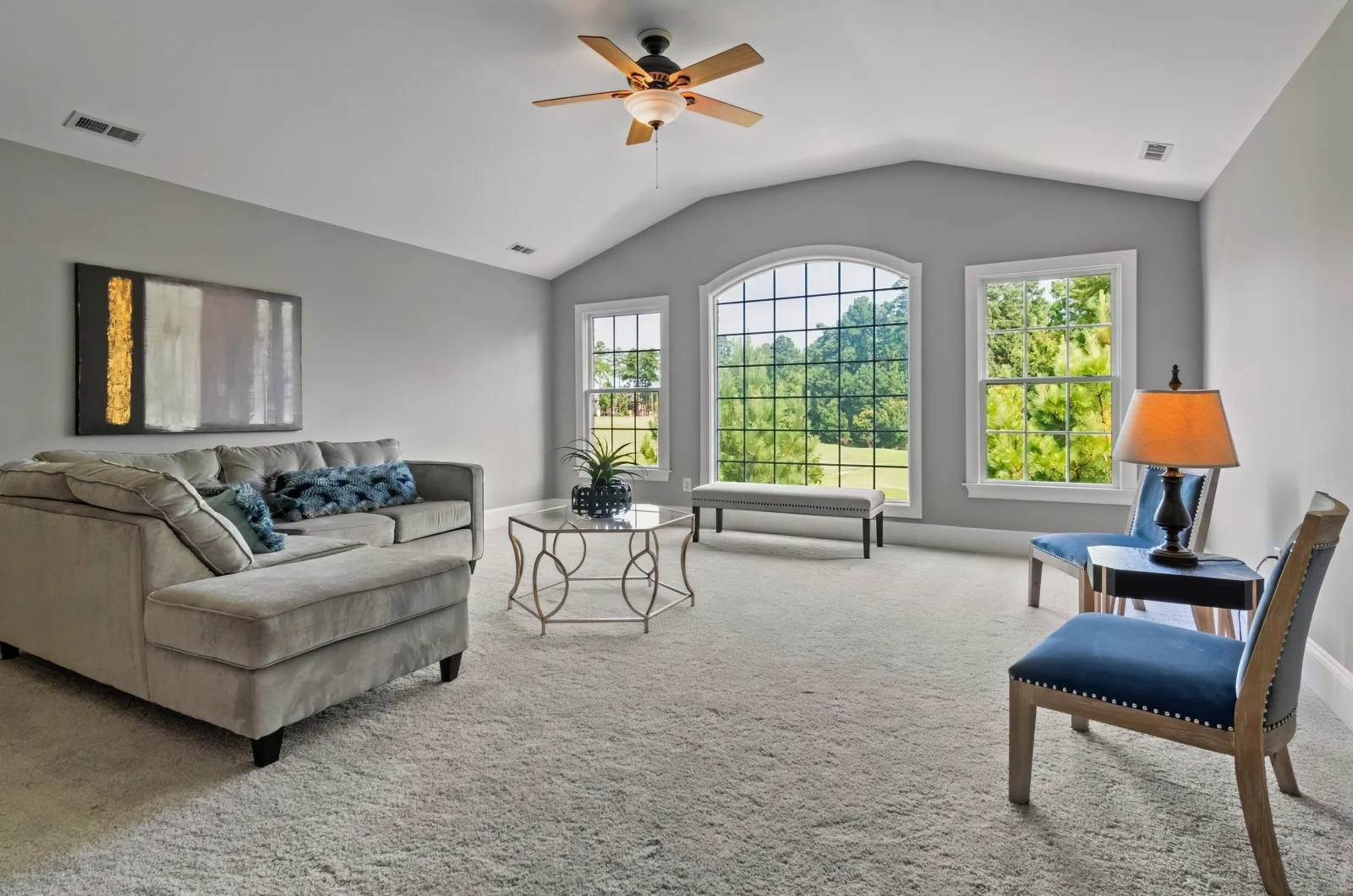
Floors are a major reflection surface, especially in rooms with hard finishes overhead. Covering even 25% of the floor area can produce a noticeable drop in midrange reverb. For offices and classrooms with budget constraints, this is often the cheapest first move.
Carpet tile is a strong option when full-room carpet is not on the table. It is easier to replace in worn-out high-traffic areas and still delivers meaningful broadband absorption at the floor plane.
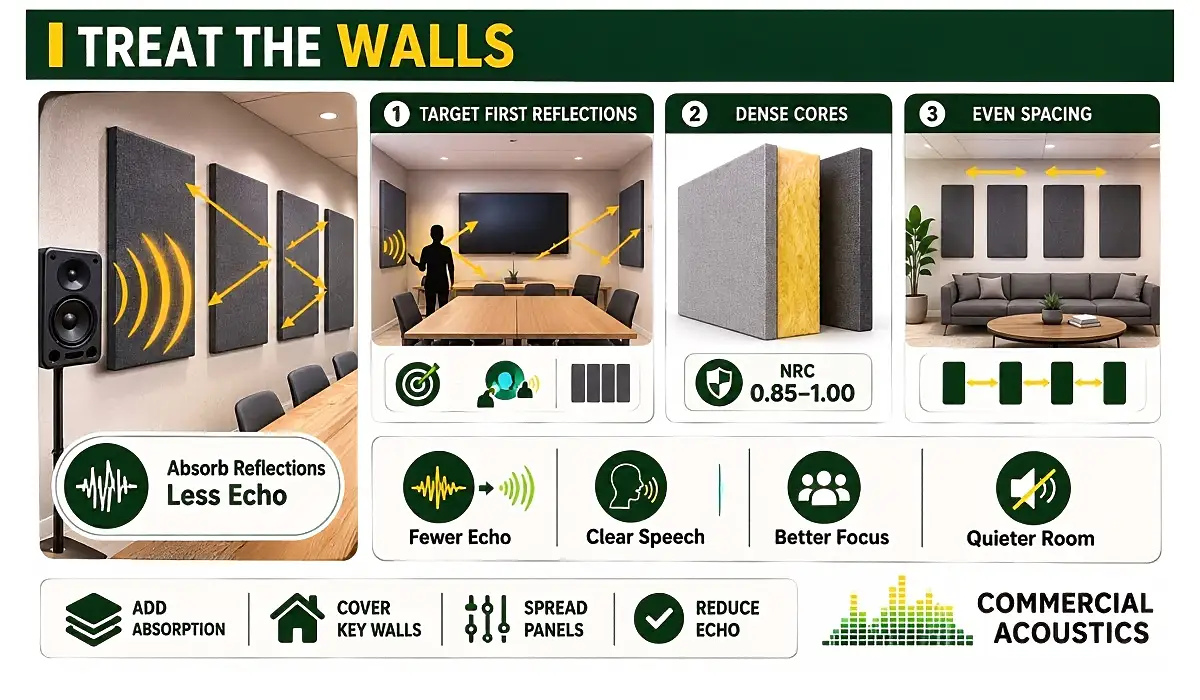
Step 2: Treat the Walls
- Target first reflections: Place panels opposite primary talkers or speakers, where flutter is loudest.
- Dense cores: Choose fiberglass or mineral wool panels rated NRC 0.85–1.00.
- Even spacing: Spread coverage across both long and short walls to break up flutter.
Walls carry most of the lateral reflection energy in a typical room. Cover roughly 25–35% of total wall area for general spaces, or up to 50% for studios and recording rooms. Acoustic absorption panels sit at the heart of most treatment plans because they handle the mid and high frequencies that drive speech intelligibility.
When wall space is at a premium or aesthetics drive the design, a stretched fabric wall system hides the absorptive core behind a tensioned designer finish. The acoustic effect is similar to a panel array, but the wall reads as architectural rather than added-on.
Coverage matters more than placement perfection in non-critical rooms. If you only have budget for 12 panels in a 30-foot conference room, get them on the wall first and tune placement on a second pass.
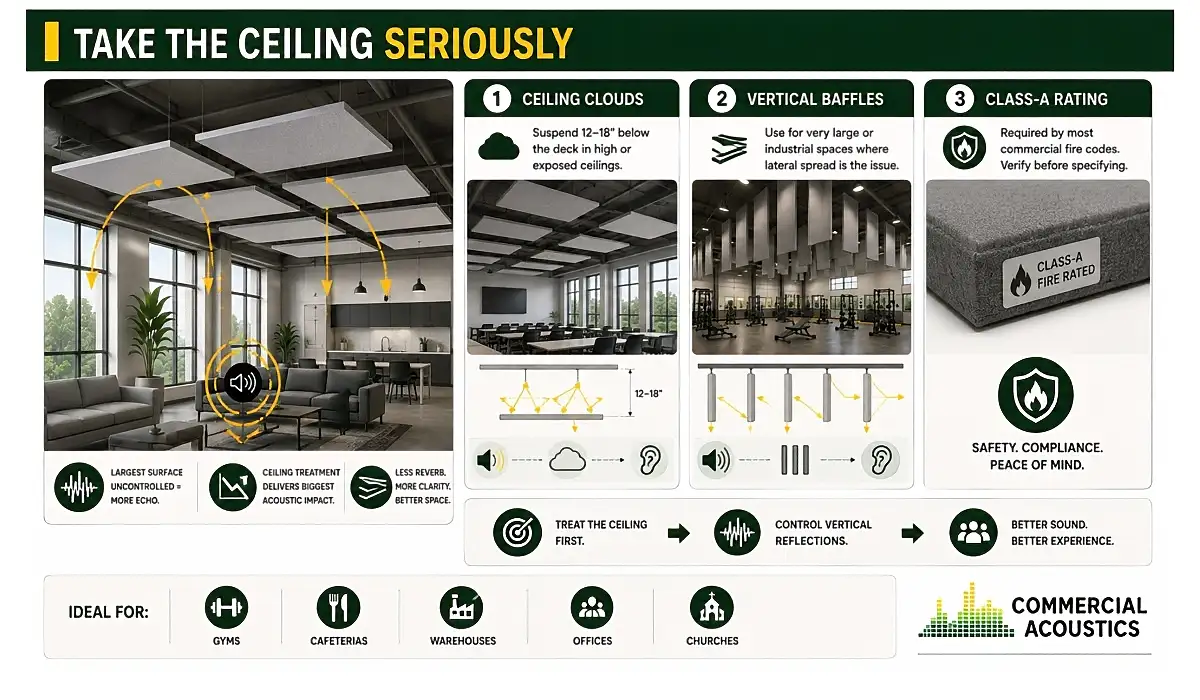
Step 3: Take the Ceiling Seriously
- Ceiling clouds: Suspend horizontally 12–18 inches below the deck in rooms with high or exposed ceilings.
- Vertical baffles: Use for very large or industrial spaces where lateral spread is the issue.
- Class-A rating: Required by most commercial fire codes. Verify before specifying.
The ceiling is usually the single largest unbroken hard surface in a room. Ignoring it is the most common reason a wall-only panel install underperforms. Ceiling clouds with NRC 0.90–1.15 cut vertical reflections hard and free up wall space for finishes or signage.
In gyms, cafeterias, and warehouses, vertical fabric-wrapped baffles outperform clouds because they intercept lateral as well as vertical energy. They also work well when the ceiling deck itself cannot accept a hung panel.
Step 4: Add Diffusion, Not Just Absorption
- Bookshelves: Random book depths scatter mid and high reflections naturally.
- Engineered diffusers: QRD, skyline, or barrel-pyramid panels keep the room lively.
- Texture mix: Pair diffusers with absorbers so the room is clear but not deadened.
Absorption alone can make a room feel lifeless. Diffusers redirect reflections in scattered directions rather than absorbing them outright. The result is a room that still feels acoustically present but no longer smears speech or music.
An EKKO barrel-pyramidal diffuser works well on a rear wall in conference rooms, lecture halls, or worship spaces where you want to retain warmth and natural tone. Diffusion is also the right call for high-end residential media rooms and recording spaces.
Step 5: Soft Furnishings and Drapes
- Upholstered furniture: Sofas, ottomans, and fabric chairs absorb mids and highs.
- Heavy drapes: Cover reflective glass and concrete with floor-length dense fabric.
- Textile wall art: Canvases, felt art, and tapestries add absorption without reading as treatment.
Soft materials are the easiest way to reduce flutter and high-frequency reflections in a finished space. Each new fabric surface absorbs airborne sound that would otherwise bounce. A large sofa plus two heavy drapes can drop perceived echo noticeably in a medium conference room, with zero acoustic-product cost.
This step matters more than people expect in restaurants and hospitality spaces. The right banquette upholstery and drape spec can shave RT60 by 0.2–0.4 seconds before any dedicated acoustic panel goes in.

Step 6: Bass Traps for Low Frequencies
- Corner placement: Stack traps floor to ceiling in vertical corners where low energy collects.
- Thick, dense cores: 4–6 inch mineral wool or fiberglass for usable low-frequency absorption.
- Combined treatments: Pair bass traps with broadband wall panels for a flat response.
Low frequencies pile up in corners and create a boomy, blurred sound. Bass traps absorb that energy and balance the room’s low end. Without them, the rest of the panel array fights uphill against an uneven response that high-frequency absorbers cannot fix.
Most offices and classrooms do not need full bass-trap treatment, but theaters, media rooms, studios, and worship spaces almost always do. If you can hear a hum, a thump, or a “rumble” linger after a kick drum, your low end is uncontrolled.
Material Performance Reference
| Material | Typical NRC | Best Use |
|---|---|---|
| Fiberglass panels | 0.85–1.00 | Offices, conference rooms, classrooms |
| Mineral wool panels | 0.90–1.10 | Studios, theaters, restaurants |
| PET felt panels | 0.65–0.90 | Open offices, design-led interiors |
| Acoustic foam | 0.40–0.90 | Small rooms, vocal booths, budget builds |
| Heavy drapes | 0.35–0.65 | Windows, removable treatment, hospitality |
| Carpet on pad | 0.30–0.60 | Floors in offices, classrooms, hotels |
Choose by program and price, not color. Fiberglass and mineral wool give the broadest absorption and are the safe default for most commercial work. PET felt earns its place where the panel has to read as design rather than treatment. Foam works in small rooms on tight budgets but falls off below ~250 Hz, which is why it is rarely the right call for offices or restaurants.
For a deeper dive on the numbers behind these ratings, the sound absorption coefficient chart shows how each material performs across the 125 Hz to 4 kHz band, not just at the headline NRC value.
Common Mistakes to Avoid
- Foam-only treatments: Foam handles highs, not full range. Speech clarity does not come from foam alone.
- Ignoring the ceiling: Half of the reflection energy comes from above. A wall-only install will underperform.
- Undersized coverage: Four panels on one wall will not change a 30-foot room. Plan for 25–40% surface coverage.
- Over-deadening: Too much absorption strips the natural tone and makes the room feel “dead” and uncomfortable.
- Confusing echo with noise transfer: Reducing echo inside a room does not stop noise from coming through the wall. That is a soundproofing problem, not a treatment problem.
Good acoustic design controls reflections without erasing them. The goal is a room that sounds intentional, where speech is clear and music has body. Strip too much energy and the room reads as cold or clinical, which is a different complaint to fix.
Need a Custom Echo Plan?
Echo control gets a lot easier when the room is modeled before product is ordered. We size coverage from your floor plan, surface finishes, and ceiling height, then spec the right mix of panels, clouds, and diffusion for your RT60 target.
If you want a second set of eyes on a room that is not landing, talk to the team behind this work. Send a floor plan and a few photos and we will come back with a treatment plan and a budget range.
FAQs: Reducing Echo in a Room
What is the fastest way to reduce echo in a room?
Add rugs and wall panels with NRC 0.85+. Cover 25% of hard surfaces and most rooms drop noticeably in reverb the same day.
Do curtains actually help with echo?
Yes. Heavy, floor-length drapes absorb mids and highs, especially in front of glass. They will not fix low-frequency boom but they kill flutter fast.
How much acoustic coverage does a room need?
Plan for 25–35% of total wall and ceiling surface in general rooms, up to 50% for studios. Below 20% you usually cannot hear the difference.
Is reducing echo the same as soundproofing?
No. Echo control treats reflections inside the room. Soundproofing stops sound from getting in or out. The materials and methods do not interchange.
What RT60 should I target?
For offices and classrooms aim 0.4–0.6 seconds. Restaurants 0.5–0.8. Worship and lecture halls 0.8–1.2. Studios run lower than 0.4.

Walker Peek|Founder & CEO, Commercial Acoustics
Walker founded Commercial Acoustics in 2013 to bring aerospace-grade engineering discipline to soundproofing, and runs the firm as CEO from its 12,000 sq ft Tampa production facility. The company designs custom acoustic panels, sound membranes, and masking systems for multi-family, hospitality, healthcare, and commercial projects across the US — built around Walker’s invention, Wall Blokker, an EVA-based sound barrier that hits STC 50-plus at roughly $1 per square foot installed.
A Jacksonville native, Walker spent five years at Kennedy Space Center with Craig Technologies before founding Commercial Acoustics — certifying aerospace manufacturing to the AS9100 standard and leading Six Sigma Black Belt process-improvement teams on NASA programs. He is a certified Industrial Noise Control Engineer and the author of Architectural Acoustics: A Practical Handbook.
