Table of Contents
Choosing the Right Acoustic Treatment
Acoustic panels, diffusers, and bass traps all get marketed as “sound treatment,” which leads to a lot of people buying the wrong product for their problem. They solve different problems at different frequencies, and using one when you needed another usually means your room still sounds bad after you’ve spent the money. This guide breaks down what each one actually does, when to use it, and how to combine them when one tool isn’t enough.
The Three Tools at a Glance
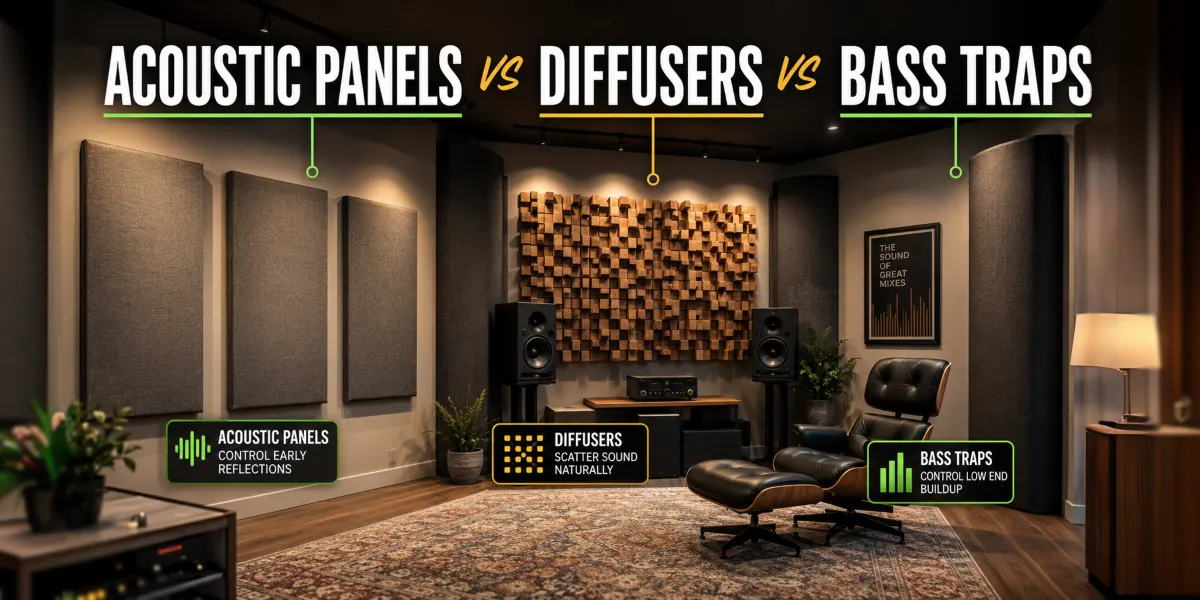
The fastest way to understand the difference is to see them side by side. Every one of these targets a different part of the frequency spectrum and a different acoustic problem.
Acoustic Panels: Absorbing Mid & High Frequencies
Acoustic panels are the default tool for reducing echo and reverberation. They’re typically a porous absorber—fiberglass, mineral wool, or polyester batting—wrapped in fabric and mounted to walls or ceilings. When a sound wave hits a panel, friction within the porous material converts the wave’s energy into a tiny amount of heat. The wave doesn’t bounce back into the room.
Most acoustic panels are rated by their NRC (Noise Reduction Coefficient), a single-number average of absorption from 250 Hz to 2 kHz. A quality 2″-thick panel will rate around 0.80–0.95 NRC, meaning it absorbs 80–95% of the sound energy that hits it in that band. They’re very good in the speech and music midrange, less effective below about 250 Hz, and almost useless below 100 Hz.
Use acoustic panels when the problem is echo, reverberation, or muddy speech—conference rooms, classrooms, restaurants, podcast studios, gyms, and large open offices.
Diffusers: Scattering Sound, Not Killing It
Diffusers do something fundamentally different from panels. Instead of absorbing sound, they break up reflections by scattering the wave in many directions at once. The energy is still in the room—it’s just no longer arriving at your ear as a single hard echo.
The most common designs are quadratic residue (QRD) and skyline diffusers, with irregular wells of varying depth that scatter mid and high frequencies based on the math of those wells. From a design standpoint, they look like sculpted wood or composite panels with a grid of vertical slats or three-dimensional blocks.
The key idea: diffusers preserve the energy in the room, which keeps it sounding alive and spacious. Over-absorb a room with too many panels and it goes dead and lifeless. Diffusers let you tame harsh reflections without sucking the life out of the space. They’re standard in recording studios, music rooms, performance halls, and home theaters—anywhere the room needs to sound natural.
Bass Traps: Tackling Low Frequencies
Low frequencies are stubborn. A 60 Hz wave is roughly 19 feet long—much bigger than a 2″ acoustic panel can meaningfully absorb. That’s the entire reason bass traps exist. They’re specialty absorbers designed to soak up the low-frequency energy that panels can’t touch.
There are two main types:
- Porous bass traps – oversized panels of dense fiberglass or mineral wool, usually 4–8″ thick, stacked in corners. Effective from about 80 Hz upward.
- Tuned (resonant) bass traps – membrane or Helmholtz designs that target a specific narrow frequency. Used when a single problem frequency dominates the room.
The corner placement isn’t arbitrary. Low frequencies build up in room corners because of how standing waves form between parallel surfaces. Putting absorbers in the corners catches the most energy for the least square footage of treatment. In a small room with boomy or muddy bass, a few floor-to-ceiling corner traps will do more than dozens of mid-frequency panels.
Which One Do You Actually Need?
The right tool depends on what your room sounds wrong doing. A simple decision tree:
- “I can’t hear myself think—the room rings.” → Acoustic panels. Echo and reverb are mid/high frequency problems.
- “Speech sounds muddy or hard to follow.” → Acoustic panels at first reflection points.
- “The bass is boomy and uneven—some notes are louder than others.” → Bass traps in the corners.
- “The room is too dead after I added panels.” → Diffusers to add back life and spaciousness.
- “I want a critical listening or recording space.” → All three, in the right ratio.
The most common mistake we see: people buy acoustic panels for a room with bass problems. The panels don’t do anything because they don’t reach low enough in the spectrum. The room still sounds boomy, the panels get blamed, and the actual fix (bass traps in the corners) never happens.
Combinations That Work in Real Rooms
Most well-treated rooms use more than one tool. A few proven combinations:
The ratio matters as much as the count. A common rule of thumb for critical-listening spaces: cover roughly 20–30% of wall and ceiling surface area with treatment, weighted toward absorption in the mid frequencies, with diffusion making up the rest. Over-treat and you kill the room. Under-treat and the original problem stays.
Conclusion: Use the Right Tool for the Right Frequency
Acoustic panels absorb mids and highs. Diffusers scatter them. Bass traps absorb the lows that panels can’t reach. Each one does a different job at a different part of the frequency spectrum, and most rooms with real acoustic problems need at least two of the three working together. The smartest treatment plan starts with the question “what does this room sound wrong doing?” and works backward to the right tool, in the right place, at the right ratio. For a tailored treatment plan for your space, get in touch via Commercial Acoustics.
FAQs: Panels, Diffusers & Bass Traps
What’s the difference between acoustic panels and diffusers?
Panels absorb sound—wave energy gets converted to heat in porous material. Diffusers scatter sound in many directions instead of absorbing it. Panels make a room drier; diffusers keep it sounding alive.
Do I need bass traps if I already have acoustic panels?
Often yes. Most panels work above 250 Hz and do little under 100 Hz. Bass traps handle the 30–250 Hz range. If your room sounds boomy or muddy, panels alone won’t fix it.
Where should I put acoustic panels?
At the first reflection points—the spots on side walls and ceiling where sound bounces directly to the listening position. Treating those first beats spreading panels evenly around the room.
Can a room have too much sound treatment?
Yes. Over-absorption makes a room feel dead and flat. Swap some panels for diffusion to control reflections without killing the room’s energy. About 20–30% surface coverage is usually the sweet spot.

Walker Peek|Founder & CEO, Commercial Acoustics
Walker founded Commercial Acoustics in 2013 to bring aerospace-grade engineering discipline to soundproofing, and runs the firm as CEO from its 12,000 sq ft Tampa production facility. The company designs custom acoustic panels, sound membranes, and masking systems for multi-family, hospitality, healthcare, and commercial projects across the US — built around Walker’s invention, Wall Blokker, an EVA-based sound barrier that hits STC 50-plus at roughly $1 per square foot installed.
A Jacksonville native, Walker spent five years at Kennedy Space Center with Craig Technologies before founding Commercial Acoustics — certifying aerospace manufacturing to the AS9100 standard and leading Six Sigma Black Belt process-improvement teams on NASA programs. He is a certified Industrial Noise Control Engineer and the author of Architectural Acoustics: A Practical Handbook.
