Table of Contents
Why the Difference Matters
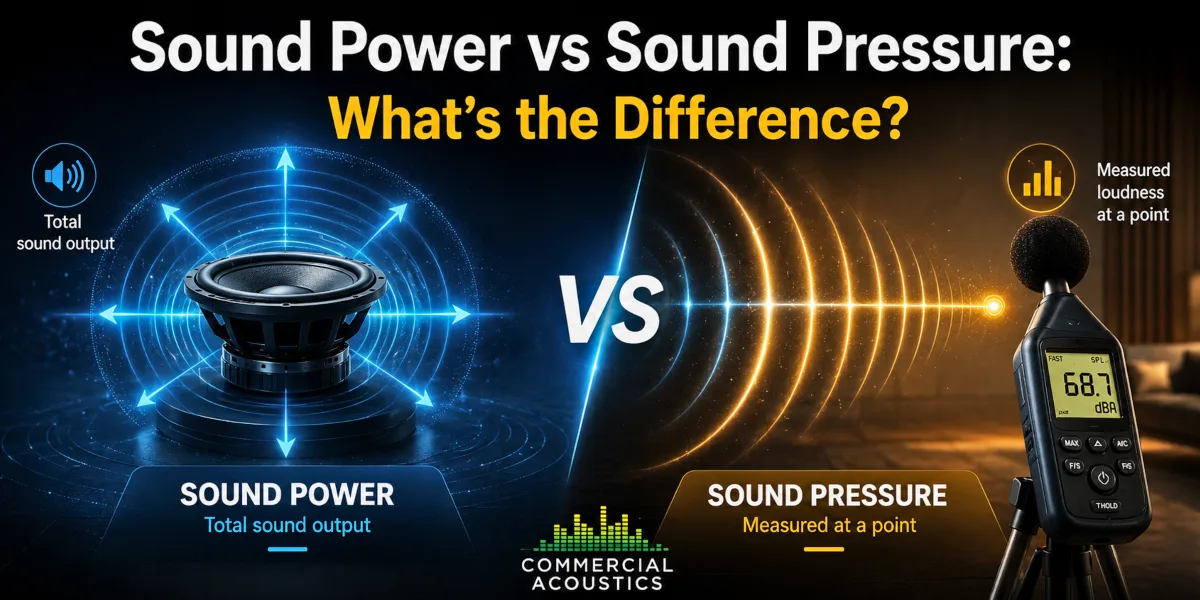
Every spec sheet for a fan, generator, rooftop unit, or generator lists a decibel number — but not every number means the same thing. Sound power describes the energy a source emits. Sound pressure describes what you hear at a point in space. Mixing the two up is how an 85 dB fan ends up being specified into a space that needed 45 dB at the property line.
Sound power is the cause. Sound pressure is the effect. One is a property of the equipment itself; the other depends on distance, room volume, and surroundings. Understanding the relationship between them is the difference between a quiet building and a complaint.
What Is Sound Power?
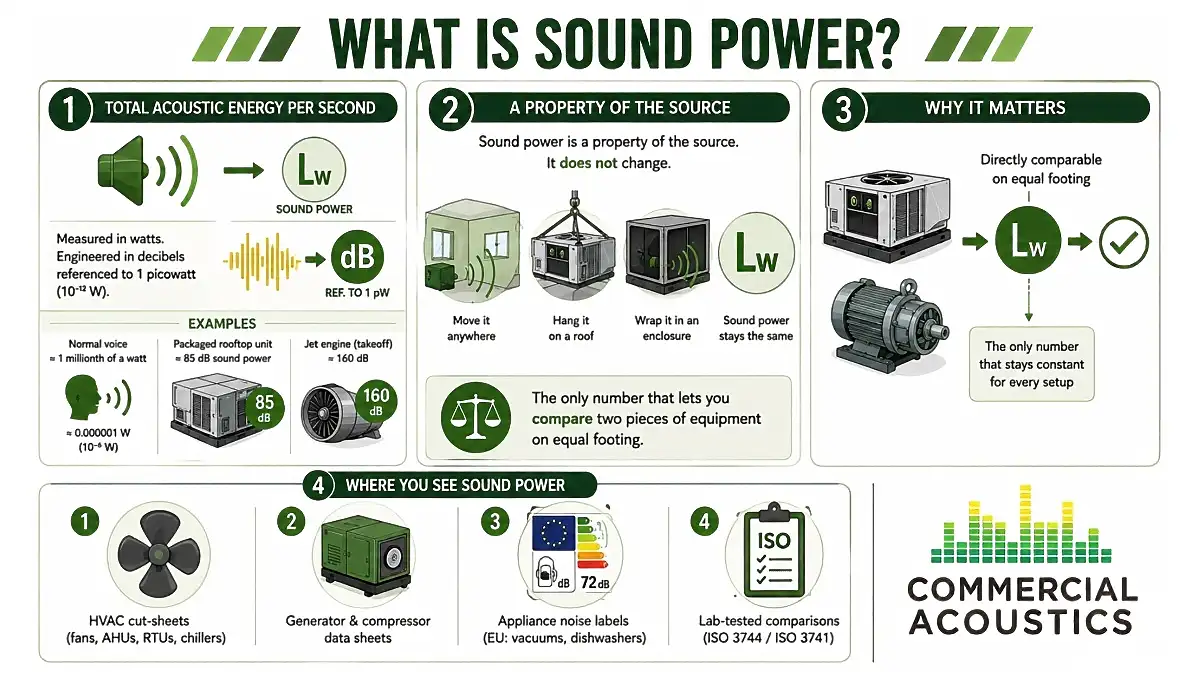
Sound power (Lw) is the total acoustic energy a source radiates per second, measured in watts. Because the values are tiny — a normal voice is about a millionth of a watt — engineers express it in decibels referenced to 1 picowatt (10-12 W). A typical packaged rooftop unit might be rated at 85 dB sound power; a jet engine at takeoff is around 160.
The key feature: sound power is a property of the source. It does not change when you move the source into a bigger room, hang it on a roof, or wrap it in an enclosure. That is why manufacturers publish it. It is the only number that lets you compare two pieces of equipment on equal footing.
Sound power shows up on:
- HVAC equipment cut-sheets (fans, AHUs, RTUs, chillers)
- Generator and compressor data sheets
- Appliance noise labels in Europe (vacuums, dishwashers)
- Lab-tested product comparisons under ISO 3744 or ISO 3741
What Is Sound Pressure?
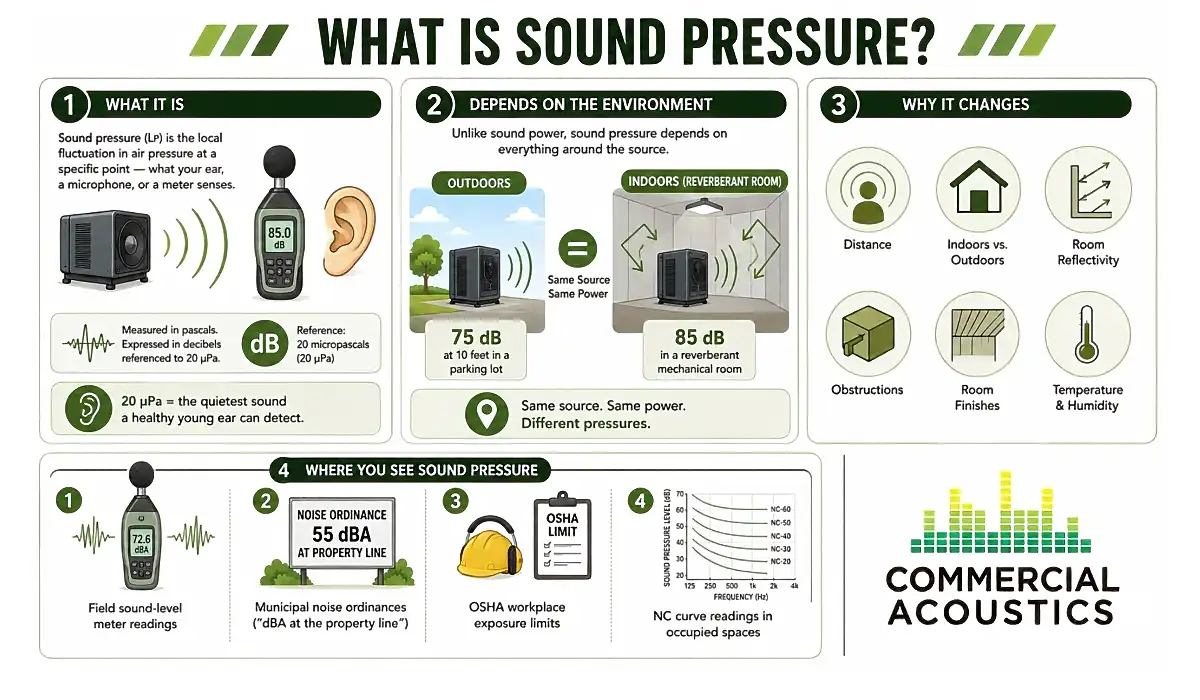
Sound pressure (Lp) is the local fluctuation in air pressure caused by a sound wave at a specific point — what your ear, a microphone, or a phone meter actually senses. It is measured in pascals and expressed in decibels referenced to 20 micropascals (20 µPa), the quietest sound a healthy young ear can detect.
Unlike sound power, sound pressure depends on everything around the source: how far away you are, whether you are indoors or outdoors, how reflective the room is, what is in the way. A 95 dB sound power source might read 75 dB at 10 feet in a parking lot and 85 dB in a reverberant mechanical room — same source, same power, different pressures.
Sound pressure shows up on:
- Field sound-level meter readings
- Municipal noise ordinances (“dBA at the property line”)
- OSHA workplace exposure limits
- NC curve readings in occupied spaces
Sound Power vs Sound Pressure: Key Differences
- Energy emitted by the source
- Watts — dB re 1 pW (10-12 W)
- Fixed property of the equipment
- Found on cut-sheets & ISO 3744/3741 lab tests
- Use to compare products
- What a listener actually senses
- Pascals — dB re 20 µPa
- Depends on distance, room, surroundings
- Found on field meters, ordinances, OSHA
- Use to predict what is heard
| Feature | Sound Power (Lw) | Sound Pressure (Lp) |
|---|---|---|
| What It Describes | Energy emitted by the source | Pressure variation at a point |
| Unit | Watts (dB re 1 pW) | Pascals (dB re 20 µPa) |
| Depends on Environment? | No — fixed property of the source | Yes — distance, room, surfaces |
| Where You See It | Manufacturer cut-sheets, lab tests | Field meters, ordinances, OSHA |
| Best Use | Comparing equipment | Predicting what a listener will hear |
For a deeper technical breakdown from one of the industry’s leading sound-measurement instrument makers, see Brüel & Kjær’s “What is Sound Power and Sound Pressure?” reference guide.
Converting Between Power and Pressure
For a source radiating freely outdoors, the relationship between sound power and sound pressure follows a simple inverse-square law. As distance doubles, the pressure level drops by 6 dB. The basic formula:
Lp = Lw − 20 log10(r) − 11
Where r is the distance from the source in meters. The “− 11” accounts for spherical spreading in a free field. A 90 dB sound power source becomes roughly 69 dB at 3 meters outdoors — a difference of more than 20 dB just from geometry.
Inverse-square law — free field
A 100 dB sound-power source produces about 90 dB at 1 m, dropping 6 dB with every doubling of distance in a free field. Indoors, reflections flatten this curve past the critical distance.
Indoors, the math changes. Walls, ceilings, and floors reflect energy back into the room, so the pressure does not drop off as quickly with distance. In a reverberant mechanical room, the pressure level can stay nearly constant past a certain point — the so-called reverberant field. This is why HVAC noise in a tight equipment closet can be 10–15 dB louder than the same equipment would be in the open.
The takeaway: you cannot read a sound power number off a cut-sheet and use it directly as a design target. You have to convert it to a sound pressure level at the listener’s location, accounting for distance, directivity, and room effect. For mechanical rooms, that conversion is the basis of every credible mechanical noise control strategy.
Real-World Applications
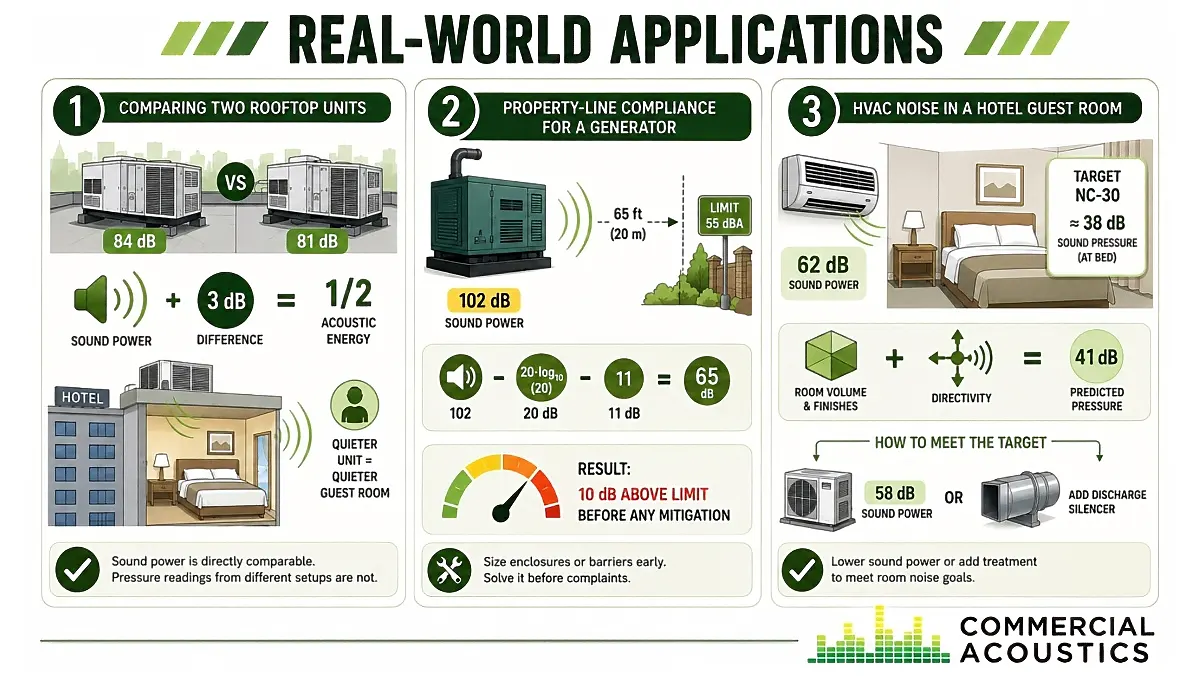
Comparing Two Rooftop Units
An architect choosing between two packaged RTUs for a hotel rooftop sees 84 dB on one cut-sheet and 81 dB on another. Both are sound power values. The 3 dB difference is real — the quieter unit emits half the acoustic energy — and that gap will carry through to whatever the guest hears in the top-floor suite. Comparing pressure readings from different test setups would be meaningless, but the sound power numbers are directly comparable.
Property-Line Compliance for a Generator
A standby generator is rated at 102 dB sound power. The municipal ordinance allows 55 dBA at the property line, 65 feet (20 m) away. Running the conversion (102 − 20 log10(20) − 11 = 65 dB) shows the unit will land 10 dB above the limit before any enclosure or barrier — a problem the engineer can size before specifying the generator, not after the first complaint.
HVAC Noise in a Hotel Guest Room
A through-wall PTAC unit lists 62 dB sound power. The design target is NC-30 in the guest room — roughly 38 dB sound pressure at the bed. Accounting for room volume, finishes, and the unit’s directivity, the predicted pressure level is 41 dB. Switching to a unit rated 58 dB sound power, or adding a discharge silencer, closes the gap without redesigning the room.
Conclusion: Two Numbers, One Source
Sound power and sound pressure describe the same sound from two different angles. Power is what the source emits, pressure is what the listener hears, and the distance between them is filled with math — inverse-square spreading, directivity, room effect, and absorption. Treat the two numbers as interchangeable and you will miss specs by 10 to 20 dB.
The discipline is simple: when comparing equipment, use sound power; when predicting what a room or property line will experience, convert to sound pressure and account for the path. Good acoustic design lives in that conversion.
For expert consulting, mechanical-noise predictions, or field testing, contact Commercial Acoustics to connect with our engineering team.
FAQs: Sound Power vs Sound Pressure
What is the difference between sound power and sound pressure?
Sound power is the total acoustic energy a source emits and is a fixed property of the equipment. Sound pressure is what you measure at a point in space — it depends on distance, room reflections, and surroundings. Power is the cause; pressure is the effect.
Why do manufacturers list sound power instead of sound pressure?
Sound power is independent of the test environment, so it lets buyers compare two products on equal footing. A pressure number is only meaningful with a stated distance and a known room, so it cannot be compared across data sheets without more information.
How do you convert sound power to sound pressure?
For a source radiating freely outdoors, Lp = Lw − 20·log10(r) − 11, where r is the distance in meters. Indoors, you also add a room-effect correction that accounts for reflective surfaces and room volume.
What units are sound power and sound pressure measured in?
Sound power is measured in watts, expressed in decibels referenced to 1 picowatt (10⁻¹² W). Sound pressure is measured in pascals, expressed in decibels referenced to 20 micropascals (20 µPa), the threshold of human hearing.
Which one do noise ordinances use?
Noise ordinances use sound pressure, almost always expressed as dBA at a specific distance — typically the property line. Sound power is rarely cited in code; it is an engineering tool used to predict the pressure level that will actually be measured.

Walker Peek|Founder & CEO, Commercial Acoustics
Walker founded Commercial Acoustics in 2013 to bring aerospace-grade engineering discipline to soundproofing, and runs the firm as CEO from its 12,000 sq ft Tampa production facility. The company designs custom acoustic panels, sound membranes, and masking systems for multi-family, hospitality, healthcare, and commercial projects across the US — built around Walker’s invention, Wall Blokker, an EVA-based sound barrier that hits STC 50-plus at roughly $1 per square foot installed.
A Jacksonville native, Walker spent five years at Kennedy Space Center with Craig Technologies before founding Commercial Acoustics — certifying aerospace manufacturing to the AS9100 standard and leading Six Sigma Black Belt process-improvement teams on NASA programs. He is a certified Industrial Noise Control Engineer and the author of Architectural Acoustics: A Practical Handbook.
