
Table of Contents
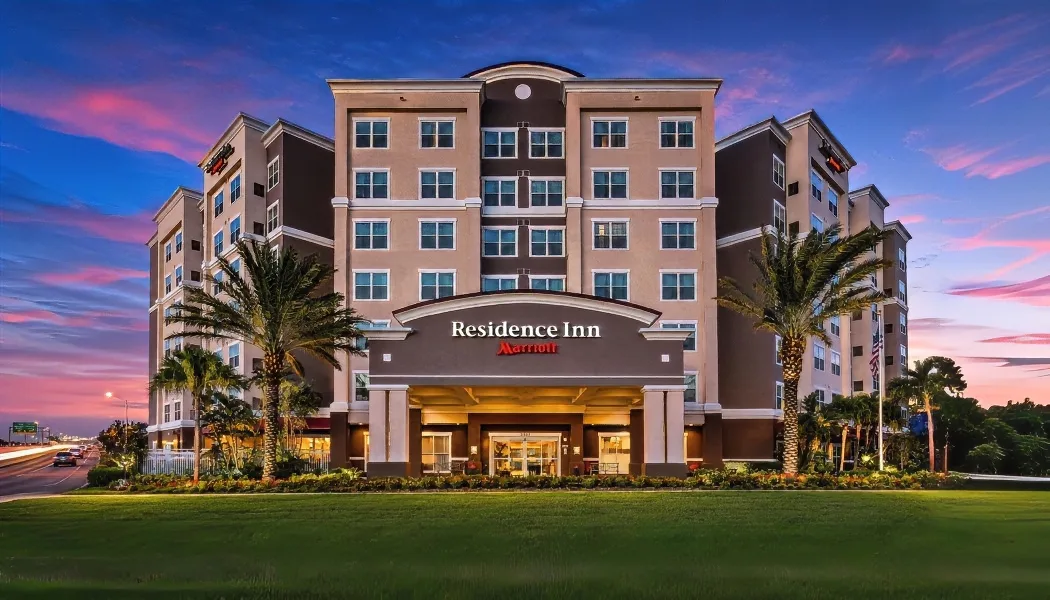
Project Overview: Residence Inn Highway-Facing Rooms
- Project: Guest room window soundproofing on highway-facing elevations
- Client: Residence Inn property (specific location anonymized under NDA)
- Setting: Hotel adjacent to a major highway, traffic-driven guest complaints
- Primary Failure Path: Highway noise transmitting through guest room window glazing
- Solution: Mass-loaded vinyl soundproofing curtain over each highway-facing window
- Fabric: MLV core wrapped in cotton canvas, designer-grade aesthetic
- Result: Highway noise reduction up to 75 percent at the window, guest complaints dropped substantially
This Residence Inn sat on the wrong side of a major highway. Guests in the highway-facing rooms could hear traffic the entire night and the front desk fielded the complaints every morning. The hotel had never done acoustic testing and the windows had never been treated. The owner needed a fix that worked, did not require glass replacement, and kept the room aesthetics inside Residence Inn brand standards.
Commercial Acoustics assessed the highway-facing rooms, confirmed the windows were the dominant transmission path, and specified a mass-loaded vinyl soundproofing curtain over each window. The fix installed without construction, cost a fraction of glazing replacement, and reads as designer drapery from the guest side of the room.
Why Hotel Windows Are the Loudest Transmission Path
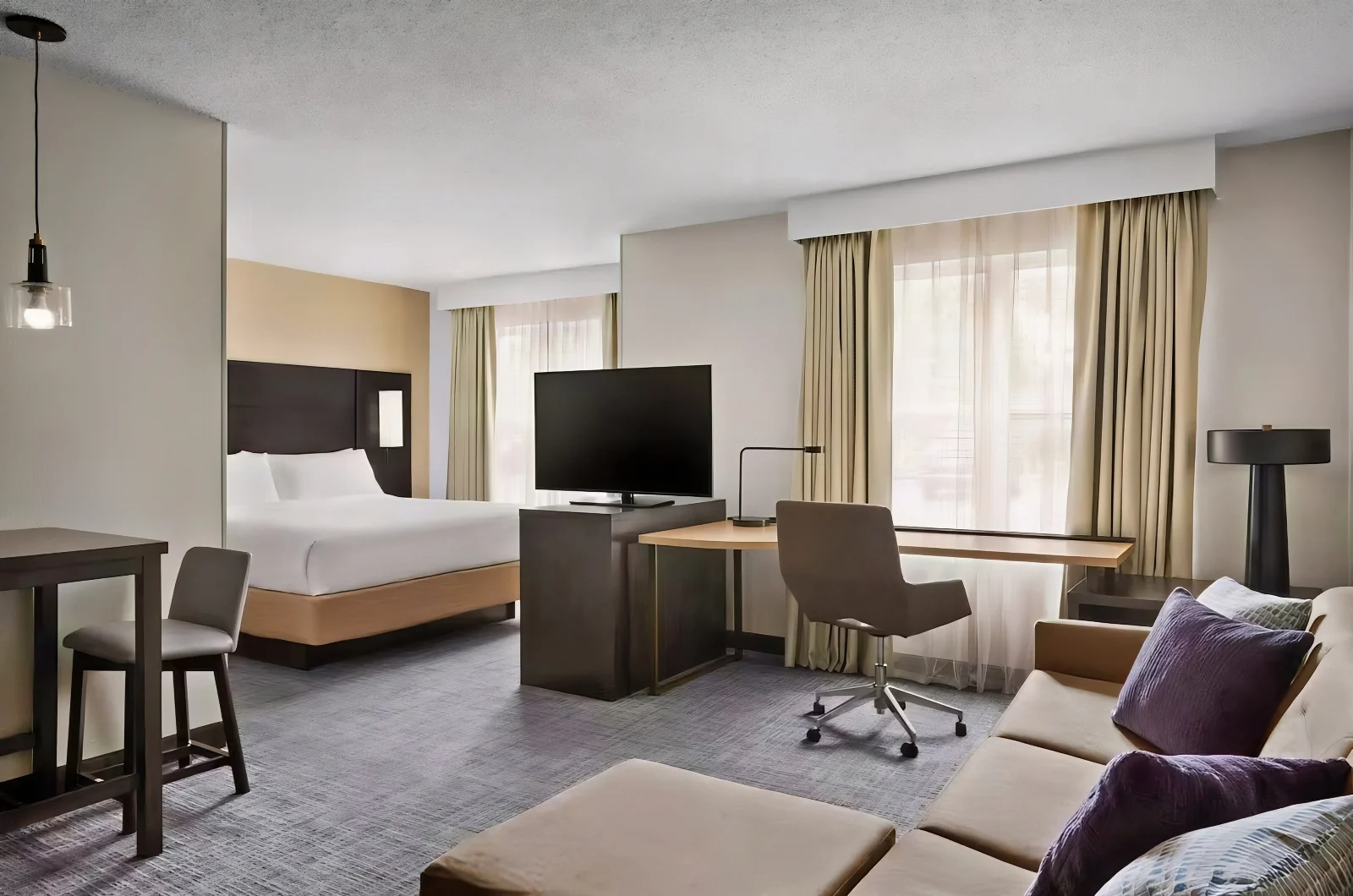
Hotel guest rooms have one wall to the outside world. That wall is mostly glass. Whatever the exterior wall STC rating is on paper, the window in that wall sets the actual sound transmission floor. A wall rated STC 50 with a window rated STC 28 performs at roughly STC 32 in practice, because sound takes the path of least resistance and the window is that path.
Most hotel windows are single-pane on older properties or a basic dual-pane on newer ones. Neither is engineered for highway-grade exterior noise. The glass is thin and the frame seals are not gasketed for acoustic performance.
For a hotel near a highway, airport, or downtown corridor, the window is almost always the dominant complaint source, so the broader exterior noise control strategy starts by identifying the weakest path from source to receiver.
For a hospitality assessment case that diagnosed three failure modes including this exact window problem, see the hotel acoustic consultant ASTC field test case study.

Highway Noise & OITC: What Hotel Glazing Misses
Highway noise is dominated by low-frequency rumble from heavy truck traffic and tire-road interaction. The acoustic rating that captures this kind of noise is OITC, Outdoor-Indoor Transmission Class. STC measures sound transmission across a broad frequency range, but it weights speech-band sound heavily. OITC weights the lower frequencies that highways actually produce.
A typical hotel double-pane window rates OITC 25 to 27. The OITC target for a guest room within 200 feet of a freeway is OITC 35 or higher. That delta is real and it is audible. The window passes thermal code, fails acoustic comfort, and the guest writes the review.
The MLV Curtain Solution: Designer Drape That Blocks Sound
- Core: Mass-loaded vinyl, the dense sound barrier doing the actual blocking
- Outer Fabric: Cotton canvas in selectable colors, reads as standard hotel drapery
- Coverage: Full window plus overlap onto the surrounding wall for edge sealing
- Hardware: Heavy-duty rod and rings rated for the curtain weight, ceiling-mount for clean lines
- Performance: Up to 75 percent reduction in audible noise at the window, depending on glass-to-curtain seal
The product family is a fabric-wrapped acoustic fabric system that puts MLV behind a designer face. The curtain hangs from a heavy-duty rod, drops to the floor, and overlaps the wall by a few inches on each side to seal the edges of the window opening. When drawn, it functions as a barrier. When open, it stacks like normal drapery. Housekeeping handles it the same way they handle any hotel curtain.
For another fabric-curtain install in a hospitality-adjacent vertical, see the restaurant soundproof curtain partition case.

Hotel Window Treatment Options Compared
A hotel facing highway noise has multiple treatment options. The right one depends on budget, disruption tolerance, and how aggressive the noise target is.
The MLV curtain hits the sweet spot for most hotel retrofits. Hotels rarely have appetite for replacing every guest room window. The curtain delivers most of the noise drop at a fraction of the cost, with zero room-out-of-service time during install.
This Applies to Motels Too
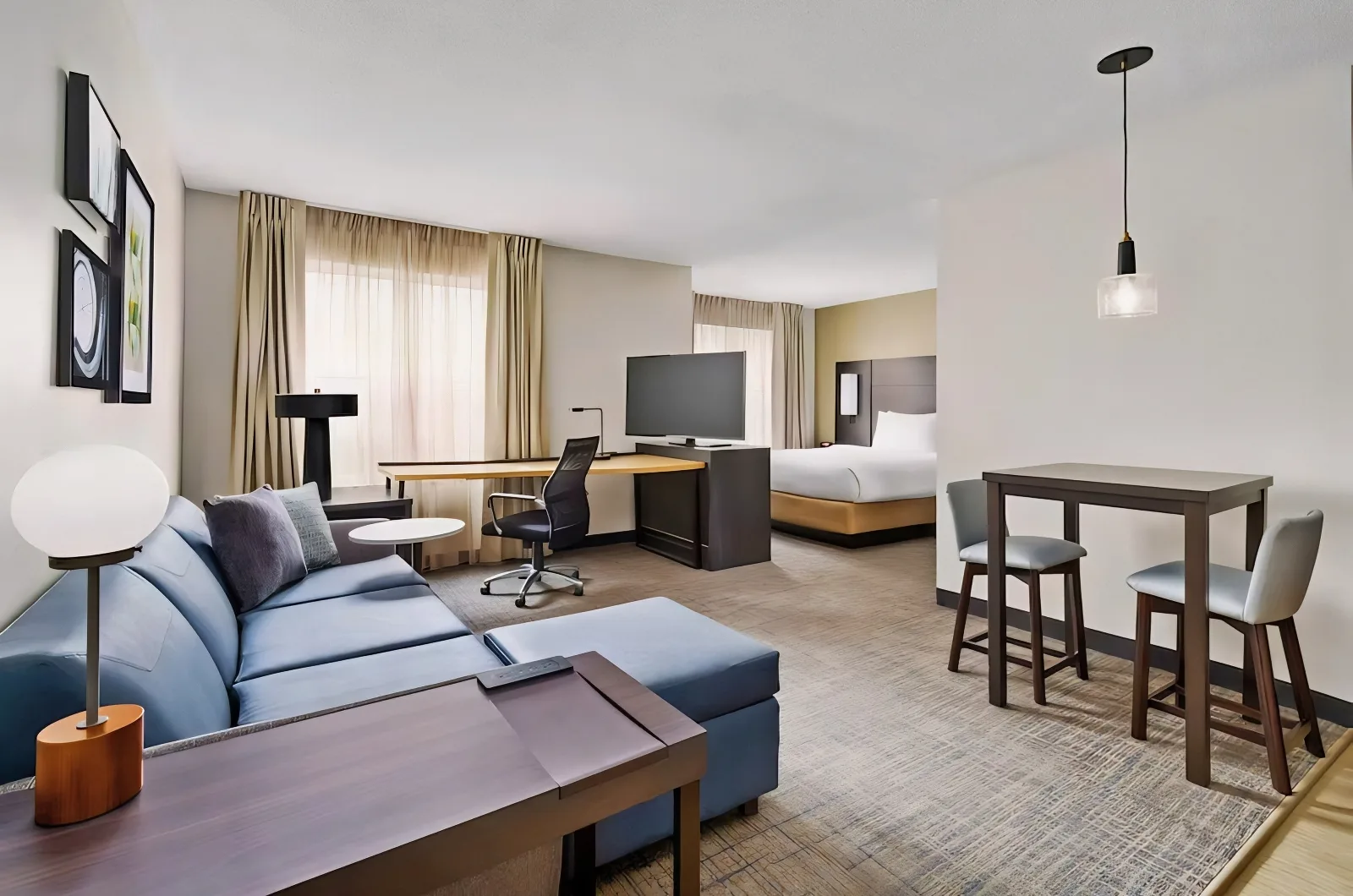
The motel side of the lodging market has the same window problem in a worse form. Motel guest rooms typically use single-pane glazing with minimal frame sealing, which puts the OITC even lower than the hotel baseline. Many roadside motels sit closer to traffic than a typical Residence Inn footprint, so the highway-noise dBA at the window is higher to start with.
The MLV curtain works the same way at a motel as it does at a hotel. Lower install cost relative to glass replacement matters more in the motel market because per-room economics are tighter. The curtain installs in a couple of hours per room and the operator does not need to rotate guests out of inventory.
What Hotel Operators Should Spec
- Verify the Path: SPL meter confirms window is the dominant source
- OITC, Not STC: Use OITC ratings for any highway-facing glazing
- Curtain Coverage: Full window plus wall overlap, not edge-to-edge
- Fabric Color: Match the room palette so it reads as drapery
- Phased Rollout: Pilot worst-complaint rooms first, expand by survey trend
Doing the spec right starts with an honest measurement and ends with a phased rollout against the survey data. Skip the audit and the curtain layout becomes guesswork. Skip the phasing and the budget request hits a wall.
Conclusion: Hotel Window Soundproofing Done Right
Hotel window soundproofing is one of the highest-leverage acoustic fixes in the hospitality industry. The window is the dominant transmission path on every highway- or airport-facing guest room, and standard hotel glazing rarely hits the OITC needed for exterior noise.
An MLV curtain closes the gap at a fraction of the cost of glass replacement, with zero construction and no rooms out of inventory. The Residence Inn project dropped audible highway noise by up to 75 percent at the window.
If your hotel or motel is fielding guest noise complaints from highway, airport, or street traffic, talk to a hospitality acoustic consultant about a curtain pilot in the worst-complaint rooms before the next quarter of survey data lands.
FAQs: Hotel Window Soundproofing & Highway Noise
How much can a soundproofing curtain reduce hotel window noise?
A mass-loaded vinyl curtain wrapped in cotton canvas can reduce audible noise at the window by up to 75 percent depending on the seal at the wall edges and the floor. The exact reduction depends on the window’s starting OITC and the curtain coverage area, but most highway-facing hotel rooms see a meaningful drop in complaints within the first week of install.
What is OITC and why does it matter for hotel windows?
OITC is Outdoor-Indoor Transmission Class, the acoustic rating that captures low-frequency exterior noise like highway traffic. Standard hotel windows rate OITC 25 to 27. Hotels within 200 feet of a freeway should target OITC 35 or higher. The gap is real and it is what guests hear at night.
Is window curtain soundproofing cheaper than replacing the glass?
Yes by roughly an order of magnitude. An MLV curtain install per room runs a few hundred dollars in product and a few hours of labor. A full glazing replacement to laminated acoustic glass runs into thousands per room with multiple days of room-out-of-service time. For most hospitality retrofits the curtain is the right first step.
Does this work for motel windows with single-pane glass?
Yes and the relative improvement is often larger because the starting OITC of single-pane glass is so low. The MLV curtain installs the same way at a motel as it does at a hotel. The per-room install cost stays low and the noise drop is felt immediately, which matters more in the price-sensitive motel market.

Walker Peek|Founder & CEO, Commercial Acoustics
Walker founded Commercial Acoustics in 2013 to bring aerospace-grade engineering discipline to soundproofing, and runs the firm as CEO from its 12,000 sq ft Tampa production facility. The company designs custom acoustic panels, sound membranes, and masking systems for multi-family, hospitality, healthcare, and commercial projects across the US — built around Walker’s invention, Wall Blokker, an EVA-based sound barrier that hits STC 50-plus at roughly $1 per square foot installed.
A Jacksonville native, Walker spent five years at Kennedy Space Center with Craig Technologies before founding Commercial Acoustics — certifying aerospace manufacturing to the AS9100 standard and leading Six Sigma Black Belt process-improvement teams on NASA programs. He is a certified Industrial Noise Control Engineer and the author of Architectural Acoustics: A Practical Handbook.
