Table of Contents
Why Lecture Hall Acoustics Matter
- Speech Intelligibility: Clear communication depends on short reverberation times and low background noise.
- Room Versatility: Lecture halls serve as classrooms, auditoriums, and event spaces.
- Comfort and Focus: Proper acoustics help listeners stay engaged without vocal strain.
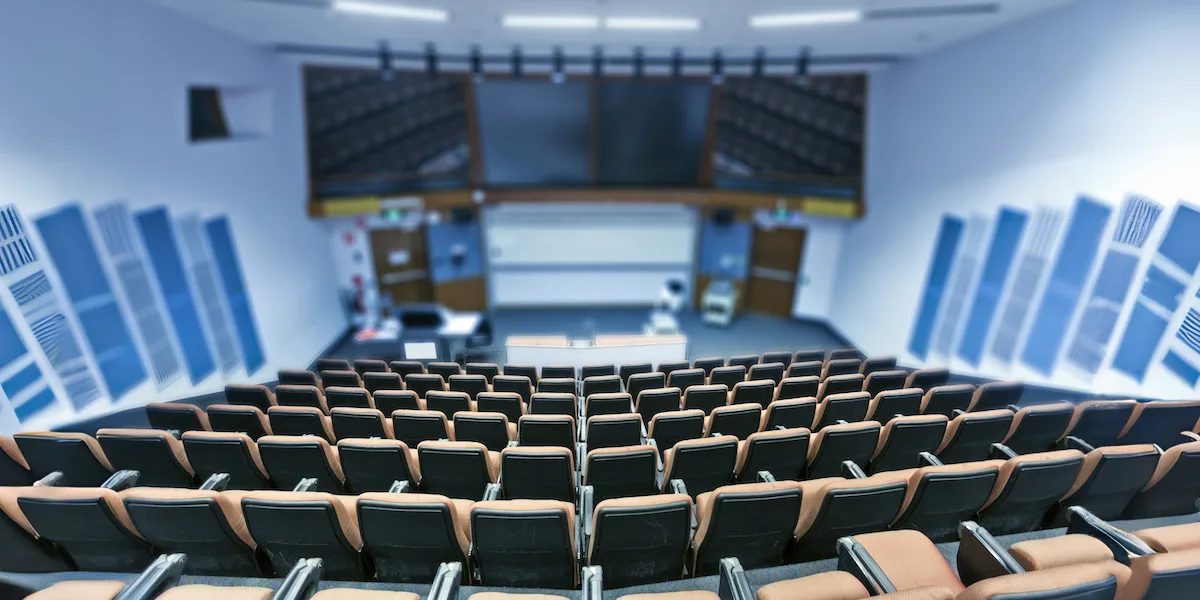
Lecture hall acoustics directly influence learning outcomes and audience engagement. Poorly designed rooms amplify echoes, blur speech, and make it difficult for listeners to follow the speaker—even when a microphone is used. Whether it’s a small college classroom or a 400-seat auditorium, sound reflections, background noise, and room geometry must be balanced to achieve consistent clarity across every seat.
Common Acoustic Problems
- Reverberation: Long decay times make speech sound muddy or distant.
- HVAC Noise: Mechanical systems add unwanted background noise.
- Uneven Sound Coverage: Flat floors and untreated surfaces cause inconsistent volume and clarity.
In large halls, reflections from hard surfaces—like glass, drywall, or concrete—can dominate the sound field. These reflections mask important speech frequencies (500–4000 Hz) and reduce intelligibility. Excessive mechanical noise from HVAC systems or projectors can worsen the issue, particularly in lecture halls where amplified speech is common. Recognizing these factors early is key to creating a comfortable listening environment.
Acoustic Treatment Strategies
- Wall Panels: Absorb reflections and control mid-frequency reverberation.
- Ceiling Treatments: Use acoustic ceiling tiles or clouds to reduce overhead echo.
- Balanced Absorption: Distribute panels evenly rather than concentrating them on one wall.
Effective lecture hall acoustics rely on a combination of absorption and diffusion. Acoustic wall panels reduce flutter echo and enhance clarity, while treated ceilings help manage the long reflections that often occur in sloped or vaulted spaces. The best-performing halls combine soft furnishings, upholstered seating, and carpet to stabilize reverberation time without over-damping the room. These balanced treatments ensure speech remains natural yet intelligible throughout the space.
Controlling Mechanical and Background Noise
- Separate Equipment Rooms: Keep HVAC and pumps away from lecture spaces.
- Insulated Ducts: Line ducts and pipes to block vibration and air noise.
- Flexible Connections: Use isolators and mounts to prevent structure-borne sound.
Mechanical noise is one of the biggest threats to good lecture hall acoustics. Sound from air diffusers or duct vibrations can quickly mask important syllables. Using pipe lagging and acoustic wraps around mechanical systems helps maintain a quiet background level. Ideally, mechanical systems in lecture halls should not exceed 35 dBA to preserve clear, effortless communication.
Sound Reinforcement and System Design
- Even Speaker Coverage: Distribute loudspeakers for balanced sound across the audience.
- Delay Alignment: Match rear speakers with the direct sound from the podium.
- Directional Control: Aim loudspeakers toward listeners, not reflective surfaces.
Even in well-treated lecture halls, amplified sound is often required. Proper loudspeaker design ensures that no section of the audience experiences echoes or uneven volume. Good system design should support natural speech—not overpower it. By integrating acoustic treatment and calibrated sound reinforcement, universities can achieve both clarity and comfort for every event or presentation.
Improving Lecture Hall Acoustics
- Add Wall and Ceiling Absorption: Control reflections for better speech intelligibility.
- Reduce Background Noise: Treat ducts, doors, and equipment rooms.
- Refine Room Geometry: Sloped floors and staggered ceilings improve sound coverage.
Acoustic upgrades don’t always require a full renovation. Many projects improve dramatically with the addition of wall panels, sound-absorptive ceilings, or mechanical isolation treatments. For universities modernizing older facilities, installing acoustic fabric wall systems can yield immediate improvements in clarity and comfort without major architectural changes.
Conclusion: Design for Clarity and Learning
Lecture hall acoustics define how effectively information is shared. When rooms echo or mechanical systems dominate, even a talented lecturer can struggle to hold attention. Balanced acoustics reduce reverberation, prevent fatigue, and enhance the learning experience for every attendee.
Commercial Acoustics works with architects, engineers, and universities to design, test, and install high-performing acoustic solutions. From early design consultation to post-construction testing, we help ensure every lecture hall meets the acoustic standards that students and instructors expect.
FAQs: Lecture Hall Acoustics
What is the ideal reverberation time for a lecture hall?
For most lecture halls, reverberation time (RT60) should range between 0.6 and 0.9 seconds for optimal speech clarity.
Do all lecture halls need acoustic panels?
Yes, especially larger ones. Wall and ceiling panels prevent echo buildup and ensure consistent sound distribution across every seat.
Can ceiling tiles alone fix acoustic issues?
No. Ceiling tiles help, but combining them with wall absorption and soft furnishings provides the best overall balance.
What causes poor acoustics in lecture halls?
Long reverberation, reflective surfaces, and mechanical noise are the most common culprits.
Can Commercial Acoustics assist with lecture hall design?
Yes. Our team provides consulting, design, and installation services to improve lecture hall acoustics and meet code-compliant performance targets.

Walker Peek|Founder & CEO, Commercial Acoustics
Walker founded Commercial Acoustics in 2013 to bring aerospace-grade engineering discipline to soundproofing, and runs the firm as CEO from its 12,000 sq ft Tampa production facility. The company designs custom acoustic panels, sound membranes, and masking systems for multi-family, hospitality, healthcare, and commercial projects across the US — built around Walker’s invention, Wall Blokker, an EVA-based sound barrier that hits STC 50-plus at roughly $1 per square foot installed.
A Jacksonville native, Walker spent five years at Kennedy Space Center with Craig Technologies before founding Commercial Acoustics — certifying aerospace manufacturing to the AS9100 standard and leading Six Sigma Black Belt process-improvement teams on NASA programs. He is a certified Industrial Noise Control Engineer and the author of Architectural Acoustics: A Practical Handbook.
