
Table of Contents
Working Inside One Stud Row
A single-stud wall gives you one row of framing and maybe four inches of depth to work with. That constraint is the whole problem. You cannot drop in a second stud row or a deep air gap, so every STC point has to come from the handful of moves that fit inside the wall you already have.
Two mechanisms do the heavy lifting. Mass builds a denser barrier that reflects sound back toward its source. Flexibility breaks the rigid paths that let vibration pass straight through the framing. Most single-stud walls that miss their target ignore the second one and just pile on more rigid material, which barely moves the number.
The Four Levers That Move STC
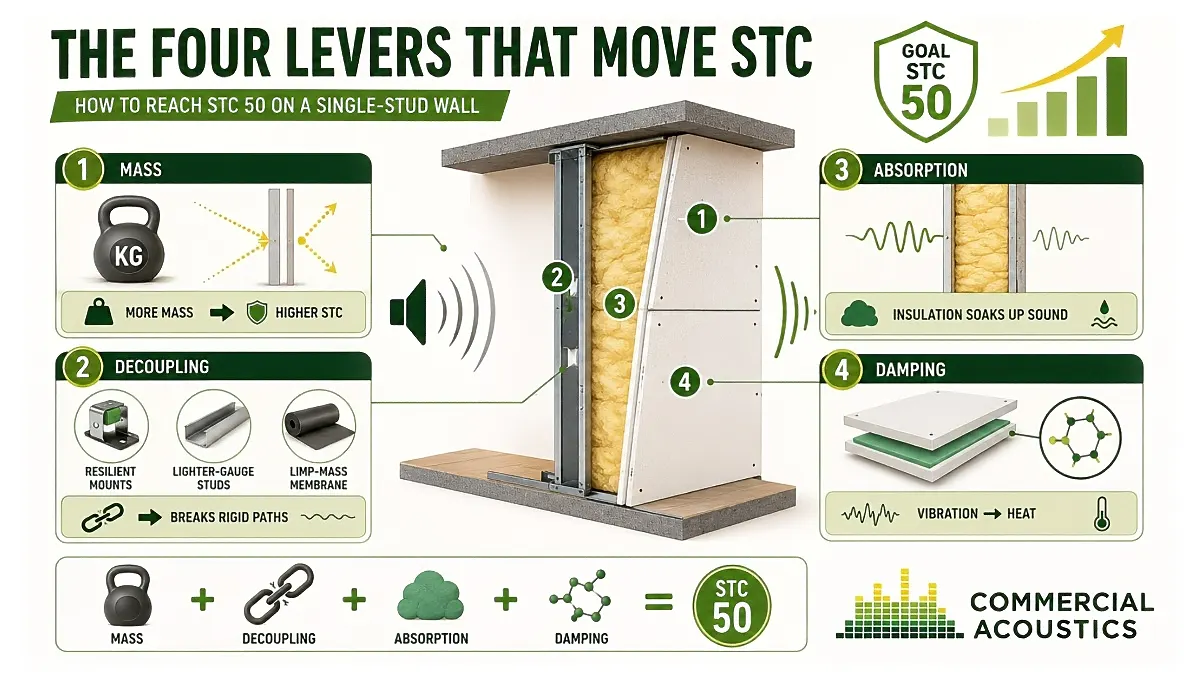
Four levers do the work, and on a single-stud wall the framing itself matters more than it would on a thick double-stud build. It pays to understand how STC ratings work before you settle on studs and spacing.
1. Mass
A denser barrier reflects more sound back toward its source. The rough rule is 6 dB of STC for every doubling of mass, though that payoff tapers off above STC 40. On a thin wall, mass is the easy win but rarely the whole answer.
2. Decoupling
Breaking the rigid path between the drywall and the studs. With one stud row to work with, decoupling comes from resilient mounts, lighter-gauge studs, or a limp-mass membrane rather than a second wall. This is the lever most single-stud walls leave on the table.
3. Absorption
Cavity insulation soaks up the energy bouncing inside the wall before it reaches the far face. Standard fiberglass batt handles this for almost every single-stud assembly, and it costs next to nothing to include.
4. Damping
A constrained-layer compound spread between two sheets of drywall turns vibration into a small amount of heat instead of passing it through. It adds real points where decoupling is limited, which makes it a natural partner on single-stud builds.
Why a Stiffer Wall Blocks Less Sound
It is counter-intuitive to most contractors that a 20-gauge stud wall has a lower STC than a 25-gauge wall, despite being stronger. The instinct says a stronger wall reflects more, and stronger means more steel. The catch is where that steel sits. It is concentrated at the studs, and sound travels easily through those stiff connectors like an electrical short-circuit.
The same logic explains spacing. Studs at 24 inches on center give the wall faces more room to flex independently than studs at 16 inches, so the wider layout blocks more sound. Strength and stiffness work against you here, which is the opposite of how framing usually gets specified.
What Each Upgrade Actually Adds
Not every move earns its cost. The table below ranks the common single-stud upgrades by what they return, drawn from a decade of reviewing wall assemblies. The pattern is consistent: flexibility beats brute mass, and decoupling beats both.
| Upgrade | Typical STC Change | Why |
|---|---|---|
| Switch 20-gauge to 25-gauge studs | +4 to 7 | Lighter framing flexes more, and it costs less than heavy gauge |
| Add a decoupling membrane | Biggest Gain | Separates drywall from studs and adds mass at the same time |
| Deepen studs 3-5/8" to 6" (25-gauge) | +3 to 4 | Steel studs only, wood gains little from extra depth |
| Move studs 16" to 24" on center | Modest | Fewer rigid connections per foot of wall |
| Add a layer of drywall | +1 to 3 | Rigidly screwed, so it is the least efficient option |
Three Common Mistakes That Cap Your STC
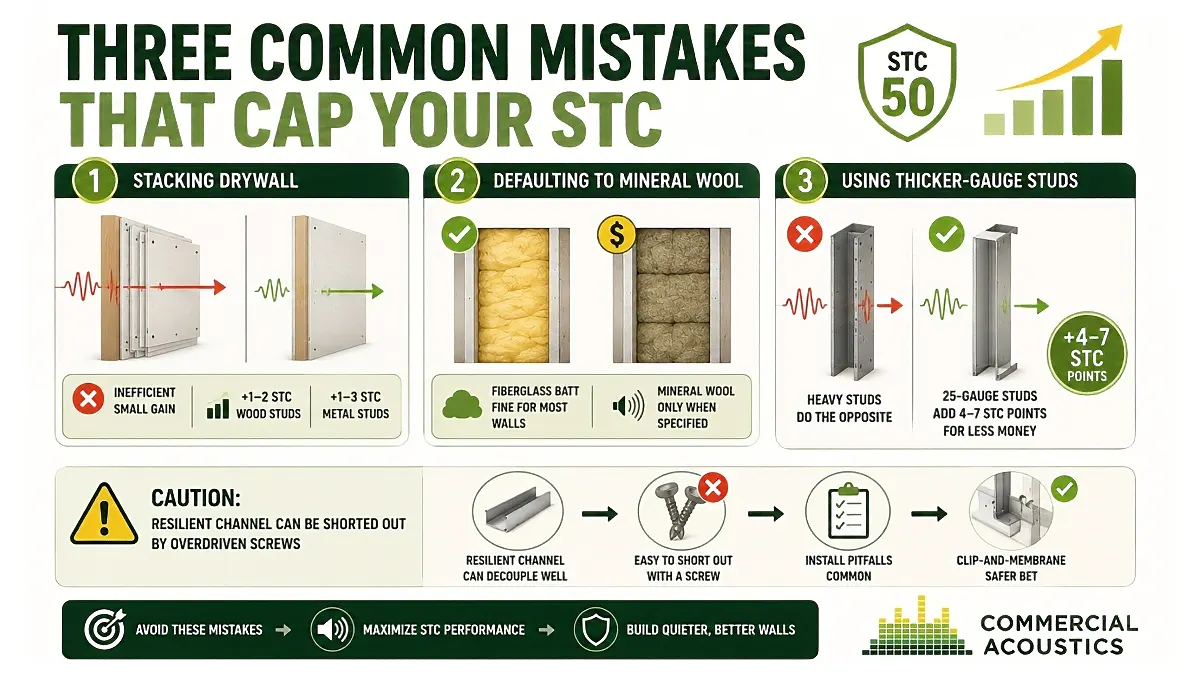
1. Stacking Drywall
Layering on extra panels is an inefficient way to raise STC. Each sheet screws rigidly to the framing, so sound travels straight through the gypsum. Wood studs gain only 1 to 2 points per layer, metal studs 1 to 3. The same money usually buys more isolation elsewhere.
2. Defaulting to Mineral Wool
Fiberglass batt is fine for the vast majority of walls. Mineral wool carries some low-frequency benefit for mechanical rooms, but it only earns its premium when an acoustic consultant calls for it on a specific assembly.
3. Using Thicker-Gauge Studs
After years of reviewing assemblies, this is the most common own-goal. Crews reach for heavier studs to make the wall stronger and block more sound, and it does the exact opposite. Switch to 25-gauge studs to add 4 to 7 STC points for less money.
Resilient channel deserves its own caution. It can decouple a single-stud wall well on paper, but it is easy to short out with a single overdriven screw, which is why we cover resilient channel install pitfalls separately. On a wall with no margin for error, a clip-and-membrane approach is usually the safer bet.
Can a Single-Stud Wall Reach STC 50?
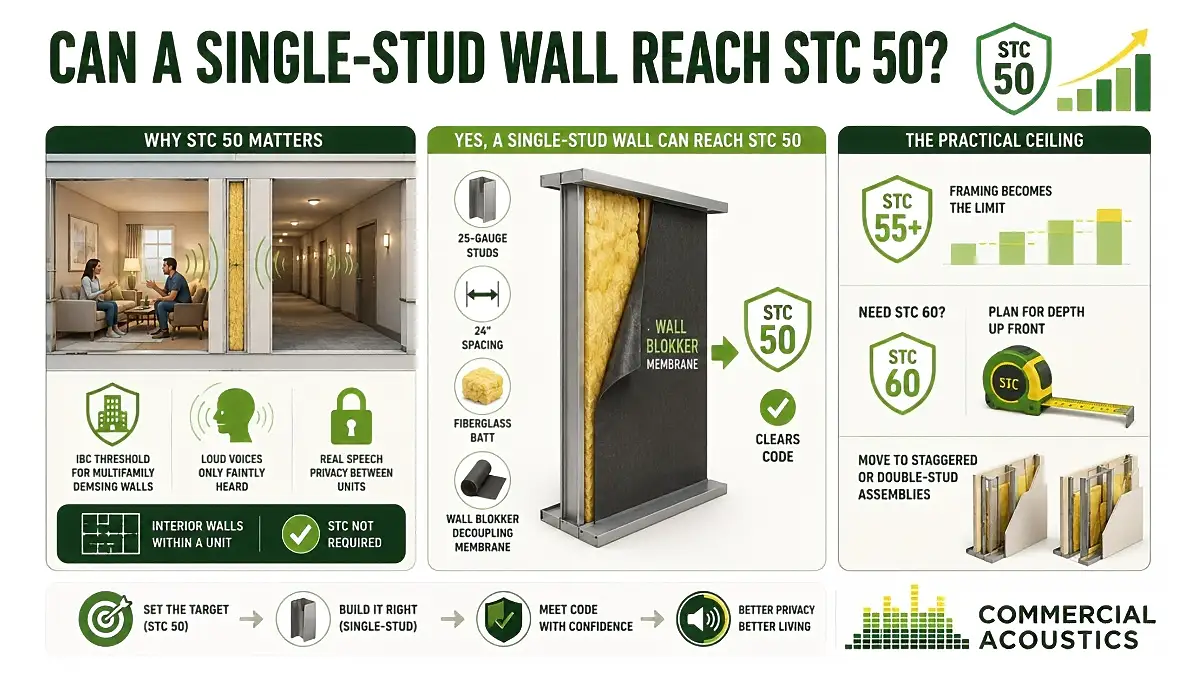
STC 50 matters because it is the International Building Code threshold for multifamily demising and corridor walls, the boundaries where one dwelling meets another unit or a public space. At STC 50, loud voices are only faintly heard and adjacent units get real speech privacy. Partitions inside a single unit usually carry no STC requirement.
A single-stud wall can hit STC 50, but it is close to the practical ceiling. Pair 25-gauge studs with 24-inch spacing, fiberglass batt, and a Wall Blokker decoupling membrane, and the assembly clears code without a second stud row.
Past STC 55, the math changes. The framing itself becomes the limit, and you move into staggered and double-stud assemblies with a genuine air gap. If the target is STC 60 for a theater or a sensitive demising wall, plan for the depth up front rather than chasing it inside one stud row.
How to Verify a Wall’s STC
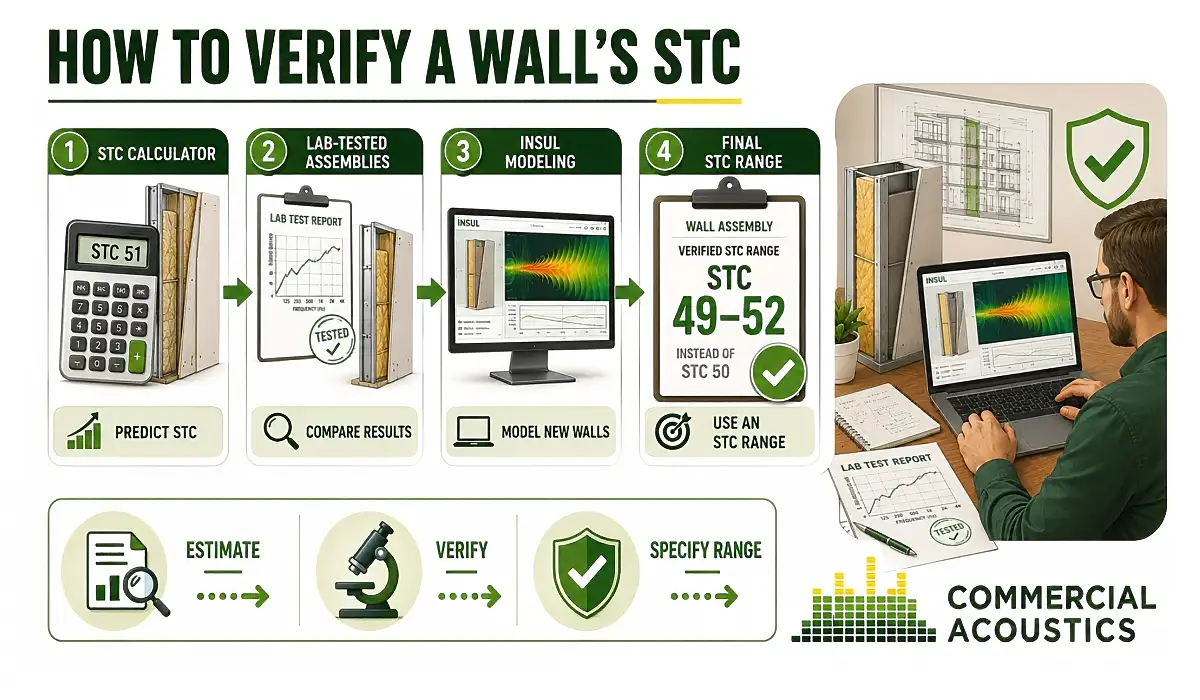
No single method is exact, so most analysts combine two and list an STC range on the wall schedule rather than a false-precision single number. Start with an STC calculator that predicts ratings from rules of thumb and underlying lab data, which makes the gauge and spacing effects easy to see.
Then cross-check against tested assemblies. Our STC lab test data covers common single-stud builds, and you can confirm against published lab measurements from third-party research bodies. For new assemblies with no close test match, modeling software like INSUL fills the gap. The video at the bottom of this post walks through an INSUL estimate.
The Bottom Line
A single-stud wall rewards finesse over force. Lighter studs, wider spacing, and a decoupling membrane will carry most assemblies to the STC 50 that code demands, while extra drywall and heavier framing mostly burn budget. The wall you already have can do more than its thickness suggests.
Know the ceiling before you commit. If the spec calls for STC 55 or higher, the honest answer is more depth, not more layers, and that is a conversation worth having with the engineers who review these walls before the framing goes up.
FAQs: Single-Stud Wall STC
Can a single-stud wall reach STC 50?
Yes, but it sits near the practical ceiling. Pair lighter 25-gauge studs with 24-inch spacing and a decoupling membrane, and a single-stud wall can meet the STC 50 that code requires for multifamily demising walls.
Do thicker studs increase a wall’s STC?
No, they lower it. Heavier 16 or 20-gauge studs are stiffer, so they transmit vibration more efficiently across the wall. Switching to 25-gauge studs adds roughly 4 to 7 STC points and costs less.
Does adding more drywall improve STC?
Barely. Because each layer screws rigidly to the framing, extra drywall adds only 1 to 2 points on wood studs and 1 to 3 on metal. Decoupling the drywall returns far more per dollar.
What is the highest STC a single-stud wall can hit?
Most single-stud assemblies top out around STC 50 to 55 once mass and decoupling are optimized. Reaching STC 60 and beyond usually requires staggered or double-stud framing with a real air gap.
Is fiberglass or mineral wool better in the cavity?
Fiberglass batt is fine for most single-stud walls. Mineral wool adds modest low-frequency benefit for mechanical rooms, but it rarely justifies the cost unless an acoustic consultant specifies it for the assembly.

Walker Peek|Founder & CEO, Commercial Acoustics
Walker founded Commercial Acoustics in 2013 to bring aerospace-grade engineering discipline to soundproofing, and runs the firm as CEO from its 12,000 sq ft Tampa production facility. The company designs custom acoustic panels, sound membranes, and masking systems for multi-family, hospitality, healthcare, and commercial projects across the US — built around Walker’s invention, Wall Blokker, an EVA-based sound barrier that hits STC 50-plus at roughly $1 per square foot installed.
A Jacksonville native, Walker spent five years at Kennedy Space Center with Craig Technologies before founding Commercial Acoustics — certifying aerospace manufacturing to the AS9100 standard and leading Six Sigma Black Belt process-improvement teams on NASA programs. He is a certified Industrial Noise Control Engineer and the author of Architectural Acoustics: A Practical Handbook.
