Table of Contents
Project Overview: Telecom Conference Room Acoustic Treatment
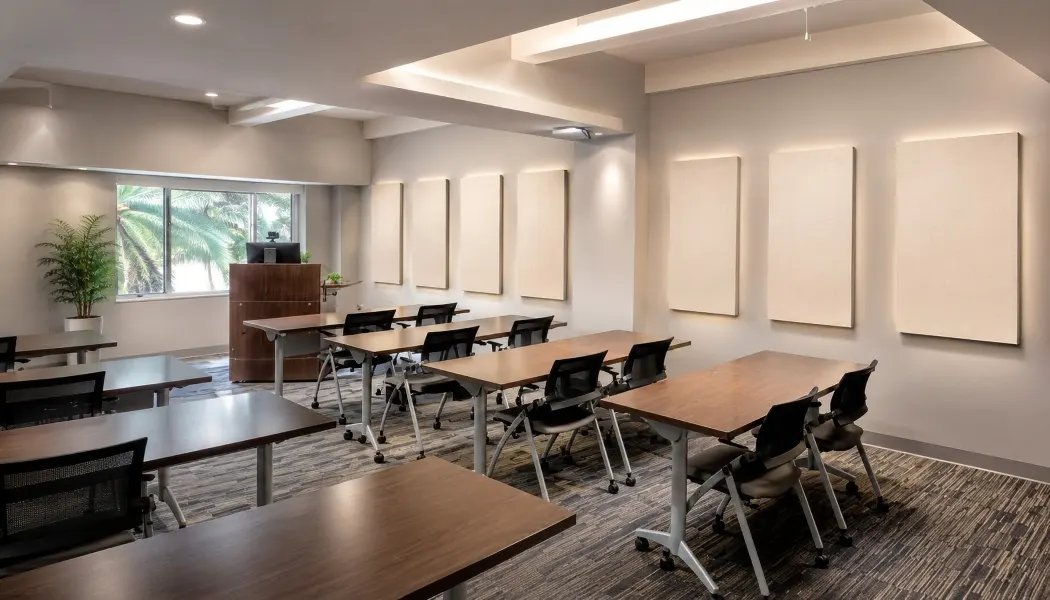
- Project: Acoustic Panel Install for a Healthcare Telecom / Presentation Room
- Location: New Orleans, LA
- Facility Type: Hospital Conference Room with Ceiling-Mounted Telecom
- Client: Ochsner Hospital
- Pre-Treatment RT60: 1.1 seconds (above the microphone intelligibility threshold)
- Scope: Reverberation Assessment, Sabin Calculation, Custom Panel Manufacture, Install
Why Telecom Rooms Need Sub-1-Second RT60
Healthcare conference rooms with telecom equipment have a stricter acoustic target than most meeting spaces. Ceiling- and table-mounted microphones pick up the room’s reverberant field along with the speaker’s voice, and above 1 second RT60 the reflections smear into the direct signal hard enough that the person on the other end of the call simply cannot understand what was said, which is the same reason acoustic treatment for recorded speech matters in studios.
The room in this project ran low-pile carpet over hard floor and otherwise hard surfaces — drywall, glass, exposed structure. RT60 measured at 1.1 seconds, which is fine for a casual meeting room with two people sitting close to each other. It is unusable for a remote-collaboration call where the mic is on the ceiling and the speaker is across the table.

Reverberation Test and Sabin Calculation
- Pre-Treatment RT60: 1.1 seconds, broadband
- Target RT60: Below 1.0 seconds for telecom microphone clarity
- Method: On-site reverberation assessment plus Sabin-formula modeling
- Inputs: Room volume, finish NRC values, target RT60 window
Sabin’s formula sets the absorption math: required Sabins equal room volume divided by target RT60, then multiplied by a constant. Plugging the pre-treatment RT60, room volume, and existing finish NRC values into the formula returned a clean number for the panel quantity needed to land below the 1-second mic threshold. The room acoustics calculator walks the same Sabin math anyone can run on their own room.

Acoustic Panel Specification
- Panel Type: Acoustic absorption panels with high-NRC fabric face
- Manufacture: Built at the Tampa, FL facility, shipped to New Orleans
- Mount: Wall-mounted distribution at seated head height and above
- NRC Held: To architect’s published spec across the speech band
Panel selection followed the standard healthcare-conference-room playbook: acoustic absorption panel in a fabric-wrapped finish, mounted to intercept the first reflections that hit the mic. That hospital acoustic treatment approach depends on distribution across multiple walls; clumping the same panel count into a single zone loses the area effect that happens when absorption surrounds the source rather than facing it from one side.

Results: RT60 from 1.1 to 0.78 Seconds
- Pre-Install RT60: 1.1 seconds
- Post-Install RT60: 0.78 seconds (below the 1-second mic threshold)
- Reduction: 30 percent drop, mid-frequency improvement most pronounced
- Outcome: Microphone clarity restored on remote calls
Post-install RT60 came in at 0.78 seconds — comfortably under the 1-second mic threshold. The mid-frequency improvement was the most pronounced, which matters because that band carries the consonants that drive speech intelligibility on a telecom call. As a hospital administrator put it: “the room improved by 100 percent. Before the acoustic panels you couldn’t hear anything, and now you can hear.”

The Microphone Intelligibility Threshold at 1 Second
The 1-second RT60 threshold is not a rule of thumb. It is what falls out of the speech-band reflection math when a microphone is positioned more than a few feet from the speaker. Above 1 second, the reflected energy arriving at the mic 50 to 200 milliseconds late carries enough amplitude to muddy the direct signal past usable intelligibility on a compressed telecom codec. Federal acoustic comfort design guidance places speech-driven rooms in the same sub-second reverberation window.
Different room programs land in different windows on the RT60 scale, and the right target depends on what the room is actually for. The table below maps the common windows for any operator scoping treatment for their own space.
| Room Use | Target RT60 | Why It Matters | Symptom If Missed |
|---|---|---|---|
| Telecom / Mic-Driven Conference | < 1.0 sec | Ceiling and table mics break down above this | Remote callers cannot understand the speaker |
| Speech-First Meeting Room | 0.8 – 1.0 sec | Conversation clarity around the table | Voices smear across the room |
| Multi-Purpose Boardroom (AV-Heavy) | 0.6 – 0.8 sec | Mixed speech, video, presentation | Music feels harsh, speech feels tinny |
| Hospital Patient Room (HCAHPS-Critical) | < 0.5 sec | Sleep quality drives patient satisfaction | Noise complaints, lower HCAHPS scores |
| Open Office (Sound-Masking-Compatible) | 0.4 – 0.6 sec | Pairs with masking for speech privacy | Voices carry across cubicle rows |
The pattern repeats across every vertical: hospital, commercial office, civic, education. The room program sets the target; the absorption math gets you there. For a sister healthcare project that took the patient-room HCAHPS angle further, see the hospital sound masking and HCAHPS case study. For a multipurpose-room reverberation project that landed in a different RT60 window, see the multipurpose room acoustic treatment case study at the WellCome OM Center. The deeper background on noise criteria across all of these lives in the design for noise criteria guide.

Conclusion: Telecom Conference Room Acoustic Treatment
A 1.1-second RT60 conference room with ceiling telecom became a 0.78-second room with a Sabin-sized acoustic panel install — a 30 percent reduction that crossed the 1-second microphone threshold and restored remote-call intelligibility. Any conference room running mic-driven telecom should be measured against that threshold and treated to land below it. Scope acoustic treatment for your conference room if you want this kind of pre/post measured outcome on your own space.
FAQs: Telecom Conference Room Acoustic Treatment
What RT60 should a telecom conference room target?
Below 1.0 seconds RT60. Ceiling and table microphones pick up reflected energy along with the direct voice, and above 1 second the reflections smear the signal past intelligible on a compressed telecom codec. The Ochsner project landed at 0.78 seconds, comfortably under the threshold.
Why is 1 second the magic threshold for microphones?
It falls out of the speech-band reflection math. Reflections arriving at the mic 50 to 200 milliseconds after the direct signal carry enough amplitude above 1 second to muddy the codec output. Below 1 second, the reflections decay fast enough that the codec preserves consonant clarity on the remote end.
How many acoustic panels does a conference room need?
Sabin-formula math sets the count. Required Sabins equal room volume divided by target RT60, then multiplied by a constant. The Ochsner room landed in the standard count for a healthcare conference space — typically 8 to 16 panels for a 200 to 400 square foot room with hard finishes.
What is the difference between conference room and patient room acoustics?
Conference rooms target microphone intelligibility (sub-1-second RT60). Patient rooms target sleep and HCAHPS scores (sub-0.5-second RT60). Different programs, different targets, different treatment quantities — though the underlying tool (acoustic absorption panels) is often the same.
Walker Peek|Founder & CEO, Commercial Acoustics
Walker founded Commercial Acoustics in 2013 to bring aerospace-grade engineering discipline to soundproofing, and runs the firm as CEO from its 12,000 sq ft Tampa production facility. The company designs custom acoustic panels, sound membranes, and masking systems for multi-family, hospitality, healthcare, and commercial projects across the US — built around Walker’s invention, Wall Blokker, an EVA-based sound barrier that hits STC 50-plus at roughly $1 per square foot installed.
A Jacksonville native, Walker spent five years at Kennedy Space Center with Craig Technologies before founding Commercial Acoustics — certifying aerospace manufacturing to the AS9100 standard and leading Six Sigma Black Belt process-improvement teams on NASA programs. He is a certified Industrial Noise Control Engineer and the author of Architectural Acoustics: A Practical Handbook.
