

Table of Contents
Project Overview: Hotel AC Noise Reduction
- Project: In-Room HVAC Noise Reduction via Closet Door Retrofit
- Location: 305 N Cattlemen Rd, Sarasota, FL 34235
- Facility Type: Hotel Guest Rooms with In-Room HVAC Closet
- Issue: Cycled compressors and blower fans waking guests overnight
- Scope: Acoustic Diagnostic, Materials Testing, MLV + Fiberglass Retrofit
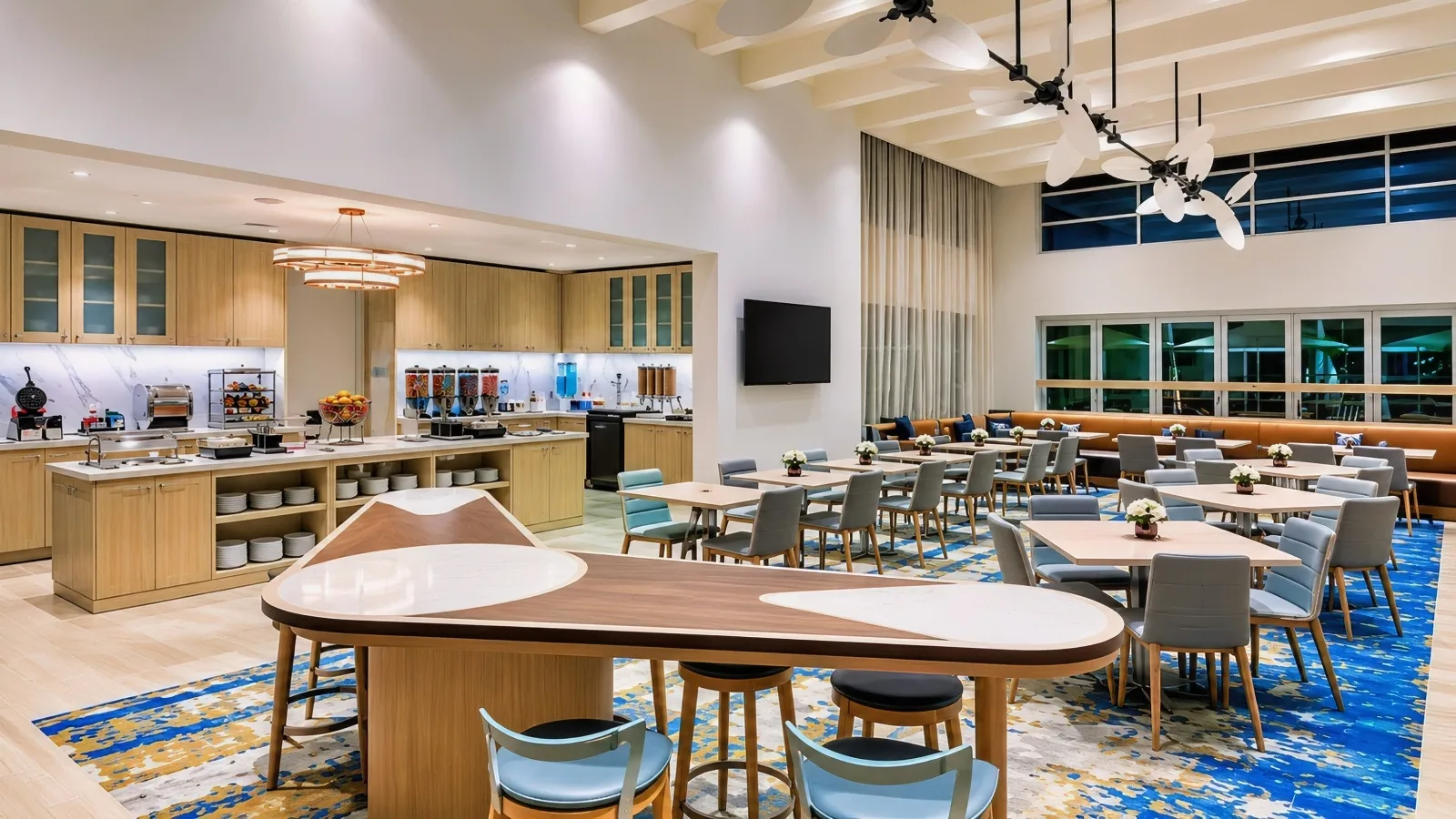
This project was completed at Homewood Suites by Hilton Sarasota / Lakewood Ranch, an extended-stay Hilton property in the Sarasota UTC corridor at 305 N Cattlemen Rd. The HVAC closet retrofit documented here was rolled out across guest rooms after the in-room cycling noise surfaced repeatedly in overnight guest complaints.

The Hotel AC Noise Problem
Hotel rooms collect every kind of noise complaint — neighbors, road, airport, plumbing — but in-room HVAC noise is the most persistent and the one that actually wakes paying guests. Cycled compressors and blower fans run on schedules the guest cannot predict, which is exactly the pattern that disrupts sleep cycles and produces the worst online review language.
The property manager at this Sarasota UTC area hotel called us with the standard ask: lower the AC noise in occupied rooms without ripping out the HVAC plant. The constraint was real — replacing units across the property would have run into six figures and weeks of room downtime per floor.
On-Site Acoustic Diagnostic
- Source Measurement: Calibrated SPL meter at the HVAC closet face
- Receive Measurement: Same meter at the guest pillow position
- Method: Each candidate solution installed and tested individually
- Goal: Identify the highest-leverage retrofit before scaling across rooms
The diagnostic split the noise path into source (the AC unit) and receiver (the guest’s pillow). Measuring both let us track which treatment moved the receive number — the only number that actually matters when the goal is fewer noise complaints.
Testing each candidate solution individually beat assembling a “kitchen sink” treatment package. Each variable came in or out of the package based on its measured contribution, which kept the per-room cost down and made the eventual rollout defensible to the property’s CapEx review.
Independent Variables Tested
- Fiberglass Thickness: Different absorptive panel depths
- MLV Density: Mass-loaded vinyl thickness and per-square-foot mass
- Mounting Location: Top, middle, and bottom of the louvered HVAC door
- Mounting Method: Adhesive vs. mechanical fastening
The MLV thickness variable mattered most for source-side blocking. Heavier MLV stopped more direct sound transmission through the louvered door panel; lighter MLV slipped energy through. The Wall Blokker mass-loaded vinyl membrane in the heavier weight class was the right pick for this application.
Fiberglass thickness drove the absorptive side. Thicker fiberglass converted more low-frequency blower energy to heat before it could escape into the room. Mounting location turned out to matter more than expected — top placement vs. bottom placement materially changed the noise path geometry, which is what set up the eventual winning combination.
The Winning Solution: MLV Top, Fiberglass Bottom
- Top of Door: Mass-loaded vinyl panel blocking direct transmission
- Bottom of Door: Fiberglass panel insulation absorbing reflected energy
- Air Path: Forced through the absorber instead of straight out the louvers
- Geometry: Elongates the noise path from fan to guest by ~3 feet effective
The combination won because it changed the noise path geometry, not just the surface materials. MLV at the top blocked the most direct transmission line from the blower fan to the guest. Fiberglass at the bottom forced the supply air through an absorptive medium before it exited the closet, which converted the highest-frequency fan energy to heat before it reached the room.
What looks like a simple two-material retrofit is actually doing two acoustic jobs at once: source-side blocking on the dominant transmission path, and receive-side absorption on the residual airflow path. Either treatment alone would have moved the number a few dBA. The combination moved it enough to drop guest complaints to near zero.
Results: 7 to 8 dBA Reduction at the Pillow
- Outside HVAC Door: 7 dBA reduction
- At Guest Pillow: 8 dBA reduction
- Cost Savings: ~$800 per unit vs. AC replacement
- Operational Impact: Zero room downtime per install vs. weeks for replacement
An 8 dBA reduction at the pillow position is the difference between “I can hear the AC clearly” and “the room feels quiet.” The decibel scale is logarithmic — 8 dBA off the source roughly halves perceived loudness. That moves the room out of “complain to the front desk” territory and into “sleep through the night” territory.
The CapEx math worked too. Replacing each AC unit would have cost roughly $800 per room plus labor and the operational hit of taking the room out of service. The retrofit cost a fraction of that, ran during normal off-hours housekeeping windows, and let the property keep every room in service while the rollout happened.
Why HVAC Soundproofing Beats Unit Replacement
- Cost: Roughly one-tenth the per-room budget of unit replacement
- Downtime: Off-hours retrofit vs. multi-day room closure
- Scalability: Same retrofit pattern works across an entire room block
- Reversibility: Retrofit can be removed and re-applied if rooms are renovated
| Approach | Per-Room Cost | Downtime | Pillow dBA Reduction | Property Rollout |
|---|---|---|---|---|
| MLV + Fiberglass Retrofit | ~1/10 of replacement | Off-hours, no closure | 8 dBA | All rooms stay in service |
| AC Unit Replacement | ~$800 + labor | Multi-day room closure | Depends on new unit spec | Lost revenue per closure day |
Unit replacement is the right call when an AC is genuinely broken or end-of-life. When the unit works fine but is just loud — which is the case for most hotel HVAC complaints — soundproofing the closet door is the cheaper and faster path to the same guest experience. The acoustic intervention treats the symptom (noise reaching the guest) without paying for capacity or refrigeration the room does not actually need.
For a sister hospitality project where the acoustic problem was reverberation rather than HVAC noise, see the Miami acoustic consultant for hotels case study. For a new-construction hotel where soundproofing was specified at the wall-assembly level, see the La Quinta Orlando hotel soundproofing project.
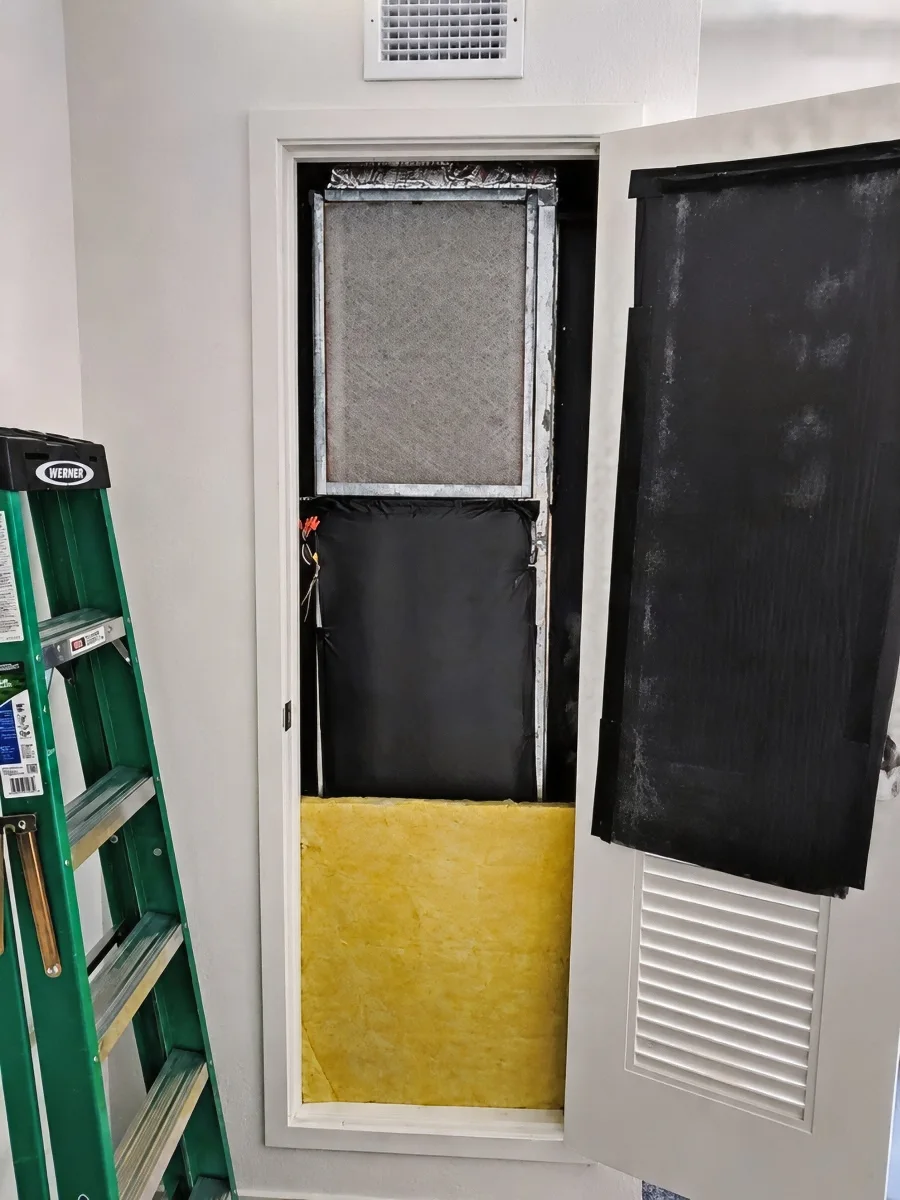
Conclusion: Hotel AC Noise Reduction
An MLV-and-fiberglass retrofit on the louvered HVAC closet door dropped AC noise 7 dBA outside the closet and 8 dBA at the guest pillow, saved roughly $800 per unit versus AC replacement, and ran during off-hours without taking rooms out of service. The principles transfer to almost any hotel with in-room HVAC closets — and to the team behind hotel soundproofing projects for operators who need to scope a rollout across their own property.
FAQs: Hotel AC Noise Reduction
What causes hotel AC and HVAC noise complaints?
Cycled compressors and blower fans cycling on and off through the night are the top sources. Guests cannot predict when the unit will run, which is exactly the pattern that breaks sleep cycles. Direct transmission through the louvered HVAC closet door is the dominant noise path in most rooms.
Can hotel AC units be soundproofed without replacement?
Yes. The Sarasota project here cut AC noise 8 dBA at the guest pillow with a mass-loaded vinyl plus fiberglass retrofit on the HVAC closet door — no unit replacement, no room downtime. Soundproofing the closet door treats the dominant noise path at a fraction of the cost of replacing the AC unit itself.
How much noise reduction is realistic for a hotel HVAC retrofit?
7 to 8 dBA at the guest pillow is achievable on most in-room HVAC closets, which roughly halves perceived loudness. That moves the room out of complaint territory for most guests. Bigger reductions are possible with full closet rebuilds, but rarely needed once the closet door is properly treated.
What does HVAC closet retrofit cost compared to replacing the AC unit?
The retrofit runs roughly one-tenth the per-room budget of AC replacement and avoids multi-day room downtime. The Sarasota property saved about $800 per unit versus replacement, plus the revenue protection of keeping every room in service through the rollout window.

Walker Peek|Founder & CEO, Commercial Acoustics
Walker founded Commercial Acoustics in 2013 to bring aerospace-grade engineering discipline to soundproofing, and runs the firm as CEO from its 12,000 sq ft Tampa production facility. The company designs custom acoustic panels, sound membranes, and masking systems for multi-family, hospitality, healthcare, and commercial projects across the US — built around Walker’s invention, Wall Blokker, an EVA-based sound barrier that hits STC 50-plus at roughly $1 per square foot installed.
A Jacksonville native, Walker spent five years at Kennedy Space Center with Craig Technologies before founding Commercial Acoustics — certifying aerospace manufacturing to the AS9100 standard and leading Six Sigma Black Belt process-improvement teams on NASA programs. He is a certified Industrial Noise Control Engineer and the author of Architectural Acoustics: A Practical Handbook.
