
Table of Contents
Project Overview: Restaurant Fabric Wall Acoustic Upgrade
- Project: Stretched Fabric Wall Acoustic Upgrade After Initial Panels Underperformed
- Location: 1600 Harbor Dr S, Venice, FL 34285
- Facility Type: High-End Fine Dining, Gulf-View Restaurant Above the Venice Pier
- Client: Fins at Sharky’s and Sharky’s on the Pier
- Existing Treatment: 1″ Acoustic Panels at NRC 0.7 (insufficient on busy nights)
- Scope: Sabin Recalculation, 450 SF Fabric Wall at NRC 1.05, Custom Track Cuts
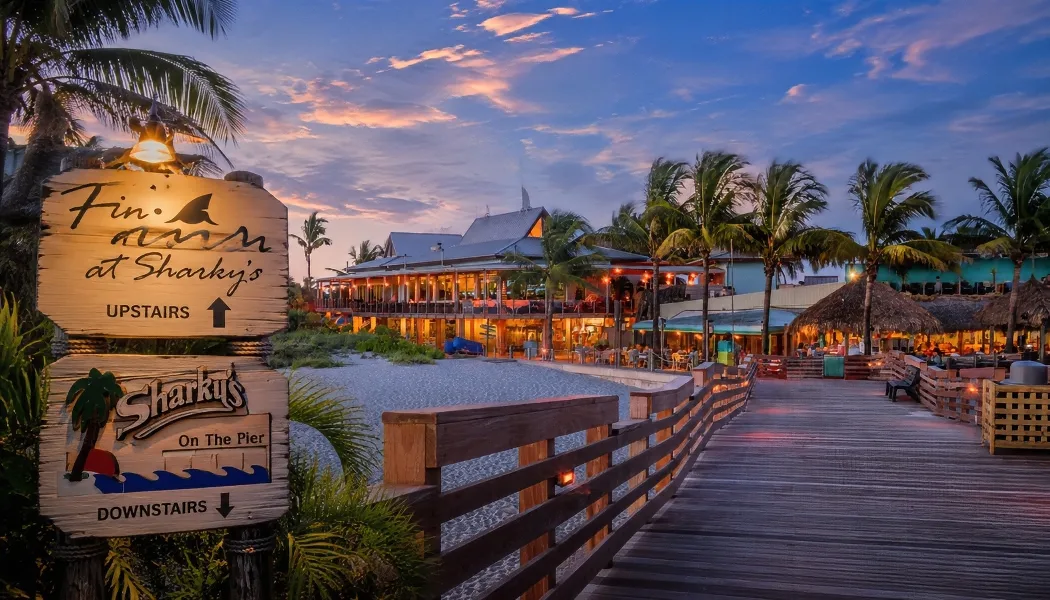
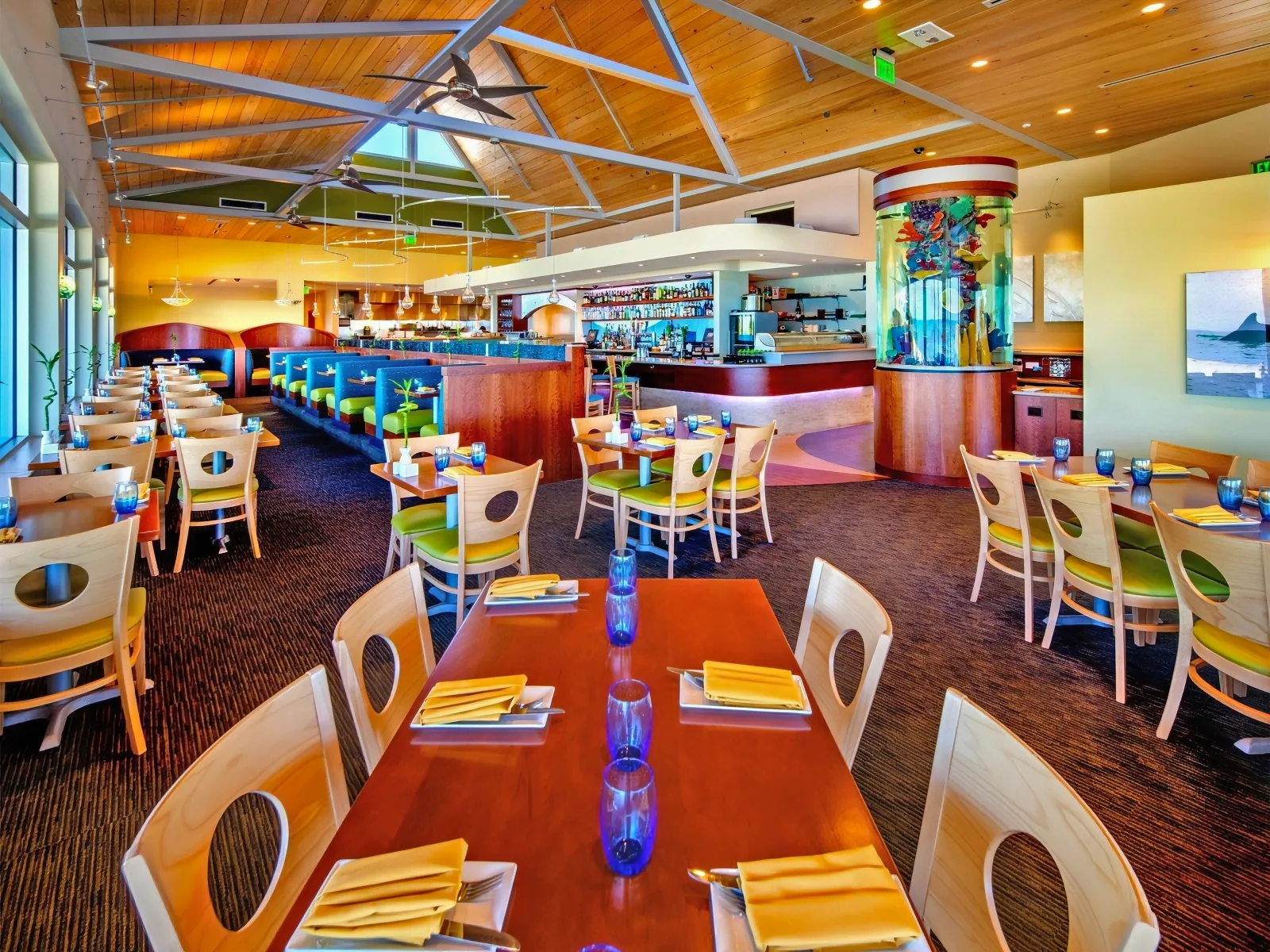
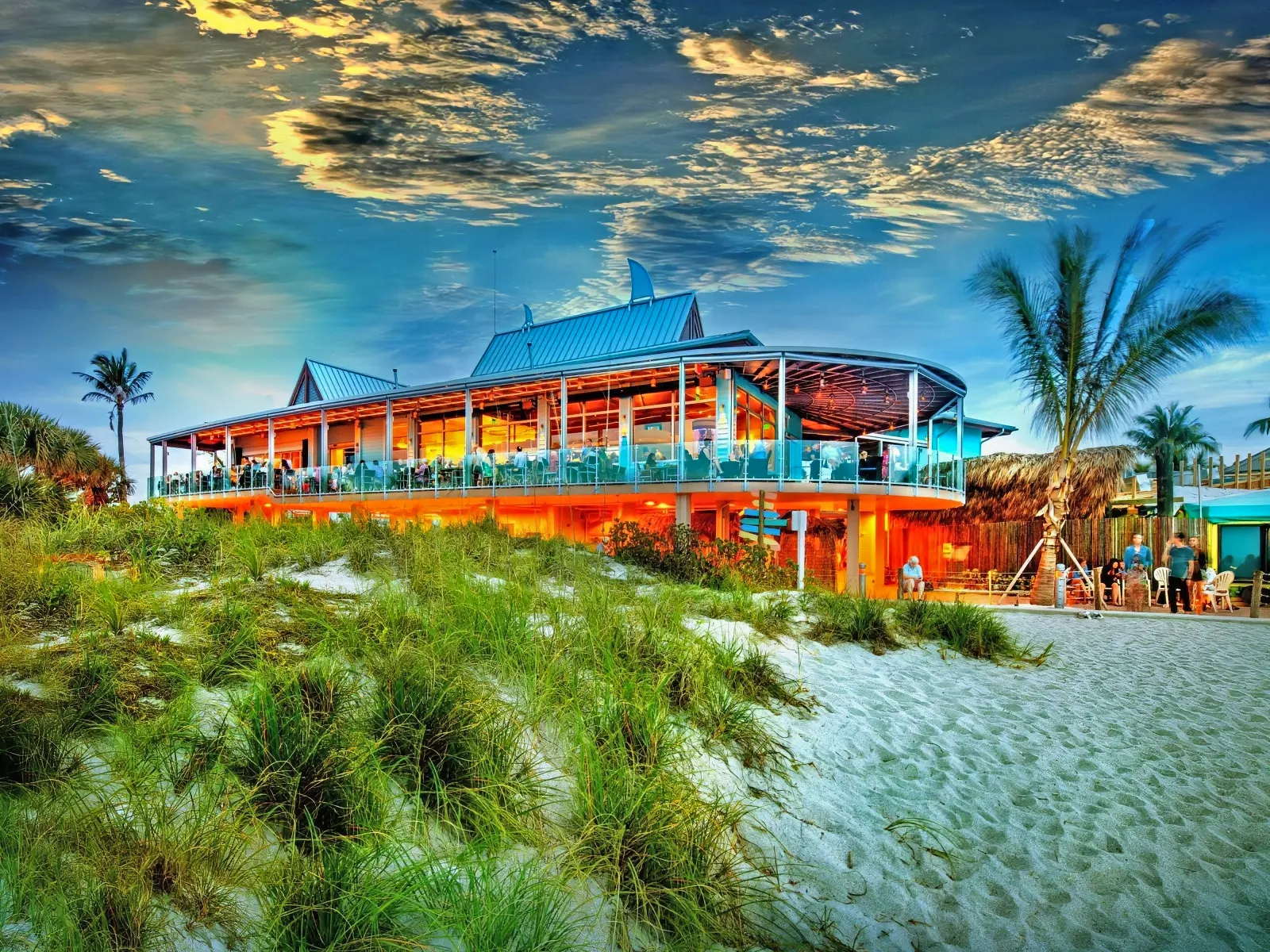
Fins at Sharky’s is the upstairs fine-dining sister concept to Sharky’s on the Pier, the long-running ground-floor restaurant that opened the Venice Pier location years earlier. Both properties share the same address and ownership group, with Sharky’s on the Pier still operating downstairs as the casual beach-bar concept. The acoustic work documented here covers the upstairs Fins dining room.
Why the First Round of Panels Wasn’t Enough
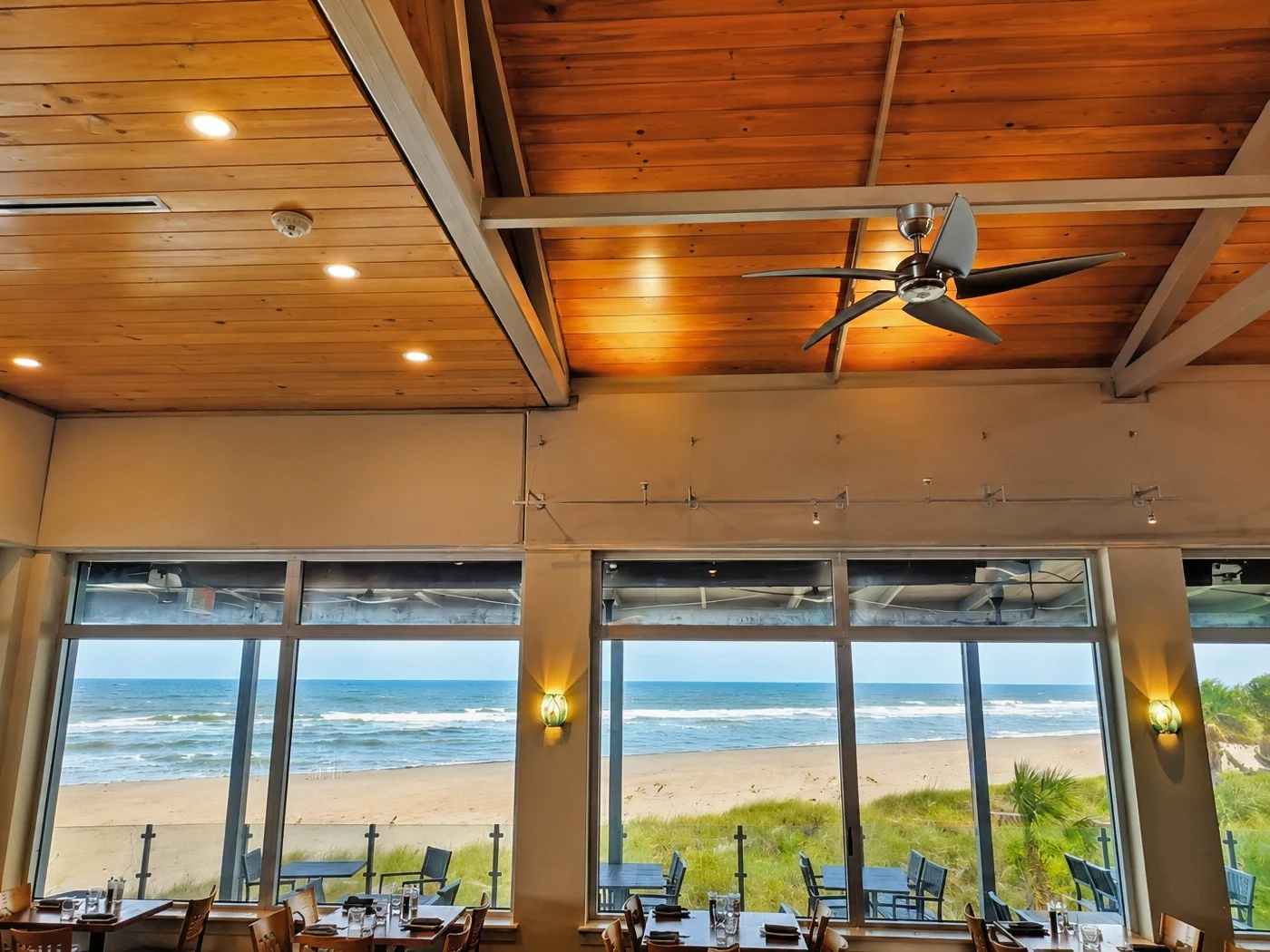
Fins at Sharky’s sits above the Venice Fishing Pier with a direct Gulf view, surrounded by boutiques and other fine dining establishments. The room had been treated once already — 1″ acoustic panels at NRC 0.7 went in the prior year — and the restaurant manager was still fielding noise complaints on busy nights. The first install softened the worst of the room but did not get the reverberation under control.
Thin, low-NRC panels are the most common cause of a “we already treated the room and it still doesn’t work” call. NRC 0.7 absorbs about two-thirds of incident energy across the speech band; NRC 1.05 absorbs effectively all of it. On a hard-surfaced room running a busy dinner service, that 35-percentage-point gap is the difference between a room you can hold a conversation in and a room where guests give up trying.
Sabin Calculation: Why 450 SF of NRC 1.05
- Required Coverage: 450 SF of high-NRC absorption
- NRC Target: 1.05 (compared to existing 0.7 on the original 1″ panels)
- Core Spec: 2″ fiberglass core for full-band absorption
- Method: Sabin’s formula plugged with measured baseline + finish NRC values
Sabin’s formula is the right way to size any acoustic upgrade: required Sabins equal room volume divided by target RT60 multiplied by a constant. Plugging the measured baseline against the existing finish NRC values returned 450 SF of NRC 1.05 absorption to land at the working dining-room reverberation target. The room acoustics calculator walks the same math anyone can run on their own room.
Stretched Fabric Wall Specification
- Core: 2″ high-density fiberglass for low-frequency absorption
- Face: Acoustically-transparent designer fabric, restaurant-grade
- Mount: Track-mounted system, field-installed
- Coverage: Wall-to-wall above the 10′ height line
The acoustic fabric wall system is the right tool when an upgrade needs significant wall area or has to flex around existing finishes. Pre-fabricated panels are sized in a factory and delivered to fit; track-mounted fabric wall is built in the field, which lets the install run wall-to-wall and floor-to-ceiling without gaps or sizing compromises.
The 2″ fiberglass core does the acoustic work. The fabric face does the design work. Together they read as a finished wall plane rather than a row of panels stuck to a wall — which matters in a high-end dining room where every visible surface is on the brand.
Installation: High Wall and Custom Cuts Around Lighting
- Start Height: 10′ off the floor, extending to ceiling
- Aesthetic: Treatment above sightline, dining design preserved
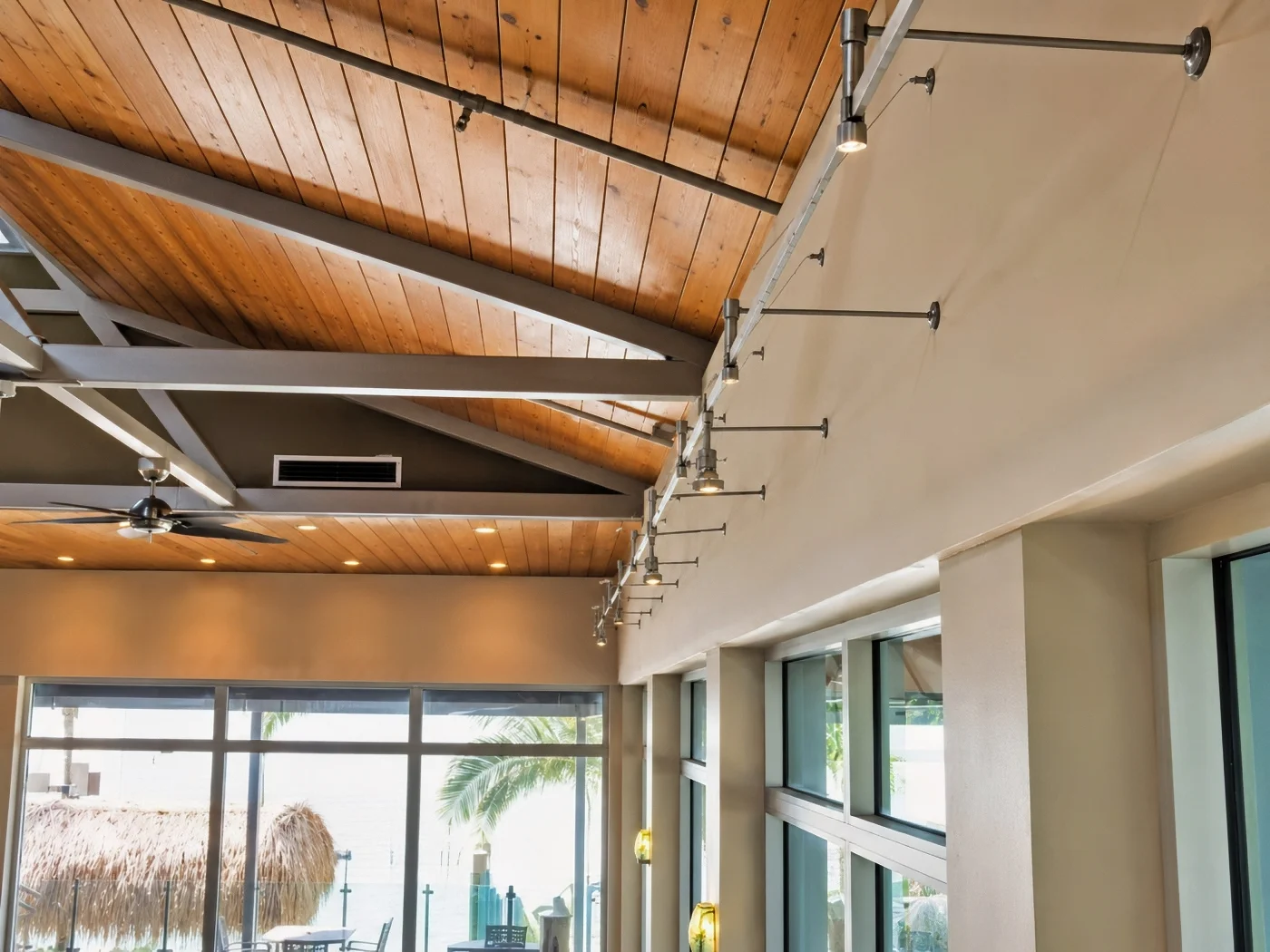
- Lighting: Custom track cuts to flow around existing fixtures
- Field Flexibility: Track-system advantage over pre-fab panels
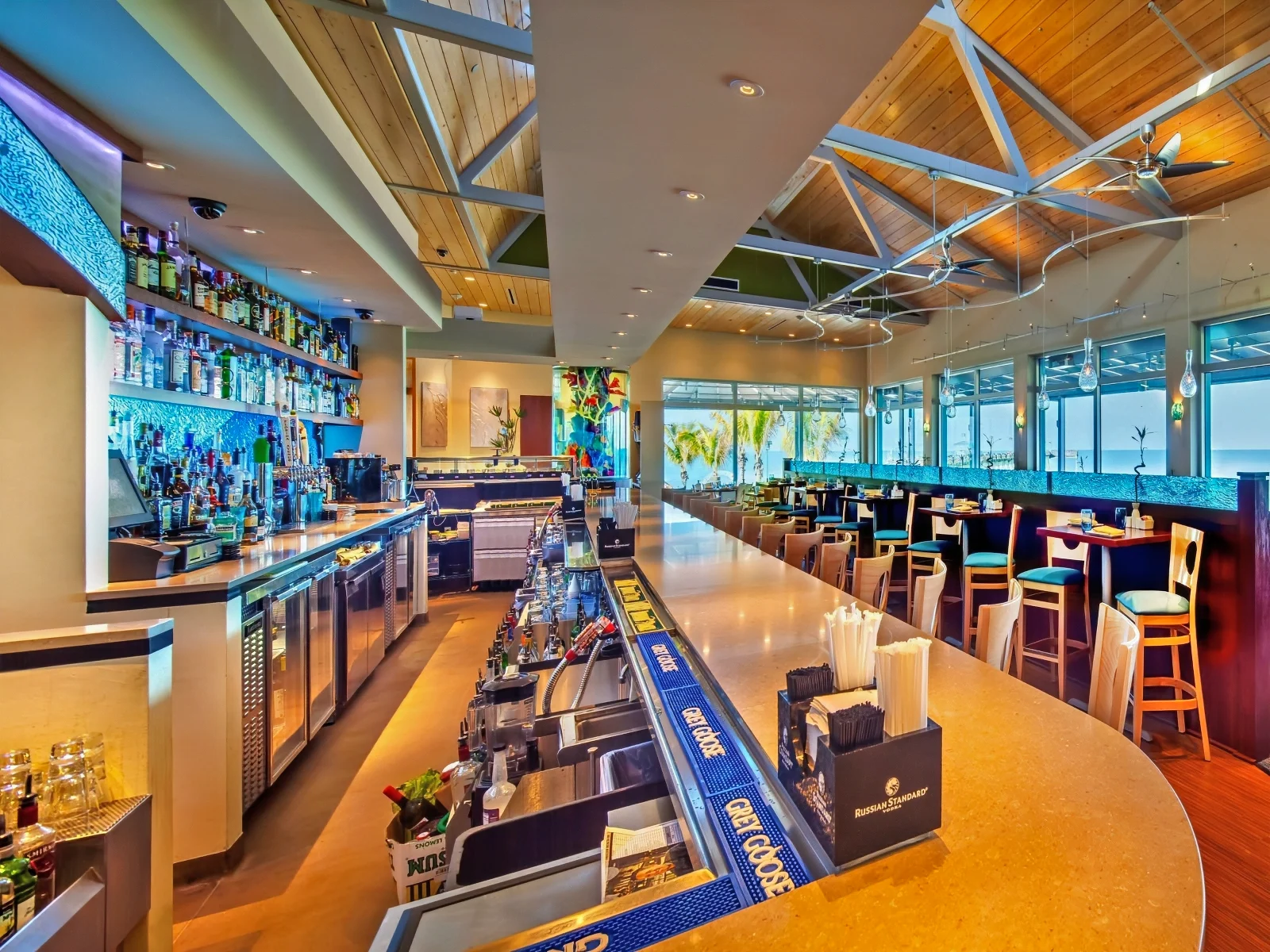
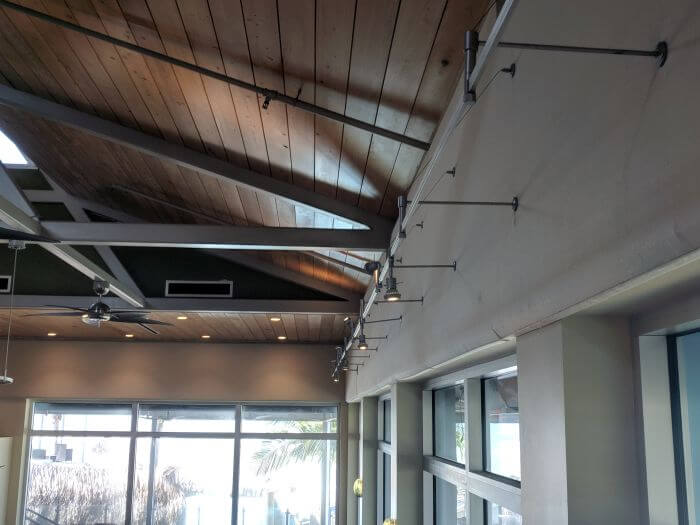
Mounting starts at the 10-foot height line so guests at table level see the original dining room, not the acoustic treatment. Above the sightline, the fabric wall covers the upper perimeter and the ceiling junction — exactly the surfaces where the worst speech-band reflections originate in a hard-finished room.
The existing lighting structure forced custom cuts in the track system itself, which a pre-fabricated panel package could not have accommodated. Field-installed fabric wall handles obstructions like this by design — the track gets cut on site, the fabric pulls flush around fixtures, and the install reads as deliberate rather than worked-around.
When Fabric Wall Beats Standard Panels
Fabric wall is the right pick when a room needs significant wall coverage, has to fit around existing fixtures, or when the upgrade is a redo of a previous treatment that did not deliver. Standard pre-fabricated panels are cheaper per square foot and work well in distributed-coverage layouts, but they hit a ceiling on large continuous surfaces and on aesthetic continuity. The table below maps the working trade-offs for any operator scoping their own restaurant treatment.
| Treatment | NRC | Best For | Trade-Off |
|---|---|---|---|
| Stretched Fabric Wall (2″ Core) | 1.05 | Wall-to-wall coverage, large continuous surfaces, fixture cuts | Higher cost per SF, requires field install |
| Standard Acoustic Panel (2″) | 1.00 | Distributed wall coverage at multiple zones | Pre-fab sizing, gaps between panels |
| Standard Acoustic Panel (1″) | 0.70 | Mild reverberation, small dining rooms | Underperforms on busy lively nights |
| Ceiling Clouds | 1.00+ | Hard-finish walls locked by brand design | Ceiling-only limits placement options |
For a sister restaurant project that took the ceiling-cloud path on a different problem, see the Mekenita Cantina ceiling clouds case study. For a sibling restaurant that needed sound transmission control rather than absorption, see the Wright’s Gourmet curtain partition case study.
Conclusion: Restaurant Fabric Wall Acoustic Upgrade
The Fins at Sharky’s upgrade swapped underperforming 1″ NRC 0.7 panels for 450 SF of 2″ NRC 1.05 fabric wall, mounted above the 10-foot height line and cut to flow around existing lighting. The room reads as designed instead of treated, and busy-night reverberation is back inside the working dining range. Browse our other restaurant acoustic projects for similar work across Florida and beyond.
FAQs: Restaurant Fabric Wall Acoustic Upgrade
What is the difference between fabric wall and standard acoustic panels?
Standard panels are pre-fabricated in a factory and delivered to fit. Fabric wall is field-installed on a track system, which lets it run wall-to-wall, floor-to-ceiling, and around fixtures without gaps. Fabric wall handles large continuous surfaces and aesthetic continuity better; standard panels are cheaper per square foot for distributed coverage.
Why did the original 1-inch panels underperform at the restaurant?
The original panels were NRC 0.7, which absorbs about two-thirds of incident energy across the speech band. Busy lively restaurants need NRC closer to 1.0 to control reverberation on full-house nights. The 35-percentage-point gap between NRC 0.7 and NRC 1.05 is what determines whether a treated room actually feels treated.
When should a restaurant choose fabric wall over standard panels?
Fabric wall wins when the room needs large continuous coverage, has to fit around existing fixtures, or when a previous panel install underdelivered. Standard panels remain the cheaper pick for distributed coverage on smaller rooms with simple wall layouts and no fixture conflicts.
What NRC do you need for a busy lively restaurant?
Aim for NRC 1.0 to 1.05 absorption on the treated surfaces. Anything below NRC 0.85 will struggle on full-house busy nights — the room may sound fine on a quiet Tuesday and unbearable on a Saturday at 8 PM. The Sabin formula sets the required square footage once the NRC is locked.


Walker Peek|Founder & CEO, Commercial Acoustics
Walker founded Commercial Acoustics in 2013 to bring aerospace-grade engineering discipline to soundproofing, and runs the firm as CEO from its 12,000 sq ft Tampa production facility. The company designs custom acoustic panels, sound membranes, and masking systems for multi-family, hospitality, healthcare, and commercial projects across the US — built around Walker’s invention, Wall Blokker, an EVA-based sound barrier that hits STC 50-plus at roughly $1 per square foot installed.
A Jacksonville native, Walker spent five years at Kennedy Space Center with Craig Technologies before founding Commercial Acoustics — certifying aerospace manufacturing to the AS9100 standard and leading Six Sigma Black Belt process-improvement teams on NASA programs. He is a certified Industrial Noise Control Engineer and the author of Architectural Acoustics: A Practical Handbook.
