Table of Contents
Why Yoga Studios Are Hard to Keep Quiet
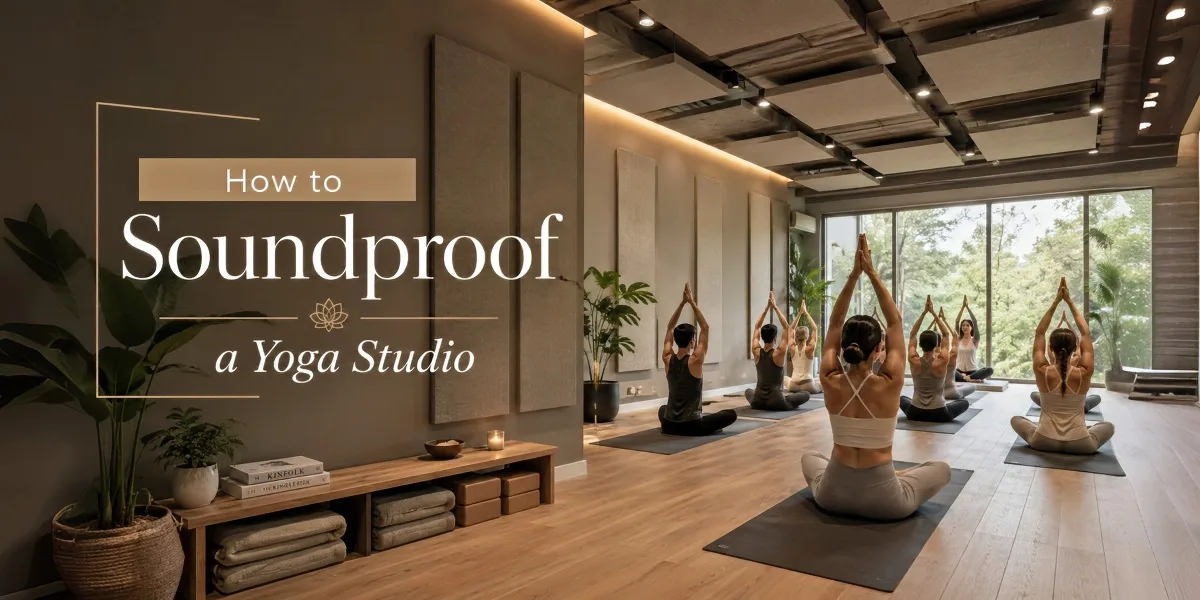
Yoga studios have one of the most demanding acoustic briefs in commercial design. The practice space needs to be calm enough for silent meditation, intimate enough for an instructor’s mic to carry clearly, and isolated enough that the spin class on the other side of the wall doesn’t pull people out of savasana with a 6 am bass drop.
The challenge is that boutique fitness tenants cluster together—yoga next to CrossFit next to a juice bar next to a barre studio—and a standard tenant wall doesn’t come close to delivering the isolation a yoga practice requires. This guide covers 7 prioritized strategies for soundproofing a yoga studio, each with real performance specs (STC, NRC, NC, dBA) you can hand to an architect or contractor.
How Quiet Should a Yoga Studio Be?
Most commercial spaces tolerate background noise levels in the 40–50 dBA range. A yoga studio needs to be quieter than that—closer to a bedroom at night than to a coffee shop. The chart below shows what untreated and properly treated studios actually deliver, and what kind of intrusion levels you can expect from the neighbors next door.
The gap between the red row and the green row is what proper acoustic envelope work buys you: dropping a studio from typical office-background noise levels (where every neighbor sound intrudes on practice) down to bedroom-quiet levels (where stillness is actually possible). For context on the decibel scale, see Decibels Explained.
7 Soundproofing Strategies in Priority Order
Listed in priority order—defensive isolation first (keeping the noise out), then interior treatment for clarity and calm, then sound-system design and background mechanical noise. Every strategy includes target specs (STC, NRC, NC, dBA) so you can spec against a real benchmark.
1. Build STC 50+ Demising Walls to Block Adjacent Noise
- STC 50 minimum on shared walls: blocks gym, retail, and restaurant noise from bleeding in.
- STC 55+ if adjacent to a cardio gym or music venue: aerobics-class bass needs extra mass.
- Walls extend slab-to-deck: sound flanks easily above suspended ceiling tile.
The single biggest yoga studio acoustic problem isn’t your own studio—it’s the spin class next door, the CrossFit gym above you, or the restaurant below. Boutique fitness tenants cluster in the same strip-mall and mixed-use buildings, and a standard demising wall doesn’t come close to blocking a Zumba bass line at 7 am. See our STC rating chart for wall assembly performance.
2. Specify Solid-Core Doors with Acoustic Seals
- Solid-core door at every entry: hollow-core leaks at the same rate as an open window.
- Perimeter gasketing on all four sides: seals the head and jambs continuously.
- Automatic drop seal at the threshold: closes the gap that wrecks STC performance.
A great wall paired with a bad door performs at the door’s rating. A hollow-core door with weatherstripping can drag a STC 50 wall down to an effective STC 25 in the room. Specifying a sealed solid-core door at every studio entrance protects the envelope you just paid to build.
3. Treat Walls with Absorptive Panels
- NRC 0.80+ panels at first-reflection points: behind the instructor mat, side walls, mirror-opposite zones.
- 15–20% targeted wall coverage: placement matters more than total area.
- Natural or fabric-faced finishes: blend with the calm aesthetic, no obvious treatment look.
Yoga studios are full of reflective surfaces—mirror walls, hardwood floors, glass partitions, exposed brick. Wall panels at the first reflection points calm the reverb so the instructor’s voice carries clearly without becoming muddy, and so the room doesn’t feel echoey during silent meditation.
4. Install Acoustic Ceiling Clouds or Baffles
- NRC 0.85+ ceiling absorbers: 25–30% coverage for typical studio dimensions.
- Suspended below exposed structure: preserves the airy industrial-yoga aesthetic.
- RT60 target under 0.8 seconds: the threshold for a calm, intimate practice environment.
Open exposed-deck ceilings are a yoga design trademark—and an acoustic problem. Ceiling clouds or vertical baffles add absorption without dropping the visual height. The reverb difference between an untreated and treated studio is dramatic; most practitioners can feel it instantly. See our overview of specialty ceilings.
5. Use Cork, Carpet, or Vinyl Flooring (Not Bare Hardwood)
- Cork flooring: warm underfoot, naturally sound-absorbing, sustainable aesthetic.
- Low-pile commercial carpet tile: NRC 0.30–0.40, durable, replaceable in sections.
- Resilient vinyl with cushion underlayment: easy clean, soft impact, decent absorption.
Bare hardwood and polished concrete are gorgeous and they ruin the room acoustically. Hard floors reflect both airborne sound (voices, music) and impact noise (footfall, mats hitting the floor). Cork, carpet tile, and resilient vinyl all deliver real acoustic value while keeping the studio aesthetic warm.
6. Design the Sound System & Instructor Mic Carefully
- Distributed low-volume speakers: multiple small speakers beat one or two loud ones.
- Lavalier or headset mic for the instructor: intelligible voice at conversational level.
- Integrated sound-bath capability: dedicated channels and subwoofers for vibrational music.
Yoga studios depend heavily on background music, instructor amplification, and sometimes sound-bath sessions where the music itself is the practice. Designing the sound system for even coverage at a moderate volume keeps the experience consistent across the room and prevents the “loud at the front, quiet at the back” problem that drives volume up.
7. Tame the HVAC for Background Quiet
- NC 30 target for the studio: below the threshold of audibility for most occupants.
- Vibration isolators under rooftop and ducted units: prevent structure-borne rumble.
- Duct silencers on long supply and return runs: kill the “whoosh” that disturbs silent practice.
Yoga is one of the few commercial spaces where the HVAC noise floor genuinely matters. A 45 dBA mechanical drone is fine in a coffee shop and unacceptable during savasana. NC 30 puts the system below the audibility threshold for most occupants, which is the standard for any room where stillness is part of the experience. For reference, the EPA’s protective noise guidance puts the recommended indoor level around 45 dBA.
Yoga Studio Soundproofing Cheat Sheet
Use this matrix to match strategies to your buildout phase and budget. Green cells are quick wins (low cost or easy install); red cells flag the structural moves worth planning at the framing stage. Adjacent-tenant isolation (#1) is the highest-impact move—everything else compounds from there.
Holding the Quiet
A yoga studio is one of the only commercial spaces where silence is the product. Get the envelope right at buildout—walls, doors, HVAC—and the interior treatment compounds from there. Members feel the difference within their first class. We help studio owners spec acoustic systems that don’t require apologizing for the spin class next door. Reach out anytime.
FAQs: Soundproofing a Yoga Studio
What’s the biggest acoustic problem in most yoga studios?
Sound bleeding in from adjacent tenants—particularly cardio gyms, spin studios, and music-heavy retail. Standard tenant walls deliver around STC 35–40, which doesn’t come close to blocking a bass-heavy aerobics class from disrupting savasana.
How quiet should a yoga studio be?
Target an ambient level of 30–35 dBA—comparable to a quiet bedroom at night. Most untreated studios run 45–55 dBA, where neighbor noise and HVAC drone make true silence impossible.
What’s the most cost-effective single soundproofing upgrade?
A solid-core door with proper acoustic seals on every studio entry. Hollow-core doors with weatherstripping can drag a STC 50 wall down to effective STC 25. Sealed solid-core doors protect everything else you’ve invested in.
Will acoustic panels alone be enough?
No. Wall panels and ceiling clouds calm interior reverb, but they don’t block adjacent tenant noise. For most yoga studios, the demising walls and entry doors are the first investment; absorptive treatment comes second.

Walker Peek|Founder & CEO, Commercial Acoustics
Walker founded Commercial Acoustics in 2013 to bring aerospace-grade engineering discipline to soundproofing, and runs the firm as CEO from its 12,000 sq ft Tampa production facility. The company designs custom acoustic panels, sound membranes, and masking systems for multi-family, hospitality, healthcare, and commercial projects across the US — built around Walker’s invention, Wall Blokker, an EVA-based sound barrier that hits STC 50-plus at roughly $1 per square foot installed.
A Jacksonville native, Walker spent five years at Kennedy Space Center with Craig Technologies before founding Commercial Acoustics — certifying aerospace manufacturing to the AS9100 standard and leading Six Sigma Black Belt process-improvement teams on NASA programs. He is a certified Industrial Noise Control Engineer and the author of Architectural Acoustics: A Practical Handbook.
