
Table of Contents
Why Staggered Studs Beat a Single Row
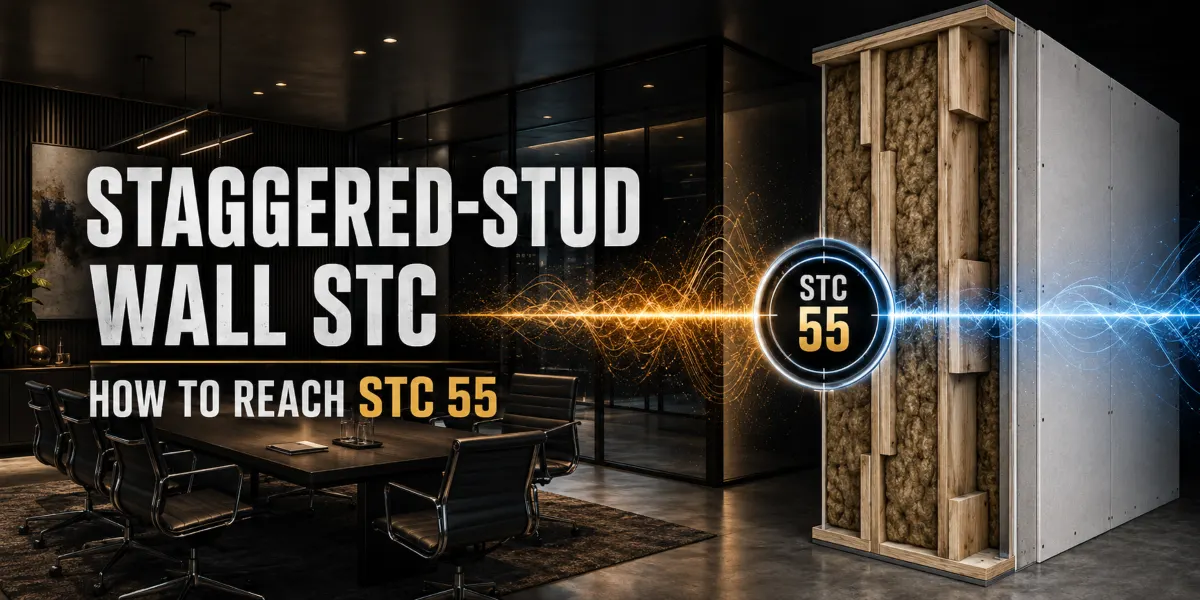
A staggered stud wall alternates studs front and back along a single wide bottom plate. No stud touches both faces of the wall, so the drywall on one side never shares framing with the other. That partial decoupling is what lifts it well above a single-row wall without the depth of a true double-stud build.
The payoff is meaningful. A basic staggered wall with one layer of drywall per side sits near STC 48, where a single-stud wall of the same build lands in the low 40s. Add a second layer and a damping compound and a staggered wall clears STC 55.
What Drives a Staggered Wall’s STC
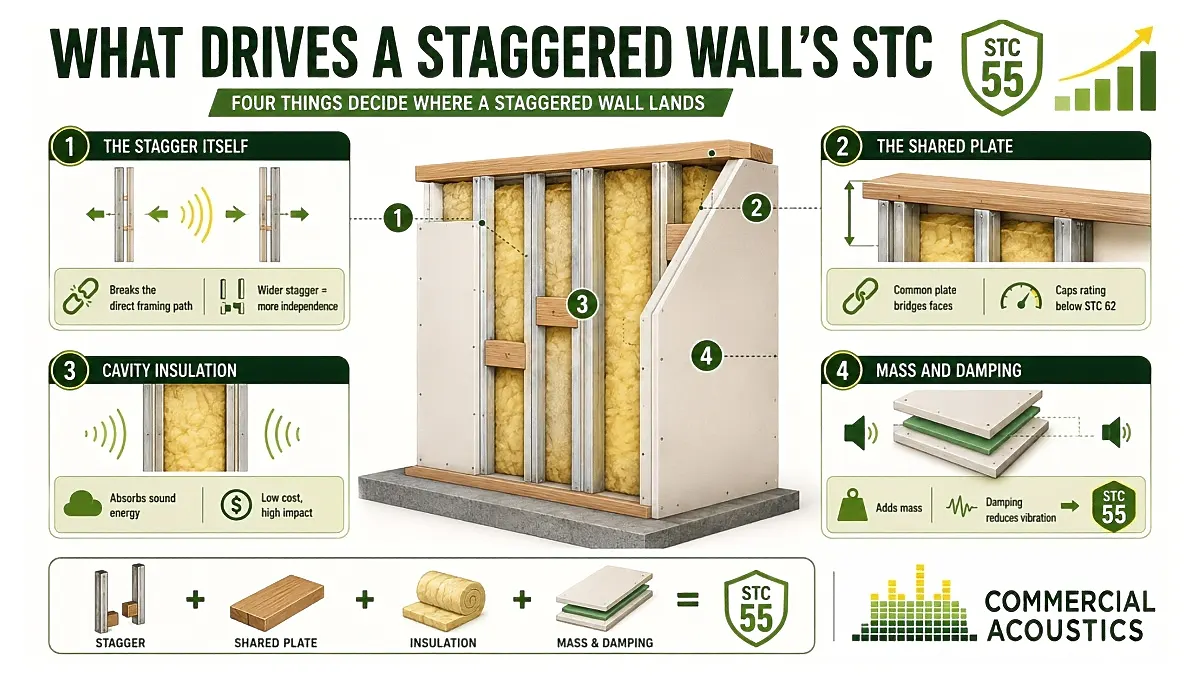
Four things decide where a staggered wall lands. The stagger hands you partial decoupling for free, so the rest comes from the plate, the cavity, and the mass you add to each face.
1. The Stagger Itself
Studs alternate so each one touches only one face of the wall. That breaks the direct framing path that drags down a single-row wall, and it does so on a single plate. The wider the stagger, the more independent the two faces become.
2. The Shared Plate
Both rows of studs sit on one common bottom and top plate, usually a 2×6. That plate is the catch. It still bridges the two faces, so a staggered wall cannot fully decouple the way a double-stud wall does. The shared plate is what caps the rating below STC 62.
3. Cavity Insulation
Fiberglass or mineral wool batt woven through the staggered studs absorbs the energy bouncing inside the wall. It fills the deeper cavity that the stagger creates, and it is one of the cheapest points on the build. Leaving it out wastes the framing you already paid for.
4. Mass and Damping
A base staggered wall sits near STC 48, so mass is how you reach 55. Add a second layer of 5/8-inch drywall per side and a damping compound between the layers. Together they carry the wall from the high 40s into the mid and upper 50s.
Staggered Builds and Their STC
These are typical lab STC ranges for staggered wood framing. Field numbers move with workmanship and flanking, so treat them as targets rather than guarantees. The damping layer is what reliably clears the STC 55 mark.
| Build | STC Range | Notes |
|---|---|---|
| Base staggered, one layer 5/8" each side, batt | ~STC 48 |
Studs alternate, plate still bridges |
| Add a second drywall layer each side | STC 52-54 |
Mass on each face |
| Add damping compound between layers | STC 55-57 |
Clears the STC 55 target |
| Deeper plate with a wider stagger | Up to 62 |
Top of the staggered range |
Single-Stud vs Staggered vs Double-Stud
Staggered sits in the middle of the stud-wall ladder. It beats a single row by a wide margin and undercuts the depth of a double-stud wall. If you need to climb past STC 60, step up to a double-stud wall and the air gap that comes with it.
| Wall Type | STC Range | Best For |
|---|---|---|
| Single-stud | STC 45-55 |
Retrofits and tight wall cavities |
| Staggered-stud | STC 48-62 |
Real isolation on a single plate |
| Double-stud | STC 56-69 |
Maximum isolation, theaters, demising walls |
Three Common Mistakes That Cap Your STC
1. Expecting Double-Stud Numbers
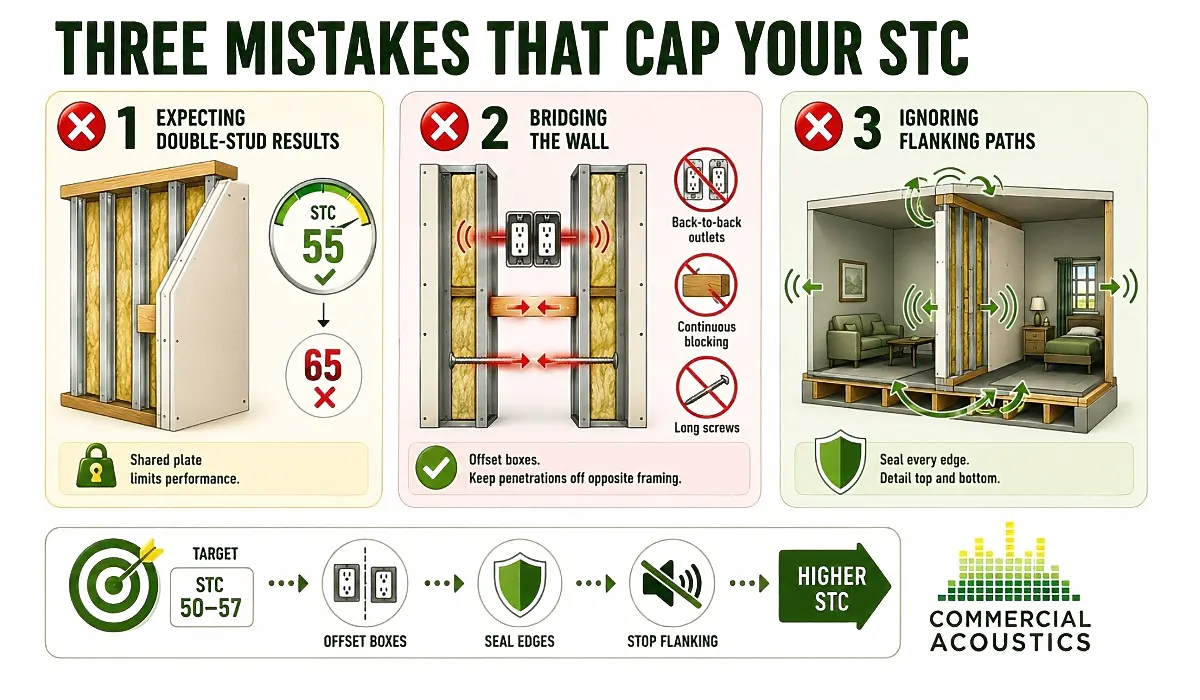
The shared plate is a hard ceiling. A staggered wall will not reach the STC 65 to 69 of a true double-stud build, no matter how much drywall you add. Spec it for STC 50 to 57 and use a double-stud wall when the target runs higher.
2. Bridging the Two Faces
The stagger only helps if nothing solid reconnects the faces. Back-to-back electrical boxes, continuous blocking, or a deep fastener that catches both rows all short the wall. Offset the boxes and keep penetrations off the opposite framing.
3. Ignoring Flanking Paths
A staggered wall only blocks what passes straight through it. Sound flanks around it through the floor, the ceiling, and the structure at the edges. Seal the perimeter and detail the top and bottom, or the field number lands well under the lab rating.
Is a Staggered Wall Worth It?
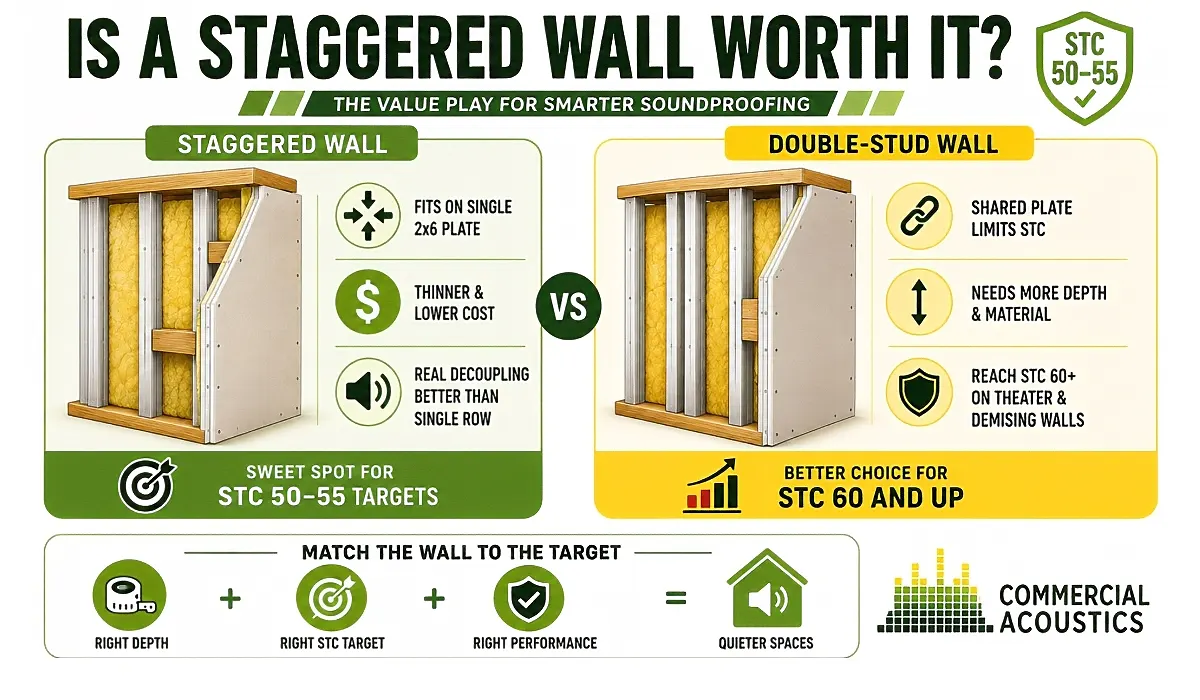
A staggered wall is the value play. It fits on a single 2×6 plate, so it is thinner and cheaper than a double-stud wall while delivering real decoupling a single row cannot touch. For an STC 50 to 55 target, it is often the sweet spot. For a builder-side view of how this assembly goes together on real jobsites, Fine Homebuilding has a thorough Building Soundproof Walls project guide.
Where it falls short is the top end. The shared plate keeps it under double-stud numbers, so for STC 60 and up on a theater or demising wall, the extra depth of a double-stud wall earns its keep. Match the wall to the target, not the other way around.
How to Verify a Wall’s STC
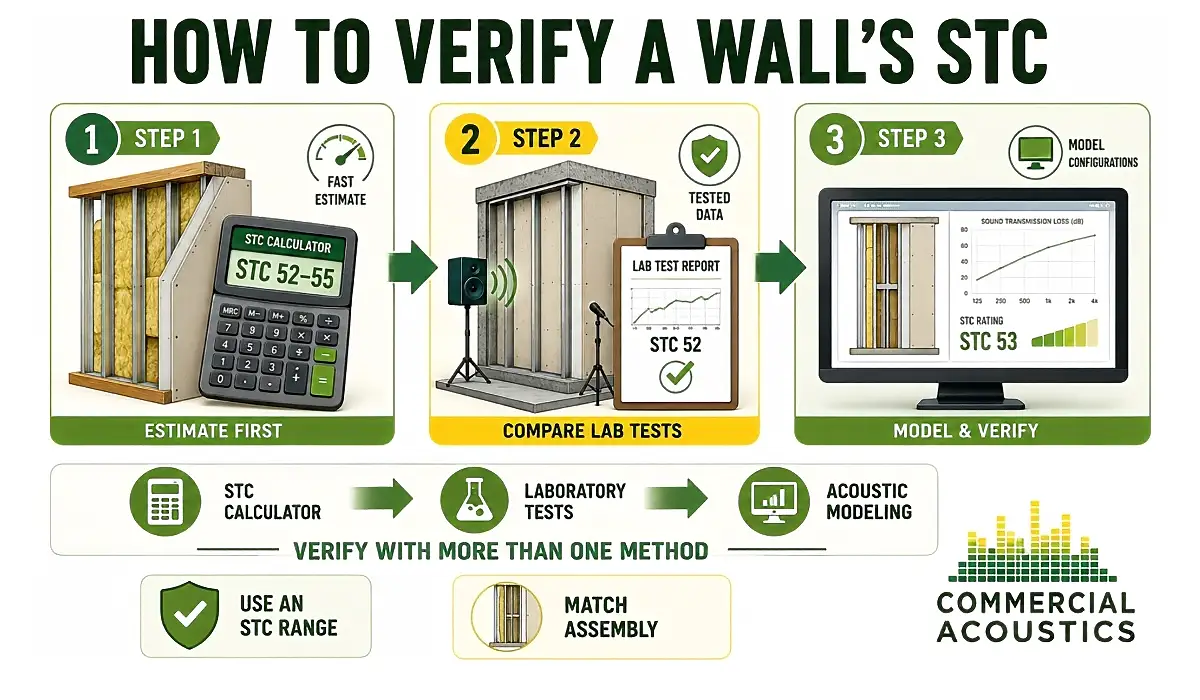
No prediction is exact, so list an STC range on the wall schedule and confirm it more than one way. An STC calculator gives a fast estimate from the build, and it shows how the stagger and the extra layers move the number.
Cross-check against tested assemblies before you commit. Our STC lab test data covers staggered builds, and modeling software like INSUL fills the gaps for configurations with no close match.
For the full set of variables behind any wall rating, start with our wall assembly STC breakdown and work back to the assembly that fits your depth and budget.
Isolation Without the Footprint
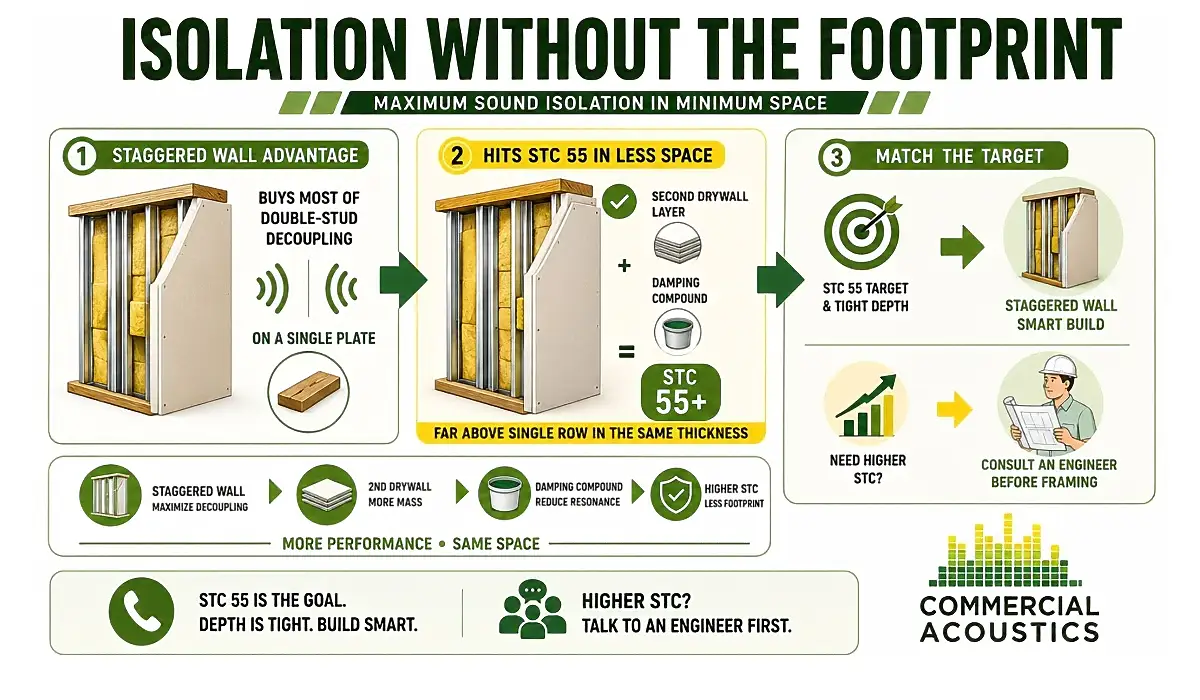
A staggered wall buys most of a double-stud wall’s decoupling on a single plate. That is why it clears STC 55 with a second drywall layer and a damping compound, far above what a single row can reach in the same thickness.
The shared plate is the ceiling. When STC 55 is the target and depth is tight, staggered is the smart build. When the number has to go higher, it is worth a short call with an engineer who details these assemblies before the framing goes up.
FAQs: Staggered Stud Wall STC
How much STC does a staggered stud wall add?
A base staggered wall reaches about STC 48 with one layer of drywall per side, and a second layer with a damping compound clears STC 55. The top of the range is near STC 62 before the shared plate caps it.
Can a staggered stud wall reach STC 55?
Yes. Start from a base near STC 48, add a second layer of 5/8-inch drywall per side, and place a damping compound between the layers. That combination reliably brings a staggered wall to STC 55.
Is a staggered wall better than a double-stud wall?
No, not for raw isolation. The shared bottom plate bridges the two faces, so staggered tops out near STC 62 while a double-stud wall reaches 69. Staggered wins on thickness and cost, not peak performance.
How thick is a staggered stud wall?
About 6 to 7 inches. Staggered 2×4 studs sit on a single 2×6 plate, so with one layer of drywall each side the finished wall lands near 6.75 inches of total depth.
What is the difference between staggered and double-stud walls?
Staggered studs alternate on one shared plate for partial decoupling. A double-stud wall uses two fully separate plates and an air gap for complete decoupling, which is why it reaches a higher STC.

Walker Peek|Founder & CEO, Commercial Acoustics
Walker founded Commercial Acoustics in 2013 to bring aerospace-grade engineering discipline to soundproofing, and runs the firm as CEO from its 12,000 sq ft Tampa production facility. The company designs custom acoustic panels, sound membranes, and masking systems for multi-family, hospitality, healthcare, and commercial projects across the US — built around Walker’s invention, Wall Blokker, an EVA-based sound barrier that hits STC 50-plus at roughly $1 per square foot installed.
A Jacksonville native, Walker spent five years at Kennedy Space Center with Craig Technologies before founding Commercial Acoustics — certifying aerospace manufacturing to the AS9100 standard and leading Six Sigma Black Belt process-improvement teams on NASA programs. He is a certified Industrial Noise Control Engineer and the author of Architectural Acoustics: A Practical Handbook.
