
Table of Contents
Why Sound Masking Design Matters
Sound masking isn’t just about dropping in a few speakers—it’s about building a consistent noise floor that improves speech privacy & focus. Poor design creates “hot spots,” uneven coverage, and wasted budget. Done right, a masking system makes conversations fade into the background so teams can work without distraction.
The right outcome depends on three levers: the masking type (direct vs. diffuse), speaker layout/spacing, and smart zoning. Architects & contractors who dial in these variables get predictable results across open offices, private suites, healthcare, call centers, & multi-tenant buildings.
Types of Sound Masking
Direct vs. Diffuse Fields
- Direct field: Downward-firing speakers; fast installs but prone to “hot/cold” areas in large open plans.
- Diffuse field: Upward-firing to the deck; reflections deliver more uniform coverage across big rooms.
- Pick by use: Direct works in smaller, regular grids; diffuse shines in open plans & mixed heights.
Direct-field sound masking uses downward-firing speakers for quick installs, but it often creates uneven coverage in larger offices. Diffuse-field systems, which send sound upward to the deck before reflecting it down, deliver more consistent results. For smaller, uniform layouts direct works well, while diffuse fields are better for open offices or spaces with mixed ceiling heights.
Classic (Analog) vs. Digital (Networked)
- Analog: Stand-alone, field-tuned volume, great under ~10,000 sq ft, quick to deploy.
- Digital: CAT5/PoE with head-end control, easy reprogramming, paging/music/mass-notification integration.
- Budget note: Speakers are often cheaper on digital; the controller adds cost but pays off on large jobs.
A classic sound masking system is ideal for offices under 10,000 square feet because it’s simple, affordable, and field-tuned during setup. Digital sound masking, on the other hand, is built for larger projects — offering programmable zones, remote adjustments, and integration with paging or mass-notification systems. While digital carries a higher upfront cost, it delivers long-term flexibility and scalability.
Speaker Placement & Zoning
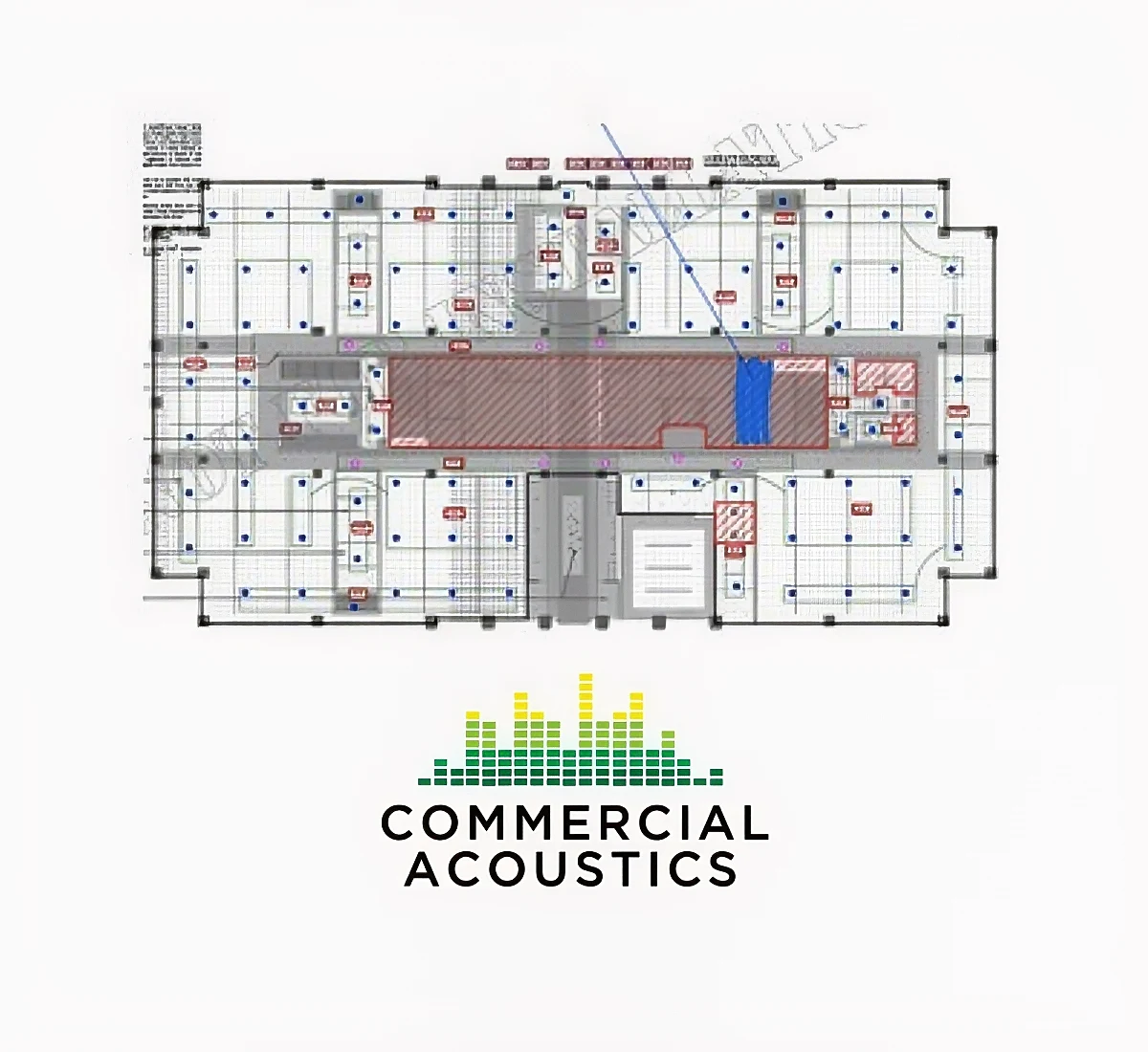
- Where they go: Typically in the plenum above ACT; decorative units for exposed ceilings & feature areas.
- Zoning: Separate open office from private offices, conference rooms, reception, & wellness areas.
- Schedules: Auto-adjust levels for peak office hours while keeping enclosed rooms steady.
Plenum installs keep hardware invisible while ACT diffuses sound evenly. Thoughtful sound masking system design and zoning let you run higher levels in noisy open areas & gentler levels where confidentiality matters most—like HR, legal, & healthcare admin suites.
Speaker Spacing (The Quick Math)
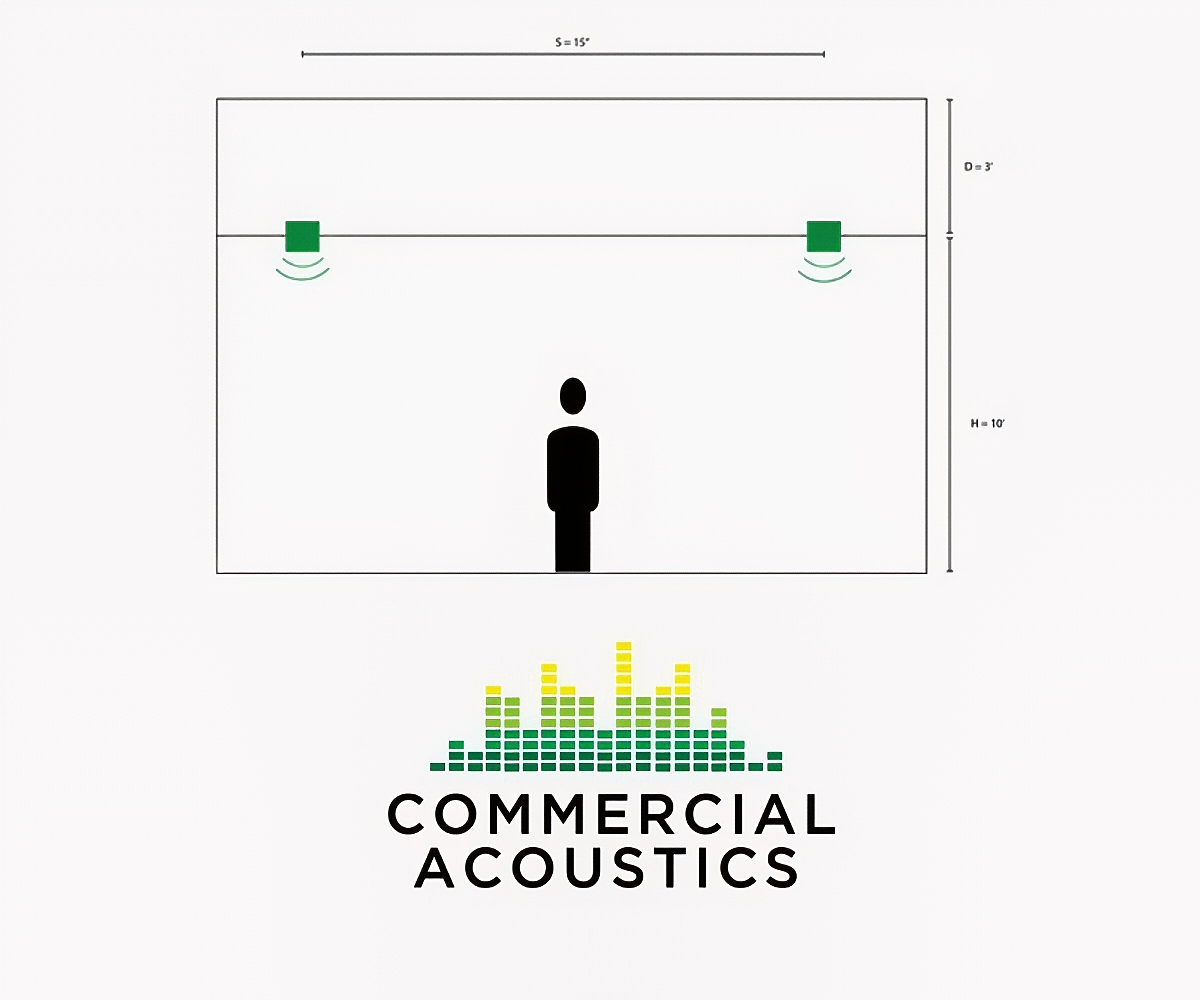
- Rule of thumb: S = 1.4 × (2D + H − 4), where S = on-center spacing (ft), D = plenum depth (ft), H = ceiling height (ft).
- Typical result: Most offices land near 15–16 ft on-center, ~225 sq ft per speaker.
- Edge offsets: ~7–8 ft from walls; adjust around beams, soffits, & irregular bays.
If budgets are tight, spacing can stretch toward 1.7 × (2D + H − 4), but uniformity drops. In spaces with spray foam on the deck or heavy cross-members, shift back toward tighter spacing for smoother coverage.
Good sound masking system design keeps spacing consistent and tuning balanced. Small layout shifts can create uneven coverage, so align speakers precisely and zone by use — open areas, corridors, and private suites — for smooth, uniform sound.

Applications & Benefits
- Open offices: Cuts distraction & improves task focus.
- Healthcare: Supports speech privacy at nurse stations & check-in.
- Multi-tenant: Reduces cross-suite audibility & complaint calls.
Masking isn’t just an office play. It’s now a standard layer in HIPAA-sensitive areas, law & finance suites, call centers, & civic buildings—anywhere speech privacy & productivity matter.
Effective sound masking system design tailors coverage to each environment—denser layouts in open offices, lighter zones in private suites, and fine-tuned levels for healthcare and government settings where compliance and confidentiality are critical.
Example Layouts by Office Size (With Numbers)
Small Office (7,500 sq ft)
- Assumptions: H = 9 ft, D = 3 ft → S ≈ 1.4 × (2×3 + 9 − 4) = 1.4 × 11 = 15.4 ft.
- Speakers: ~7,500 ÷ 225 ≈ 33 units (round to 34–36 for edges & odd bays).
- Zoning: 2–3 zones (open office, private offices, conference).
- System: Classic/analog is cost-effective here.
Analog keeps hardware simple & labor light. Use closer spacing near reception or glass-heavy areas to avoid level dips. Wall offset ~7–8 ft keeps perimeter coverage smooth.
Good sound masking system design keeps analog layouts efficient—consistent spacing, clean zoning, and predictable coverage. Even in simple systems, small tweaks around glass lines, hard surfaces, or ceiling breaks make a big difference in how evenly the sound field performs.
Medium Office (25,000 sq ft)
- Assumptions: H = 10 ft, D = 3 ft → S ≈ 1.4 × (6 + 10 − 4) = 1.4 × 12 = 16.8 ft.
- Speakers: ~25,000 ÷ 225 ≈ 111 units (plan 115–125 with edges & corridors).
- Zoning: 6–10 zones (open areas by department, training, reception, huddle rooms).
- System: Digital/networked for easy tuning & future moves.
Networked control speeds commissioning & reconfiguration. Use presets for occupied/unoccupied schedules & slightly lower levels in enclosed offices to keep the noise floor comfortable.
Large Office / Campus (120,000 sq ft)
- Assumptions: H = 12 ft, D = 4 ft → S ≈ 1.4 × (8 + 12 − 4) = 1.4 × 16 = 22.4 ft (cap practical spacing to ~16 ft for uniformity).
- Speakers: ~120,000 ÷ 225 ≈ 533 units (plan 560–600 total with edge factors & special rooms).
- Zoning: 12–20+ zones across floors/wings with paging & emergency integration.
- System: Digital/IP with head-end, PoE, & BMS integration.
Keep on-center spacing near 15–16 ft even if the formula yields higher numbers; large floors benefit from tighter grids. Leverage presets for departments with different noise profiles (sales vs. engineering) & coordinate with paging/mass notification.
Common Design Mistakes to Avoid
- Over-spacing: Pushing beyond ~16 ft O.C. produces uneven coverage & complaint calls.
- No zoning: One level for the whole floor forces open office levels onto quiet rooms.
- Set-and-forget: Skipping commissioning & seasonal retuning leads to drift over time.
Great hardware can still flop with poor layout, missing zones, or no commissioning plan. A short post-occupancy tuning visit usually locks in performance for the long haul.
According to the International Facility Management Association (IFMA), maintaining consistent background sound levels is essential for speech privacy and occupant comfort. IFMA’s data shows that open offices typically perform best around 35–40 dB NC, while private offices fall closer to 30–35 dB NC—supporting the need for proper zoning and post-commissioning adjustments in any sound masking system design.
How to Get Your Sound Masking System Designed
At Commercial Acoustics, our engineers develop sound masking layouts that balance coverage, cost, and comfort—complete with speaker counts, zoning recommendations, and stamped design documents. By starting with a professional design, architects and contractors avoid costly mistakes and deliver predictable results for their clients.
Request a Sound Masking System Design—get predictable speech privacy, fewer distractions, & a smooth install for your next project.
FAQs: Sound Masking System Design
What’s the main goal of a sound masking system?
To create a consistent background noise that reduces distractions and improves speech privacy. Proper design keeps volume even throughout the space so conversations fade naturally instead of standing out.
How do I know whether to use direct or diffuse sound masking?
Direct-field systems work best in smaller offices or spaces with uniform ceilings. Diffuse-field systems shine in large or open-plan areas, reflecting sound off the deck for smoother coverage across varied ceiling heights.
When should I choose a digital sound masking system design over analog?
Analog is ideal for smaller offices under about 10,000 sq ft—it’s simple and cost-effective. Digital systems make more sense for large or multi-floor projects since they allow zone control, remote adjustments, and easy reconfiguration.
How far apart should sound masking speakers be placed?
Most offices perform best with roughly 15–16 feet between speakers, about 225 sq ft per unit. Tighten spacing near glass walls or reception zones to avoid uneven coverage and level dips.
Can sound masking be added after construction?
Yes. Sound masking is one of the easiest acoustic systems to retrofit since speakers sit above the ceiling grid or on decorative mounts. The key is to plan zones and cable paths early to minimize installation labor later.
