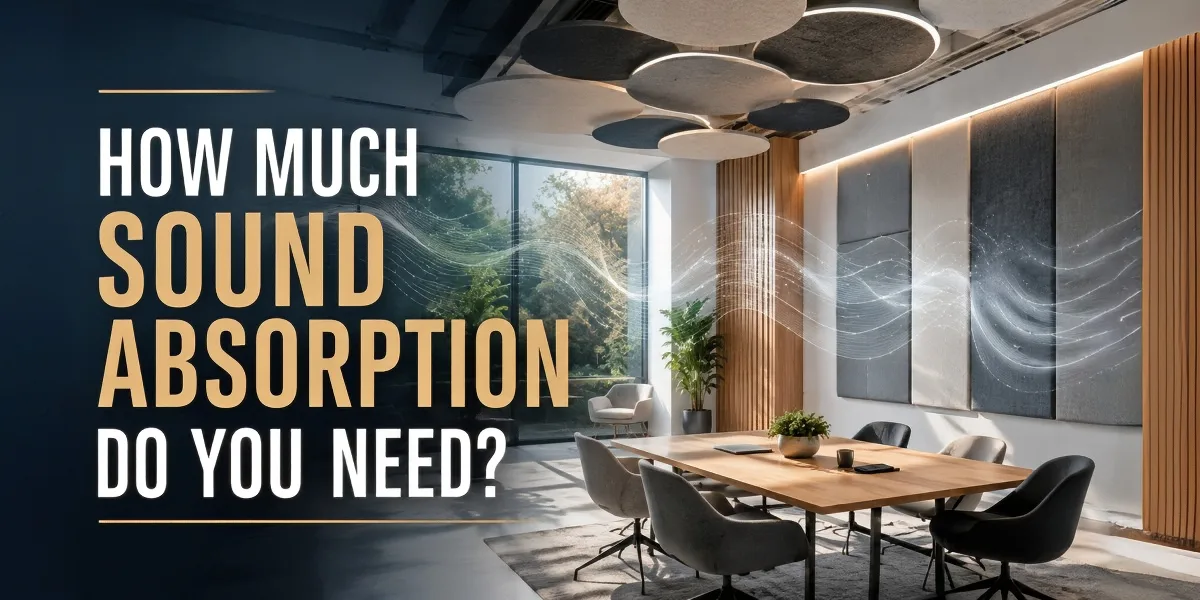
How Much Sound Absorption Do You Need?

Acoustic panels providing sound absorption coverage in a commercial room

Quick Overview

  • Sabine formula: RT60 = 0.049 × V / A (imperial), where V is room volume in cubic feet and A is total absorption in sabins.
  • Sabins: The absorption a surface provides equals its area times its NRC. Sum across every surface to get A.
  • Target RT60: 0.4–0.6 s for offices and classrooms, 0.5–0.8 s for restaurants and multipurpose rooms, 0.8–1.2 s for worship and lecture halls.
  • Coverage rule of thumb: Plan for 25–35% of total wall and ceiling area in NRC 0.85+ material to hit speech-room targets.

The Sabine Formula at a Glance

  • Imperial form: RT60 = 0.049 × V / A
  • Metric form: RT60 = 0.161 × V / A
  • V: Room volume in cubic feet (or cubic meters)
  • A: Total absorption in sabins, calculated as Σ (surface area × NRC) for every surface in the room

The Sabine formula is the workhorse equation for room acoustics. It predicts how long sound takes to decay 60 dB after the source stops, which is what occupants feel as the “echoiness” of a room. The formula is a simplification, but it is accurate enough for sizing acoustic treatment on standard commercial work.

The math runs both ways. Plug in a room and get its existing RT60. Plug in a target RT60 and back-solve for how many sabins of additional absorption you need. The room acoustics calculator automates both directions against your specific room dimensions and surface finishes.

Sabine formula equation RT60 equals 0.049 times volume divided by absorption
Sabine formula: RT60 = 0.049 x V / A

The Four Drivers of Room Reverb

  • Room volume: Bigger rooms have longer reverb. Cube the dimensions and you cube the decay path.
  • Surface material: Hard finishes (drywall, concrete, glass) reflect almost everything. Soft finishes (carpet, panels, fabric) absorb.
  • Surface area: A 20-ft tall room has 4× the wall area of an 8-ft room with the same floor plan. More wall area means more reflection paths.
  • Geometry: Parallel hard walls generate flutter echo and standing waves. A cube of painted drywall is the textbook worst case.

These four drivers compound. A large room with hard finishes and parallel walls reverberates far more than a smaller room with the same NRC profile but better geometry. That is why a yoga studio in a converted warehouse sounds harsh while a similarly sized carpeted conference room sounds fine.

Adding furniture, carpet, and acoustic ceiling tile knocks down a meaningful share of the reflection energy before any dedicated treatment goes in. Most office and hospitality rooms are halfway to their RT60 target just from the build-out.

NRC: How Materials Stack Up

MaterialTypical NRC% Absorbed
Painted drywall0.05–0.105–10%
Painted concrete0.05–0.105–10%
Glass (plate)0.05–0.185–18%
Carpet on pad0.30–0.6030–60%
Acoustic ceiling tile (standard)0.45–0.7045–70%
Acoustic ceiling tile (high-CAC)0.70–0.9070–90%
Fabric-wrapped acoustic panel0.85–1.0085–100%
Heavy drape0.35–0.6535–65%
Table 1: Typical NRC values by common surface material

NRC (Noise Reduction Coefficient) is the average absorption coefficient across the 250–2000 Hz band. An NRC of 0.85 means the surface absorbs 85% of incident speech-range energy and reflects 15%. Higher is better for absorption.

For a deeper view of how NRC varies across the full frequency band (not just the headline number), the sound absorption coefficient chart shows the 125–4000 Hz octave-band values that drive real performance.

The Absorbs-Water Rule of Thumb

  • Absorbs water → absorbs sound. Carpet, fabric, foam, mineral wool all let water soak in. They also let sound energy soak in.
  • Repels water → reflects sound. Glass, polished concrete, steel, tile, painted drywall. Anything that beads water reflects sound.
  • The rule fails on: Closed-cell foam (sealed, doesn’t absorb water but does damp some frequencies), and perforated metal (reflective but acoustically transparent in front of fibrous backing).

This is not a formal acoustic principle. It is a useful shortcut for walking a space and predicting acoustic behavior before any measurement. If your eye says the finish would soak up a spilled coffee, the math will probably back you up on absorption.

Sabine Math in Action: An Untreated Yoga Studio

  • Room: 20 ft × 20 ft × 16 ft tall
  • Walls and ceiling: Painted drywall (NRC 0.10)
  • Floor: Painted concrete (NRC 0.10)
  • Target RT60: 0.5 s (speech-driven yoga class)
  • Complaint: Instructor cannot be heard clearly
Yoga studio worked example using the Sabine formula for sound absorption sizing
Yoga studio worked example using Sabine formula

Step 1 — Get the Room Volume

V = 20 × 20 × 16 = 6,400 cubic feet.

Length times width times height. That’s the cubic volume of the space.

Step 2 — Calculate Surface Areas

  • Floor: 20 × 20 = 400 sq ft
  • Ceiling: 20 × 20 = 400 sq ft
  • Walls: 4 × (20 × 16) = 1,280 sq ft
  • Total interior surface: 2,080 sq ft

Step 3 — Convert Each Surface to Sabins

  • Floor: 400 × 0.10 = 40 sabins
  • Ceiling: 400 × 0.10 = 40 sabins
  • Walls: 1,280 × 0.10 = 128 sabins
  • Total absorption A: 208 sabins

Every surface contributes (area × NRC) sabins. With nothing in the room but painted hard finishes, the total absorption is tiny.

Step 4 — Apply the Sabine Formula

RT60 = 0.049 × 6,400 / 208 = 1.51 seconds.

That’s roughly 3× the 0.5 s target for a speech-driven yoga class. The math confirms exactly why the instructor can’t be heard.

Step 5 — Back-Solve for Treatment

  • Target absorption: A = 0.049 × 6,400 / 0.5 = 627 sabins
  • Existing absorption: 208 sabins
  • Treatment needed: +419 sabins
  • At NRC 0.90: roughly 465 sq ft of acoustic panel and ceiling cloud coverage

465 sq ft of NRC 0.90 product drops this room from 1.51 s to the 0.5 s target. For how to split that coverage between walls and ceiling on a real layout, the companion post on how many acoustic panels you actually need works through panel placement.

RT60 Targets by Room Type

Room TypeRT60 Target (s)Why
Recording studio (live room)0.2–0.4Tight control, low coloration
Office, classroom, conference room0.4–0.6Speech intelligibility first
Restaurant, lobby, retail0.5–0.8Lively but conversational
Multipurpose hall, gym, yoga studio0.6–1.0Mixed-use, voice + activity
Worship, lecture hall (amplified)0.8–1.2Warm but intelligible
Concert hall, symphony1.6–2.2Musical bloom and decay
Table 2: RT60 ranges by room program type

The right RT60 depends on what happens in the room, not on its size. A 5,000-cubic-foot conference room and a 5,000-cubic-foot worship space need different sabin counts because they need different decay times.

How to Tell If You Have Enough Coverage

  • Clap test: A sharp clap should die in roughly your target RT60. Anything that lingers past a second in a small room means undersized treatment.
  • Smartphone RT60 apps: Free or low-cost apps (Studio Six SPL, Reverb) deliver ~0.1 s accuracy. Good enough to verify a treatment hit its design target.
  • Coverage benchmark: If treated wall + ceiling area is below 20% of total surface, the room will not perceive a change. Push to 25–35% for general spaces.

Measure before and after. The most common rework on undersized treatments is a second round of panels six months later because the first round looked nice in renderings but never moved the needle. Sabine math up front prevents that loop.

When the Simple Formula Falls Short

  • Very absorptive rooms: Sabine over-predicts decay when average absorption climbs above ~0.30. Use the Eyring formula for studios and listening rooms.
  • Strongly non-uniform absorption: If all the absorption sits on one face (e.g., ceiling tile only), Sabine assumes diffuse decay and over-states the result.
  • Low-frequency rumble: Sabine ignores the <250 Hz region where bass traps and room modes dominate. Bass-heavy rooms need explicit low-frequency treatment.
  • Coupled volumes: Atrium openings to adjacent spaces, balconies, and unsealed door openings all complicate the math beyond a single-room equation.

For 90% of commercial work, the Sabine formula is the right tool. Studios, theaters, and worship spaces with critical acoustic goals need ray-tracing or measurement-based models. That work is what acoustical consulting exists for.

Pulling It Together

The Sabine formula reduces a complicated reverb problem to a single equation. Pick a target RT60, plug in your room dimensions, sum the sabins from every surface, and back-solve for how many sabins of treatment to add.

The math is the easy part. The judgment call is selecting the right RT60 for the room program, choosing absorption materials whose NRC matches the frequency range that matters, and placing the treatment where it earns its sabins. Get those three right and the room measures within design intent on the first pass.

Need a Custom Coverage Calc?

If you have a room that is not landing acoustically and want a real Sabine workup against an RT60 target, send us a floor plan and surface finish list. We will return sabin counts by face, a coverage recommendation, and a product mix. Start a project conversation and we will turn it around.

FAQs: Sound Absorption Sizing

What is the Sabine formula?

RT60 = 0.049 × V / A in imperial units (or 0.161 × V / A in metric). V is room volume, A is total absorption in sabins. It predicts reverberation time.

How is NRC calculated?

NRC is the average of a material’s absorption coefficient at 250, 500, 1000, and 2000 Hz, rounded to the nearest 0.05. It is one number summarizing speech-range absorption.

How much wall coverage do I need?

Plan for 25–35% of wall and ceiling surface area in NRC 0.85+ material for general commercial rooms. Studios and critical-listening rooms run 40–50%+.

What is a sabin?

A sabin is the absorption of one square foot of a perfectly absorptive surface (NRC 1.00). Real-world sabins per surface equal area times NRC.

Does furniture count toward absorption?

Yes. Upholstered seats, drapes, and people themselves all add sabins. For most commercial rooms, occupied conditions improve RT60 by 10–25%.