
Table of Contents
Project Overview: Soundproofing for Developers
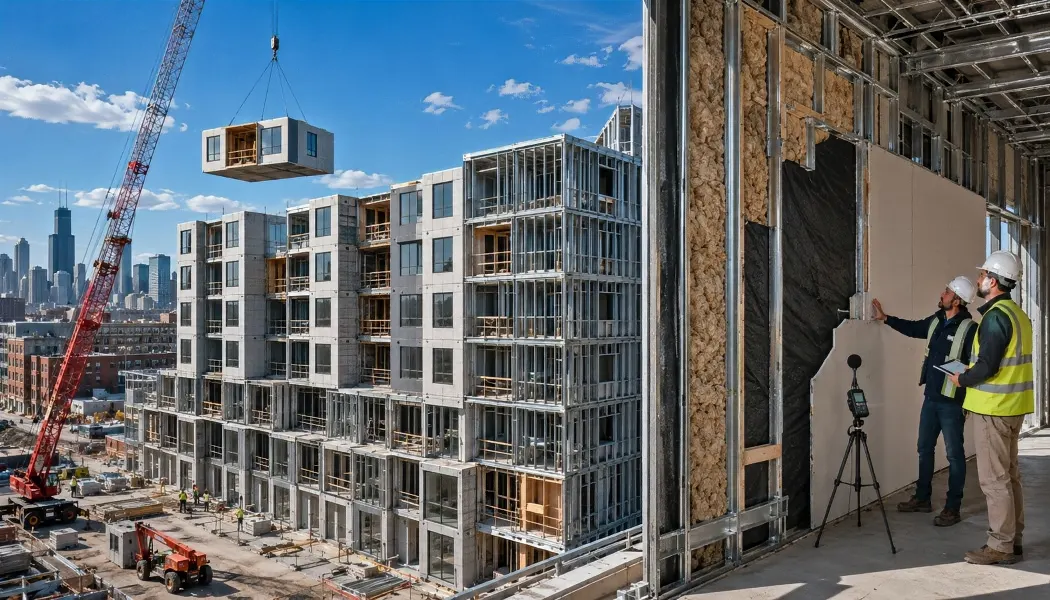
- Project: Pre-Construction STC Lab Testing for a Modular Multi-Family Developer
- Client: ULI-Awarded Developer in Chicago, IL
- Construction Type: Panelized Light Gauge Steel Framing for Five- to Thirteen-Story Buildings
- Question: What Happens to STC When You Switch From Wood Stud to Light Gauge Steel?
- Test Scope: 8 Wall Assemblies 12, 14, 16, and 18 Gauge Studs, With and Without Wall Blokker Pro
- Outcome: Wall Blokker Pro Delivered a Plus 5 STC Delta Across Every Gauge Tested
Why Modular Construction Hits a STC Problem
Modular construction is reshaping mid-rise multi-family. Panelized light gauge steel framing assembled off-site cuts schedule, reduces on-site labor, and limits weather exposure during the build. The Chicago developer behind this project was running the math on a switch to panelized framing for a series of five- to thirteen-story developments and the cost case looked strong.
The acoustic case was the open question. Light gauge steel studs do not behave like the dimensional lumber wood studs the entire residential acoustic codebase was developed around. Switching the stud material is not free. The same wall geometry, same drywall layers, same insulation, and same fasteners can deliver different STC depending on what is between the two faces of drywall.
Developers running this calculation cannot afford to find out post-occupancy that the new construction technique misses IBC 1207.1 acoustic minimums. The fix is to lab-test the assembly options before committing the construction technique. The general framing on what STC measures and why field results often trail lab numbers lives in our common wall STC values reference.
Light Gauge Stud STC: The Counterintuitive Math
- Intuition: Thicker Stud Equals Stronger Wall Equals Better Soundproofing
- Reality: Thicker Stud Equals Stiffer Wall Equals Worse Soundproofing
- Mechanism: Stiffer Studs Don’t Flex, So They Couple Both Faces Together Acoustically
- Magnitude: 3 to 10 STC Points Lost When Moving to Heavier Gauge or Closer Spacing
This is the surprise that catches developers mid-switch. Heavier gauges (lower numbers 12 ga is thicker than 18 ga) produce stiffer walls. Stiffer walls do not flex enough to dampen sound at the frequencies that matter for speech privacy. The result is that a 12 gauge wall can test several STC points lower than the same wall built with 18 gauge studs.
Closer stud spacing makes the same problem worse. A 6-inch stud at 24-inch on center is more flexible than the same stud at 16-inch on center. Tighter spacing increases the structural rigidity, which couples the two drywall faces together more efficiently, which lowers STC.
Modular framing systems often spec heavier gauges and closer spacing because the panels are handled and shipped off-site. The structural case for those choices is real. The acoustic case is the trade-off the developer has to manage. The deeper background on building codes and acoustic minimums lives in our building codes acoustics guide.
The 8-Wall Lab Test Setup
- Studs: 6-Inch Light Gauge Steel at 24-Inch On Center
- Drywall: Two Layers of 5/8-Inch Gypsum, Both Faces
- Variables: 12 ga, 14 ga, 16 ga, and 18 ga Studs
- Treatment: One Layer of Wall Blokker Pro Membrane, With and Without
- Tests: Eight Total Assemblies, Each Tested in a Calibrated STC Lab Chamber
The point of running eight tests instead of two was to isolate the gauge variable from the membrane variable. Testing 12 ga with and without Wall Blokker, then 14 ga with and without, then 16 ga with and without, then 18 ga with and without, gives a clean comparison of how the membrane performs across stud thicknesses.
Lab testing is the only way to get this answer reliably. Field tests pick up flanking, penetrations, and assembly variability that obscure the contribution of any single layer. A controlled chamber test isolates the wall assembly itself.
Test Results: Wall Blokker Pro Plus 5 STC Across All Gauges
The headline finding was the consistency. Wall Blokker Pro added approximately 5 STC points to every assembly tested, regardless of stud gauge. The base wall (no membrane) varied across gauges as expected heavier gauges tested lower than lighter gauges but the delta from adding the membrane stayed essentially constant.
That predictability is what a developer running pre-construction acoustic spec actually needs. Knowing the membrane adds plus 5 across the gauge range means the gauge selection can be driven by the structural and panelization requirements without forcing a separate acoustic redesign for each gauge variant.
The product page with full spec data and a deeper assembly library lives at the Wall Blokker Pro mass-loaded membrane page.
For a sister project that ran the same Wall Blokker Pro overlay logic on residential adaptive reuse demising walls instead of pre-construction modular testing, see the adaptive reuse apartment soundproofing case study.
Light Gauge Stud STC Targets by Building Type
Different building types pull modular construction toward different STC floors. Multi-family is held to IBC 1207.1 minimums. Hotels run higher because brand standards exceed code. Dormitories sit between. Office build-outs target lower numbers because the noise budget is different. The table below maps the working windows.
| Building Type | Lab STC Target | Why That Floor | Modular Implications |
|---|---|---|---|
| Multi-Family Mid-Rise (5-13 Story) | STC 50 | IBC 1207.1 residential code minimum | Add membrane to offset gauge-driven STC loss |
| Hotel (Brand Standard) | STC 55+ | Brand acoustic spec exceeds code | Membrane plus thicker drywall or resilient channel |
| Dormitory / Student Housing | STC 50 to 53 | Code minimum plus complaint margin | Membrane on every demising line |
| Modular Office Build-Out | STC 40 to 45 | Conference and tenant separation | Membrane optional, drywall mass often sufficient |
The Chicago developer landed in the top row at IBC 1207.1 multi-family minimum. The plus 5 STC contribution from Wall Blokker Pro across every gauge gave the developer a consistent acoustic budget to plug into the panelized assembly spec regardless of which gauge the structural team selected.
Conclusion: Soundproofing for Developers
Soundproofing for developers running modular construction is a pre-construction problem, not a post-occupancy problem. Lab-testing the wall assemblies before the panel order locks in the STC budget, isolates the gauge variable from the membrane variable, and gives the structural team room to optimize panel spec without breaking acoustic code. More on the team behind soundproofing for developers for ownership groups scoping similar pre-construction acoustic work.
FAQs: Soundproofing for Developers
Why does light gauge steel framing affect STC differently than wood?
Light gauge steel studs are stiffer than dimensional lumber. Stiffer studs couple the two drywall faces together acoustically, which reduces the wall’s ability to dampen sound at speech-privacy frequencies. The same drywall and insulation can deliver lower STC on steel than on wood.
Does heavier gauge steel improve or hurt STC?
Hurts. A 12 gauge stud is thicker and stiffer than a 16 or 18 gauge stud, which couples the wall faces together more efficiently and lowers STC by 3 to 10 points. The structural case for heavier gauge is real, but the acoustic trade-off has to be managed.
What does Wall Blokker Pro add to a modular wall assembly?
Approximately plus 5 STC points across every stud gauge tested in this case study (12, 14, 16, 18 ga). The mass-loaded membrane adds barrier mass between the drywall layers, which offsets the rigidity-driven STC loss from the heavier steel framing.
Should developers lab-test wall assemblies before construction?
Yes when switching construction technique. Modular framing systems use stud gauges and spacing that the residential acoustic codebase was not developed around. Lab testing isolates the variables and locks the STC budget before the panel order commits the assembly.

Walker Peek|Founder & CEO, Commercial Acoustics
Walker founded Commercial Acoustics in 2013 to bring aerospace-grade engineering discipline to soundproofing, and runs the firm as CEO from its 12,000 sq ft Tampa production facility. The company designs custom acoustic panels, sound membranes, and masking systems for multi-family, hospitality, healthcare, and commercial projects across the US — built around Walker’s invention, Wall Blokker, an EVA-based sound barrier that hits STC 50-plus at roughly $1 per square foot installed.
A Jacksonville native, Walker spent five years at Kennedy Space Center with Craig Technologies before founding Commercial Acoustics — certifying aerospace manufacturing to the AS9100 standard and leading Six Sigma Black Belt process-improvement teams on NASA programs. He is a certified Industrial Noise Control Engineer and the author of Architectural Acoustics: A Practical Handbook.
