Table of Contents
Project Overview: Clubhouse Acoustic Panel Treatment at Country Club of Ocala
- Project: Clubhouse Acoustic Panel Treatment for a Mid-Tier Country Club
- Location: 6823 SE 12th Cir, Ocala, FL 34480
- Facility Type: Country Club Clubhouse with Dining, Lounge, and Multipurpose Event Space
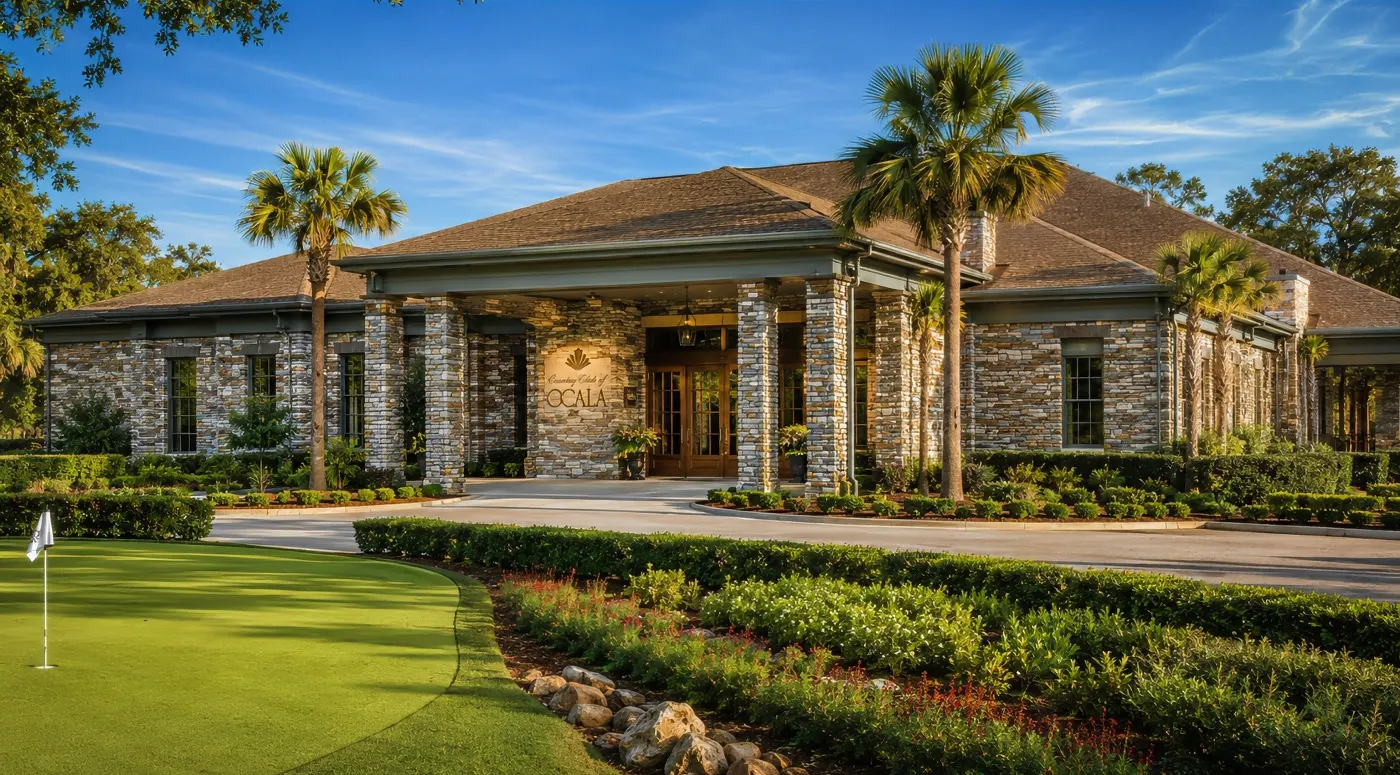
- Client: Country Club of Ocala
- Objective: Reduce Reverberation from 3.5 Seconds Down to the 2 Seconds
- Scope: Field RT60 measurement, acoustic modeling, install of 90 wall panels
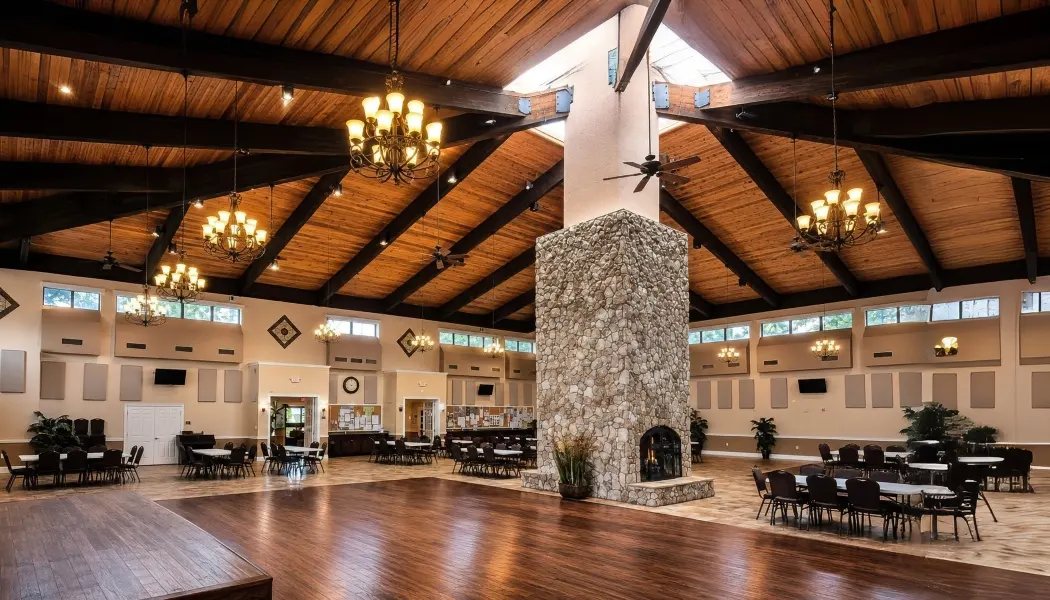
Country Club of Ocala called Commercial Acoustics in to fix a problem that almost every mid-tier clubhouse in Florida runs into within the first year of operation: a multipurpose great room that sounds great on paper and lousy in practice. Hard floors, gypsum walls, and a tall ceiling collected reflections instead of breaking them up, and members were starting to skip mixers and bingo because the room had become physically tiring to sit in.
The project was a post-construction acoustic retrofit, which is the easier half of clubhouse work. Reverb is one of the few acoustic problems that can be solved cleanly after the building is finished, without touching framing or finishes. For a comparable clubhouse in the same state, see our golf clubhouse acoustics upgrade at The Concession Golf Club in Bradenton, FL.
Acoustic Challenges in a Mid-Tier Country Club Clubhouse
- Measured Reverberation: 3.5 seconds RT60, roughly twice the target
- Reflective Finishes: Hard floor, gypsum walls, tall open ceiling, no soft goods
- Use Pattern: Mixers, Networking, Bingo, Speeches, Amplified Music
- Constraint: Operating clubhouse; treatment had to stay clean and not close the room
The reverberation time we measured in the great room was about 3.5 seconds, well above the 1.5–2 second range that most acoustic designers recommend for multipurpose rooms. At that level, speech intelligibility falls apart fast. Two members standing six feet apart at a mixer end up shouting because every word they say is competing with its own echo. Our deeper write-up on clubhouse acoustics covers the full range of finishes that drive this problem in country club construction.
Beyond the discomfort, the reverberation was bottlenecking the venue’s revenue mix. Country club great rooms earn their keep on bookings: weddings, member dinners, board meetings, holiday events. None of those work in a 3.5 second room, so the staff had been quietly pushing larger events to outdoor venues. Acoustic treatment was the bottleneck unlock. Our clubhouse soundproofing solutions page covers the full menu of treatments that apply here.
Solution: A Three-Step Acoustic Panel Treatment Process
Every clubhouse acoustic project we run uses the same three-step sequence. Skipping any of the three is the most common reason a clubhouse retrofit underperforms. Below is the playbook we ran at Country Club of Ocala.
Step 1: Measure or Model the Room to Quantify the Treatment Needed
You can quantify the problem two ways. The first is a field measurement using an impulse source like a popped balloon or a calibrated impulse generator, captured with a real-time analyzer. That is what we ran at Country Club of Ocala, and the result came back at 3.5 seconds RT60. The second is to model the room from drawings, which our room acoustics calculator handles using a Sabine calculation across each surface area and finish absorption coefficient.
Note: modeling is excellent for small to medium rooms with conventional geometry. For large clubhouse great rooms or rooms with vaulted ceilings and balconies, modeling alone tends to overestimate the absorption needed, and a field measurement is worth the trip.
Step 2: Pick the Acoustic Product That Fits the Room and the Aesthetic
Once Step 1 gives you a treatment quantity, the next decision is product. The standard menu is wall-mounted absorption, ceiling clouds, ceiling baffles, art-printed panels, or a full stretched-fabric wall system. For Country Club of Ocala the right answer was wall-mounted panels, and the math came out to roughly 90 panels to bring RT60 into the 1.5–2 second range. The base product line is documented on our acoustic absorption panel page.
Note: 2″ thick panels are the right default for country club rooms. They carry a higher overall NRC and, more importantly, hold their absorption coefficient down into the lower frequencies where amplified speech and music live. 1″ panels lose performance below 250 Hz, which is exactly where wedding bands and PA systems push the most energy.
Step 3: Install the Panels and Re-Measure
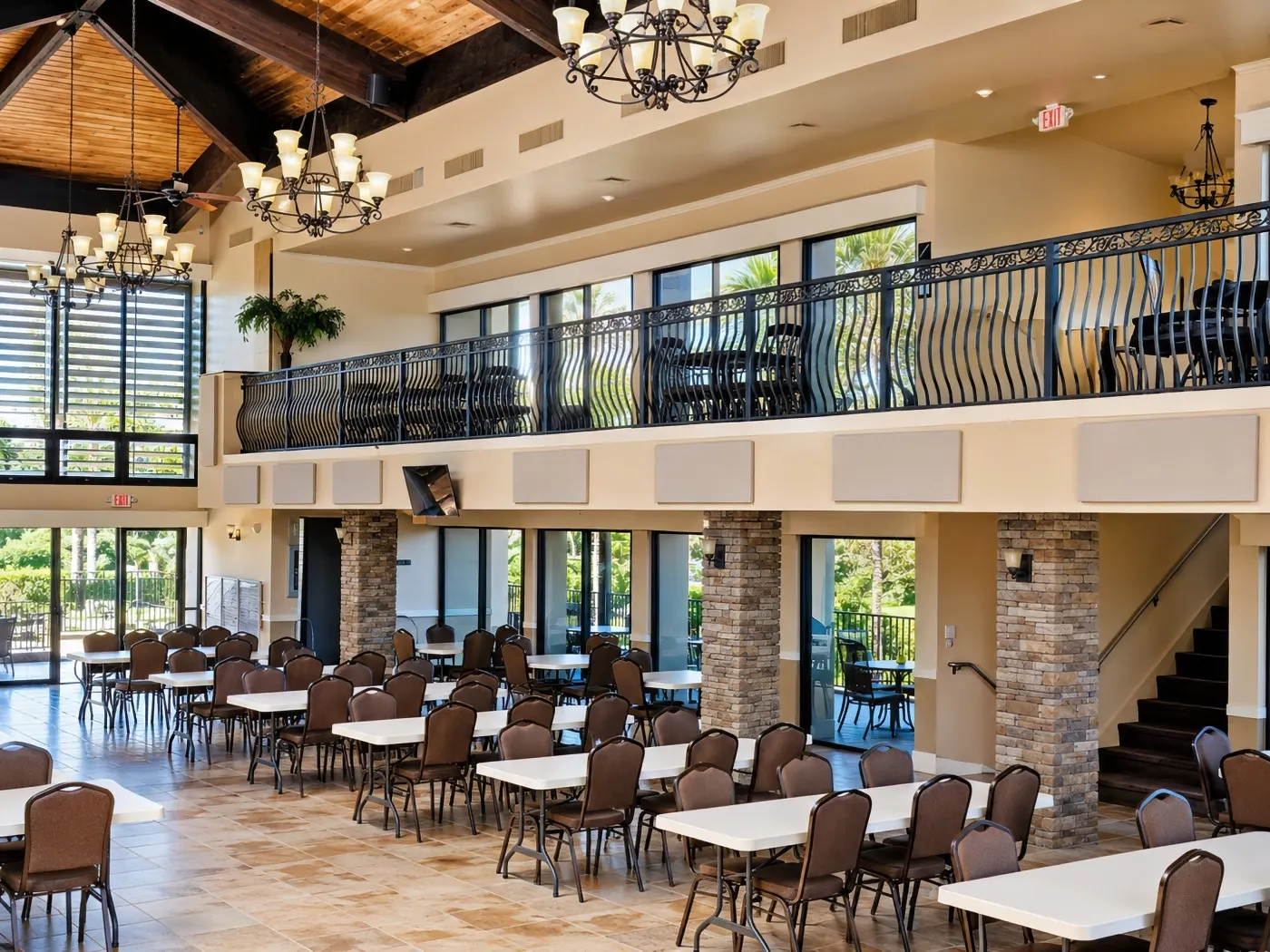
The 90 panels at Country Club of Ocala were wall-mounted with impaling clips, which lets a two-person crew set a panel in under a minute and removes the need for through-fastening into finished wall surfaces. Installation height was set above eye level to keep members from brushing the fabric face, which over time stains or dents the panel edges. Panel orientation was mixed horizontal and vertical to follow the contour of the room and the lines under the mezzanine railings. Fabric color options for projects like this are on our acoustical fabric options page.
After install, we ran the same impulse test from Step 1 and re-measured RT60. The reading came back below 1.8 seconds, comfortably inside the multipurpose-room target. For high-traffic clubhouse rooms with active sports leagues or kids’ programming, we generally specify an impact-resistant panel face rather than the standard resin-hardened fabric, but for the dining and event use at Country Club of Ocala the standard build was the right call.
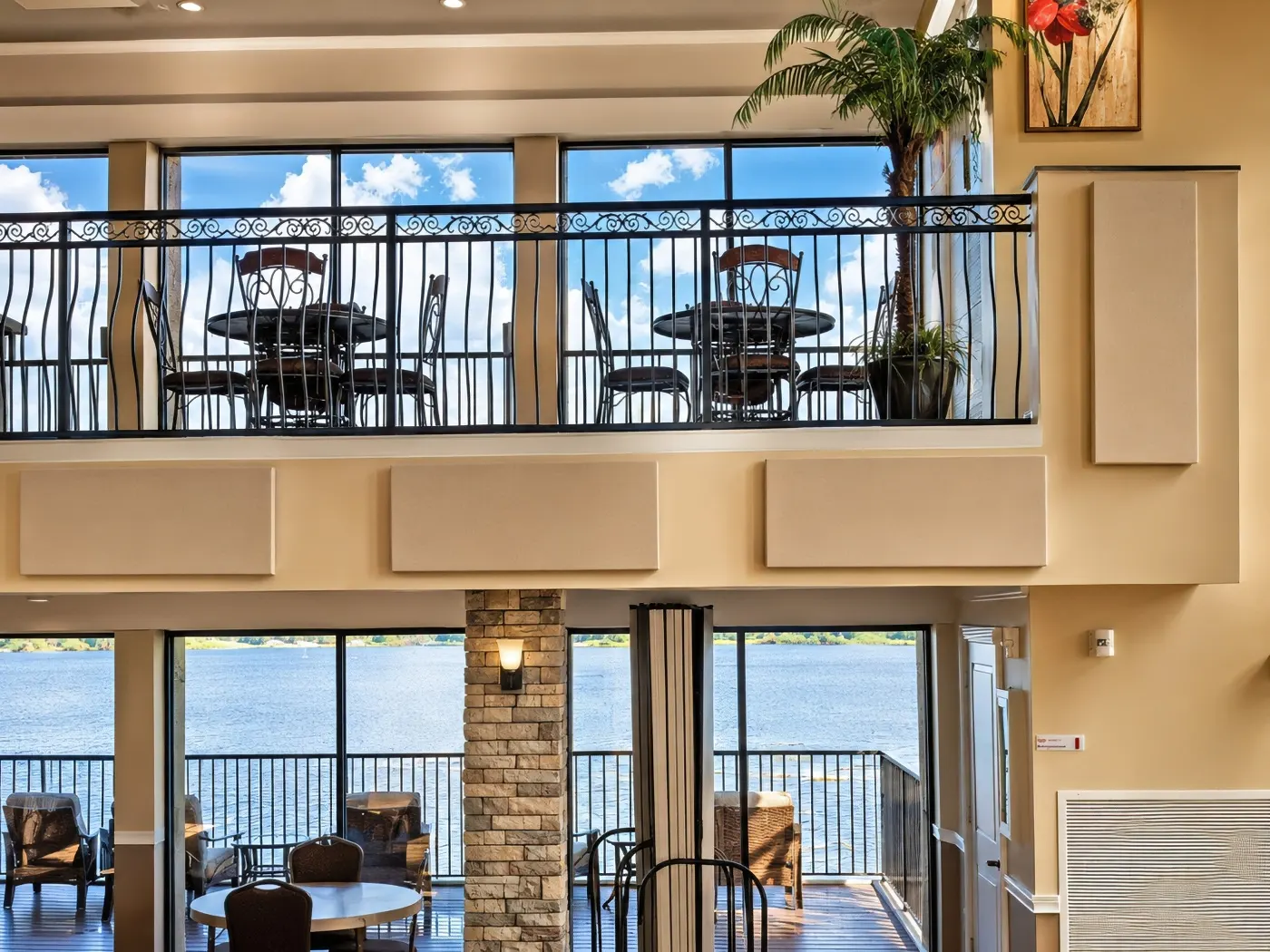
Results: Reverb Cut From 3.5 to Under 1.8 Seconds
- Pre-Treatment RT60: 3.5 Seconds
- Post-Treatment RT60: Under 1.8 seconds, inside the multipurpose-room target
- Panel Count: 90 2″-Thick Wall-Mounted Acoustic Panels
- Install Method: Impaling clips, above eye height, mixed horizontal and vertical
The 1.7-second swing in RT60 is the difference between a room that is physically tiring to use and a room that hosts a wedding without anyone leaning across the table to hear the toast. Member feedback shifted within the first month, and the staff started actively booking events that previously would have moved off-site. Other clubhouse retrofits where the answer was a fabric wall system rather than panels are covered in our Del Webb Lakewood Ranch case study in Bradenton, FL.
Conclusion: Acoustic Panel Treatment for Country Club Clubhouses
The takeaway for clubhouse and country club operators: a great room with a 3+ second reverb time is not a structural problem. It is a finishes problem, and it can be solved in a single phased install without closing the venue. Measure the room, calculate the panel quantity, pick a panel that performs at the frequencies your space actually uses, and install above eye height with impaling clips. The math is repeatable across most country club great rooms in the Southeast.
Commercial Acoustics provides field reverberation testing, acoustic modeling, panel manufacturing, and installation for country clubs, social clubs, and private event venues nationwide. For another acoustic treatment project at a higher-end Florida country club, see our acoustic ceiling treatment case study at Broken Sound.
FAQs: Clubhouse Acoustics and Reverb Control
What reverberation time is right for a clubhouse great room?
Most acoustic designers target 1.5 to 2 seconds RT60 for multipurpose clubhouse and event rooms. That range balances speech intelligibility for mixers, speeches, and bingo with enough liveness for amplified music and dining ambience. Anything above 2.5 seconds and conversations get tiring; below about 1.2 and the room starts to feel dead.
How many acoustic panels does a clubhouse usually need?
It depends on room volume, surface finishes, and target reverberation time. For a typical mid-size country club great room with hard floors, gypsum walls, and a tall ceiling, the panel count usually lands between 60 and 120 wall-mounted 2-inch panels. Country Club of Ocala came in at 90 panels to drop RT60 from 3.5 seconds to under 1.8 seconds.
Why are 2-inch acoustic panels recommended over 1-inch?
2-inch panels carry a higher overall NRC and, more importantly, retain absorption coefficient down into the lower frequencies where amplified speech and music live. 1-inch panels lose absorption performance below 250 Hz, which is exactly where wedding bands, DJs, and PA systems put the most energy. For any clubhouse that hosts amplified events, 2-inch is the right default.
Can a clubhouse stay open during acoustic panel installation?
Yes. Wall-mounted panel installs use impaling clips that let a two-person crew set each panel in under a minute, with no through-fastening into finished surfaces. Most clubhouse retrofits run on an off-hours schedule and the room is back in service the next morning.

Walker Peek|Founder & CEO, Commercial Acoustics
Walker founded Commercial Acoustics in 2013 to bring aerospace-grade engineering discipline to soundproofing, and runs the firm as CEO from its 12,000 sq ft Tampa production facility. The company designs custom acoustic panels, sound membranes, and masking systems for multi-family, hospitality, healthcare, and commercial projects across the US — built around Walker’s invention, Wall Blokker, an EVA-based sound barrier that hits STC 50-plus at roughly $1 per square foot installed.
A Jacksonville native, Walker spent five years at Kennedy Space Center with Craig Technologies before founding Commercial Acoustics — certifying aerospace manufacturing to the AS9100 standard and leading Six Sigma Black Belt process-improvement teams on NASA programs. He is a certified Industrial Noise Control Engineer and the author of Architectural Acoustics: A Practical Handbook.
