Table of Contents
Project Overview: Acoustic Treatment for a South Florida Live Music Venue
- Project: Acoustic Treatment for a Multipurpose Live Music Hall
- Location: South Florida
- Facility Type: Multipurpose Hall Hosting Live Bands and Member Events
- Capacity: 200 to 300 Attendees per Show
- Objective: Reduce Reverberation from 2 Seconds to ~0.8 Seconds
- Scope: ~100 Custom Acoustic Absorption Panels, Laser-Guided Wall Install, 2-Day Window
A South Florida live music venue called us in after a recent renovation made the room sound worse. Management swapped the original carpet for a lower-pile commercial product as part of a member-area refresh, and the change pulled enough mid- and high-frequency absorption out of the room that the live band sound fell apart almost overnight.
The hall hosts about 200 to 300 attendees on a typical night, mostly classic-band rendition shows. With the original carpet pile gone, the FOH operator was pushing the PA harder to fight the room, and the higher gain was triggering complaints from neighboring units. The fix had to land in a single off-hours install window so the venue could reopen without missing a weekend.
Acoustic Challenges in a Live Music Hall
- Pre-Treatment RT60: 2.0 seconds, well above the 0.8-1.0 second target for amplified live music
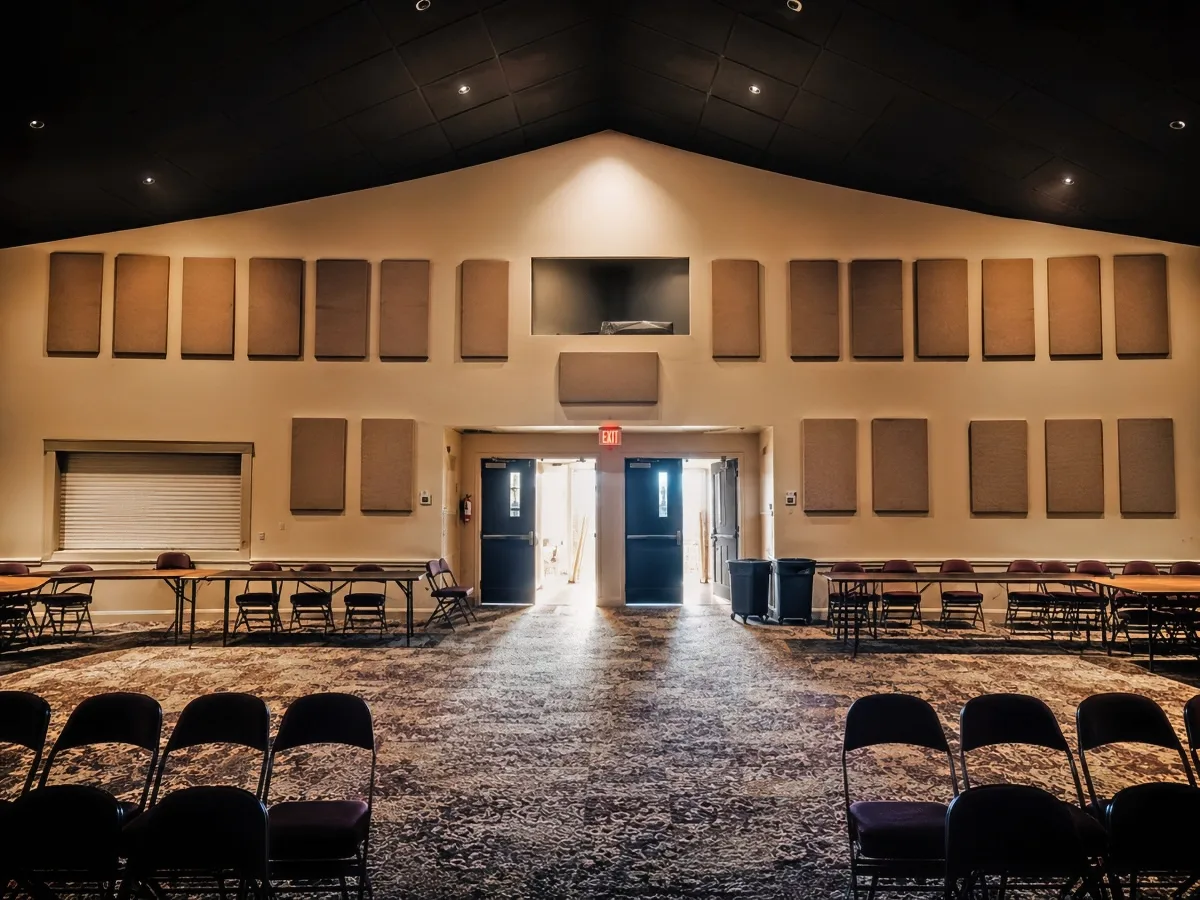
- Reflective Finishes: Drywall walls, drop ceiling, and lower-pile commercial carpet
- Use Pattern: Amplified bands, member events, banquet seating, occasional speaker programming
- Operational Constraint: Single off-hours install window; venue could not close for a week
Live music venues are some of the harder rooms to tune because the right reverberation depends on what is on stage. Spoken-word programming wants 1.0 to 1.2 seconds. Symphonic and acoustic music wants 1.5 to 2.0 seconds. Amplified bands and DJ work need to land tighter, around 0.6 to 1.0 seconds, because PA energy adds its own reflections and the room cannot help reinforce volume the way an unamplified ensemble would, a common constraint in live music acoustic treatment for venues. Our room acoustics calculator handles the Sabine math behind these targets.
Above 1.5 seconds in an amplified room, every word and every note bleeds into the next one. The FOH operator hears the smear and pushes the PA up to compensate, which makes the room louder without making it any clearer. Audiences strain to follow the music and the venue starts losing repeat attendance. That was the operational pattern at this hall before treatment.
Solution: ~100 Custom Acoustic Absorption Panels
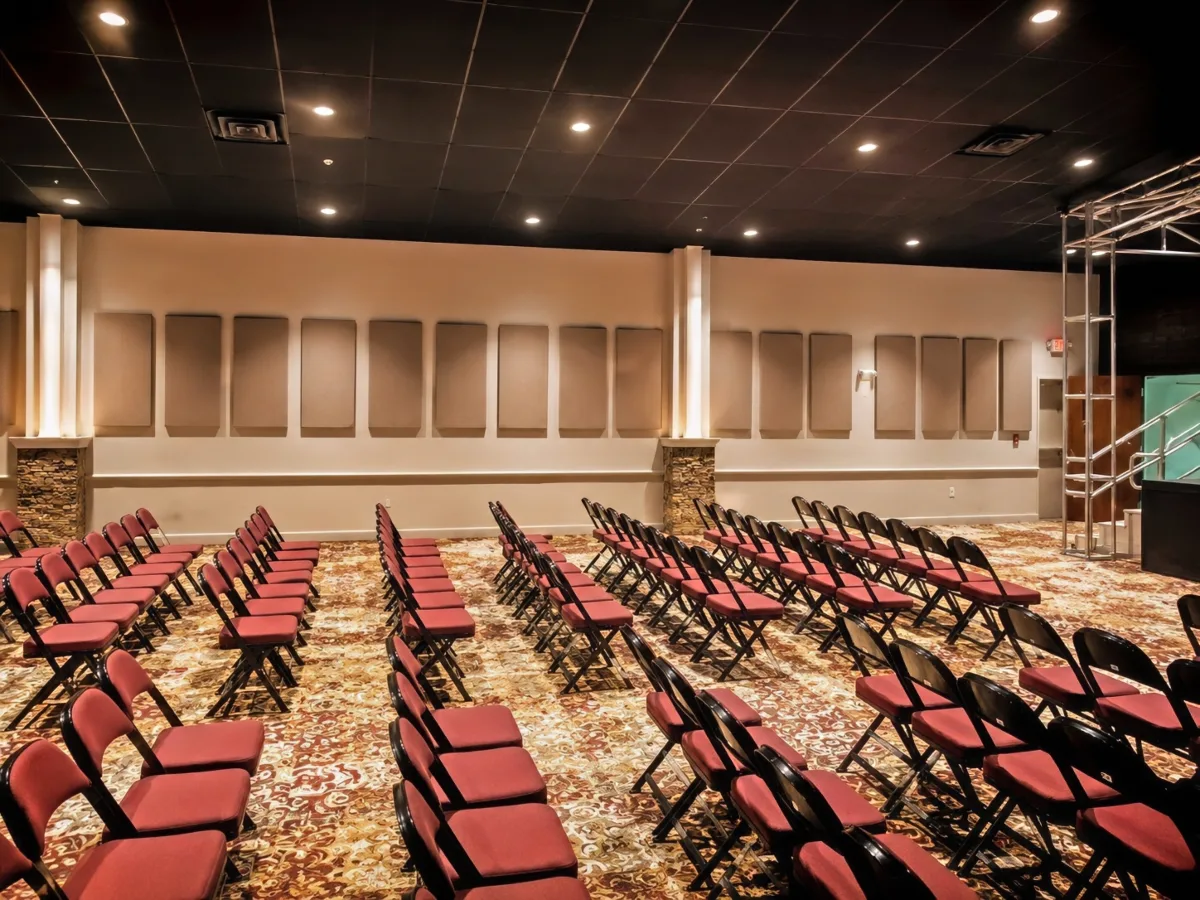
- Material: Custom-fabricated acoustic absorption panels, fabric-wrapped face
- Quantity: ~100 panels (initial Sabine calc landed in the 90-120 range)
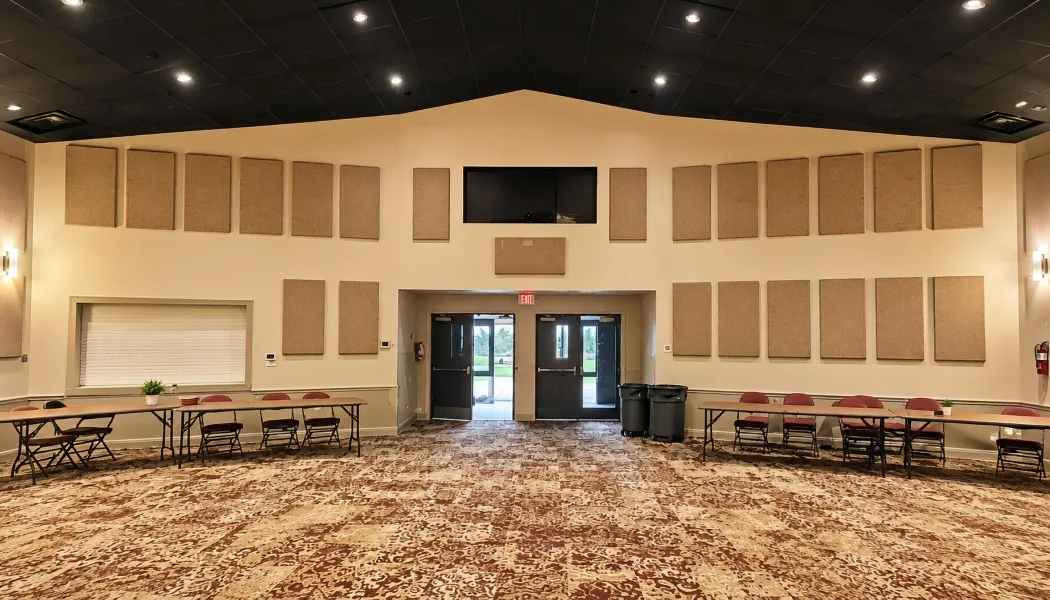
- Placement: Two horizontal bands across all four walls, above and below the trim line
- Mount: Wall-mounted, mechanical fasteners through the panel back
Panel quantity came off a Sabine calculation against the measured 2.0-second baseline and a 0.8-second target. The math returned a 90 to 120 panel range, and we manufactured ~100 to land near the middle of that window. Reference detail for the panel family is on our acoustic absorption panel page.
Layout was two horizontal bands of panels distributed around the entire perimeter. Putting the absorption around the audience rather than concentrating it behind the band lets the room handle off-axis reflections without killing the front-of-house sound that gives a live band its energy. Coverage at this density gets a multipurpose hall well inside the live-music RT60 window without making the room feel dead between sets.
For depth on absorption coefficient and how panel thickness shifts the working frequency band, see our sound absorption coefficient guide. The short version: 2-inch panels carry the broadband NRC needed for amplified vocals and instruments, where 1-inch panels would have left the bass band underabsorbed.
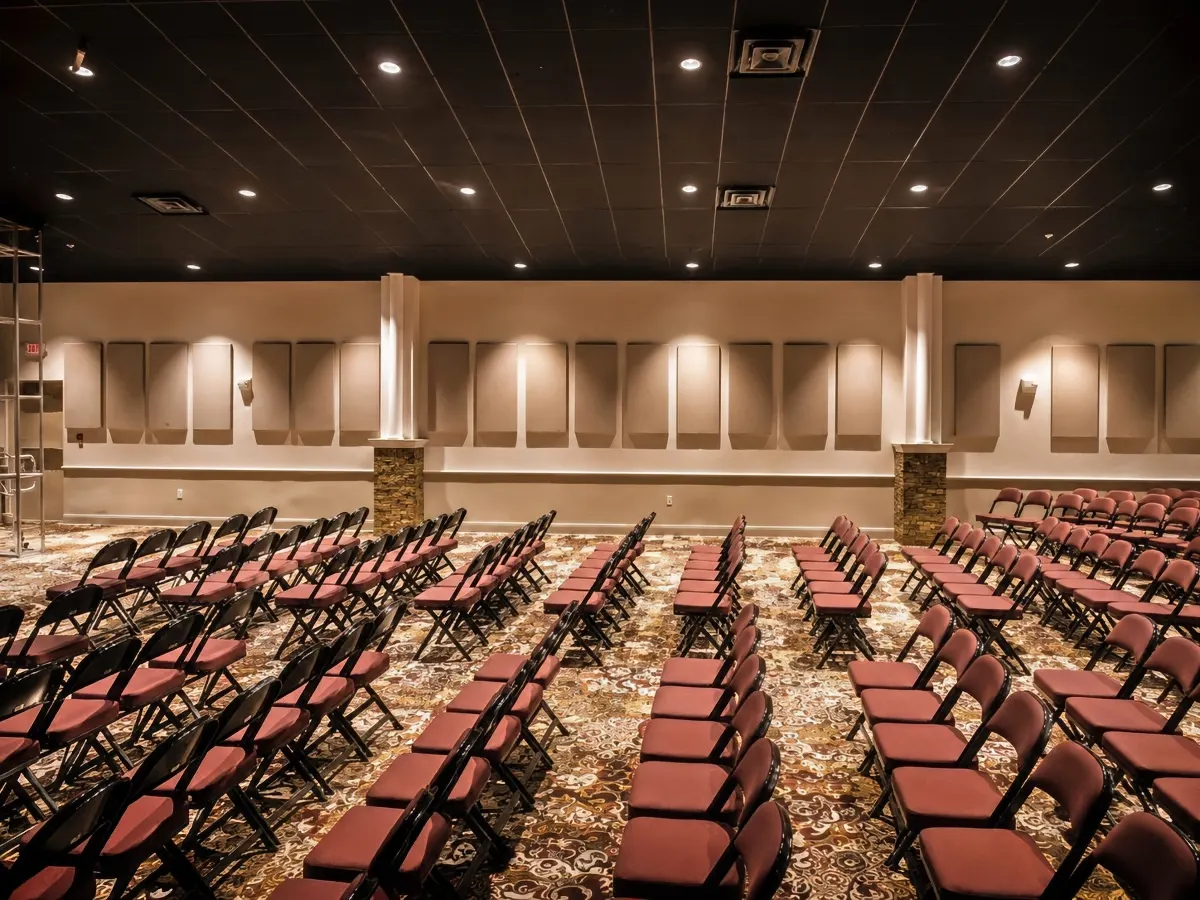
Live Music RT60 Targets and Why 0.8 Seconds Worked
RT60 targets vary by program type more than by room size. Three reference windows cover most live music situations.
- Amplified Live Music Venues: 0.6-1.0 seconds. PA stays clear, room still feels alive.
- Acoustic and Orchestral Music: 1.5-2.0 seconds. Decay reinforces unamplified ensembles.
- Cinema and Recorded Music Playback: 0.4-0.6 seconds. Short decay lets the soundtrack lead.
0.8 seconds lands inside the amplified live-music window with a touch of headroom toward the longer end. That keeps the room feeling like a venue rather than a recording booth, which matters for a hall that hosts repeat-attendee member events. A more aggressive 0.5-second target would have killed audience energy between songs and made the space feel cold.
The other reason 0.8 worked: removing the original carpet during the renovation pushed the room to 2.0 seconds, but the structure under the carpet (drywall, drop ceiling, columns) was the same as before. Restoring absorption with wall panels rather than re-installing thick carpet kept the renovation aesthetic intact and let the panel selection do the acoustic work. For a different venue type that pushed the same calculation toward a longer target, see our Largo Central Park performing arts venue.
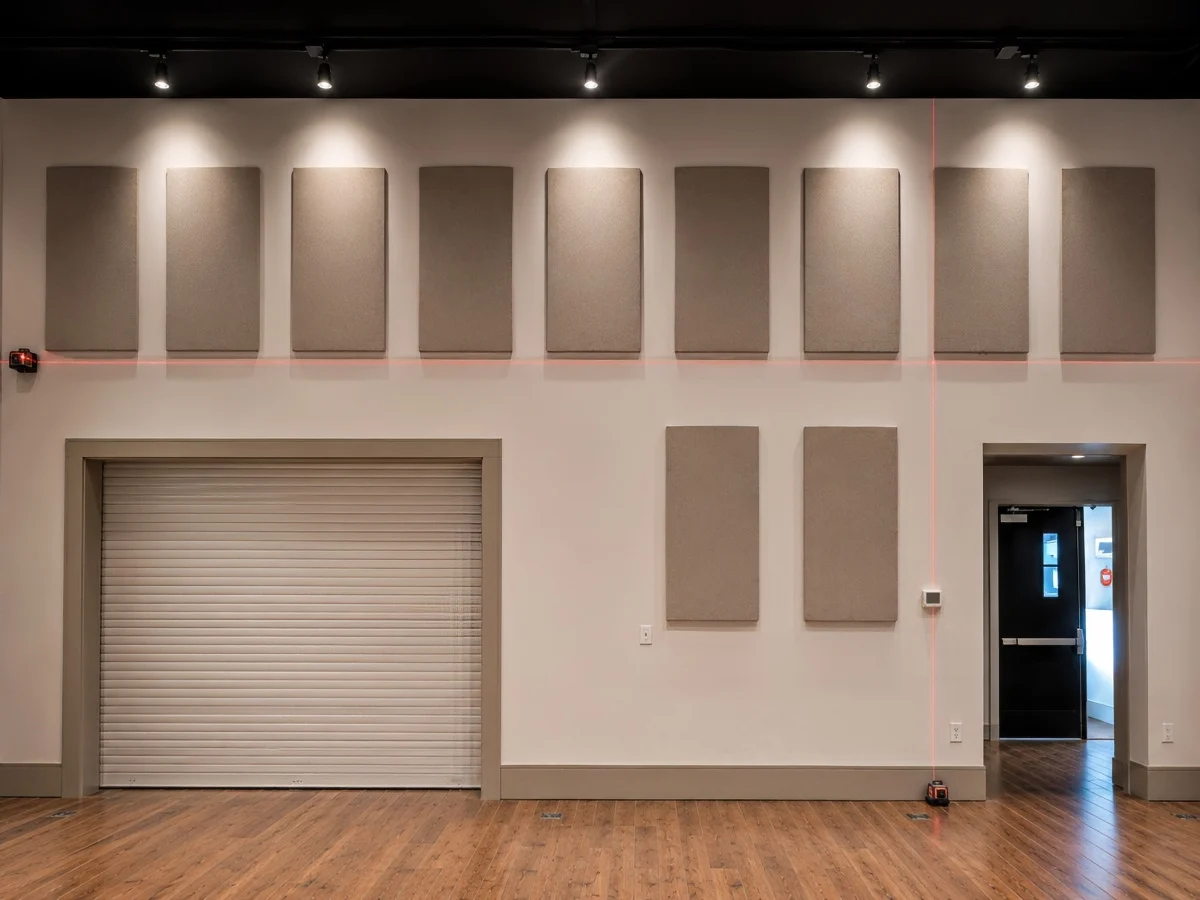
Installation: Self-Leveling Laser for Even Panel Layout
Panel install on a public-facing music venue is a finish job as much as an acoustic one. A panel layout that drifts a quarter inch over a 30-foot wall reads as crooked from the audience and undermines the room aesthetic the management spent renovation budget on. Our crew set a self-leveling laser as a reference line at the start of the install and worked off that single datum across all four walls.
The laser keeps the entire panel band on a continuous level reference even when the room geometry has slight irregularities, columns, or non-rectangular corners. It also speeds the install: each panel only needs one anchor point measured against the laser, then squared off the panel itself, rather than measuring every panel from the floor or ceiling. The full ~100-panel install ran in under 2 days with this approach.
For another venue-side acoustic project where renovation timing drove install windows, see our Chapin Theater renovation in Orlando.
Results: 60% Reverb Reduction in Under 2 Days
- Pre-Treatment RT60: 2.0 seconds
- Post-Treatment RT60: Just under 0.8 seconds
- Reverb Reduction: 60% drop
- Install Window: Under 2 days, single off-hours window
The 0.8-second post-treatment number landed at the upper end of the amplified live-music target window. From the audience side that is the difference between straining to follow lyrics and being able to hear the band clearly without leaning forward. The FOH operator brought PA gain back down to a comfortable working level, and the noise complaints from neighboring units stopped after the first weekend back in operation; for outdoor properties, the same complaint pattern may call for live music venue noise control with a perimeter barrier.
The room still reads as alive between songs, which matters for a venue whose business is repeat-attending members rather than ticketed one-time concert audiences. For a parallel acoustic-design engagement at a historic Tampa venue, see our Tampa Historic Public Theatre.
Conclusion: Acoustic Treatment for Live Music Venues
Live music venue acoustics come down to a single number: broadband RT60 against the program type. Get the target right and the room supports the band. Get it wrong and the FOH operator chases the room all night while audiences quietly stop coming back.
For a flat-floor multipurpose hall hosting amplified bands, the playbook is small. Aim for 0.6 to 1.0 seconds RT60. Distribute 2-inch absorption around the audience perimeter rather than concentrating it behind the band. And if a renovation traded deep-pile carpet for a lower-pile commercial product, restore that absorption with wall panels before the venue reopens for live shows.
Commercial Acoustics provides reverberation testing, panel design and fabrication, and installation for live music venues, multipurpose halls, banquet rooms, and private clubs across the Southeast. Most engagements run on a single off-hours install window so the venue reopens the next weekend.
FAQs: Live Music Venue Acoustics
What RT60 should a live music venue target?
Amplified live music venues target 0.6 to 1.0 seconds RT60. Tight enough to keep the PA clear, loose enough to feel alive. Acoustic and orchestral music runs longer at 1.5 to 2.0 seconds. Cinema and recorded playback runs shorter at 0.4 to 0.6 seconds.
How many acoustic panels does a 250-capacity hall need?
It depends on room volume, finishes, and target RT60. A typical 200 to 300 capacity multipurpose hall with hard finishes lands somewhere between 80 and 130 panels. The South Florida hall in this case study came in at ~100 panels to cut RT60 from 2 seconds to under 0.8 seconds.
Why does new carpet hurt a venue’s acoustics?
Carpet pile thickness controls how much mid- and high-frequency absorption the floor contributes to the room. Swapping deep-pile to lower-pile carpet during a renovation can pull a meaningful fraction of the room’s broadband absorption out without anyone realizing it until the next live show.
How is a live music venue different from a theater acoustically?
Live music venues are flat-floor multipurpose rooms running amplified PA. Theaters are usually sloped-floor rooms designed around unamplified speech or symphonic music. The RT60 targets differ by 0.5 to 1.0 second, the seating geometry differs, and the absorption distribution strategy differs accordingly.
Walker Peek|Founder & CEO, Commercial Acoustics
Walker founded Commercial Acoustics in 2013 to bring aerospace-grade engineering discipline to soundproofing, and runs the firm as CEO from its 12,000 sq ft Tampa production facility. The company designs custom acoustic panels, sound membranes, and masking systems for multi-family, hospitality, healthcare, and commercial projects across the US — built around Walker’s invention, Wall Blokker, an EVA-based sound barrier that hits STC 50-plus at roughly $1 per square foot installed.
A Jacksonville native, Walker spent five years at Kennedy Space Center with Craig Technologies before founding Commercial Acoustics — certifying aerospace manufacturing to the AS9100 standard and leading Six Sigma Black Belt process-improvement teams on NASA programs. He is a certified Industrial Noise Control Engineer and the author of Architectural Acoustics: A Practical Handbook.
