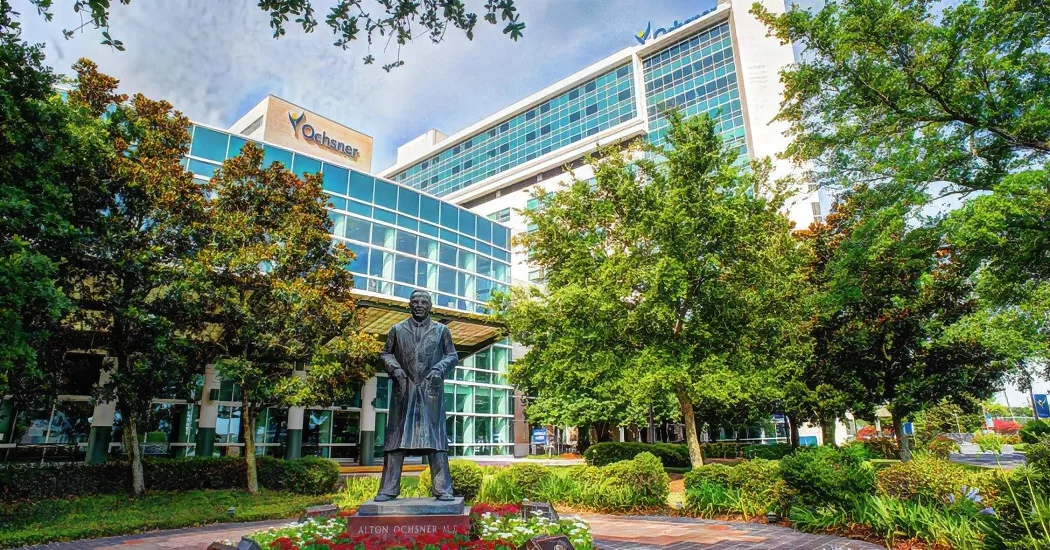
Healthcare Sound Testing for Hospitals: Ochsner Medical Center in New Orleans

Project Overview: Ochsner Medical Center Healthcare Sound Testing

  • Project: AHCA healthcare sound testing & ASTC verification
  • Address: 1514 Jefferson Hwy, Jefferson, LA 70121
  • Facility Type: Healthcare // Hospital
  • Client: Ochsner Medical Center – New Orleans
  • Objective: Verify ASTC vs. AHCA targets & safeguard patient privacy
  • Scope: After-hours field STC testing (ASTC) per ASTM E336 across key partitions

Ochsner Medical Center in New Orleans recently completed a major expansion to enhance patient care and clinical capacity. As part of the close-out process, the facility required field verification of sound isolation between critical spaces. Testing confirmed whether partitions met AHCA’s Apparent Sound Transmission Class (ASTC) requirements—an essential step to protect patient privacy, improve rest, and maintain acoustic control in sensitive medical environments. Conducted after hours, the evaluation captured real-world conditions such as HVAC systems and residual hospital activity while minimizing interference from daytime traffic.

Ochsner Medical Healthcare Sound Testing

Ochsner Medical Center: Facility Profile

  • Established leader: Flagship hospital of Ochsner Health, serving the Gulf South since 1942
  • Size & scope: One of Louisiana’s largest academic medical centers with over 700 beds
  • Specialties: Comprehensive care in cardiology, cancer treatment, neurosciences & transplantation

As one of the region’s foremost healthcare providers, Ochsner Medical Center combines advanced research, teaching, and clinical care. The New Orleans campus includes specialized procedure rooms, imaging suites, patient care wings, and teaching facilities—spaces where acoustic performance directly affects both outcomes and compliance. For architects and contractors, the hospital represents a demanding environment where construction quality, code adherence, and AHCA verification are essential to project success.

Ochsner Medical Rooms with ASTC Values

AHCA Targets & Why STC Matters

  • Patient well-being: Lower noise & better sleep improve recovery outcomes
  • Speech privacy: HIPAA-sensitive conversations require higher isolation
  • Design assurance: ASTC targets confirm partitions meet healthcare use cases

AHCA guidance and related standards define minimum isolation between common adjacencies. For example, patient-to-patient rooms typically require ASTC 45, while noisy equipment rooms adjoining procedure or imaging suites may push requirements to ASTC 60. Establishing these targets early—and validating them in the field—keeps projects compliant and protects patient experience throughout the facility lifecycle.

Control Room into NUC MED 1 Ochsner Medical Center

Testing Method & Constraints

  • Standard: ASTM E336 field measurement of apparent STC (ASTC)
  • Timing: After-hours testing to limit crowd & operational noise
  • Reality check: HVAC, corridor traffic & devices still influence results

Field testing captures performance with the realities of a working hospital—air handlers, bed movement, staff conversations, alarms, and rolling carts. That’s why planning for background noise is critical, and why results can differ from laboratory STC ratings. Testing teams coordinate with facilities staff to access rooms, control temporary noise sources, and sequence measurements efficiently.

AHCA Compliance for Ochsner Medical Center

Results & Findings (High-Level)

  • Compliance snapshot: Most partitions met intended ASTC targets; a few were marginal
  • Common issues: Small flanking paths at penetrations, head-of-wall gaps & door undercuts
  • Quick wins: Sealant continuity, upgraded door sweeps & targeted patching at utilities

The compiled report grouped measurements by adjacency (e.g., patient-to-patient, corridor-to-patient, equipment-to-procedure). Where readings were near-misses, the causes were typically localized: incomplete sealant at head-of-wall joints, oversized electrical boxes back-to-back, or door perimeter leakage. Focused remediation restored isolation without invasive rework.

Ochsner Medical Healthcare Sound Testing for Privacy Protection

Recommendations for Healthcare Projects

  • Detailing first: Prioritize head-of-wall seals, backer boxes & staggered box layouts
  • Doors matter: Use high-quality gasketing, sweeps & solid cores at sensitive rooms
  • Test at the right time: Pre-occupancy or early turnover reduces costly rework

Designers should call out robust acoustic details in the drawings and submittals, with mockups for repeated conditions (patient rooms, imaging suites). During construction, trade coordination around penetrations and MEP rough-in is the best defense against flanking. Finally, scheduling field tests ahead of full occupancy captures true performance while corrective work is still simple.

Ochsner Medical Center Sound Testing Meets AHCA Requirements

Conclusion: Healthcare Sound Testing That Protects Privacy & Rest

Validated ASTC performance at Ochsner gives the project team confidence that partitions support patient recovery, clinical communication, and regulatory expectations. Targeted touch-ups addressed small gaps quickly, avoiding disruptive construction while preserving design intent.

For architects, general contractors, and healthcare owners, early coordination and timely field testing are the most cost-effective path to AHCA compliance, patient comfort, and durable acoustic performance. If you’re planning a hospital or medical facility project, contact us to discuss sound testing or acoustic consulting tailored to your design goals.

Ochsner Medical Pediatric Sound Testing

FAQs: Healthcare Sound Testing & AHCA Compliance

How is ASTC different from STC?

STC is a lab rating for assemblies; ASTC is a field-measured value that reflects real-world construction, flanking, and building systems. AHCA reviews typically rely on ASTC because it captures as-built performance.

When should healthcare projects be sound-tested?

Ideally just before occupancy or at phased turnover—late enough that partitions, doors, and MEP are complete, but early enough to fix issues without impacting operations.

What are the fastest fixes for marginal ASTC results?

Sealant continuity at head-of-wall & perimeter joints, door gasketing/sweeps, treating back-to-back boxes, and sealing minor penetrations often recover several ASTC points with minimal disruption.

Which rooms usually need the highest isolation?

Spaces adjacent to loud equipment (e.g., MRI mechanical, imaging control rooms) and areas with sensitive speech privacy (e.g., exam/consult, procedure rooms) commonly target higher ASTC values.