Table of Contents
Project Overview: Office Sound Privacy Decision Framework
- Project: Office Sound Privacy Decision Framework, Modular vs. Drywall
- Location: Tampa, FL (corporate office)
- Facility Type: Closed Offices Behind Modular Partition System
- Issue: Audible Speech Transfer Across Adjacent Office Walls
- Existing Setup: Modular Wall System, Armstrong Calla Tiles, Lencore Sound Masking
- Scope: ASTC Field Testing, Wall System Comparison, Decision-Tree Recommendation
The Office Sound Privacy Problem in Modular Buildouts
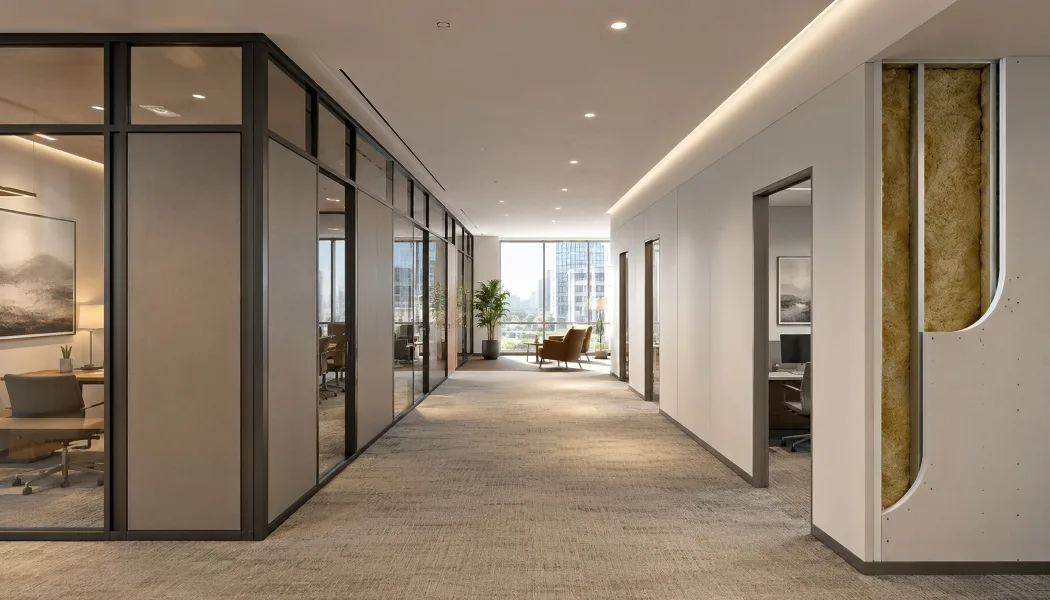
Modern corporate offices spec modular partition systems for one obvious reason: flexibility. Walls reconfigure in days, not weeks. The trade-off shows up after the buildout, when occupants discover that a partition rated for design flexibility was not rated for speech privacy. Conversations carry across walls that look solid on the floor plan and fail in the field.
This Tampa corporate client ran into the standard pattern. Modular partitions with a published lab STC range of 31 to 48, ceiling tiles at CAC 35, and a Lencore sound masking system installed and tuned. On paper the package looks complete. In the rooms, staff reported clearly audible and articulated conversations between adjacent offices — not muffled voices, but full sentences.

STC Targets for Office Privacy
- Standard Closed Office: STC 45 (LEED v4 minimum)
- Executive Office: STC 50 (LEED v4 executive standard)
- HR / Legal / Interview Rooms: STC 50+ (confidentiality-grade)
- Field-to-Lab Gap: Field ASTC typically 5 to 10 points lower than lab STC
Building code does not mandate STC ratings between commercial offices, so the targets come from LEED, WELL, and the design team’s own spec. LEED v4 sets STC 45 between standard offices and STC 50 between executive offices and interview rooms. Confidentiality-grade rooms (HR investigations, legal review, regulated work) generally specify STC 50 or higher.
The lab-to-field gap is the variable most design teams underestimate. A wall rated STC 45 in a controlled lab routinely measures ASTC 35 to 40 in the actual building because flanking paths the lab does not have — ceiling tile grids, baseboards, glass joints — leak around the wall. Spec the wall for the field number, not the lab number. The STC rating chart walks what each numeric range delivers in lived sound.

Modular Wall vs. Drywall: The Comparison Table
The decision between modular partition systems and drywall comes down to a trade between reconfigurability and acoustic performance. Modular wins on flexibility; drywall wins on field-measured ASTC. The table below maps the working trade-offs across six common office wall configurations.
| Wall System | Field ASTC Range | Best For | Trade-Off |
|---|---|---|---|
| Standard Modular Partition (No Batt) | 27 – 31 | Open-plan offices, low-privacy zones | Audible speech transfer between rooms |
| Modular Partition with Acoustic Batt | 31 – 35 | Standard closed offices, low sensitivity | Below the LEED v4 office target |
| Drywall Partition (No Batt) | 36 | Standard closed offices, balanced budget | Less reconfigurable than modular |
| Drywall with Fiberglass Batt | 44 | Executive offices, HR, legal, interview rooms | Higher cost, locked floor plan |
| Double-Layer Drywall + Resilient Channel | 50+ | Confidential or regulated environments | Premium cost plus added thickness |
| Sound Masking Overlay (Any Wall) | +5 to 10 effective | Pairs with any wall to lift speech privacy | Does not fix an underperforming wall |
Modular partitions with batting top out around ASTC 35 in field conditions, which is below the LEED v4 STC 45 standard-office target. Drywall with fiberglass batting reliably delivers ASTC 44 — over the threshold. For the underlying field-test data behind these ranges, see the corporate office ASTC field test case study, which ran the same protocol across 10 partition types in a comparable office.
When Sound Masking Helps and When It Doesn’t
- Standard Tuning Range: 45 to 48 dBA at four feet off the floor
- Effective Lift: 5 to 10 ASTC points of equivalent speech privacy
- Diagnostic Signal: Masking running above 49 dBA = wall problem, not masking problem
- Pairing: Works with any wall system but does not fix one that is already failing
The Lencore system in this Tampa office was running at 49 dBA at four feet — well above the standard 45 to 48 dBA tuning window. That is the diagnostic signal that the masking is being asked to compensate for an under-performing wall. Cranking the masking volume buys a few more dBA of speech privacy at the cost of staff who hate the office because it sounds like a server room.
For a sister project where masking was the right tool because flanking paths could not be sealed, see the corporate open office sound masking case study. The decision tree there split cleanly: when the walls are reasonable but flanking paths are open, mask the receiver side; when the walls themselves are the bottleneck, fix the walls.

The Decision Framework: Which Wall for Which Use
- Open-Plan Zones: Modular partitions, no batting required, sound masking does the rest
- Standard Closed Offices: Drywall + fiberglass batting (ASTC 44, meets LEED standard)
- Executive / HR / Legal: Drywall + batting, with attention to flanking paths
- Interview / Confidential Rooms: Double-layer drywall + resilient channel + acoustic seal
The framework simplifies once the use cases are sorted. Open-plan and low-privacy zones can run modular partitions with masking — the flexibility is worth the lower ASTC because privacy was never the priority there. Standard closed offices need drywall and batt to clear LEED v4. Executive, HR, and legal rooms need the same plus attention to flanking paths around glass and baseboards.
Confidential and regulated environments live in their own band. Double-layer drywall with resilient channel and acoustic seals at every boundary clears ASTC 50 and stays there even with HVAC running. The cost is real — two to three times a standard drywall wall — but the alternative is a privacy failure on a wall the operator cannot rebuild without reopening the floor.
Conclusion: Office Sound Privacy Decision Framework
Office sound privacy lives or dies on field-measured ASTC, not lab-published STC. Modular partitions deliver flexibility and top out around ASTC 31–35; drywall with batt clears the LEED v4 standard-office threshold at ASTC 44. Sound masking is a finishing tool, not a substitute for a wall. More on the team behind office acoustic projects for design teams sizing privacy across their own buildouts.
FAQs: Office Sound Privacy
What STC should an office wall target for sound privacy?
LEED v4 sets STC 45 between standard closed offices and STC 50 between executive offices and interview rooms. Building code does not mandate office STC, so design targets come from LEED, WELL, or the spec. Field ASTC typically runs 5 to 10 points below the lab STC for the same wall.
Why do modular wall systems underperform their published STC?
Lab STC numbers are measured under perfect conditions. Field ASTC includes flanking paths the lab does not have — ceiling tile grids, baseboards, glass joints, walls that stop at the ceiling. Modular partitions are particularly vulnerable because their sectional construction multiplies the joints where sound can flank around the wall face.
When does sound masking actually help office privacy?
Masking adds 5 to 10 ASTC points of effective speech privacy when paired with a reasonable wall. It does not rescue an underperforming wall on its own. If the masking system has to run above 49 dBA to mask voices, the wall is the problem, not the masking. Standard tuning is 45 to 48 dBA at four feet.
What’s the cheapest path to LEED v4 office STC compliance?
Standard drywall partition with fiberglass batting and attention to flanking paths. That assembly reliably hits ASTC 44 in the field, which clears the LEED v4 standard-office target. Modular partitions with batt top out around ASTC 35 — short of the standard. Anything tighter (executive, interview) calls for double-layer drywall.

Walker Peek|Founder & CEO, Commercial Acoustics
Walker founded Commercial Acoustics in 2013 to bring aerospace-grade engineering discipline to soundproofing, and runs the firm as CEO from its 12,000 sq ft Tampa production facility. The company designs custom acoustic panels, sound membranes, and masking systems for multi-family, hospitality, healthcare, and commercial projects across the US — built around Walker’s invention, Wall Blokker, an EVA-based sound barrier that hits STC 50-plus at roughly $1 per square foot installed.
A Jacksonville native, Walker spent five years at Kennedy Space Center with Craig Technologies before founding Commercial Acoustics — certifying aerospace manufacturing to the AS9100 standard and leading Six Sigma Black Belt process-improvement teams on NASA programs. He is a certified Industrial Noise Control Engineer and the author of Architectural Acoustics: A Practical Handbook.
