
Table of Contents
Project Overview: Specialty Ceilings for a High-End Office
- Project: Specialty Ceilings and Stretched Fabric Wall on a High-End Office Tenant Fit-Out
- Location: 1001 Water Street, Downtown Tampa, FL
- Facility Type: Class A High-Rise Office, 12th-Floor Tenant Build-Out
- Client: DPR Construction (General Contractor)
- Acoustic Scope: Ceiling Tile, Drop Baffles, Felt Panels, Stretched Fabric Wall
- Objective: Pre-Occupancy Acoustic Treatment Across the Full Office Floor
- Sequencing: Coordinated With Electrical, Sprinkler, and Finish Trades
This was a full acoustic scope on a single-tenant fit-out, not a single-product retrofit. The 12th-floor office build-out called for four different ceiling and wall systems coordinated alongside electrical, sprinkler, and finish trades. The whole acoustic package landed before the tenant moved in, which is the right schedule for any high-end office build.
The High-End Office Tenant Fit-Out
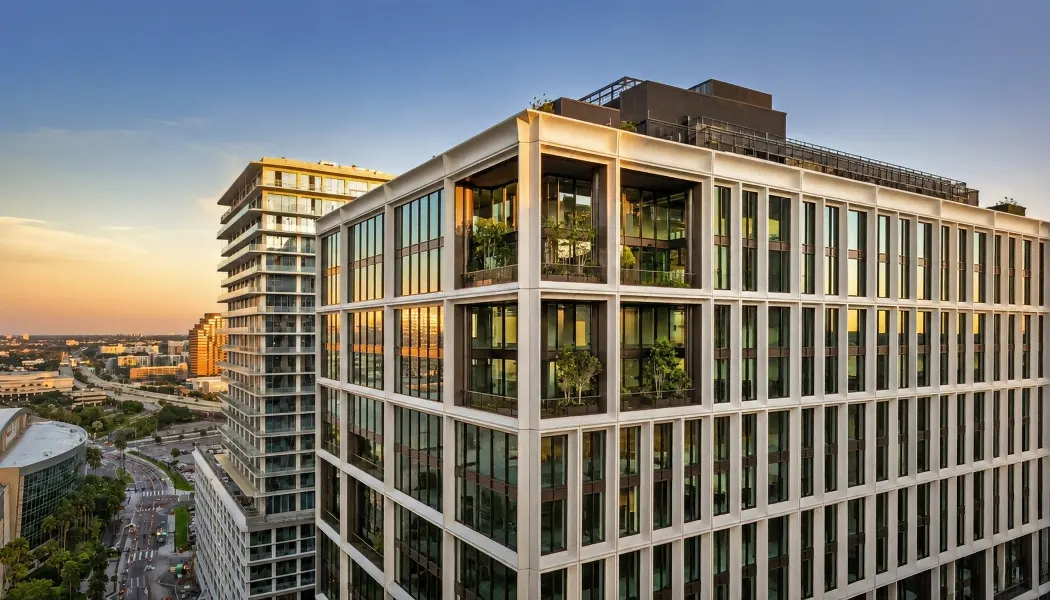
1001 Water Street is a new high-rise in the downtown Tampa Water Street district, built out as Class A office and ground-floor retail. Commercial Acoustics was contracted to furnish and install the full acoustic scope on the 12th floor before the tenant occupied the space.
The design team set the acoustic goals alongside the finish selections. That coupling is what separates a high-end office build from a value-engineered tenant fit-out. Specialty ceiling systems get specified because they hit acoustic targets and look like the finish itself, not like a separate acoustic afterthought.
Why Specialty Ceilings Belong in High-End Office Builds
- Acoustic Performance: High NRC across speech and mid-frequency bands
- Visual Integration: Reads as designed ceiling finish, not as a treatment overlay
- Zoning Flexibility: Different systems handle different room conditions across the same floor
- Architect Specification: Lives in the design intent set, not a punch-list add
High-end office builds use specialty ceilings because a single acoustic system cannot solve a Class A floor on its own. Open office areas need broad-coverage absorption with the right reflectance for daylight. Conference rooms need speech-band absorption tight against the wall plane. Corridors and lobby areas need visual rhythm that absorbs without reading as foam panels.
Each ceiling type carries a different acoustic and visual role across the floor. The full taxonomy of options lives in our specialty ceiling types explained reference, which covers baffles, clouds, metal, and wood ceiling families with their NRC and aesthetic trade-offs.
Acoustic Ceiling Tile for the Open Floor
- Open Office Field: USG Orion acoustic ceiling tile
- Secondary Field: Armstrong Lyra PB tile for visual contrast zones
- Coverage: Suspended grid across the open work area
- Function: Base absorption layer that anchors the rest of the ceiling stack
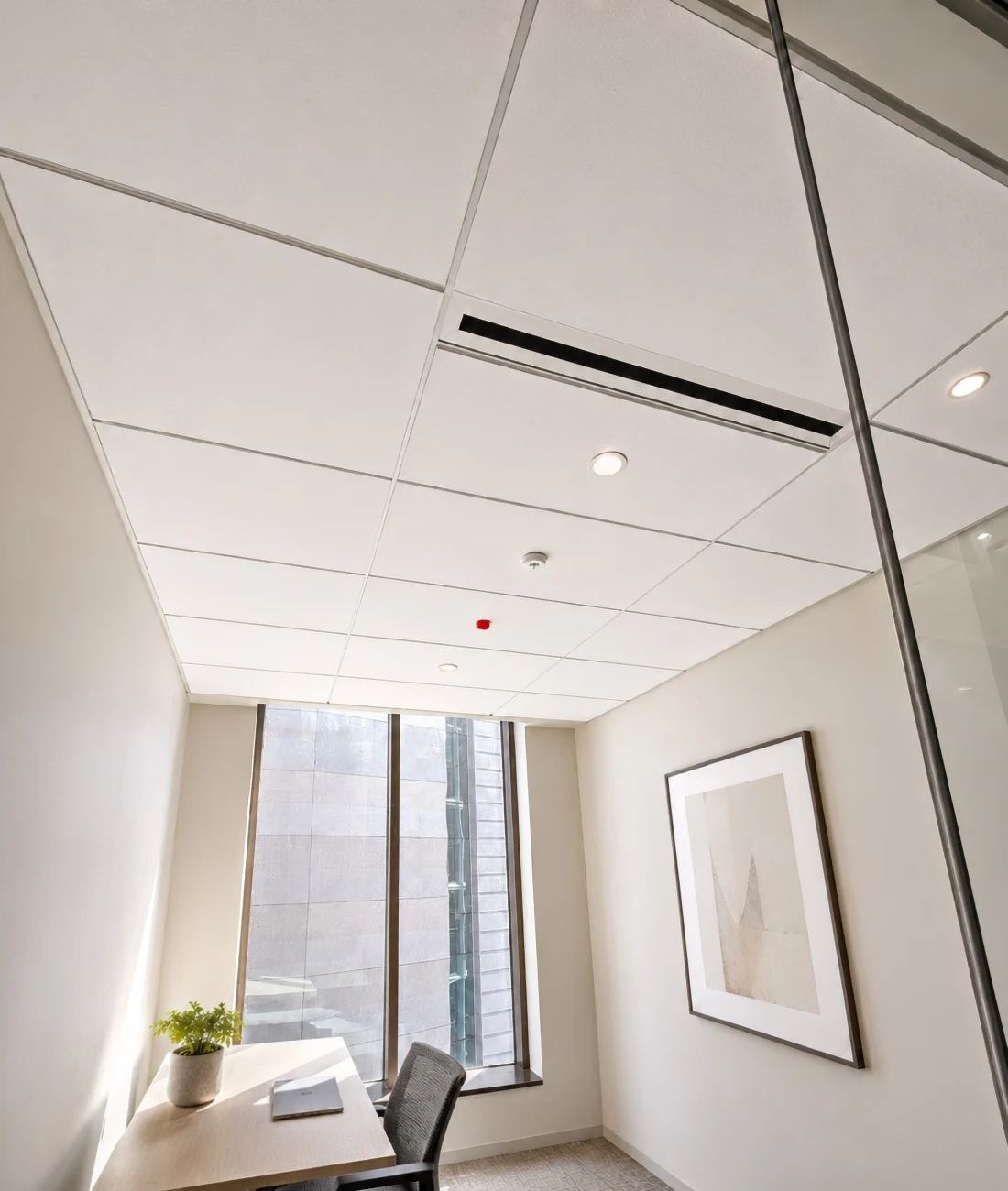
The open office floor used acoustic ceiling tile as the base treatment layer. USG Orion across the primary work field, Armstrong Lyra PB across secondary zones for visual differentiation. Both tile lines carry NRC values appropriate for open office work, where the goal is speech privacy across the floor plate without killing the room visually.
Tile by itself does not finish the acoustic scope. It handles the broad-coverage absorption, but conference rooms, corridors, and break areas each need supplemental treatment on top. The tile was installed first because every other ceiling system suspended off the same grid or coordinated against it.
Drop-Design Ceiling Baffles for Visual Layering
- Product: Turf drop-design ceiling baffles
- Placement: Drop pattern over collaboration and break-area zones
- Function: Vertical absorption surfaces that absorb on both faces
- Visual Read: Designed feature element, not concealed acoustic equipment
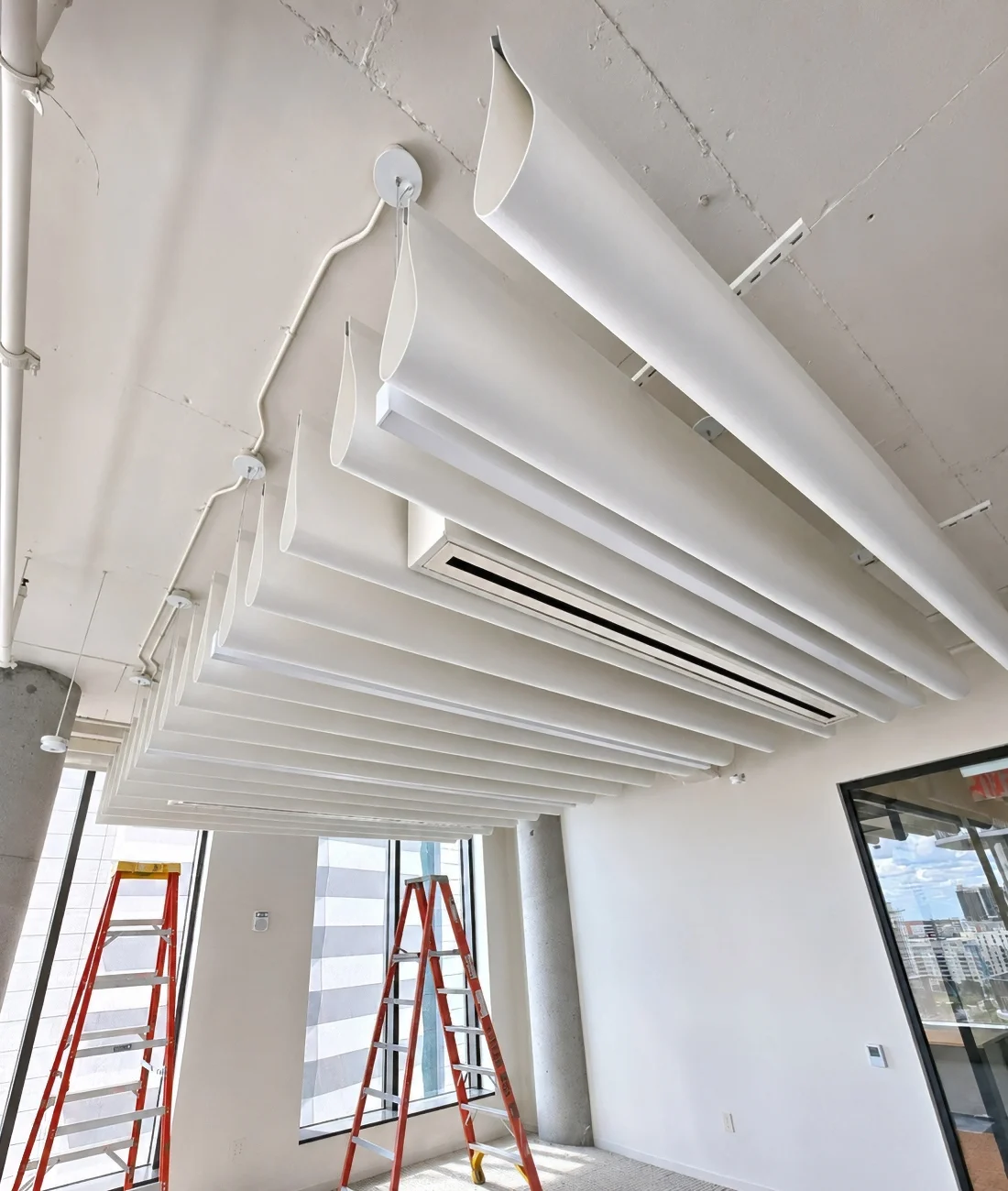
Drop-design ceiling baffles dropped over zones that needed both acoustic absorption and visual rhythm. Hanging vertically from the ceiling, each baffle absorbs on both faces, which is roughly twice the absorption per square foot compared with surface-mounted ceiling tile. The drop pattern broke up the open volume above the workstations and added the kind of visual layering that high-end office design relies on.
Our fabric-wrapped ceiling baffles work in the same role on similar projects when the design intent calls for a softer-finish baffle face. The Turf product reads cleaner in a high-end office context, but the absorption math is comparable.
Full-Coverage Felt Ceiling Panels
- Product: Acoufelt capped-framework felt ceiling panels
- Application: Full-coverage zones above corridors and feature spaces
- Finish: Pressed-felt face that integrates with high-end office finish palette
- Function: Higher-NRC absorption where the design called for solid ceiling plane
Felt ceiling panels covered the corridors and feature zones where the design called for a continuous ceiling plane rather than a suspended-grid look. The Acoufelt product carries acoustic absorption in the pressed-felt face itself, which means the ceiling reads as a clean finished surface while still doing the acoustic work the design needed.
Felt also handles the in-between zones where ceiling tile feels too utilitarian and a baffle would have read too busy. That middle aesthetic register is where the felt panel earns its place in the specialty ceiling vocabulary.
Conference-Room Stretched Fabric Wall
- System: Stretched fabric wall with Camira acoustically transparent fabric
- Substrate: 1 inch and 2 inch fiberglass options behind the fabric face
- Application: Conference room walls where speech-band absorption mattered most
- Finish: Reads as flush designed wall, no visible panel edges
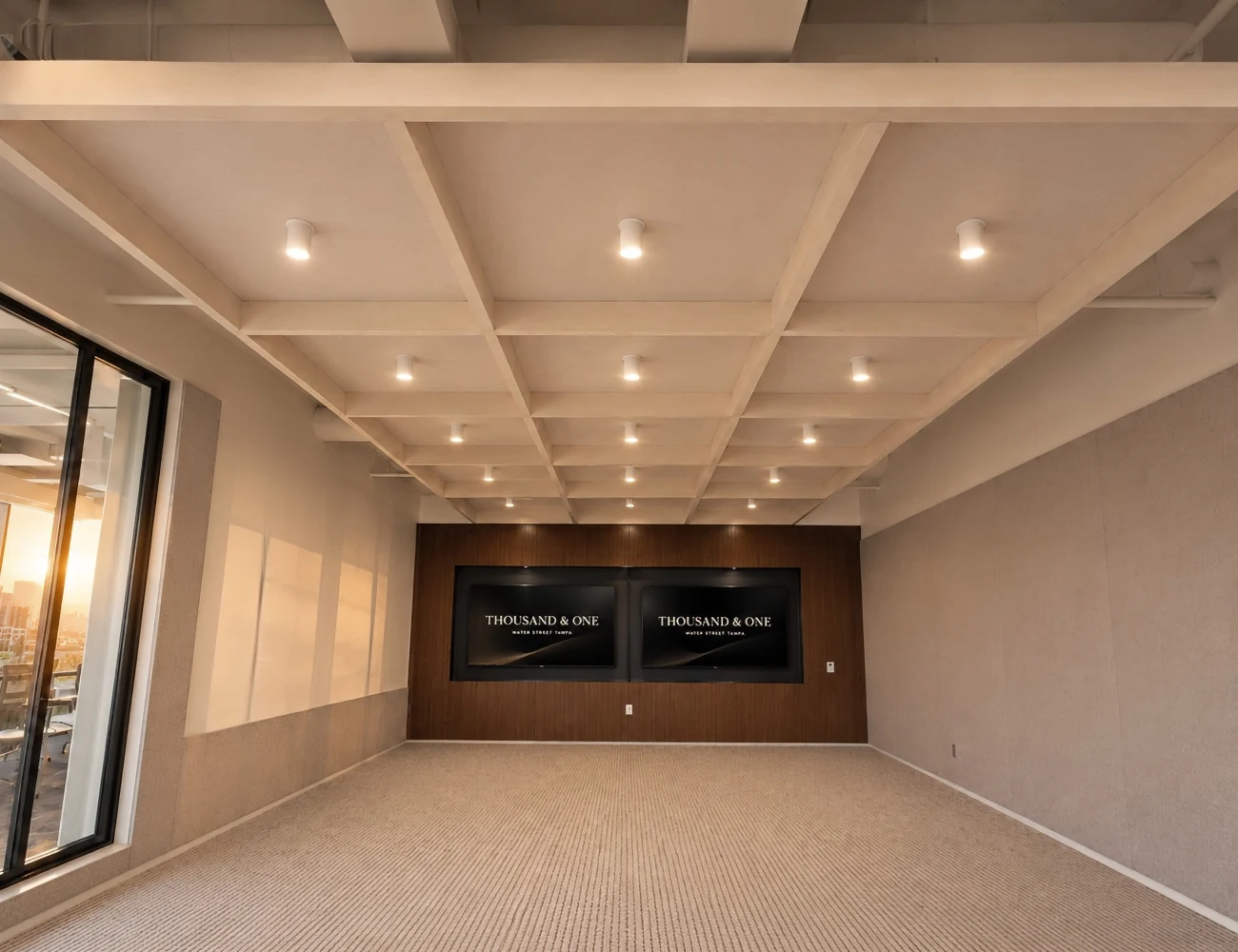
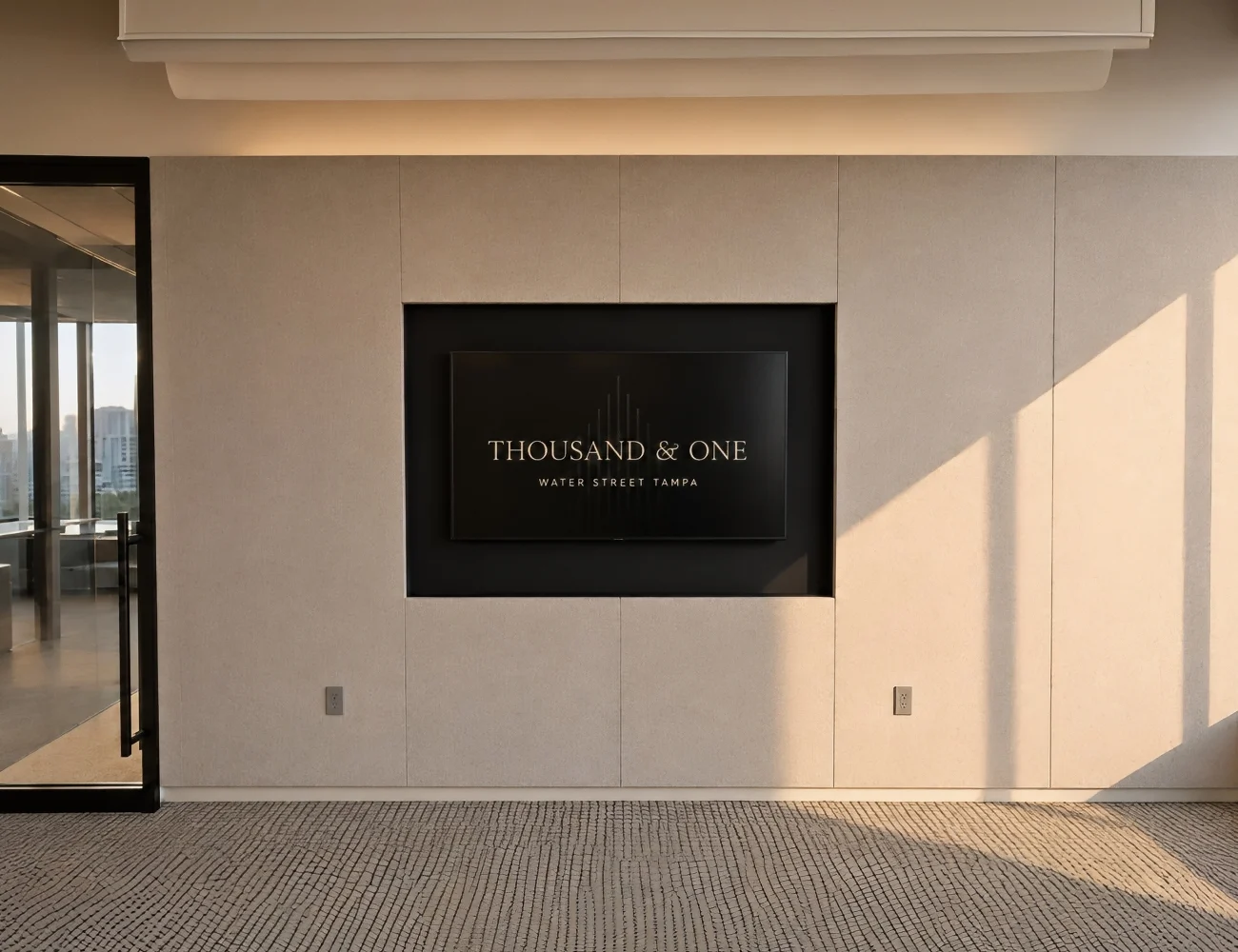
Conference rooms got acoustic fabric wall system treatment on the speech-facing wall plane. The Camira fabric carries the design finish, the fiberglass substrate behind it does the acoustic absorption, and the track profile keeps the fabric tensioned tight enough to read as a flush wall finish. No visible panel edges, no overlay aesthetic.
Fabric wall in conference rooms is the standard play because that is where speech intelligibility for in-person and virtual meetings has to land cleanly. The substrate thickness gets selected per room, with thicker substrate where low-frequency content from large displays or video conferencing needs absorption.
Installation Sequencing on an Active Build-Out
- Step 1: Rough electrical and HVAC complete
- Step 2: Ceiling grid hung, acoustic tile installed across the open field
- Step 3: Drop baffles and felt panels installed against finished tile field
- Step 4: Sprinkler heads dropped, then stretched fabric wall as the final finish layer
Installation sequencing matters more on a multi-system specialty ceiling job than on any single-product retrofit. Get the order wrong and trades work over each other, finish faces get damaged, and the punch list grows. The 12th-floor scope ran ceiling first, vertical accents next, sprinkler drops in the middle, fabric wall last. The TECO boardroom project documents the same fabric-wall-last sequencing on a smaller scope.
Coordinating with the GC is the part that makes or breaks the schedule. DPR ran the trade sequence and our crew slotted in at the right moment for each ceiling family. Repairs to the felt panels happened twice when electrical and sprinkler work conflicted with finished surfaces, which is normal for an active build-out and was anticipated in the scope.
Conclusion: Specialty Ceilings for a High-End Office
The 1001 Water Street build is the case for a full specialty ceiling scope on a high-end office, sequenced into the active tenant build-out rather than retrofitted afterward. Four ceiling and wall systems on one project, coordinated with electrical, sprinkler, and finish trades, delivered before the tenant occupied. The same multi-system approach lives across our office acoustic treatment work for Class A tenant builds.
FAQs: Specialty Ceilings for a High-End Office
What does a specialty ceiling treatment include?
A specialty ceiling treatment combines multiple acoustic ceiling systems on the same project. Typical components include acoustic ceiling tile for the field, drop-design baffles or clouds for visual layering, and full-coverage felt panels in areas needing higher absorption.
When is the right time to install specialty ceilings in a high-end office?
Pre-occupancy during the tenant build-out. Specialty ceiling work coordinates with electrical, sprinkler, and HVAC roughs, and retrofitting after furniture moves in usually requires removing finishes that were already installed.
Are stretched fabric walls only for conference rooms?
They work in any space where the wall plane needs a finished aesthetic and high acoustic absorption. Conference rooms are the most common location in office build-outs, but the same fabric-wall system also fits executive offices, board rooms, and lobby walls.
How do you sequence multiple acoustic ceiling systems on one project?
The acoustic scope follows the trade sequence. Rough electrical first, then ceiling grid, then acoustic tile, then baffles or felt panels, then sprinkler heads, then any final fabric wall work last so finish faces stay protected during overhead trade work.

Walker Peek|Founder & CEO, Commercial Acoustics
Walker founded Commercial Acoustics in 2013 to bring aerospace-grade engineering discipline to soundproofing, and runs the firm as CEO from its 12,000 sq ft Tampa production facility. The company designs custom acoustic panels, sound membranes, and masking systems for multi-family, hospitality, healthcare, and commercial projects across the US — built around Walker’s invention, Wall Blokker, an EVA-based sound barrier that hits STC 50-plus at roughly $1 per square foot installed.
A Jacksonville native, Walker spent five years at Kennedy Space Center with Craig Technologies before founding Commercial Acoustics — certifying aerospace manufacturing to the AS9100 standard and leading Six Sigma Black Belt process-improvement teams on NASA programs. He is a certified Industrial Noise Control Engineer and the author of Architectural Acoustics: A Practical Handbook.
