Table of Contents
Project Overview: Acoustic Treatment for the Pinellas Park Public Works Auditorium
- Project: Acoustic Treatment for a Multi-Purpose Public Works Auditorium
- Location: 6051 78th Ave N, Pinellas Park, FL 33781
- Facility Type: Municipal Training and Public Meeting Space with Retractable Partition
- Client: City of Pinellas Park, Public Works Department
- Objective: Reduce Reverberation from 2.5 Seconds toward a Working Meeting Range
- Scope: 5-Area Impulse Test, Sabine Calculation, 45 Wall-Mounted Panels
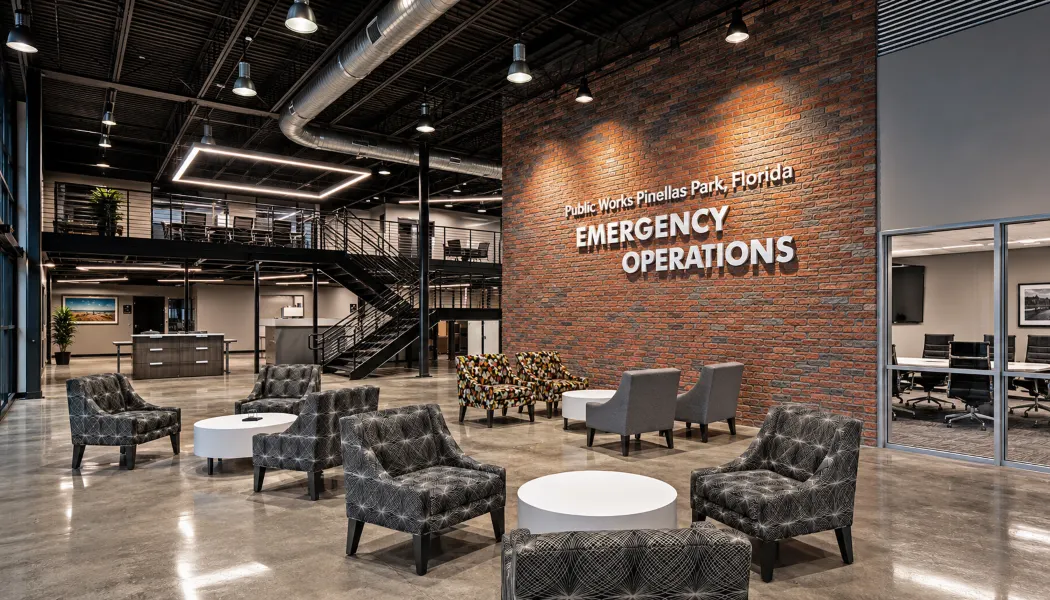
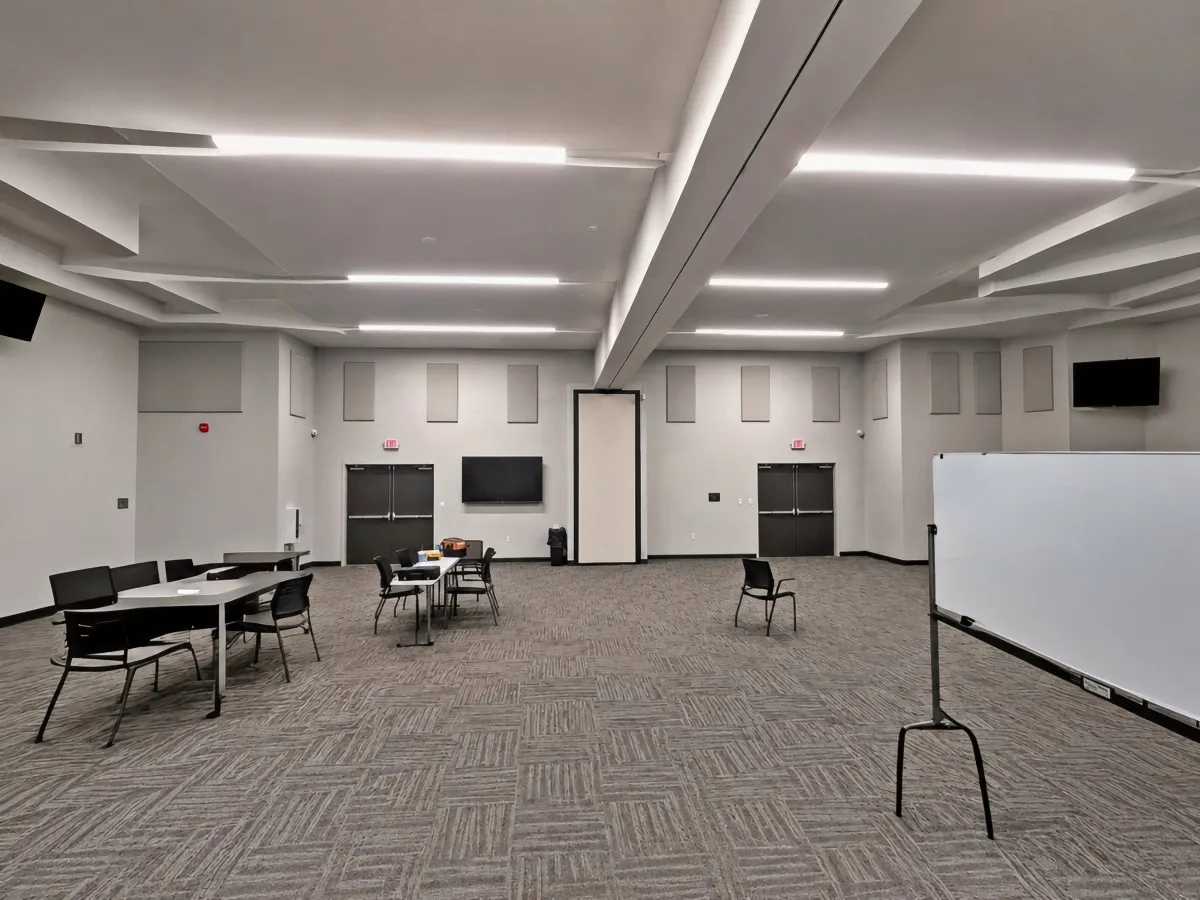
The Pinellas Park Public Works Department Public Works Department called Commercial Acoustics in to fix significant echo and reverb in their public works auditorium. The room functions as both a training space and a public meeting venue, splittable into two halves with a retractable wall divider, with hard finishes throughout.
Our scope opened with on-site reverberation testing across five different positions in the room, both with the central divider extended and retracted. Average broadband RT60 came in at 2.5 seconds, slightly longer at 500 Hz. From that baseline a Sabine calculation set the panel quantity at 45 acoustic absorption panels, sized 2 ft by 4 ft, mounted high on the perimeter walls.
Acoustic Challenges in a Multi-Purpose Municipal Meeting Space
- Pre-Treatment RT60: 2.5 seconds broadband, longer at 500 Hz
- Reflective Finishes: Drywall walls, drop ceiling, commercial carpet tile
- Use Pattern: Staff training, public meetings, briefings, with the partition open or closed
- Wall Obstructions: Air vents, exit signs, wall-mounted TVs, and the retractable partition track
Multi-purpose municipal meeting rooms have a harder acoustic profile than they look on the surface. Programming changes from week to week — staff training one day, a public hearing the next, an emergency briefing the night after — and the right reverberation target shifts with the program. Add a retractable partition that splits the room in half, and now there are effectively three different rooms to tune: the full open space and each of the two split-halves.
Above 2 seconds RT60, every program type breaks down. Speech intelligibility falls apart, video playback feels muddy, and meeting participants strain to follow conversation across the room. Our deep-dive on how the sound absorption coefficient is measured covers the math behind the panel quantity calculation.
Solution: 45 Wall-Mounted Acoustic Panels with Aesthetic Layout
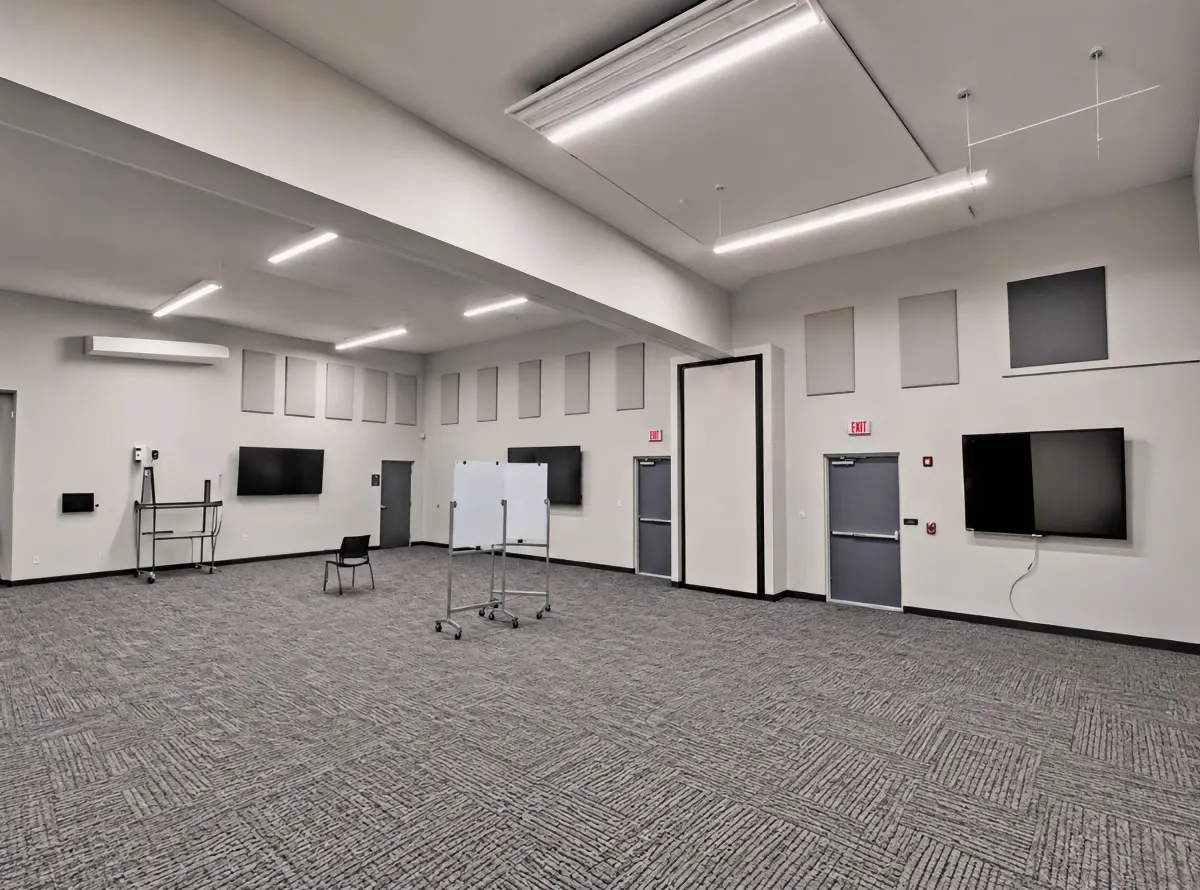
- Quantity: 45 acoustic absorption panels, 2 ft by 4 ft
- Mount: Wall-mounted high to reduce staining and damage from chairs and equipment
- Manufacturing: Built at our Tampa facility, delivered three weeks after order
- Layout: Even spacing on each wall, with per-wall pattern adjustments for obstructions
The panels here are from our standard acoustic absorption panel line. One detail most municipal facilities miss on a first acoustic install: mount height. We set the panels high on the wall, well above where chair backs, training tables, and rolling AV carts can hit them.
That keeps the fabric face out of daily traffic. The panels still look clean at year five instead of beat up by year two. The Layout was set up wall-by-wall, not as one global grid. Each wall has its own obstruction set: the retractable partition track on one face, wall-mounted TVs on another, exit signs and HVAC vents elsewhere.
Same panel count overall, different spacing per wall. From any single sightline in the room, the wall you are looking at reads as evenly spaced.
Auditorium Acoustics RT60 Targets and the Area Effect
Auditorium acoustics live and die on RT60 against the program type. A few reference windows cover most municipal multi-purpose spaces:
- Speech-First Meeting Rooms: 0.8–1.2 seconds. Tight enough to keep speech crisp.
- Multi-Purpose Auditoriums: 1.0–1.5 seconds. Compromises across all program types.
- Lecture and Training Halls: 1.0–1.3 seconds. Slightly tighter for amplified speech.
The Pinellas Park public works auditorium target landed in the multi-purpose window because the room carries both speech and amplified-program use. Target RT60 was set in the 1.0–1.3 second range with the divider open and slightly shorter with the divider closed (smaller volume per side).
The other variable that separates a working acoustic install from a mediocre one is the area effect. The effectiveness of an acoustic treatment is roughly proportional to the perimeter of the treatment divided by the surface area of the treatment. In plain terms, spreading the same panel count across the room evenly absorbs more sound than clumping the same number of panels into a single corner. Direct and reflected sound waves both have to find absorption to be converted to heat, and a more distributed panel layout gives them more chances. Our room acoustics calculator with Sabine math handles the prediction side of this calculation.
Working Around Air Vents, Doors, and Retractable Partitions
Public works facilities almost never give an acoustic crew a clean wall to mount on. The Pinellas Park job had air vents at the high band, exit signs over both door pairs, wall-mounted TVs across one face, and the retractable partition track running the entire ceiling-to-wall transition on the opposite face. Each of those is an obstruction that breaks an even panel grid.
Our practice on rooms like this is to set the panel rhythm wall-by-wall rather than chase a global symmetry that would never survive the first vent. Each wall gets its own even spacing across the panels that fit, accounting for that wall’s specific obstruction set. From the floor of the room, every wall looks rhythmically consistent within itself; the eye does not register that the wall opposite has a slightly different spacing logic. A sister write-up that covers similar acoustic-detail thinking in government and civic environments lives at our acoustic treatment for courthouses and government spaces guide.
Results: 55% Reverberation Reduction
- Pre-Treatment RT60: 2.5 seconds
- Post-Treatment RT60: 1.2 seconds
- Reverb Reduction: 55% drop
- Outcome: Working speech intelligibility for both training and public meetings
Post-install impulse testing across the same five positions used in the baseline returned an average RT60 of 1.2 seconds. That is inside the multi-purpose meeting room window and represents a 55 percent drop against the 2.5-second baseline. Speech intelligibility came back across the full room footprint, training video playback cleared up, and public hearings stopped requiring the front rows to lean forward to follow the speaker.
Conclusion: Acoustic Treatment for Public Works Auditoriums
Public works auditoriums and other municipal multi-purpose meeting spaces almost always start with the same acoustic problem: hard finishes, large room volumes, and a programming mix that no single RT60 target will satisfy on its own. The fix is rarely complicated. Pick a target window in the 1.0 to 1.3 second range, run a Sabine calculation against the measured baseline, and mount the panel quantity that comes out of the math high on the perimeter walls.
The detail that separates a clean install from a forgettable one is the per-wall rhythm. Public meeting rooms collect obstructions over their lives — TVs, exit signs, retractable partitions, vents — and a panel layout that respects each wall’s specific geometry reads as architectural finish rather than acoustic gear. The area effect handles the rest: a distributed panel set absorbs more sound than the same panel count clumped in one corner.
Commercial Acoustics provides reverberation testing, panel design, and installation for public works departments, courtrooms, city halls, and other municipal meeting spaces across Florida and the Southeast. Most engagements run on a single off-hours install window so the facility stays in service.
FAQs: Public Works Auditorium Acoustics
What RT60 should a municipal auditorium target?
Speech-first meeting rooms target 0.8 to 1.2 seconds RT60. Multi-purpose auditoriums target 1.0 to 1.5 seconds. Lecture and training halls run slightly tighter at 1.0 to 1.3 seconds. The right number depends on the dominant program type for that room.
How many acoustic panels does a typical public meeting room need?
Panel count depends on room volume, finishes, and the RT60 reduction needed. The Pinellas Park public works auditorium came in at 45 panels of 2 ft by 4 ft to drop RT60 from 2.5 seconds to 1.2 seconds. A typical municipal meeting room lands somewhere between 30 and 60 panels.
What is the area effect in acoustics?
The area effect describes how the effectiveness of acoustic treatment is roughly proportional to the perimeter of the treatment divided by its total surface area. Spreading panels evenly across a room absorbs more sound than clumping the same panel count into one corner.
Can panel layout work around vents and retractable partitions?
Yes. Per-wall rhythm is the right approach. Each wall gets its own even spacing across the panels that fit, accounting for that wall’s obstruction set. The room reads as visually consistent from any single sightline even when each wall has slightly different spacing logic.

Walker Peek|Founder & CEO, Commercial Acoustics
Walker founded Commercial Acoustics in 2013 to bring aerospace-grade engineering discipline to soundproofing, and runs the firm as CEO from its 12,000 sq ft Tampa production facility. The company designs custom acoustic panels, sound membranes, and masking systems for multi-family, hospitality, healthcare, and commercial projects across the US — built around Walker’s invention, Wall Blokker, an EVA-based sound barrier that hits STC 50-plus at roughly $1 per square foot installed.
A Jacksonville native, Walker spent five years at Kennedy Space Center with Craig Technologies before founding Commercial Acoustics — certifying aerospace manufacturing to the AS9100 standard and leading Six Sigma Black Belt process-improvement teams on NASA programs. He is a certified Industrial Noise Control Engineer and the author of Architectural Acoustics: A Practical Handbook.
