Table of Contents
Project Overview: Law Firm Soundproofing
- Project: Confidential Speech Privacy Assessment for Adjacent Law Firm Suites
- Location: Class A multi-tenant office building, Sarasota, FL
- Tenants Tested: Two adjacent law firms across Suites 800, 840, and 860
- Standard: ASTM E336 airborne sound transmission field testing
- Wall Assembly: 25-gauge studs, 5/8 inch Type X gypsum each side, R-13 batt
- Performance Target: ASTC 38 for Confidential Privacy at Normal Voice Levels
Why Law Firms Need a Higher Soundproofing Standard
Two adjacent law firms in a Class A Sarasota office building shared a demising wall and a problem. Voices from one suite were intermittently audible in the other. Conversations were not loud. The walls were not thin. The construction documents looked correct on paper.
Commercial Acoustics was retained by the property manager to find the actual sound path and recommend a fix that would restore confidential speech privacy without a full demolition.
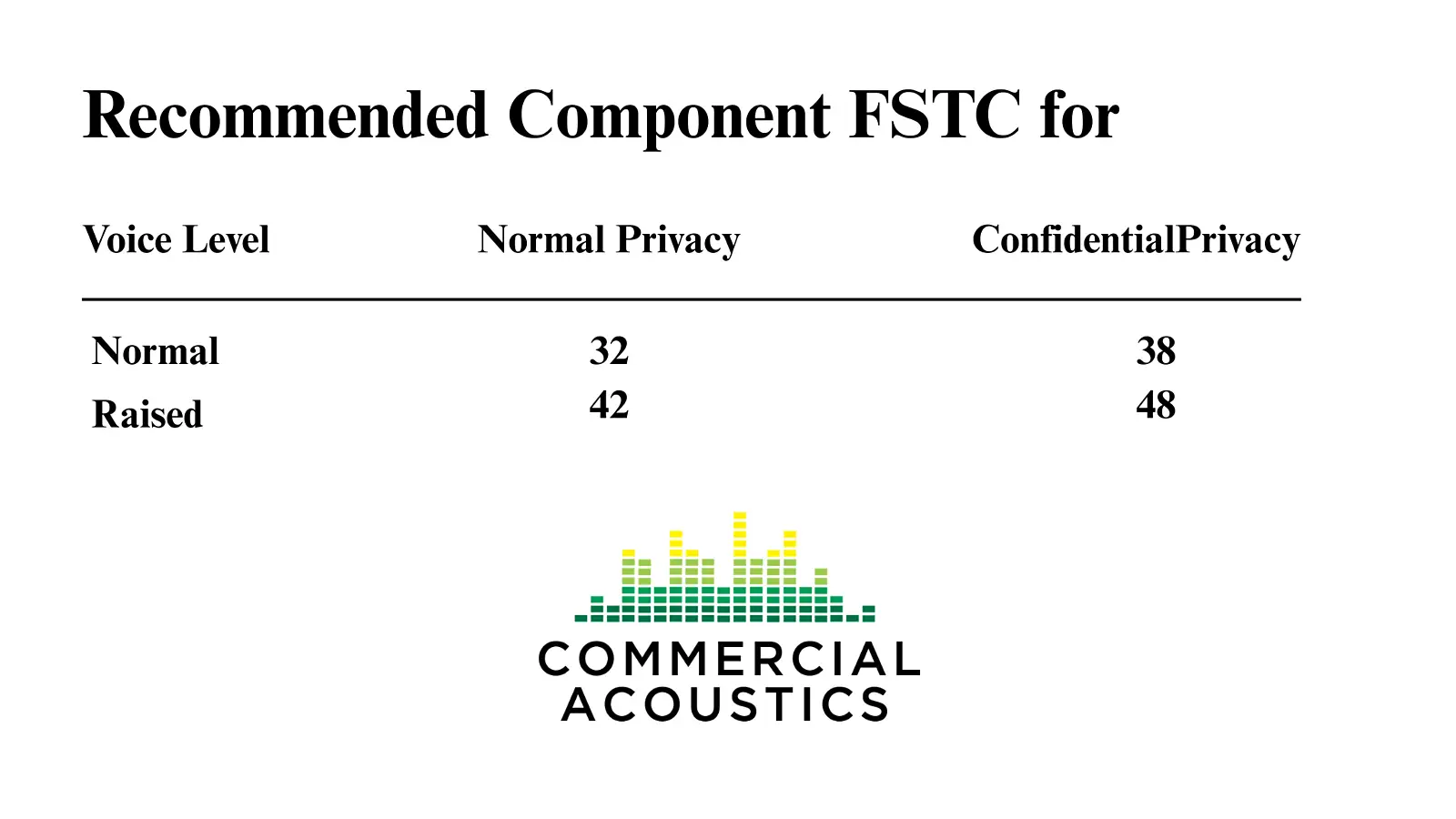
Most office tenants can live with an ASTC of 35. Voices are audible as a low murmur but words cannot be made out. For a law firm, that floor is not enough. Attorney-client privilege, opposing-counsel calls, and HR conversations all require what acousticians call confidential privacy.
The accepted ASTC threshold for confidential privacy at normal voice levels is 38. For raised voices and depositions, the target rises to 45 or higher. Standard speculative office construction rarely targets either number. That gap is the entire reason this project existed.
Three Walls, Same Construction, Different Numbers
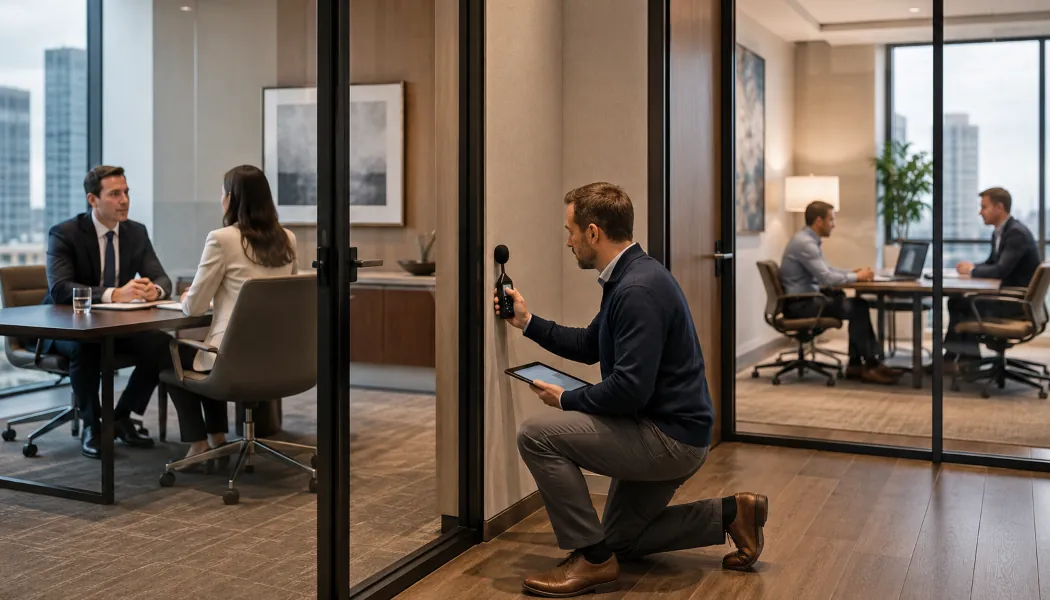
We performed three airborne sound tests per ASTM E336, the field standard for measuring sound transmission between rooms. The same wall assembly was tested in three locations within the same building. The results were not consistent.
| Test Location | Measured ASTC | Δ vs Target (38) | Confidential Privacy |
|---|---|---|---|
| Suite 840 to Suite 860 | 43 | +5 | ✅ Pass |
| Suite 840 to Suite 800 | 39 | +1 | ⚠️ Marginal |
| Suite 840 Conference to Office | 37 | −1 | ❌ Fail |
Six points of variance from the highest to the lowest result. The wall is identical in all three locations. Something else is moving the number.
To model how a target ASTC translates to real wall construction, our STC calculator walks through the assembly trade-offs side by side.
The Real Sound Path Was the Window Frames
Walking the perimeter with a sound level meter, the dominant flanking path became obvious. The exterior wall used a continuous extruded aluminum window mullion system, only one-eighth of an inch thick. That mullion runs uninterrupted past every demising wall in the building.
Sound enters the mullion in one suite, travels along the aluminum, and re-radiates into the next suite. The demising wall is bypassed entirely. Mass alone determines how much sound a thin panel transmits, and one-eighth-inch aluminum has almost none.
Secondary flanking was identified at the baseboards, where small air gaps between the gypsum and the slab allowed a low level of leakage. The plenum above the ceiling tile was tested and ruled out. No flanking path through the ceiling.
Recommendations: Treat the Flanking First
- Mullions: Apply a mass-loaded membrane to both interior faces at the demising wall intersection
- Baseboards: Remove existing base, run a continuous bead of acoustical sealant along the wall-to-slab joint, reinstall
- Walls (Optional): Add one layer of 5/8 inch Type X gypsum to the office side of the worst wall for 3 to 5 ASTC point gain
- Sound Masking (Optional): Pink-noise system tuned to NC-40 in private offices to mask residual transmission once flanking is closed
The fix order matters. Adding another layer of drywall to a wall that is being bypassed by a mullion will not move the ASTC number. The flanking path has to close first.
For mullion mass, we specify Wall Blokker mass-loaded vinyl membrane as the standard treatment. Closing the mullion path alone is projected to bring the worst wall (ASTC 37) up to 41 to 43 — into the confidential privacy range without touching the wall itself.
For the masking layer, a commercial sound masking system covers any residual speech that survives the flanking fix.
ASTC Targets by Office Tenant Type
Not every office needs the same number. The target should match what is being said in the room. The table below maps the working windows across four common office tenant types.
| Tenant Type | ASTC Target | Speech Privacy Outcome |
|---|---|---|
| General Open Office | 35 | Voices audible as murmur, words unintelligible |
| Executive Office | 40 | Normal speech inaudible, raised voices muffled |
| Law Firm, HR, Medical Intake | 45 | Full confidential privacy at normal and raised voices |
| Deposition Room, SCIF-Adjacent | 50+ | Speakerphone and shouted speech inaudible |
For more on how STC numbers translate into the real-world experience of speech privacy, see the STC rating chart.
Why ASTM E336 Field Testing Matters Before You Spend
Lab-rated STC numbers come from idealized assemblies built in isolation. Field-tested ASTC numbers come from the actual wall in the actual building, with all of its real-world flanking paths included. The two numbers are almost never the same.
For this Sarasota project, the lab STC of the tested assembly is rated near 45 per the ASTM E336 standard. The field ASTC measured between 37 and 43. The delta is the flanking.
Without the field test, the property manager would have specified another layer of drywall, paid for the work, and watched the number barely move. An ASTM E336 test is the cheapest line item on a soundproofing project, and the only one that tells you what to actually fix.
Conclusion: Confidential Office Soundproofing Done Right
Law firms cannot run on hope when it comes to speech privacy. The wall on the drawing is rarely the wall in the field, and the flanking paths around it almost always carry more sound than expected. A short ASTM E336 test, an honest read of the perimeter mullion and baseboard conditions, and a targeted fix — in that order — restore confidential privacy without rebuilding the suite. Talk to an acoustical engineer about a field assessment before the next tenant move-in.
FAQs: Law Firm Soundproofing
What ASTC rating does a law firm office actually need?
For confidential conversation at normal voice levels, ASTC 38 is the floor and 40 to 45 is the working target. Deposition rooms and partner offices should aim for 45 or higher to keep raised voices and speakerphone calls inaudible to the next suite.
Can window mullions really carry sound between offices?
Yes, and they often dominate the result. A continuous aluminum mullion has very little mass and runs past every demising wall in a building. Sound enters in one suite, travels the metal, and re-radiates into the next.
Is sound masking enough on its own for a law firm?
Sound masking helps once the flanking paths are closed, but it is not a substitute for ASTC. Masking raises the background noise floor so quiet speech is harder to follow. If voices are still audible above the masking, the wall still needs work first.
How much does an ASTM E336 office sound test cost?
A single demising wall field test typically runs from one to three thousand dollars depending on travel, number of test pairs, and reporting requirements. It is the cheapest step in any soundproofing project and the only one that confirms whether a planned fix will actually work.

Walker Peek|Founder & CEO, Commercial Acoustics
Walker founded Commercial Acoustics in 2013 to bring aerospace-grade engineering discipline to soundproofing, and runs the firm as CEO from its 12,000 sq ft Tampa production facility. The company designs custom acoustic panels, sound membranes, and masking systems for multi-family, hospitality, healthcare, and commercial projects across the US — built around Walker’s invention, Wall Blokker, an EVA-based sound barrier that hits STC 50-plus at roughly $1 per square foot installed.
A Jacksonville native, Walker spent five years at Kennedy Space Center with Craig Technologies before founding Commercial Acoustics — certifying aerospace manufacturing to the AS9100 standard and leading Six Sigma Black Belt process-improvement teams on NASA programs. He is a certified Industrial Noise Control Engineer and the author of Architectural Acoustics: A Practical Handbook.
