
Table of Contents
Project Overview: Police Interview Room Acoustic Treatment
- Project: Ceiling-Mounted Acoustic Panel Install in Police Interview Rooms
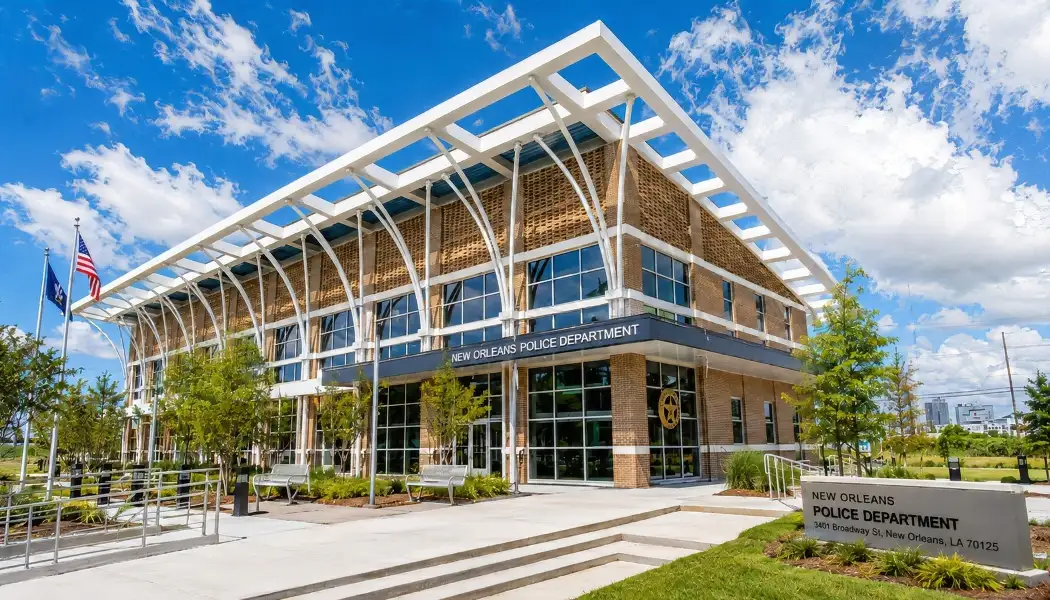
- Location: 3401 Broadway St, New Orleans, LA 70125
- Facility Type: Police Interview Rooms, Speech-Critical Use
- Client: New Orleans Police Department, via Concordia (Architect)
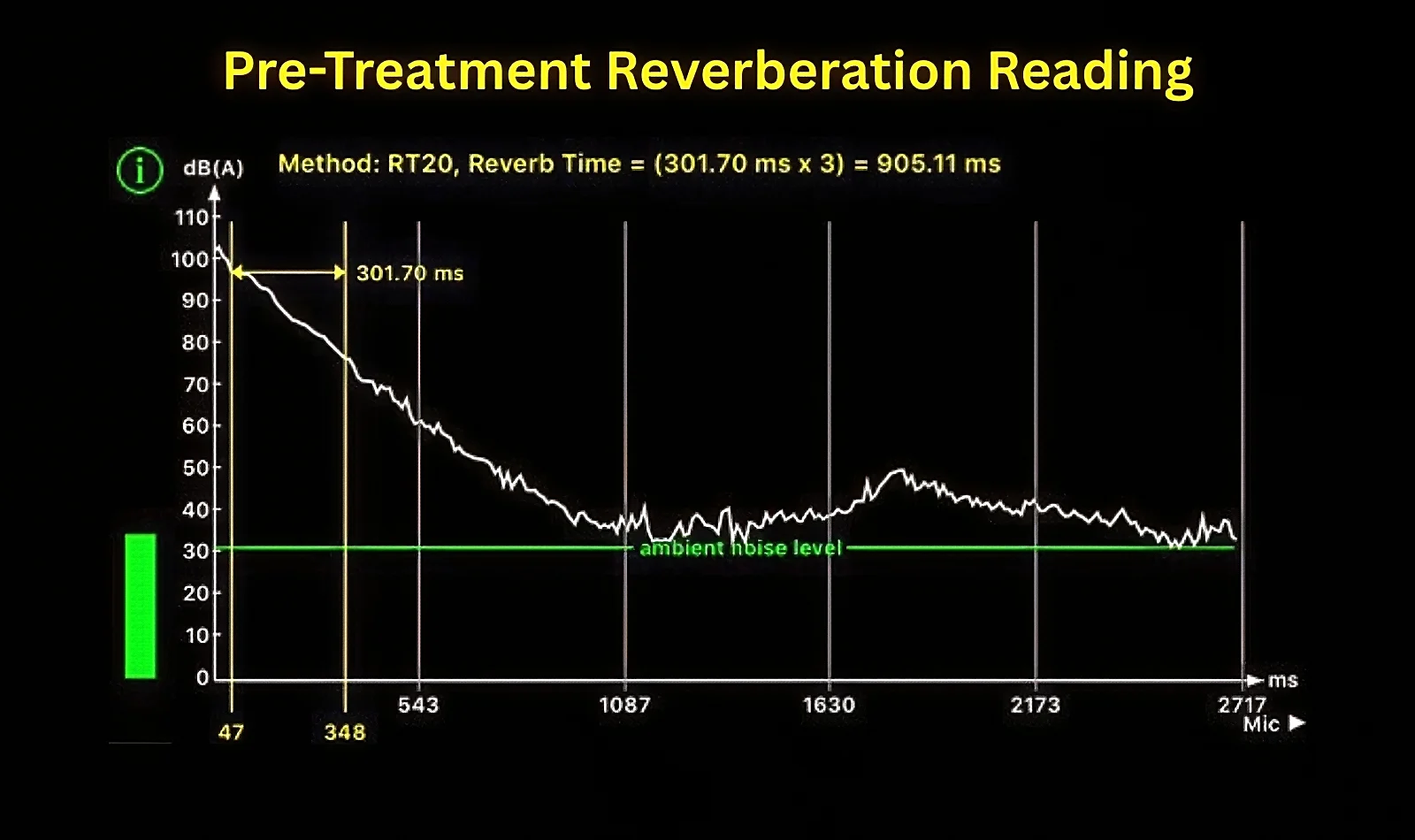
- Pre-Treatment RT60: 0.9 seconds (above the speech-clarity range)
- Scope: RT60 Baseline, Panel Specification, Ceiling Install, Post-Test Verification
Why Police Interview Rooms Need Acoustic Treatment
The architect Concordia, the NOLA architecture firm on the NOPD project, called us in once it became clear the interview rooms in the Broadway Street building were not going to deliver usable speech recordings without help. The rooms were the standard small, hard-finished spaces every police department ends up with — drywall on every face, a hard ceiling, minimal soft furnishings, and an RT60 measured at 0.9 seconds before any treatment.
That number is a problem in any speech-critical room. Reverberation above 0.6 seconds smears consonants together — the difference between a clean recording and one that an attorney will challenge in court. Police interview rooms have to clear a higher bar than a typical conference room because the recording is the deliverable. If the audio is unintelligible, the work product is unusable.
Reverberation Test: 0.9 to 0.5 Seconds
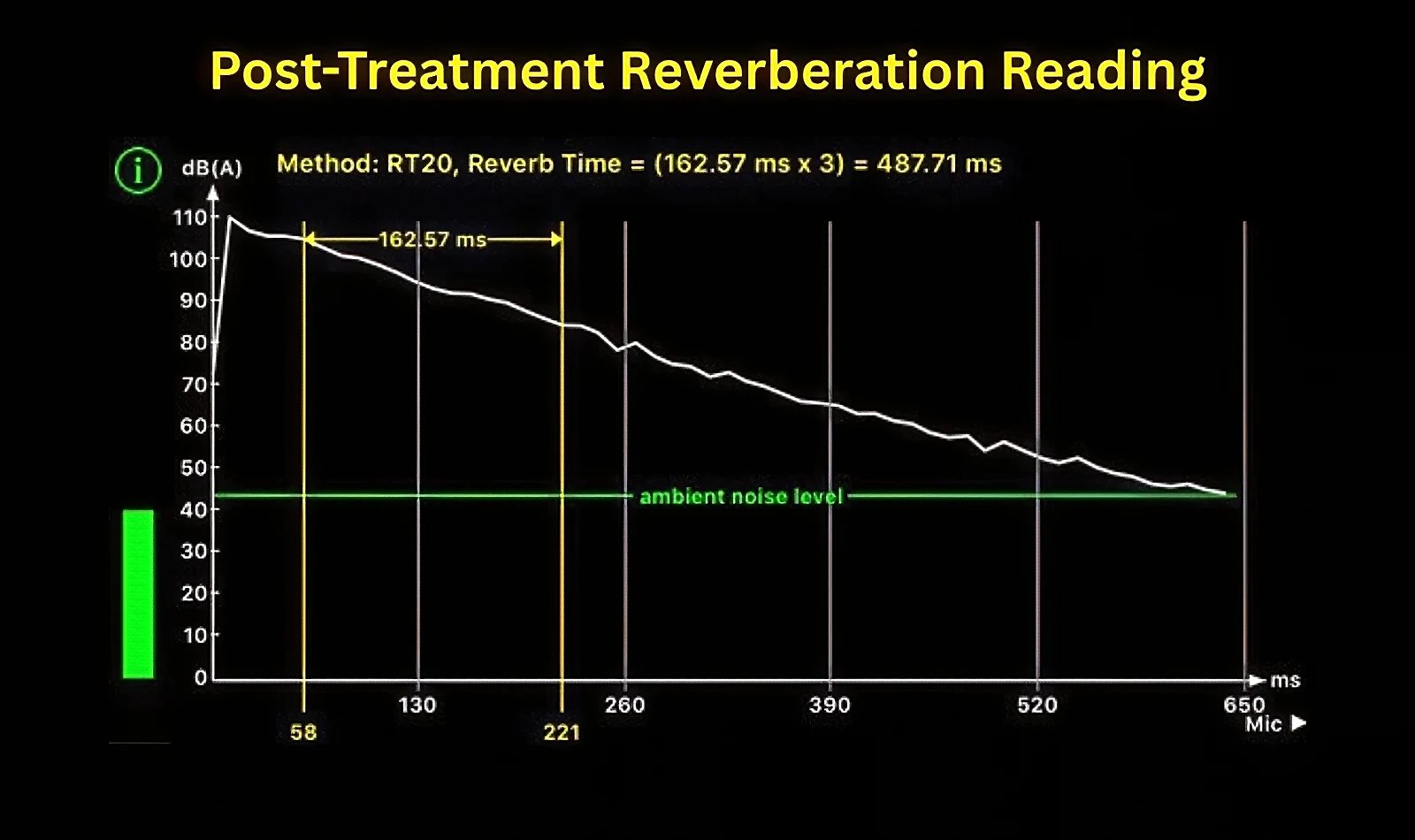
- Pre-Treatment RT60: 0.9 seconds, above the speech-clarity range
- Post-Treatment RT60: 0.5 seconds, well inside the target window
- Reduction: 44 percent drop in reverberation time
- Target Window: 0.4 to 0.6 seconds for speech-recording rooms
Post-install testing returned 0.5 seconds RT60 across the treated rooms — squarely inside the 0.4 to 0.6 second band where speech intelligibility holds up on a recording. The 44 percent reduction is consistent with a ceiling-only absorption strategy in a small room: the ceiling is the largest single reflective surface, and treating it removes the dominant first-reflection path before it gets into the microphone.
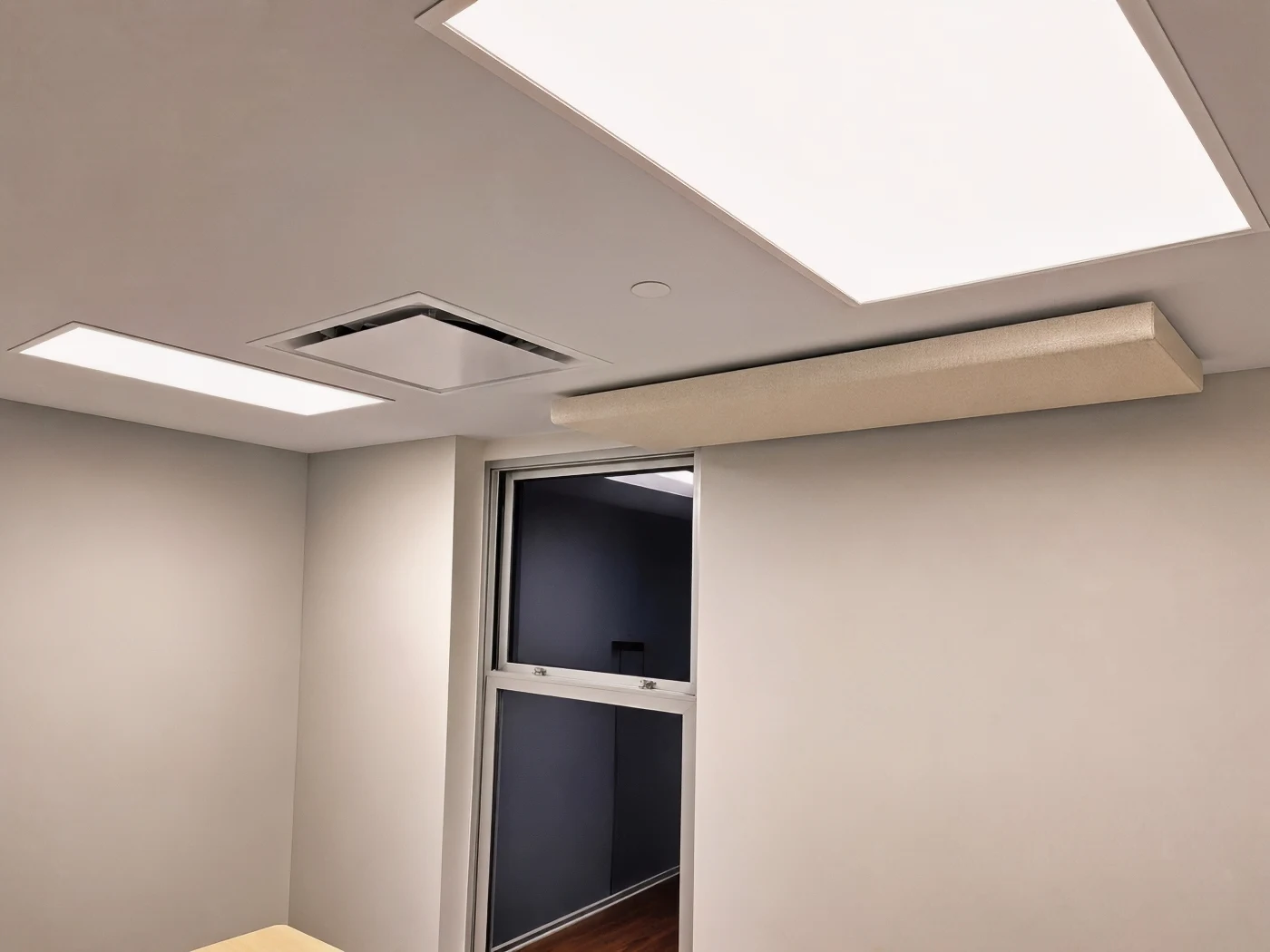
Ceiling-Mounted Absorption Panel Specification
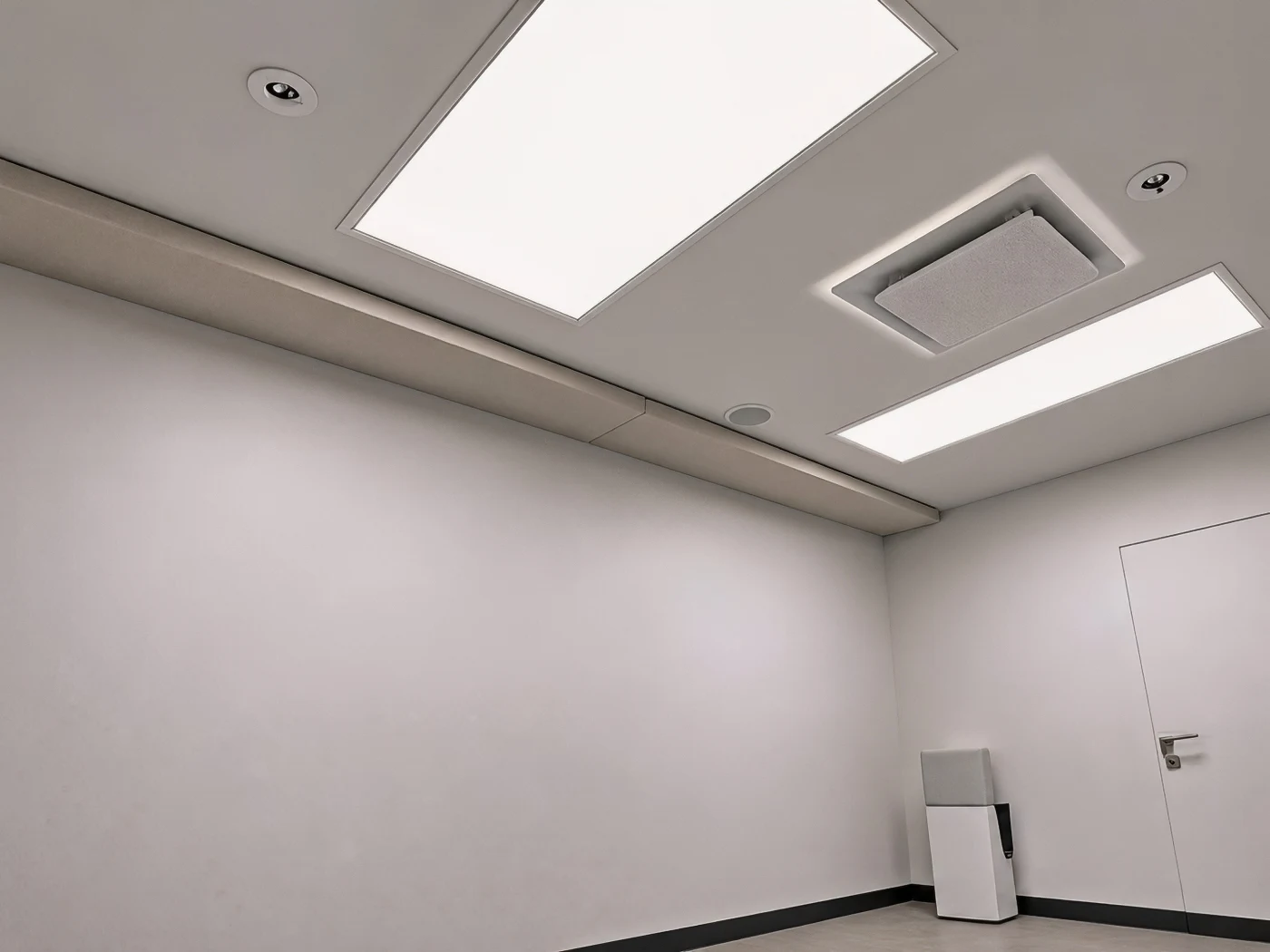
- Mount: Direct-mounted to the ceiling, no suspension hardware
- Panel Type: Acoustic absorption panel with NRC 1.00 rating
- Coverage: Full ceiling treatment to maximize absorption per square foot
- Fabric Face: Acoustically-transparent, durable enough for a working facility
The product specified was a standard ceiling-mounted acoustic absorption panel at NRC 1.00, sized to fit the room ceilings without an awkward layout. Direct ceiling mount kept the install clean — no suspension grid to drop the room ceiling, no gap behind the panel that would change the absorption math. In a police interview room, every inch of ceiling height matters because the rooms are already small.
Full ceiling coverage was the right call given how small these rooms are. Partial coverage in a small speech-critical room ends up uneven — one corner reads clean, another still smears. Treating the entire ceiling face evens out the response across the room and removes the variability that would show up on the audio recording.
Why Absorption (Not Sound Masking) Was the Right Tool Here
- Absorption: Cleans up audio inside the room (reverb, echo, smear)
- Sound Masking: Prevents transmission outside the room (speech privacy)
- NOPD Need: Audio quality, not transmission control
- Buffer Zone: Hallway and adjacent spaces handled transmission already
Sound masking and absorption solve different problems in the same room. Absorption attacks reverberation inside the four walls — the smear that ruins a recording. Sound masking raises the noise floor in adjacent spaces so a conversation inside the interview room cannot be heard from outside it. NOPD needed the first one. The Broadway Street building has buffer corridors and adjacent admin space outside the interview rooms, so transmission was not a concern; speech was already inaudible elsewhere.
For a sister project where the speech-privacy side of the equation was the dominant concern, see the Miami-Dade police interview rooms case study. Same room type, opposite acoustic priority. The two posts together cover the full absorption-vs-masking decision tree for a law enforcement design team.
Acoustic Treatment Across Law Enforcement Facilities
- Police Interview Rooms: Absorption-first for clean audio recording
- Sheriff and Court Offices: Sound masking for speech privacy in open plan
- Detention and Holding Areas: Hard-surface ceilings with selective absorption
- Courtrooms: Mixed treatment for both intelligibility and decorum
Law enforcement facilities run a wider acoustic range than most building owners realize. The same agency might need absorption in interview rooms, sound masking in open-plan admin, hard ceilings with selective treatment in holding areas, and full courtroom acoustics in a hearing space — all in one building. Each decision depends on whether the priority is intelligibility inside the room or transmission to adjacent spaces.
For the masking side of this catalog, the Orange County Sheriff sound masking project covers an open-plan admin floor. For the courtroom side, the acoustic treatment for courthouses guide walks through the panel and ceiling decisions for a working hearing room.
Conclusion: Police Interview Room Acoustic Treatment
Ceiling-mounted absorption panels at NRC 1.00 dropped the NOPD interview rooms from 0.9 seconds RT60 to 0.5 seconds — a clean 44 percent reduction that landed inside the 0.4 to 0.6 second window where speech recordings hold up under scrutiny. The right tool selection (absorption, not masking) followed from the actual problem (audio quality inside the room, not transmission outside it). Departments running into similar audio quality issues on their own interview rooms can scope acoustic treatment for your facility with our team.
FAQs: Police Interview Room Acoustic Treatment
What RT60 should a police interview room target?
Police interview rooms should hit 0.4 to 0.6 seconds RT60. Below 0.4 the room sounds dead and uncomfortable to sit in for a long interview. Above 0.6 the reverberation smears consonants together, which is the difference between a clean recording and one an attorney can challenge. The NOPD rooms here landed at 0.5 seconds.
When does a police interview room need sound masking versus absorption?
Absorption fixes audio quality inside the room. Sound masking prevents transmission outside the room. If the recording is the priority, absorption is the right tool. If keeping conversations from being overheard in adjacent spaces is the priority, sound masking is the right tool. NOPD needed the first because the building already had buffer corridors handling transmission.
Can panels be ceiling-mounted only, or do walls also need treatment?
In a small interview room, ceiling-only absorption usually does the job. The ceiling is the largest single reflective surface and treating it removes the dominant first reflection. The NOPD rooms went ceiling-only and hit the target. Larger rooms or rooms with unusually hard wall finishes may need wall panels added.
Who specifies acoustic treatment on a police facility project?
Usually the architect of record, sometimes with an acoustic consultant brought in for the speech-critical rooms. On the NOPD Broadway project, Concordia handled the architecture and brought us in for the interview room treatment specifically. Most law enforcement projects follow that same split: architect drives the design, acoustic specialist scopes the panel package.
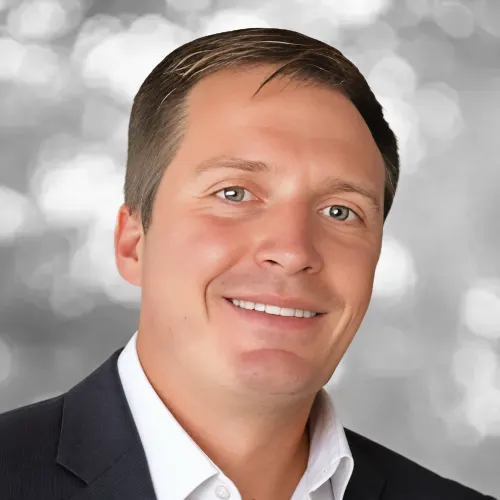
Walker Peek|Founder & CEO, Commercial Acoustics
Walker founded Commercial Acoustics in 2013 to bring aerospace-grade engineering discipline to soundproofing, and runs the firm as CEO from its 12,000 sq ft Tampa production facility. The company designs custom acoustic panels, sound membranes, and masking systems for multi-family, hospitality, healthcare, and commercial projects across the US — built around Walker’s invention, Wall Blokker, an EVA-based sound barrier that hits STC 50-plus at roughly $1 per square foot installed.
A Jacksonville native, Walker spent five years at Kennedy Space Center with Craig Technologies before founding Commercial Acoustics — certifying aerospace manufacturing to the AS9100 standard and leading Six Sigma Black Belt process-improvement teams on NASA programs. He is a certified Industrial Noise Control Engineer and the author of Architectural Acoustics: A Practical Handbook.
