

Table of Contents
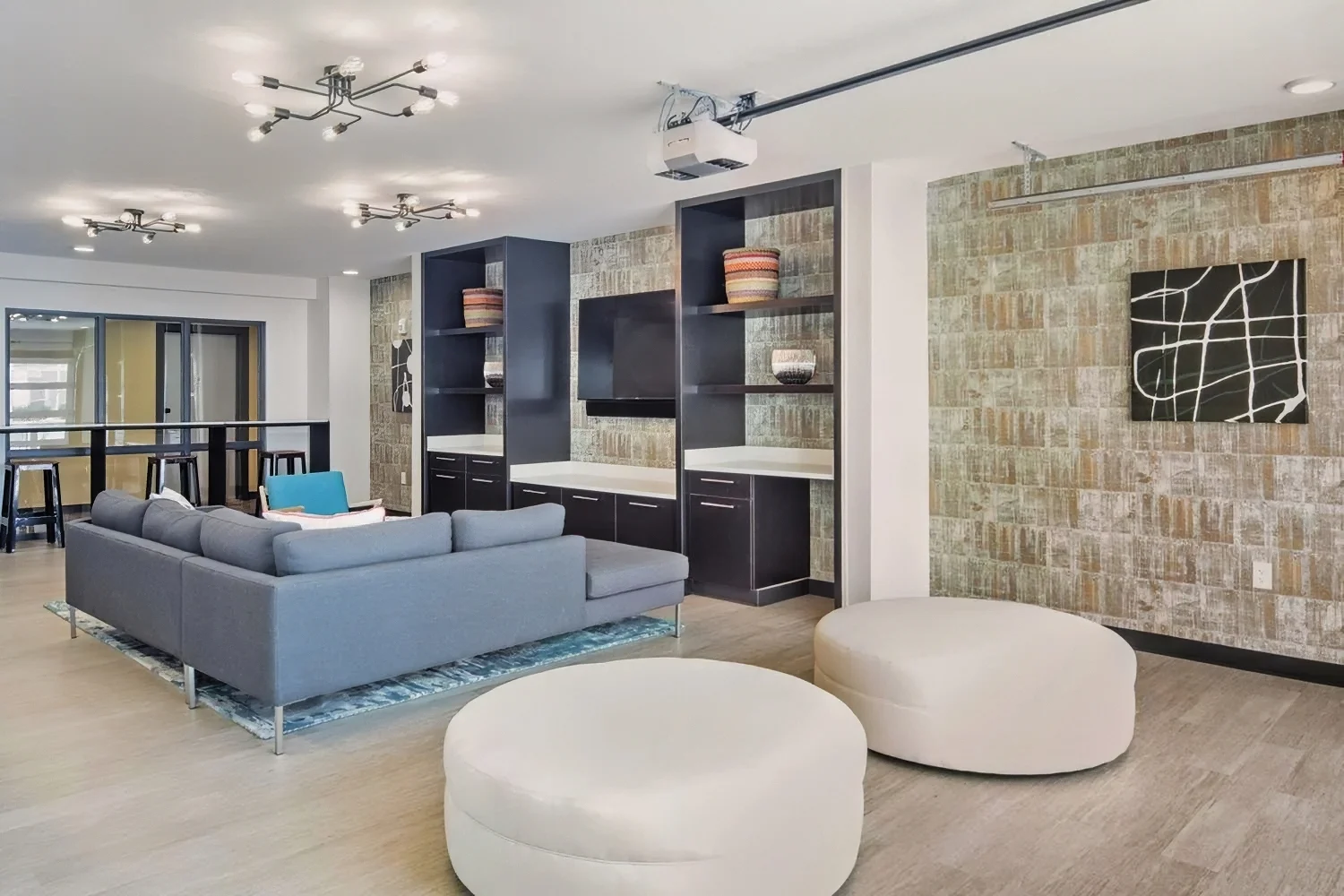
Project Overview: Evolve Student Apartments Auburn
- Project: Evolve Student Apartments demising wall soundproofing
- Developer: CA Ventures (national student housing builder)
- Architect: Westand Wright
- Location: Downtown Auburn, AL (Auburn University campus edge)
- Building: 9-story wood-frame student apartment complex
- Spec: 1/8″ Wall Blokker membrane on wood-stud demising walls
- Target: STC 50+ between adjacent units, code-minimum efficient
Student housing acoustics is its own discipline. The Evolve project sits across the street from Auburn University and runs nine stories of wood-frame construction with adjacent units sharing demising walls. The developer’s challenge was hitting code-minimum STC 50 efficiently across hundreds of demising walls without burning the build schedule on stacked drywall labor.
Commercial Acoustics was retained during the design phase to spec a faster, lower-labor demising wall assembly. The answer was Wall Blokker membrane installed directly on wood studs, eliminating the second drywall layer that the original spec called for.

Why Student Housing Acoustics Is Different
Luxury condo acoustics chases higher and higher STC numbers because residents have money and expectations. Student housing has the opposite economic shape. The developer is building hundreds of units that need to clear code, lease at competitive rent, and survive a 24-hour-a-day use cycle. The acoustic target is STC 50, not 58.
The use case is also different. Student housing means roommates, group study sessions, music, late-night socializing, and the occasional 3 AM walk to the elevator. The noise is high-frequency, speech-band, and constant. A wall that clears STC 50 reliably across that traffic is more valuable than a wall that hits STC 55 on a paper spec but barely passes a field test.
And the developer pays for it. Not the resident. Which means the value equation is build-cost-per-unit and schedule, not luxury finish or boutique consulting. The acoustic scope has to fit that constraint or it does not get specified.

The Wood-Stud Demising Wall Problem
Most multi-family soundproofing case studies focus on metal-stud demising walls. Student housing built under modern Type IV or platform-framed wood construction uses wood studs, a constraint that also appears in hotel retrofit work such as this wood-frame STC 50 wall assembly. The acoustic math is different. Wood studs are heavier and stiffer than light-gauge steel, which couples drywall faces more efficiently and transmits more sound through the assembly.
The default fix on a wood-stud wall is to stack drywall layers. Two layers per side, sometimes three. That clears STC 50 reliably but stacks up on labor cost, taping passes, finish coats, and wall thickness across hundreds of units. On a project the size of Evolve, the per-wall delta compounds into hundreds of thousands of dollars and weeks of schedule.
A mass-loaded vinyl membrane decouples that math. The membrane delivers dense surface mass without the install passes of a second drywall layer. Wood studs benefit more than metal because they carry vibration more efficiently, so the decoupling effect is larger.

Wall Blokker Membrane on Wood Studs: STC 50 Without Multiple Drywall Layers
- Membrane: 1/8″ Wall Blokker mass-loaded vinyl on the wood studs
- Drywall: Single layer of 5/8″ Type X each side over the membrane
- Result: STC 50+ on the demising wall, code clear
- Install Advantages: No seam taping on the membrane, faster than stacked drywall
The architect’s original spec called for stacked drywall on both faces of the demising wall to clear STC 50. The substitution put Wall Blokker on the studs first, then a single layer of 5/8″ Type X each side. Total wall thickness ended up close to the original spec, but the install hours dropped substantially per wall.
Membrane install on wood studs is straightforward. The product staples or screws directly to the framing, no seam tape, no skim coat, no second pass. The drywall crew comes in once instead of twice.
STC Targets by Multi-Family Housing Type
Not every multi-family build calls for the same STC. The table below maps the working windows that an acoustic scope should design to.
For a luxury-tier comparison case using the same product family at higher target, see the condo soundproofing retrofit STC 58 case.

Why Developers Choose Membrane Over Stacked Drywall
- Labor: Single drywall pass per side instead of two, no taping on the membrane
- Schedule: Drywall crew completes the demising wall in one rotation
- Wall Thickness: Comparable to the stacked-drywall spec, preserves leasable floor area
- STC Predictability: Membrane-plus-drywall assembly behaves consistently across wood-stud variations
On a 9-story student housing build with hundreds of demising walls, the per-wall labor and schedule delta compounds. Each wall that runs faster is a unit that delivers sooner, and student housing pre-leases for the academic year cycle. Missing the August move-in window because the drywall trade was overcommitted is the kind of mistake that costs a developer real money.
For developers running modular or panelized construction on the same housing type, the parallel case is the modular construction STC lab testing study.
What Student Housing Developers Should Spec Before Framing
- STC Target: STC 50 minimum, locked into the architectural drawing set
- Wall Assembly: Membrane on wood studs plus single 5/8″ Type X each side
- Penetrations: Outlets, switches, plumbing chases caulked at the membrane plane
- Floor Underlayment: IIC 50 minimum to pair with the wall STC for true unit isolation
- Field Verification: Sample ASTM E336 field test on the first completed unit-pair
Conclusion: Student Housing Soundproofing Done Right
Student housing demising walls do not need luxury STC numbers. They need a code-clear STC 50 that holds up across hundreds of identical wall sections and a 24-hour occupant cycle. The Evolve project did that by substituting Wall Blokker membrane for a second layer of drywall on every demising wall in a 9-story wood-frame build, saving labor passes and clearing schedule without compromising the acoustic target.
If you are scoping a student housing project on a developer schedule, Commercial Acoustics handles the spec, the substitution math, and the field verification as one scope.
FAQs: Student Housing Demising Wall Soundproofing
What STC rating does student housing need?
STC 50 between adjacent units is the working target for student apartments and most code jurisdictions. Dormitories sometimes accept STC 45 as a code minimum. The target reflects the budget and use case, not luxury aspiration.
Can Wall Blokker replace a second drywall layer on a demising wall?
Yes. A 1/8 inch mass-loaded vinyl membrane installed on the studs behind a single 5/8 inch Type X drywall layer typically clears STC 50 on wood-stud demising walls. The substitution drops one full drywall install pass per side and eliminates the second taping and finishing scope.
Why is wood-stud demising wall acoustics different from metal stud?
Wood studs are heavier and stiffer, which couples the drywall faces more efficiently and transmits more sound. Adding a mass-loaded vinyl membrane decouples the assembly and produces a larger STC gain on wood than on light-gauge steel. The membrane is more cost-effective on wood-frame construction.
How much does Wall Blokker save on a multi-unit student housing project?
Savings come from eliminating one drywall pass per side across every demising wall, plus the associated taping and finishing scope. On a 9-story student apartment with hundreds of walls, that compounds into substantial labor savings and several days off the drywall trade schedule.

Walker Peek|Founder & CEO, Commercial Acoustics
Walker founded Commercial Acoustics in 2013 to bring aerospace-grade engineering discipline to soundproofing, and runs the firm as CEO from its 12,000 sq ft Tampa production facility. The company designs custom acoustic panels, sound membranes, and masking systems for multi-family, hospitality, healthcare, and commercial projects across the US — built around Walker’s invention, Wall Blokker, an EVA-based sound barrier that hits STC 50-plus at roughly $1 per square foot installed.
A Jacksonville native, Walker spent five years at Kennedy Space Center with Craig Technologies before founding Commercial Acoustics — certifying aerospace manufacturing to the AS9100 standard and leading Six Sigma Black Belt process-improvement teams on NASA programs. He is a certified Industrial Noise Control Engineer and the author of Architectural Acoustics: A Practical Handbook.
